


Article
From YouTube to Headlines: Analysing News Frames of the Acid vs. Reuzegom Saga
The battle between YouTuber Acid and the student-association Reuzegom sparked intense public outcry and debate. This paper examines how Dutch left-wing ("De Volkskrant") and right-wing ("De Telegraaf") news outlets framed the case differently.

Published date
Courses
Media witnessing: journalism and vigilantism
Copyright
This work is licensed under a Creative Commons Attribution-NonCommercial 4.0 International License.
Read time
14 minutes

I. Introduction
Against the backdrop of the public outcry following the perceived lenient sentencing of a number of students involved in the death of a fellow student in Belgium, the Belgian YouTuber Acid's reaction on all of this and his conviction, this paper delves into the urgent need for scholarly scrutiny of the Acid Versus Reuzegom narrative. The paper aims to dissect generic news frames surrounding the case and investigate generic framing disparities between left-wing and right-wing publication(s) in the Netherlands. The paper answers the following question “How do generic news frames differ and what variations exist between Dutch left-wing and Dutch right-wing news publications in the Acid Versus Reuzegom case?"
Back to topRe-constructing the cCase
In February 2024, Belgian YouTuber Nathan “Acid” Vandergunst was convicted of a suspended prison sentence for disclosing personal details of individuals associated with the student association Reuzegom. Acid’s “expose” followed after the Antwerp Court of Appeal convicted the eighteen Reuzegom members for their involvement in the death of 20-year-old student Sanda Dia during their hazing ritual (Ekin, 2021). His reaction to the punishment given to the Reuzegom members mirrored the widespread public dissatisfaction with what many perceived as lenient sentencing handed down by the court. The case of Acid Versus Reuzegom ignited a firestorm of public debate. People protested on the street and the case fuelled questions over “class justice” within Belgian Society due to “the privileged background of the Reuzegom members.” (De Meester, 2023). As tension mounted, the controversy swiftly morphed into a political hotbed.
Against this backdrop of recent public outcry, this paper delves into the urgent need for scholarly scrutiny of the Acid Versus Reuzegom narrative. The paper aims to dissect generic news frames surrounding the case and investigate generic framing disparities between left-wing and right-wing publication(s) in The Netherlands. This research question guiding this study can be established as: “How do generic news frames differ and what variations exist between Dutch left-wing and Dutch right-wing news publications in the Acid Versus Reuzegom case?"
Back to topHow do generic news frames differ and what variations exist between Dutch left-wing and Dutch right-wing news publications in the Acid Versus Reuzegom case?"
II.
Understanding the Acid- vs. Versus-Reuzegom case necessitates a brief contextual overview. Originally, Reuzegom was a male-exclusive student association affiliated with prestigious institutes (Wikiwand, n.d.). Reuzegom was known for its rigorous culture of hazing rituals. In December 2018, Senegalese-Belgian student Sanda Dia died after participating in such a hazing. The thirty-hour-long rite involved exposure to ice-cold water, fish oil consumption, and excessive alcohol intake without access to water. Despite the severity of the incident, the judicial response faced criticism for the perceived leniency of the punishment, with the eighteen Reuzegom members receiving community services and small fines in May 2023.
Public discontent escalated further when Nathan “Acid” Vandergunst revealed the personal information of four Reuzegom members. He believed that their sentences were inadequate for the severity of the case. In a controversial twist, Vandergunst received a punishment harsher than all Reuzegom members combined; he would receive a three-month suspended prison sentence, a financial compensation charge of 20,000 euros and 800 euros in other fines. This penalty amplified societal discontent with the legal system within Belgian society.
Back to topIII. Theoretical FrameworkFFrames and framing mechanisms
To adequately facilitate an answer to my research question, this study employs a theoretical framework that integrates Van Vreese’s (2005) and Semetkso and Valkenburg’s (2000) definition of “generic frames” in conjunction with Tankard’s (2001) eleven framing mechanisms. This framework enables the identification and comparison of generic news frames across diverse ideological perspectives within the Acid vs. Versus Reuzegom case.
News media plays a pivotal role in shaping public opinion by presenting events and issues through specific lenses or perspectives
News media plays a pivotal role in shaping public opinion by presenting events and issues through specific lenses or perspectives, a concept known as “framing” (Davie, 2010). This theory, introduced by Erving Goffman (1974)in 1981, suggests that the presentation of information – or “the frame” – significantly influences individuals’ decision-making processes regarding interpretation (Davie, 2010). About the meaning of “frame”, Gitlin (1980, p.7) contends that frames are consistent interpretative and cognitive patterns that organise discourse and signify specific issues by selecting, emphasising, and excluding certain elements. Tankard (2001, p.101) constructs eleven mechanisms where such “frames” are evident, namely: headlines, subheads, photos, photo captions, leads, source selections, quote selections, pull quotes, logos, statics, charts, concluding statements, and overall paragraphs. The final mechanism encompasses additional narrative elements, such as anecdotes or stereotypes, beyond the explicit categories.
De Vreese (2005, p.54) notes that news framing encompasses both “issue-specific” and “generic frames.” These issue-specific frames consist of “certain frames pertinent only to specific topics or events"”. (Van Vreese, 2005, p.54). In other words, these frames focus on particular aspects within a societal category. By contrastContrastingly, as Van Vreese (2005, p.54) elaborates,Bovenkant formulier generic frames transcend these specific topics and resonate across various news stories. In other words, these frames encapsulate broader concepts or values that resonate across different situations. Semetsko and Valkenburg (2000) identifyied five types of such generic news frames:
- the “conflict frame” (1)(1) (1), highlights disputes between individuals, groups, institutions or countries;
- the “human interest frame” (2) adds an emotional angle through personal narratives;
- the “attribution of responsibility frame” (3) adds responsibility for an issue or problem;
- the “morality frame” (4) interprets events within moral and religious contexts; and
- “the economic consequence frame” (5) presents events or issues in terms of their (economic) impact on various entities.
IV. MethodsNewspaper articles as data
To address the research question comprehensively, this paper conducted a deductive, qualitative analysis of an article of two Dutch news outlets, each representing a different ideological stance. “de Volkskrant” was chosen as a left-leaning publication, (Van Den Houten, 2021), while “De Telegraaf” was selected to represent the right-leaning viewpoint. (Van Den Hourten, 2021). The analysis consists of two sections, each focusing on an article from either “de Volkskrant” or “De Telegraaf”. These articles were selected from their respective websites based on their ability to provide a comprehensive account of the entire Acid Versus Reuzegom case. Through thorough scrutiny, instances were identified where Tankard’s framing mechanisms depict the generic news frames as outlined by De Vreese, and Semetsko and Valkenburg. This methodology facilitates a coherent representation of the case across different newspapers and ideological stances.
Back to topV. Framing analysis: De Volkskrant”
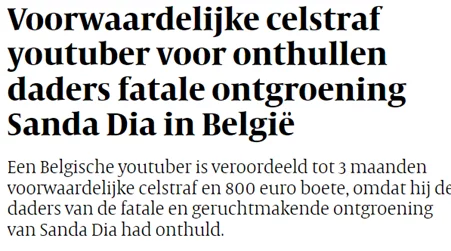
On February 22, 2024, an article in de Volkskrant discusses the Acid vs.Versus Reuzegom case (Figure 1). The article is average in length and encompasses the entire narrative of the case. Taking into account Tankard’s (2001) framing mechanisms, three generic frames are clearly visibleextremely apparent: the “conflict frame”, the “attribution of responsibility frame” and “the human interest frame”.
Conflict & Attribution of Responsibility Frames
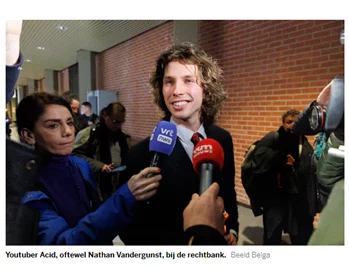
A clear “conflict frame” is evident from the title and subhead of the article. In this title and subhead, such conflict is being framed between the actions of Acid and the legal consequences he faces for revealing the perpetrators of the tragic incident. Acid’s decision to reveal the identities of those involved in the hazing incident is framed as a direct challenge to the legal system or societal norms. This results in a conflict being framed between his actions and the judicial consequences imposed upon him. This is further reinforced through the use of terms such as “suspended prison sentence” and “800 euro fine”. Their utilization further frames the conflict by emphasizing the clash between his actions and specific, punitive measures imposed upon him by the legal system. The article also consistently frames the event through the “attribution of responsibility frame”. By constructing the title to mention both Acid’s punishment (“Suspended prison sentence YouTuber”) and his initial actions (“for revealing the perpetrator's of the'fatal hazing of Sanda Dia”), the article appears to directly connect Acid’s punishment as a consequence and reaction to the perpetrators of the fatal hazing. In doing so, the title contextualizes and connects Acid’s actions to the broader hazing incident that led to Sanda Dia’s death. This linkage implies that Acid’s punishment is not solely a consequence of his actions, but also a reaction to the broader context of the “fatal hazing incident”. In doing so, the title appears to imply shared responsibility between Acid, for exposing the perpetrators, and those accountable for the fatal hazing of Sanda Dia. Furthermore, the photograph of Vandergunst in the courthouse reinforces both the responsibility and conflict frame by simply visually associating him with the legal proceedings (Figure 2).
Human Interest Frame
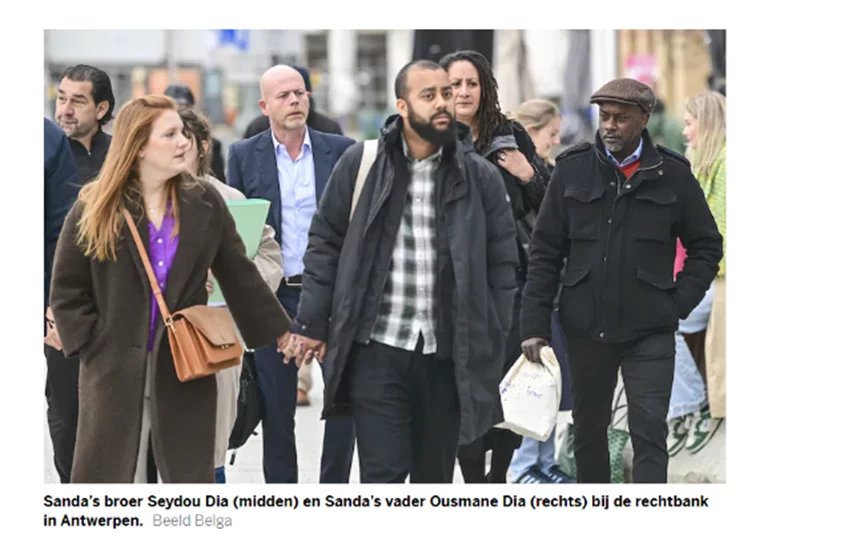
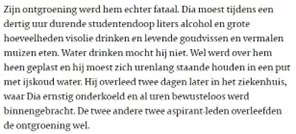
The article also prominently features a “human interest frame”. In the central portion of the article, a description illustrates the hardships Sanda endured during the hazing. Subsequently following that, an image captures Sanda’s brother and father walking towards the court in Antwerp (Figure 3). This sequence can be recognized as a human interest frame because it incorporates personal narratives and emotional elements into the narrative. The description of Sanda’s hardships (Figure 4) elicits empathy, and the image of his family walking to court adds a personal and humanizing emotional touch. It imbues the narrative with a sense of personalization and humanization. These elements enhance the reader’s connection to the narrative and add an emotional angle to the story through personal narratives; a human-interest frame.
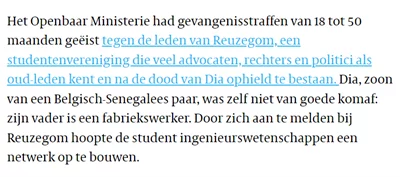
The human-interest frame is further enriched by the brief description of Sanda Dia’s background, positioned following a delineation of Reuzegom’s alumni base consisting of lawyers and politicians. The description portrays Sanda as the son of a factory-working Belgian-Senegalese couple and Sanda’s decision to join Reuzegom is depicted as driven by his aspiration to build a network (Figure 5). Bovenkant formulierThis exploration of Sanda’s socio-economic context and aspirations evokes empathy and potentially aims to establish an emotional connection with the audience. The description furnishes a more grounded narrative of Sanda Dia itself, beyond the mere images prevalent online. It frames him as a character also imbued with relatable aspirations and dreams. Such emphasis on personal experiences and sentiments aligns with the essence of the human interest frame.
“Framing analysis: De Telegraaf”
Just as in “Dde Volkskrant”, an article discussing the Acid vs. -Versus-Reuzegom case was published in “De Telegraaf” on February 22, 2024. The article is relatively short in length and encompasses the complete narrative of the case. Taking into account Tankard’s (2001) framing mechanism, three generic news frames are easily foundextremely apparent within the article: the “conflict frame”, the “attribution of responsibility frame” and “the economic consequences frame.”
Conflict Frame
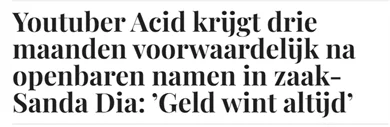
This article frames the event via the “conflict frame”. This is especially evident in its title, which can be found in Ffigure 6. Similarly to de Volkskrant, the framing within this title accentuates the conflict between the actions undertaken by Acid and the subsequent legal repercussions faced. However, the inclusion of Acid’s quote “Money Always Wins”, appears to emphasize a broader conflict taking place between his conceptions of justice and the influence of financial interest. By incorporating Acid’s statement into the title, the article not only appears to underscore the immediate conflict between Acid and “revealing names of the case Sanda Dia case”, but also situates and frames the title within a broader context and conflict of systemic concerns. It suggests that Acid perceives the case outcome as potentially influenced by power factors beyond the immediate circumstances of the case. Within this context, Acid seems to subscribe to the prevalent notion that “the members of Reuzegom hailed from wealthy and influential backgrounds and thus received lower punishment” (De Meester, 2023).
Attribution of Responsibility Frame
Similar to the de Volkskrant article, an “attribution of responsibility” frame can also be established in thise piece. Within the title of the article, Acid appears to be “framed” as the sole person responsible in the Acid vs.-Versus-Reuzegom case. The title solely focuses on Acid’s actions in the “case-Sanda Dia case” without directly referring to or contextualizing the case with other involved parties. This becomes especially clear in the utilization of the words “after disclosing names in the case of Sanda Dia”.
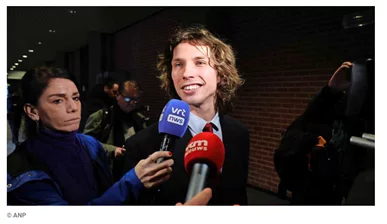
Besides contextualizing and singling out Acid’s actions within a specific event or context, the framing of this title does not attribute responsibility or even mention other parties, such as Reuzegom, involved in the conflict. By omitting explicit references to other parties involved in the case, the framing of this title appears to presuppose that readers are already familiar with the broader context of the narrative, including the roles played by different individuals or groups. The framing potentially assumes a level of familiarity with the broader context surrounding the Sanda Dia, Reuzegom and Acid case. As this framing does not explicitly acknowledge or attribute direct responsibility to other parties involved in the Acid vs. Versus Reuzegom conflict, this framing can be established as different from what was perceived in the “De Telegraaf”. Additionally, a darker version of the photograph from “Dde Volkskrant” is used (Figure 7). This darker version further places Acid in the limelight as the only one responsible for the case.
Economic Consequences Frame
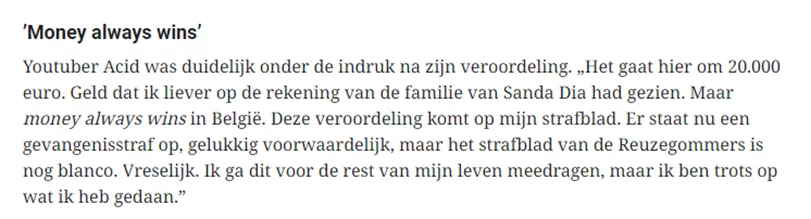
The article also prominently features an “economic consequence(s) frame”. This frame is particularly underscored in a paragraph featuring Acid’s reflection on the financial aspects of the case (Figure 8). The paragraph frames Acid’s reflection on the financial aspects of his conviction by, for instance, expressing that the funds could have been better used elsewhere. Moreover, the subtitle of the paragraph “Money Always Wins” also encapsulates a perspective empathetic to the economic ramifications of the case. It implies the significant influence of economic factors on shaping the case’s outcomes and judicial considerations. The paragraph itself also frames the pervasive influence of these factors on Belgian society as a whole. Consequently, Acid’s quotations underscore the significant influence of financial factors on outcomes and decisions on the case’s judicial considerations, as well as on individuals and other entities within the Belgian society.
VI. The verdict
Applying De Vreese’s (2005), and Semetsko and Valkenburg’s (2000) generic news frames alongside Tankard’s (2001) framing mechanics reveals significant differences in their utilization across Dutch left-leaning and right-leaning publications within the Acid vs. versus Reuzegom narrative.
In De Volkskrant”, the article primarily features a conflict frame that frames the clash between Acid’s actions and the legal repercussions he faces. Additionally, within the attribution of responsibility frame, Acid punishment is contextualized and framed alongside the disclosure of the perpetrators of Sanda Dia’s fatal hazing. This framing attributes responsibility to both parties involved. Moreover, the human interest frame has added an emotional angle to the story through personal narratives by visually depicting Sanda’s family and describing his socio-economic background.
In “De Telegraaf”, the article also primarily features a conflict frame that frames the clash between Acid’s actions and the legal repercussions he faces. Additionally, there is a broader conflict framed between Acid’s conception of justice and the influence of financial factors on “justice”. Moreover, the attribution of responsibility frame found in the title appears to singularly frame Acid as responsible within the Acid-Reuzegom case, as it focuses on Acid’s actions without mentioning the direct involvement of the other parties. Bovenkant formulierLastly, the economic consequences frame is underscored through Acid’s reflection on the role and ramifications of financial factors within the case.
It is crucial to actively comprehend the newspaper and the framing mechanism we interact with
While this paper has highlighted several disparities between the two publications, the influence of the publication's ideological predispositions on the framing choices remains undisclosed within this study. Therefore, future research should undertake an analysis to unravel how ideological predispositions influence framing choices within this case. However, these findings do underscore the importance of recognizing the substantial variation in how media outlets with different ideological stances frame and present news stories. Such understanding is crucial for readers, as news profoundly shapes our understanding of events and facilitates our perception of reality. Therefore, it is crucial to actively comprehend the newspaper and the framing mechanism we interact with. We must consult diverse sources, remain vigilant about biases and actively participate in news consumption to nurture an informed society; especially within the contemporary context where the presented “truth” is increasingly shaped by algorithms based on prior engagement rather than purely factual elements. Consumers of the news world, scrutinize your content and seek true knowledge!
Back to topVII. References
Correspondent, O. (2024, February 22). Youtuber Acid krijgt drie maanden voorwaardelijk na openbaren namen in zaak-Sanda Dia: ’Geld wint altijd’. Telegraaf.
Davie, G. (2010). Framing Theory. Mass Communication Theory: from Theory to Practical Application. Retrieved from: https://masscommtheory.com/theory-overviews/framing-theory/
De Meester, T. (2023, March 21). Wat de dood van Sanda Dia ons leert over de zelfverklaarde elite in Vlaanderen. De Wereld Morgen. Retrieved from: https://www.dewereldmorgen.be/artikel/2023/03/21/wat-de-dood-van-sanda-dia-ons-leert-over-de-zelfverklaarde-elite-in-vlaanderen/
De Vreese, C. H. (2005). News framing: Theory and typology. Information design journal+ document design, 13(1), 51-62. https://doi.org/10.1075/idjdd.13.1.06vreRetrieved from: https://www.researchgate.net/publication/250888488_News_Framing_Theory_and_Typology/link/55dcea7408aeb41644aecf7c/download?_tp=eyJjb250ZXh0Ijp7ImZpcnN0UGFnZSI6InB1YmxpY2F0aW9uIiwicGFnZSI6InB1YmxpY2F0aW9uIn19
Ekin A. (2021, January 12). Sanda Dia - Why did a hazing in Belgium lead to a Black student’s death? - Justice versus conscience. (2024, 19 january). Justice Versus Conscience. Reposted from: Al Jazeera.
Entman, R. M. (1993). Framing: Toward clarification of a fractured paradigm. Journal of Communication, 43(4), 51-58. https://doi.org/10.1111/j.1460-2466.1993.tb01304.xRetrieved from: https://www.researchgate.net/profile/Robert-Entman/publication/209409849_Framing_Toward_Clarification_of_A_Fractured_Paradigm/links/64d62bf6d3e680065aae9c55/Framing-Toward-Clarification-of-A-Fractured-Paradigm.pdf
Gamson, W. A., & Modigliani, A. (1989). Media discourse and public opinion on nuclear power: A constructionist approach. American Journal of Sociology, 95, 1–37. Retrieved from: https://www.jstor.org/stable/2780405
Gitlin, T. (1980). The whole world is watching. Berkeley: University of California Press. Retrieved from: https://www.ucpress.edu/book/9780520239326/the-whole-world-is-watching
Goffman, E. (1974). Frame Analysis: An Essay on the Organization of Experience. Harvard University PressNew York, NY et al.: Harper & Row. Retrieved from: https://is.muni.cz/el/1423/podzim2013/SOC571E/um/E.Goffman-FrameAnalysis.pdf
Guenther, L., Jörges, S., Mahl, D., & Brüggemann, M. (2024). Framing as a Bridging Concept for Climate Change Communication: A Systematic Review Based on 25 Years of Literature. Communication Research, 51(4), 367-391. https://doi.org/10.1177/00936502221137165Guenther, L., Jörges, S., Mahl, D., & Brüggemann, M. (2023). Framing as a bridging concept for climate change communication: A systematic review based on 25 years of literature. Communication Research, 00936502221137165. Retrieved from: https://journals.sagepub.com/doi/full/10.1177/00936502221137165
Ekin A. (2021, January 12). Sanda Dia - Why did a hazing in Belgium lead to a Black student’s death? - Justice versus conscience. (2024, 19 january). Justice Versus Conscience. Retrieved from: https://englishdocs.eu/sanda-dia-why-did-a-hazing-in-belgium-lead-to-a-black-students-death/#:~:text=First%20year%20students%20often%20join,It%20would%20open%20doors.
Misérus, M. (2024). Voorwaardelijke celstraf youtuber voor onthullen daders fatale ontgroening Sanda Dia in België. Volkskrant.
Semetko, H. and Valkenburg, P. (2000), Framing European politics: a content analysis of press and television news. Journal of Communication, 50 (2): 93-109. https://doi.org/10.1111/j.1460-2466.2000.tb02843.x
Tankard, J. W. (2001). The empirical approach to the study of media framing. In S. D. Reese, O. H. Gandy & A. E. Grant (eEds.), Framing Public Life: Perspectives on Media and Our Understanding of the Social World (1st ed.), (pp. 95–106). Routledge. https://doi.org/10.4324/9781410605689 Framing public life (pp. 95–106). Mahwah, NJ: Lawrence Erlbaum. Retrieved from: https://www.taylorfrancis.com/chapters/edit/10.4324/9781410605689-12/empirical-approach-study-media-framing-james-tankard-jr
Van Den Houten, A. (2021, April 28). Wat is het verschil tussen verschillende kranten. De Puttenaer | Nieuws Uit de Regio Putten. Retrieved from: https://www.deputtenaer.nl/lokaal/partnercontent/681284/wat-is-het-verschil-tussen-verschillende-kranten
Wikiwand - Reuzegom (studentenclub). (z.d.). Wikiwand. Retrieved from. https://www.wikiwand.com/nl/Reuzegom_(studentenclub)
Correspondent, O. (2024, February 22). Youtuber Acid krijgt drie maanden voorwaardelijk na openbaren namen in zaak-Sanda Dia: ’Geld wint altijd’. Telegraaf. Retrieved from: https://www.telegraaf.nl/nieuws/2128705148/youtuber-acid-krijgt-drie-maanden-voorwaardelijk-na-openbaren-namen-in-zaak-sanda-dia-geld-wint-altijd
Misérus, M. (2024). Voorwaardelijke celstraf youtuber voor onthullen daders fatale ontgroening Sanda Dia in België. Volkskrant. Retrieved from: https://www.volkskrant.nl/binnenland/voorwaardelijke-celstraf-youtuber-voor-onthullen-daders-fatale-ontgroening-sanda-dia-in-belgie~b588a60b/?referrer=https://www.google.com/
Back to top
