


Article
“The patriarchy is smashed”: Contemporary art as an effective way to challenge gender inequality
Ladies Lounge, a women only space in Tasmania’s MONA museum, got worldwide attention after a man who was denied access claimed it was discriminatory and filed a lawsuit. Drawing on Frasers theory about counterpublics and counterdiscourses in the public sphere this paper examines how contemporary art can be an effective way to start discourse on gender inequality.

Published date
Courses
New private and public spheres
Copyright
This work is licensed under a Creative Commons Attribution-NonCommercial 4.0 International License.
Read time
12 minutes

Ladies Lounge, a women-only space filled with a lot of green velvet and gold, butlers serving you drinks, and artworks by big names in the art world. The lounge started as an exhibition in MONA in Tasmania, but through a lawsuit, media attention and performances of the artist the art expanded outside of the museum. This way this piece of art became a starting point for discussions about gender inequality.
This lounge filled with art first opened in 2020 but became worldwide news last march when a man called Jason Lau filed a lawsuit against the museum, stating that this artwork was discriminatory. The artist of the artwork responded with an artistic performance during the lawsuit and several interviews. During the first court case, judges found MOMA guilty of discrimination, after which Kaechele placed the artworks from the lounge in the ladies' restroom. This way the artwork was still only accessible by women. However, at the end of September, the Supreme Court overturned the first court case and ruled that the museum could exclude men from this artwork, because it promoted equality for a marginalized group (Burke, 2024a; Burke, 2024b; Choi & Suri, 2024).
This story gained a lot of attention, not only in news media, but also on social media, where people talked about this case and the newest updates. Ladies Lounge became a starting point for conversations about the gender inequality in history, but also the gender inequality that is still present in Western societies.
In this paper, I will look at contemporary art as a way of starting and shaping discourse on gender inequality. Using discourse and textual analysis I will look at the artwork Ladies Lounge by Kirsha Kaechele and the conversations around it. First, I will give some background information about the artwork, then I will put this artwork in the context of the Feminist Art movement. After that, I will look at the concept of aeffects -a combination of effect and affect- and then I will analyze TikTok discourses around the Ladies Lounge. Finally, I will look at the direct effects of this artwork. Through this, I will argue that 21st-century contemporary art can provide a place for the formation of counter-discourses around gender inequality in Western societies
Back to topThe Feminist art movement
Evoking conversations about gender inequality through art is something that became big with the Feminist art movement. Starting during the second wave of feminism the Feminist art movement began incorporating the female perspective in their artworks. By doing this they tried to make the viewer question the social position of women. Through this they wanted to create a positive change towards equality (Feminist Art Movement Overview, n.d.). Examples of artworks that were part of this movement are Interior Scroll (Schneemann, 1975), Do Women Have To Be Naked To Get Into the Met. Museum? (Guerrilla Girls, 1989, figure 1) and Maintenance Art Tasks (Laderman Ukeles, 1973).
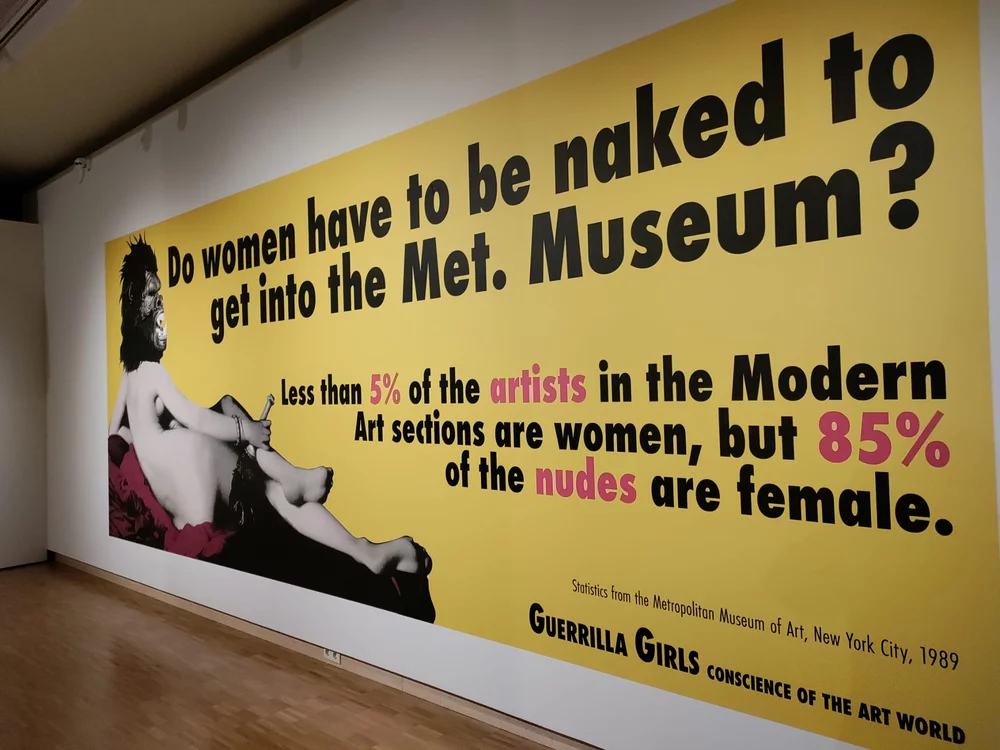
By incorporating the female perspective in the art and challenging the status quo, these artworks created a place through which an alternative discourse than the hegemonic one could be formed. These kinds of places that offer space for marginalized groups to express themselves are something Fraser (1990, pg. 67) would call subaltern counter-publics in which counterdiscourses could be formed.
Take Maintenance Art Tasks (Laderman Ukeles, 1973) for example, In this work Ukeles took part in an exhibition called c.7,500 by mopping floors and cleaning statues. Through this artwork, she explores the friction between making art and the household responsibilities that she got after giving birth to her child. In her manifest Manifesto for Maintenance Art 1969!: 'Care' A Proposal for an Exhibition she declared that from then on, she would label all of her activities as art (Reckitt, 2013).
By taking her perspective as a mother into the art world Ukeles provides a place to start a conversation about labour and the role and invisible work of women that challenged the hegemonic ideas in society. Fraser (1990) argues that the formation of these counterpublics and thus discourses that challenge or question the hegemony is essential for a functioning public sphere in which everyone can express their opinion.
Back to topThe aeffect of art
Although Kaechele doesn’t explicitly define Ladies Lounge as feminist art, she did try to make an impact towards gender equality with her art, as part of the artwork was letting men experience the exclusion women have faced for years (Choi & Suri, 2024). The impact art can have in the public sphere is defined by Duncombe (2016) through the concept of aeffect, which is a combination of effect and affect. Effect relates to activism, changing things, mostly power balances, in the material world and Affect relates to art, altering perspectives, or touching something in the inner world of someone. Although these may seem different things they influence each other, which brings us to the concept of aeffect. Using the concept of aeffect to assess the political implications of public art Landeau and Zebracki (2023, pg. 823) concluded “Public art can serve as an important communicative medium in exploring and potentially overcoming tensions, especially those that have recently emerged around reconciliation with culturally minoritized and racialized groups.”
When looking at Ladies Lounge through the theory of aeffect you can say that the different affects caused different effects. On the one hand, you have the man who faced rejection and exclusion (the affect), which made him file a lawsuit (the effect). On the other hand you have people who saw the artwork and the performance, felt empowered or even angry by it (the affect) and who spoke out about gender inequality on TikTok (the effect). This artwork caused a lot of other aeffects, some of which we might not even know about, because they happened between individuals.
Besides, one affect can lead to several effects. Take the rejection the man experienced. That led to a lawsuit, which caused media attention, which caused people to talk about it on TikTok, and at the same time, the media attention and the lawsuit also started a conversation on gender inequality. So, one affect, and reaction to that affect can cause a chain reaction of effects.
Back to topDiscourses on TikTok
One of the effects of this artwork is that it became a place and starting point for conversations on gender inequality in Western societies. To come back to the theory of Fraser (1990), the artwork served as a subaltern counter public for women all over the world, through which counter-discourses about the position of women could be formed. To illustrate this, I want to look at the discourses by people on TikTok. Therefore, I picked 3 videos from the hashtag “ladieslounge” that display some of the different reactions to the artwork and the discussions around it. These videos were among the videos from this hashtag that were most interacted with through likes, comments and saves and that were not from news platforms. I made this choice, because I wanted to illustrate how individuals are talking about this artwork.
First, I am looking at a video by creator @rachel.hastings.art (2024), in her video she shows the performance art that’s part of this artwork, a row of women in suits who look really serious and follow a choreography walking into court. The creator placed the song “Simply irresistible” under the video and wrote, “Well I guess life really is imitating art. (…) Kirsha Kaechele’s artwork really be arting.”
The song is a satirical play on the fact that this artwork was ‘simply irresistible’ for Jason Lau, who went as far as filing a lawsuit to get access to it. Using this song plays into the feeling of rejection that men experience in this artwork and almost teases the men who want to get in but can’t. Showing women in suits who do a serious performance plays into the image of leaders and persons in power wearing a suit and being busy with important things. By displaying a lot of women this way, the image of them being powerful is created by Kaechele.
Using this snippet of the artwork in this video combined with the satirical play with Simply Irresistible this video addresses the issue of exclusion and rejection, while also showing the power women have. The caption links to the quote of Oscar Wilde who stated, “Life imitates art far more than art imitates life”, referring to the power the affect of art has on our lives. (LunarMemoirs, 2024)
Through all these things this video uses the artwork of Kaechele and the events around it to step into a discourse about exclusion. By ridiculing Jason Lau for filing a lawsuit the creator emphasizes the fact that men are not used to being excluded. This contributes to a counter-discourse that raises questions about who is included and excluded in our society.
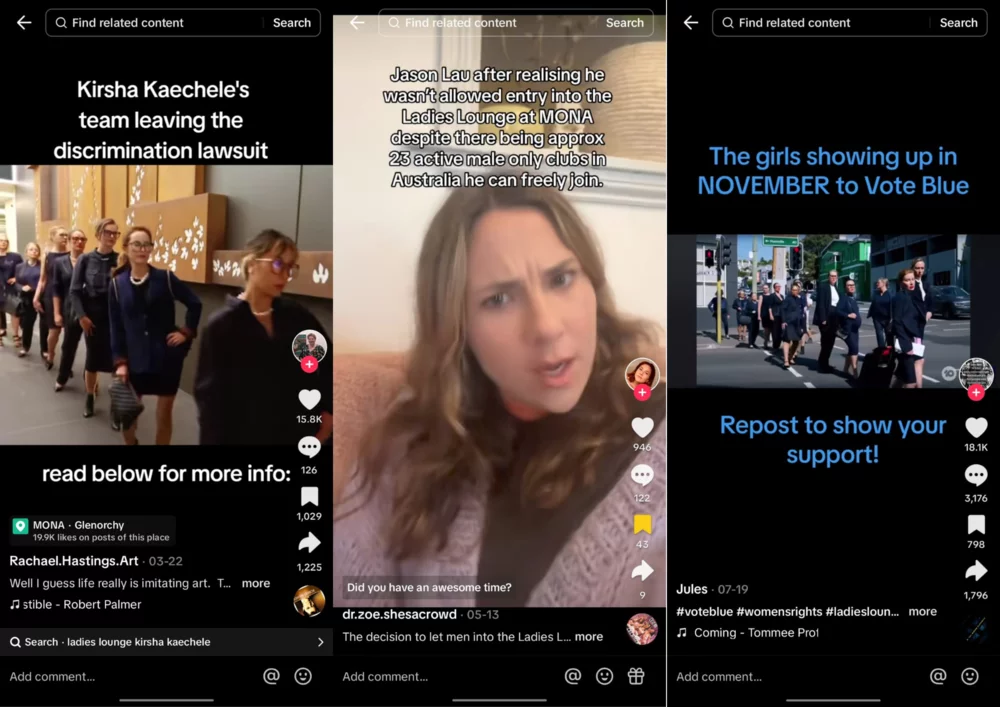
The next video by @dr.zoe.shesacrowd (2024) plays into a slightly different counter-discourse. The creator lip-syncs to a fragment from Mean Girls in which a character asks sarcastically “Did you have an awesome time (…)”. Placed over the video is the text “Jason Lau after realizing he wasn’t allowed entry into the Ladies Lounge at MONA despite there being approx. 23 active male-only clubs in Australia he can freely join”.
The nasal tone and emphasis on the word time in the audio fragment give the fragment a sarcastic tone. Through the text in the video, this sarcastic question is put in the mouth of Jason Lau. By doing this the creator frames Lau as salty because he wasn’t allowed in. Besides, the audio snippet this creator uses is from Mean Girls, which plays into the stereotype of women being mean. The creator takes on the perspective of Jason Lau and through it, she frames this issue as if Jason Lau is being excluded from a certain space by “mean women”. In the second part of the sentence, the creator juxtaposes this with the fact that there are enough spaces for Lau to go in which women are not welcome.
The counterdiscourse that this video plays into is one about discrimination. Is it okay to discriminate based on gender? In the case of this artwork, the first judge ruled that it was not. Zoe questions this decision by bringing up the fact that there are 23 places in Australia where men can discriminate against women. By doing this she questions the existence of these male-only spaces and the normality of discriminating against women.
The last video is one by @Julesrebecca777 (2024), who also shows a part of the performance art surrounding the lawsuit. In the video, the text “The girls showing up in NOVEMBER to vote blue. Repost to show your support” is written in blue and the video is supported by a fragment of the song “A storm is coming”. With this video, the creator connects the artwork back to a real-life event, namely the American elections. These elections could be the time where the first women ever becomes president of The United States. By connecting this part of the artwork to this event, the creator uses the image of strong women in suits to show what the future can look like for Americans. The snippet “A storm is coming” indicates that things can change drastically if everyone shows up and votes for the democratic party.
This video is part of a counterdiscourse that addresses men in power. It spreads the image of powerful women and by doing this it questions the reality of America having only male presidents. Besides, it also offers an alternative, namely a woman who could become president.
Back to topThe real-life effect
But Kaechele’s work doesn’t only provide a place for counter-discourses, her artwork does also directly confronts hegemonic ideas about men and women. With Ladies Lounge she flips the script of men having exclusive spaces where women are not welcome. This is reflected in an interview where she says “men’s ‘experience of rejection is the artwork”, but also in the way the space is shaped, luxurious, with butlers handing out drinks and “some of the museums most important works” (Burke, 2024a). Kaechele plays with the idea that men are normally the ones to have secluded spaces, and that women are the ones discriminated against. The space she made was not a regular space, but one that is exclusive and desirable. Who would not want to be served cold drinks from butlers? By doing this she makes the feeling of rejection even bigger. Through this exaggeration, she makes certain societal structures tangible and visible in a way that questions the normality of those structures.
The feeling of rejection Kaechele wanted men to experience can be seen as the affect that led to the biggest effect of this artwork, namely the one that was reached in the Supreme Court. The Supreme Court overruled the decision of the first judge and stated that in this case exclusion of men was allowed, because it promoted equal opportunities for women. Kaechele’s reaction? “The patriarchy has been smashed” (Burke, 2024b). This shows what Fraser (1990) argues, that counter-publics, in which counterdiscourses can be formed can be greatly beneficial for marginalized groups to reach their goals.
In conclusion, Ladies Lounge by Kirsha Kaechele shows that contemporary art can form an effective counter-discourse about gender inequality in Western societies through the different aeffects of said art. Ladies Lounge builds on the Feminist art movement which challenged hegemonic ideas by creating art that incorporated the female perspective. Art can challenge hegemonic perspectives through affect, which is the individual experience of the artwork. This affect can lead to effects, which are the consequences of the artwork in the real world. As Ladies Lounge shows one of the effects of contemporary art is the counter-discourses it can create online and in real life. Starting these discourses can be really effective in addressing and altering certain social structures.
This paper shows that 21st-century contemporary art can provide a place for the formation of counter-discourses around gender inequality in Western societies. This is relevant, because it shows how artworks can be counterpublics from which marginalized groups can benefit. In times when many people are trying to gain more equality, art can be a successful way of promoting conversations about inequality. This knowledge can help minorities and policymakers in their strategies to battle inequality worldwide.
Back to topReferences
Burke, K. (2024a, March 20). Artist behind Mona’s ladies-only lounge ‘absolutely delighted’ man is suing for gender discrimination. The Guardian.
Burke, K. (2024b, September 29). Mona’s Ladies Lounge wins appeal in bid to continue barring men from entry. The Guardian.
Choi, C., & Suri, M. (2024, July 11). A man’s world? Art exhibit about misogyny was only open to women — until a man complained. CNN.
@dr.zoe.shesacrowd. (2024, May 13). TikTok creator Zoe Shesacrowd criticizing Jason Lau [Video]. TikTok. Retrieved October 10, 2024, from
Duncombe, S. (2016). Does it Work?: The Æffect of Activist Art. Social Research: An International Quarterly, 83(1), 115–134.
Feminist Art Movement Overview. (n.d.). The Art Story. Retrieved November 6, 2024.
Fraser, N. (1990). Rethinking the public sphere: a contribution to the critique of actually existing democracy. Social Text, 25/26, 56. https://doi.org/10.2307/466240
Guerilla Girls. (1989). Do Women Have To Be Naked To Get Into The Met. Museum? [Poster].
@Julesrebecca777. (2024, July 19). Video to promote voting for Kamala Harris [Video]. TikTok. Retrieved October 10, 2024, from
Kristalijn, H. (2024a, March). Picture of Guerilla Girls artwork.
Kristalijn, H. (2024b, November). Screenshots of TikTok videos.
Laderman Ukeles, M. (1973). Maintenance Art Tasks [Performance]. Wadsworth Atheneum.
Landau-Donnelly, F., & Zebracki, M. (2023). The politics of restor(y)ing: towards a conflictual approach to art in urban public space. City, 27(5–6), 812–828. https://doi.org/10.1080/13604813.2023.2255400
LunarMemoirs. (2024, August 26). LIFE IMITATES ART. Medium.
@rachel.hastings.art. (2024, March 22). TikTok creator Rachel Hastings showing the impact of Kaechele’s Ladies Lounge [Video]. TikTok. Retrieved October 10, 2024, from
Reckitt, H. (2013). Forgotten Relations: Feminist Artists and Relational Aesthetics. In A. Dimitrakaki & L. Perry, Politics in a Glass Case: Feminism, Exhibition Cultures and Curatorial Transgressions (pp. 131–156). Liverpool University Press.
Schneemann, C. (1975). Interior Scroll [Performance].
Back to top
