


Paper
The 4B movement as a way of resistance through intimacy
No marriage with men, childbirth, sex with men, or intimate relationships with men. In this paper, the 4B movement is analyzed as a way of resistance through intimacy. Women resist individual men but also bigger societal structures by refusing intimate relationships with men. By doing this, they demand change in politics, men, and society.

Published date
Courses
Intimacy, privacy and authenticity
Copyright
This work is licensed under a Creative Commons Attribution-NonCommercial 4.0 International License.
Read time
11 minutes

No marriage with men, no childbirth, no sex with men, and no intimate relationships with men. That’s what women participating in the 4B movement promise to do. This movement started in South Korea but gained traction in the US after the election of Donald Trump. On TikTok, many women declared to participate in this movement or gave information about what this movement is. In this paper, I will use the 4B movement on TikTok after the election of Donald Trump in 2024 as a case study to answer the following research question: How do women in the 21st century use intimacy as a way of resistance?
I will answer this question by first looking at the feminist movement in the 21st century, after which I will dive deeper into the relationship between intimacy and politics. After, I will give some context about the 4B movement. Finally, I will analyze the 4B movement on TikTok after Donald Trump's election in 2024.
Back to topThe 21st century feminist movement
There are many ideas about feminism in the 21st century. Neoliberal feminism is rising, stimulating women to focus on their own ambitions. This kind of feminism is focused on ambitious women but doesn’t involve challenging the present power structures (Rottenberg, 2018). This idea is similar to the idea that we live in a post-feminist society, where women have to make their own choices, and whatever a woman chooses or wants is right for her (Adriaens & Van Bauwel, 2011).
However, Srinivasan (2021) argues in The Right to Sex that, in the case of intimacy, both of these approaches to 21st-century feminism fall short. Looking at intimacy only as a personal choice should go hand in hand with recognizing that many choices surrounding sex are almost never free choices under the influence of patriarchy. As an example, she points out how the idea of who is and isn’t desired is shaped by the society we live in (Srinivasan, 2021, p. 82-84). Thus, she argues for an intersectional approach to feminism and views feminism as a political movement that can change the world, also on the subject of intimacy (Srinivasan, 2021, p. xi-xii).
Back to topIntimacy and politics
'Intimacy' is and was viewed by scholars as an embellishment of real political issues and, therefore, as something that stands apart from conversations about equity and justice (Berlant, 1997, p. 9). The devaluation of intimacy as a serious political issue can be attributed to the divisions we make in what belongs in the private sphere orin the public sphere. If we treat private and public as harsh boundaries, they can be used to reinforce hegemonic ideas about, for example, women’s rights by just labeling them as belonging in “domestic privacy.” This can be limiting to what is and isn’t talked about and taken seriously in politics. (Fraser, 1990).
The 4B movement (the B stands for bi(非), which means 'not') originated in South Korea and stands for the refusal of childbirth, sex, intimate relationships, and marriage with men.
However, as Srinivasan (2021) argues, we can’t see intimacy as solely a private issue. Think about reproductive rights and same-sex marriage, for example. Those are issues of intimacy, but they are also results of political choices. As Oswin and Olund (2010) state: “Kinship, procreation, cohabitation, family, sexual relations, love - indeed all forms of close affective encounter - are as much matters of state as they are matters of the heart.”
Back to topThe election of Trump
That intimacy is political could also be seen during the 2024 election in the US. Before, and after the 2024 election of Donald Trump as president on the 5th of November, intimacy was involved in the conversations. For example, the statement "Grab them by the pussy," that Trump made in a conversation in 2005 (Farentholt, 2016) keeps reoccuring. Also, several slogans appeared on social media after the election, of which ‘Your body, my choice’ (Duffy, 2024) is an example and should be seen as a wordplay to the ‘My body, my choice’ slogan of the pro-choice movement. These examples show that the topic of intimacy is something that is still relevant and talked about in today’s political conversations. In response to the election of Donald Trumpand those conversations about intimacy, American women started declaring to participate in the 4B movement. They took the topic of intimacy and started resisting the possible ideas of Trump's government about it.
The 4B movement (the B stands for bi(非), which means 'not') originated in SouthKorea and stands for the refusal of childbirth,sex, intimate relationships, and marriage with men. It started around 2016 after the state announced the '3rd Plan for Ageing Society and Population'. This plan had to limit the decreasing number of babies being born. Women then realized that the state viewed their bodies mainly in a practical and objectified sense, namely as a way to have children. These ideas resulted in feminists online to participate in the 4B’sand to challenge patriarchal ideas about women. By doing this, they reclaimed power over their own lives and desires (Lee & Jeong, 2021). While in the media, it may seem as if this movement is massive in SouthKorea, the reality is that only a very small group of women in SouthKorea is part of this movement. Feminism faces a lot of backlash in Korea nowadays, and the 4B movement is not as mainstream as it may seem. However, even though it isa small movement in Korea, this movement influenced Western societies to (partially) take over this movement (Rashid, 2024).
Back to topIntimate resistance on TikTok
To find out how American women use intimacy as a way of resistance through the 4B movement, I spent a lot of time observing different TikToks under hashtags like #4b, #4bamerica, and #4bmovement. I also used the search function with those terms to find more videos. Through this research, I saw that there are two levels on which women use the 4B movement, and therefore 'intimacy,' as a way of resistance. Namely ,at the individual or personal level, and at the level of politics and societal structures. This shows that intimate resistance, just like intimacy itself, is not confined to the public or private sphere but can take place and be aimed at change in both spheres. To illustrate this, I will use TikToks that are interacted with a lot through comments, likes, and saves.
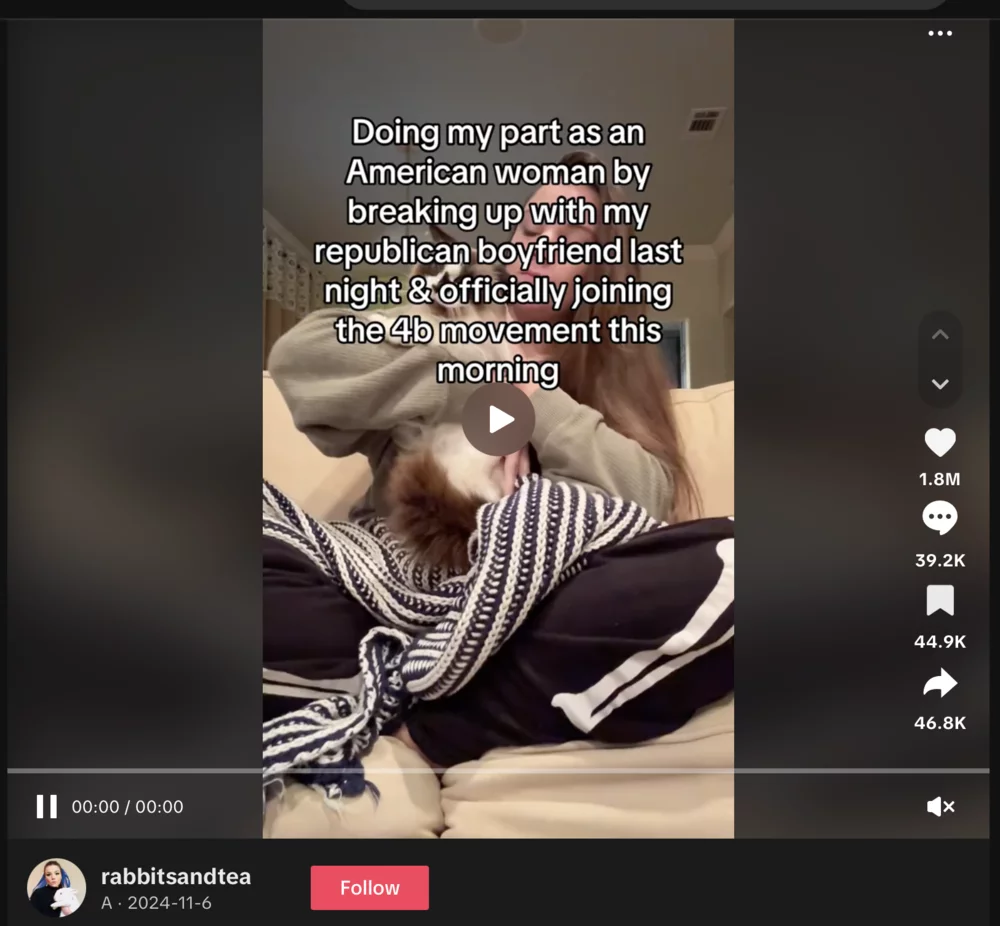
Figure 1: TikTok of creator @rabbitsandtea
On the individual level, we have the TikTok of creator @rabbitsandtea (2024), posted on the 6th of November (see Figure 1). In this video, the creator is sitting on her couch, cuddling with her cat. The text in the video reads: “Doing my part as an American woman by breaking up with my republican boyfriend last night & officially joining the 4b movement this morning.” The sound under the video is the national anthem of the US, mixed with sounds of grunting and the screeching of birds, and the caption reads: “Cat lady era activated,” (echoing J.D. Vance's negative framing of Kamala Harris). This shows how participation in the 4B movement directly has an impact from one person to another. This woman broke up with her boyfriend because he voted for the Republicans, which can be viewed as one of the 4 B’s, namely the refusal to haveintimate relationships with men. While this creator clearly shows resistance towards one man, this creator doesn’t say anything about resistance on a political or societal level in this video. The resistance here is mainly aimed at this woman who does not want to be in a relationship with a man who voted for the Republican Party. She makes a small connection to the bigger political picture by adding the distorted national anthem, but her refusal of intimacy is focused on men as individual beings.
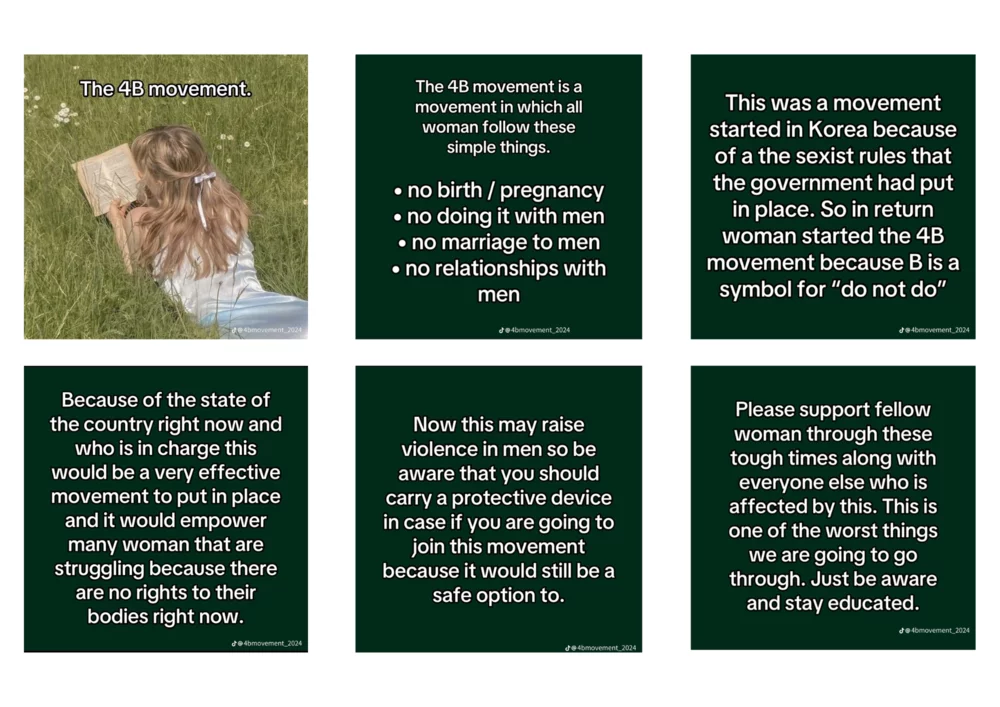
Figure 2: Screenshots of the slides in the TikTok video of @4bmovement_2024
On the other side, the video by @4bmovement_2024 (2024) points out that the bigger political issue is something to resist. This video, posted on the 7th of November, consists of a slideshow of images shown in Figure 2. The caption of the video reads, “Please support fellow women in this along with everyone else who is affected by this choice ameicans (this spelling mistake was in the caption) made. This is no longer the land of the free but it can get back there if we fight.” With this caption and text in the slides, this creator points at the effect of Trump gaining political power for women and other groups. In the fourth slide,this creator points out that women may lose rights to their bodies. This can be seen as a reference to, for example, the right to abortion that many American women are afraid to lose, and the impact this can have on healthcare for women.
The video shows that the resistance through intimacy through the political layer is based on fear for the future and also anger at the state of the country. The resistance is aimed at the people in charge, the Republican Party, who can make choices about certain rights for women and other marginalized groups. The part of the caption that says, “This is no longer the land of the free but it can get back there if we fight,” shows the trust in the movement's possible impact on politics . At the same time, this video also shows another aim of this resistance, namely, to empower women who arestruggling because of political satiation.
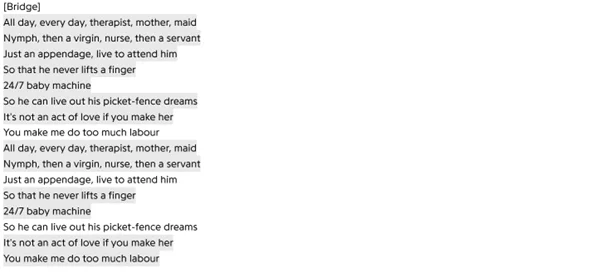
What is also interesting about this video is that it uses the song ‘Labour’ by Paris Paloma in the background. This is a song that is used in more of the videos about the 4B movement. The bridge of this song, of which the lyrics can be seen in Figure 3, points to the judgment of men towards women (Nymph then a virgin) and the various roles (therapist, mother, maid, baby machine) women are expected to take on. The sentence “It’s not an act of love if you make her, you make me do too much labour” show that this song is a critique of the systems in which women are forced to perform specific roles and fulfill certain expectations. Using this song is a way for this video to connect the intimate resistance of the 4B movement to bigger societal structures that impact women, such as the unpaid work women are supposed to do and the expectations we have of women on themes like sex and childbirth.
The refusal to be intimate with men is used as some kind of punishment or threat.
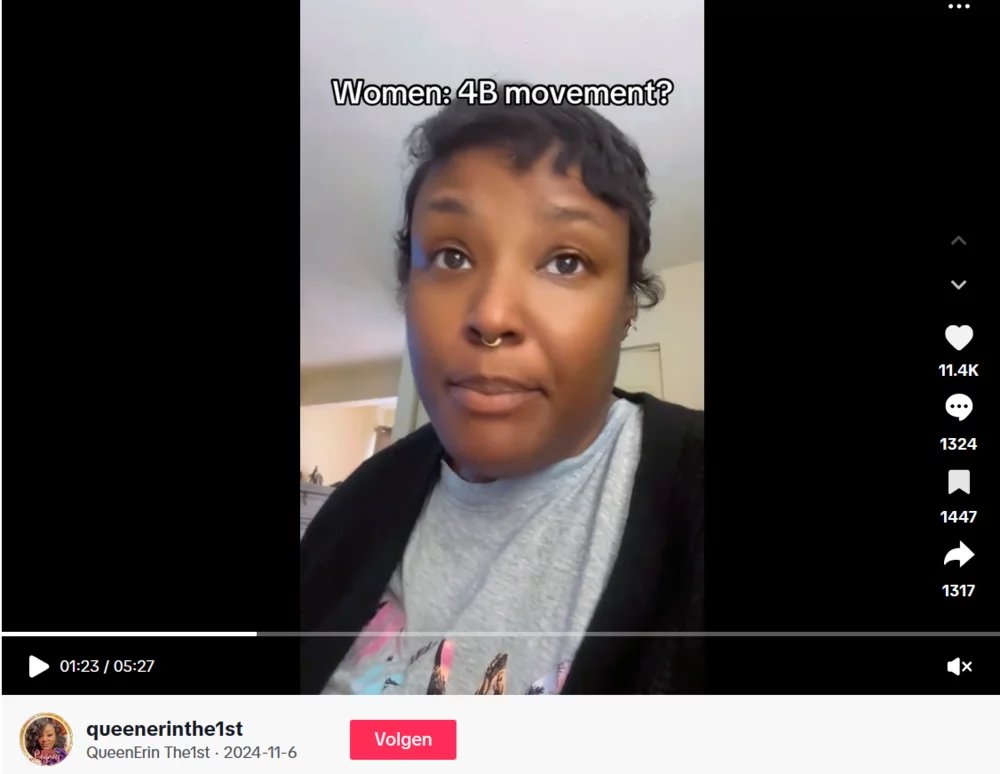
Not all videos tap into only one of the layers. Take the video by @queenerinthe1st (2024) posted on November 6th (see Figure 4) . In this 5-minute-long video, the creator says that she is ready to go 4B on men and gives reasons for herself and others to do so. First, she connects this to the personal level of resistance by saying, “I’m ready to go full 4B movement on the men.” She then points out that Black men actually “did well” and that they “got 80% or so.” This shows that her resistance is partially pointed to the individuals who voted for the Republican Party.
After this she continues by pointing out several reasons to go 4B. For example: “Why are our rights always up for grabs,” “If y’all insist on making women second-class citizens, we don’t have to give you our body,” “If we gotta fight for our reproductive rights, we don’t have to give you children,” and “I think that the only way women are going to […] break out of this misogynistic, patriarchal nightmare is to withhold our bodies.” These reasons point towards resistance aimed at political choices. The refusal to be intimate with men is used as some kind of punishment or threat. If men don’t change anything, or if they revoke certain rights, they are not going to get to be intimate with women. At the same time, the refusal of intimacy is also used as a way to keep women safe in this example. If reproductive rights are in danger, not getting pregnant may also be a way of keeping yourself safe.
Back to topConclusion
In conclusion, this paper shows how women use intimacy as a way of resistance on
both the personal and political level. By refusing marriage, childbirth, sex, and
relationships with men, women who participate in the 4B movement do not only target
individual men but also patriarchal ideas in society. Besides being a way of
resistance, this movement also empowers women and allows them toreclaim the autonomy over their bodies and intimacy. Through this, the participants
show that, in the words of Oswin and Olund (2010), intimacy is indeed “as much a
matter of state as it is of the heart.”
References
4bmovement_2024. (2024, November 7). Please support fellow woman in this along with everyone else that is affected by this choice ameicans made. This is. . . TikTok. Retrieved December 11, 2024.
Adriaens, F., & Van Bauwel, S. (2011). Sex and the City: A Postfeminist Point of View? Or How Popular Culture Functions as a Channel for Feminist Discourse. The Journal of Popular Culture, 47(1), 174–195.
Berlant, L. (1997). Introduction: the intimate public sphere. In The Queen of America goes to Washington City: Essays on sex and citizenship (pp. 1–24). Duke University Press.
Duffy, C. (2024, November 13). ‘Your body, my choice’: Attacks on women surge on social media following election. CNN.
Farentholt, D. A. (2016, October 8). Trump recorded having extremely lewd conversation about women in 2005. The Washington Post.
Fraser, N. (1990). Rethinking the public sphere: a contribution to the critique of actually existing democracy. Social Text, 25/26, 56.
Lee, J., & Jeong, E. (2021). The 4B movement: envisioning a feminist future with/in a non-reproductive future in Korea. Journal of Gender Studies, 30(5), 633–644.
Oswin, N., & Olund, E. (2010). Governing intimacy. Environment and Planning D Society and Space, 28(1), 60–67.
queenerinthe1st. (2024, November 6). 4b anyone? TikTok. Retrieved December 11, 2024, from
rabbitsandtea. (2024, November 6). Cat lady era activated #4b #4bmovement. Tiktok. Retrieved December 11, 2024, from
Rashid, R. (2024, November 15). As 4B takes the world by storm, South Korea is grappling with a backlash against feminism. The Guardian.
Rottenberg, C. (2018, May 23). How neoliberalism colonised feminism – and what you can do about it. The Conversation.
Srinivasan, A. (2021). The right to sex: Feminism in the twenty first century. Bloomsbury Publishing.
Back to top
