Review
Global craft beer in a neolocal pharmacy
DeApotheek in Ghent (Belgium) is a specialised craft beer shop with an interesting take on its authenticity practices. The shop uses the global perspective of the craft beer industry, while also commemorating the old pharmaceutical architecture of the building.

Published date
Courses
Intimacy, privacy and authenticity
Copyright
This work is licensed under a Creative Commons Attribution-NonCommercial 4.0 International License.
Read time
4 minutes

Belgium is internationally known for its iconic beer market. This idea originates from Belgium’s widest variety of different beer types compared to other traditional beer-drinking countries. It is, therefore, interesting to see that the concept of extraordinary and traditional craft beers is very much USA-based (Poelmans & Swinnen, 2018:137-139). Then again, worldwide, contemporary businesses organise their authenticity to reach popularity and iconicity with their target audience, mainly because organisational authenticity can lead to their market success (Merced, 2023).To achieve such success, authenticity has developed into a strategy which can entail both reputational and financial aspects. According to Gaden and Dumitrica (2015), this strategic authenticity can, therefore, be understood as a recommended strategy for presenting the self, resulting in a loyal audience and increased visibility in the public arena. Concerning craft beers, DeApotheek in the outskirts of Ghent in Belgium, is an interesting craft beer shop organising its authenticity in two special ways.
The first form of authenticity is made clear through its neolocalism; a practice in which local elements are strategically placed to index authenticity. Several studies have focused on how craft beer culture visualises its local heritage (Napoli, 2021:15), how it shows social and economic connections to place (Baker, 2019), and how it sources other local elements (Merced, 2023:2).
The uniqueness of DeApotheek lies in the carefully constructed dichotomy between the globalised craft beer market and the local history of the pharmacy.
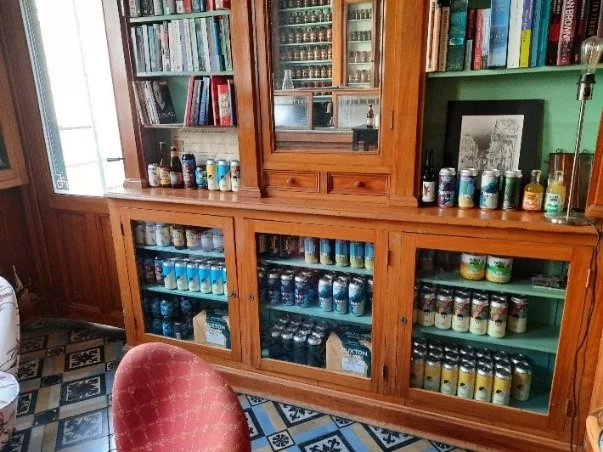
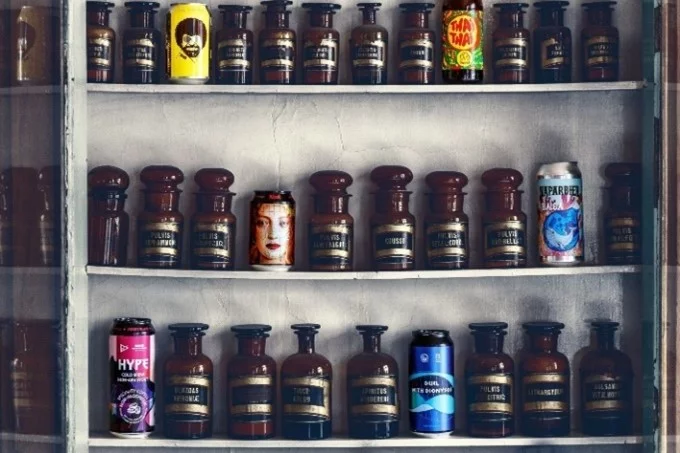
The neolocal aspect lies in the name and the interior of the shop. The shop name translates to “The Pharmacist” and this name was chosen because the building had been a pharmacy from 1880 until 2022 (DeApotheek, 2024). Because of that, the wooden medicine cabinets and the historical herbal pots – iconic to the interior of the old pharmacy – remained and were repurposed to showcase craft beers. These remainders index a history of social and community engagement the locale has (Holtkamp, Shelton, Daly, Hiner & Hagelman III, 2016). Images 1 and 2 are examples of this engaging neolocal display.
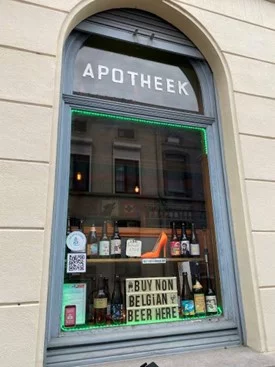
The second form of authenticity interestingly deviates from neolocalism, as it turns to globalisation instead. Image 3 shows the shop’s façade and displays the peculiar text: ‘Buy Non-Belgian Beer Here.’ Also, the website states that the few Belgian beers sold have a ‘clear and direct link to other countries’ (DeApotheek, 2024). Here we can see that the iconic status of the Belgian beer market is deliberately left out. A study by Brown (2023:4) supports that this is not odd, as craft beer consumers are ‘generally open to beer brands that play upon other areas’ identities.’
Furthermore, Verhaal and Dobrev (2022:269-270) investigated the fact that audience members ascribe lower authenticity to beers that are considered incredibly iconic. Therefore, it is likely that this shop aims to index its true authenticity by stepping away from the iconic Belgian beer market and claiming its product authenticity as part of a fully globalised enterprise.
The duality of how DeApotheek organises its authenticity is therefore interesting, but not surprising. Using Newman and Smith’s theoretical framework (2016:612), it can be argued that DeApotheek displays an existential authenticity in which the “ideal of authenticity” is often associated with highly personal and varied practices. By embracing the globalised product, while adhering to certain forms of neolocalism, DeApotheek constructs this personalised authenticity. In conclusion, the uniqueness of DeApotheek lies in the carefully constructed dichotomy between the globalised craft beer market and the local history of the pharmacy.
References
Baker, J.E. (2019). On the Bottle: situating place-based discourses in global production networks – a visual and textual analysis of craft beer labels. AUC Geographica, 54(1), 3-14.
Brown, D.M. (2023). Managing neolocalism outside the locale in real ale and craft beer entrepreneurship: The case of Ben Lui Brewery. The International Journal of Entrepreneurship and Innovation 1-9.
DeApotheek (2024). Website.
Gaden, G., & Dumitrica, D. (2015). The ‘real deal’: Strategic authenticity, politics and social media. First Monday, 20(1).
Holtkamp, C., Shelton, T., Daly, G., Hiner, C.C., & Hagelman III, R.R. (2016). Assessing Neolocalism in Microbreweries. Papers in Applied Geography, 2(1), 66-78.
Merced, J.Z. (2023). Craft Beer Landscapes of the American South: An Examination of Cultural Economy and Identity Production. Faculty of The Graduate School at The University of North Carolina, Greensboro.
Napoli, G.G. (2021). A Brewed Awakening: A Visual Analysis of Craft Beer Labels and Their Use of Multimodality in the Transmission of Culture, Identity and Taste. The Faculty of Arts and Education, University of Stavanger.
Newman, G.E., & Smith, R.K. (2016). Kinds of Authenticity. Philosophy Compass, 11(10), 609-618.
Poelmans, E., & Swinnen, J. (2018). Belgium: craft beer nation?. Economic perspectives on craft beer: A revolution in the global beer industry, 137-160.
Verhaal, J.C., & Dobrev, S.D. (2022). The Authenticity Paradox: Why the Returns to Authenticity on Audience Appeal Decrease in Popularity and Iconicity. Journal of Management, 48(2), 251-280.