

Paper
DeviantArt and AI: The showdown between manual playbour and automated playbour
By looking at DeviantArt and its no-AI alternative Side 7, the article explores an issue of the security of users' artwork with the rise of AI art generators, as well as the way the platforms deal with artwork protection.

Published date
Courses
The private life in a digital world
Copyright
This work is licensed under a Creative Commons Attribution-NonCommercial 4.0 International License.
Read time
13 minutes

Imagine finishing your latest work after days. Now imagine someone else typing keywords into a box, and gets results that look just as good minutes after. Then imagine they’re posted on the same place, but . It’s what DeviantArt (DA) artists feared, when their works could be automatically referenced by its Artificial Intelligence (AI) image generator, DreamUp.
Dissatisfied, you move to a new platform that bans AI. Are there things that motivates you to post the same? Will your work be appropriated differently in your new home? Or are they already appropriated when you first post them without AI?
In looking at DeviantArt and its no-AI alternative Side 7, I will analyze how their interfaces motivates users to post, through the lens of Light et al’s (2018) app walkthrough method. Using theories of surveillance capitalism and the ‘playbour’ phenomenon, I seek to explore aspects of user data, particularly the artwork, that can be appropriated by the platforms, and if DA’s involvement with AI art creates another area of exploitation.
Back to topHere comes a new (old) challenger
DA is the biggest online art community with over 75 million users and over 550 million artworks, and is part of website builder Wix since 2017. It was relaunched in 2019, attracting criticism for losing functions and collectivity. Announced in November 2022, DreamUp was an adaptation of Stable Diffusion (team, 2022), but was met with user outrage and forced to label all artwork not to be used for datasets, plus a form to express their disapproval. Still, that didn’t prevent them from being sued for scraping artists’ content.
Meanwhile, started back in 1993, Side 7 is one of the small-scale alternatives to DeviantArt. As an independently ruindependently-run website, it had a more traditional interface, as well as less functionalities compared to DA. Under this limitation, it is run with the principle of being a “cordial, friendly, and “small-town’” community that is free to usefree-to-use, a contrast to DA’s various paid tiers with extra functions. With the site prohibited users from submitting AI art in December 2022, some expected a large influx of migrated users, but it’s not certain on the scale and effect they’ll have.
Back to topSurveillance capitalism, Playbour, and Walkthrough
While Zuboff’s (2015) surveillance capitalism is used in explaining how personal data can be manifested, the ‘playbour’ (play labour) concept would be used to understand how sites like DA and Side 7 work, thus making sense of their different approaches.
According toTo Zuboff, surveillance capitalism “predict and modify human behavior as a means to produce revenue and market control” (p.75). While ‘big data’ flows are extracted daily without consent for automated analysis (pp.78-81), we’re being monitored under the conformity-stripping “Big Other” (p.81). This monitoring structure is inseparable, enabling personalized searches (p.83) and experiments in building a “reality business” (p.84). Interestingly, this is based on the premise that computer mediation textualizes knowledge from the society they’re embedded in, but never from “things in themselves” (Zuboff, 2015, p.77), echoing with the pre-curation process in image generating algorithms (Elgammal, 2019). As one of the largest virtual communities, DA’s back catalogue may be more vulnerable in implementing their AI art generator, using parts of the methodologies here.
Coined in Kücklich’s (2005) study on game modders, ‘playbour’ is a more flexible, deregulated economy (Scholz & Ross, 2013, p.25), and is often voluntary for working on something fun. In the case of DeviantArt, some see it as an experimental ground for new ideas, rather than being limited by social media, thus their disappointment with the relaunch. Potential exploitations from corporate capitalists are less seen (Scholz & Ross, 2013, p.25), as users may not own their creations, are subjected to financial and legal risks (Kücklich, 2005) and their data can be extracted through proprietary algorithms (Scholz & Wark, 2013, p.74). The ongoing debate of copyright and AI image generators exemplifies the hidden exploitations, where DreamUp’s launch can be seen as a case study.
Light et al’s walkthrough method (2016) would be used to understand DA and Side 7’s models, specifically in looking at their everyday usages like menus and symbols (p.893-94). However, as the latter doesn’t have a mobile app, their browser interfaces would be compared instead. We’ll first look at their frontpage that greets users, where thumbnails of others’ latest artwork or that matches the user’s preferences are put up front. We’ll also look at the user’s profile, which details their biography and works. While DA has paid tiers for customization, Side 7 splits it into Profile and Gallery pages. Finally, we’ll look at DreamUp’s Terms of Service, in comparison to Side 7’s lack of AI generation.
Back to topFirst impressions
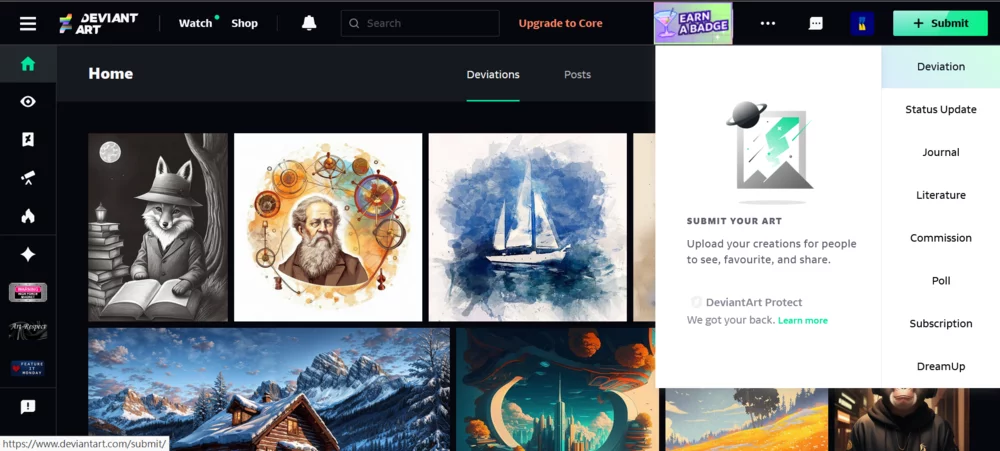
First, DA’s interface provides a convenient shortcut to a different worldview. Positioned at the top right-hand corner, the Submit button’s bright greenbright-green colour contrasts with the default black background, and redirects to another page for posting images. The + sign on it can be seen as adding your valuable take and spark an exchange of ideas amongst like-minded people, especially when it can be done unlimited times. Plus, its drop-down menu labels possible formats users can upload to the platform with outer-space themed illustrations, like portraying Status Update with an astronaut transmitting signals. Combined with the green colour scheme, this presents DA out of the mundane and a portal to where creative minds take the stage – the central theme behind their relaunch.
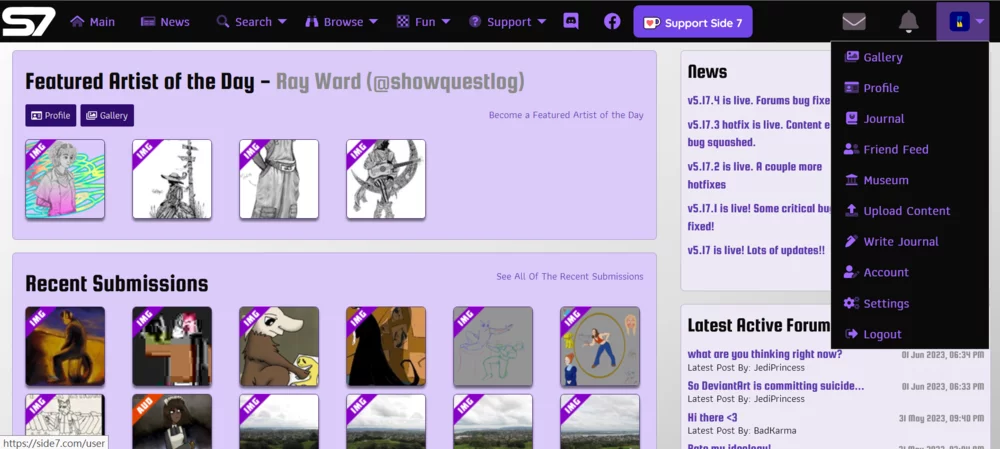
Meanwhile, Side 7 doesn’t emphasize uploading artwork, but showcases a friendly atmosphere to budding artists. Unlike DA’s eye-catching placement, the upload button is listed in the drop-down menu of the user profile with descriptive icons, although there used to be a simpler method.
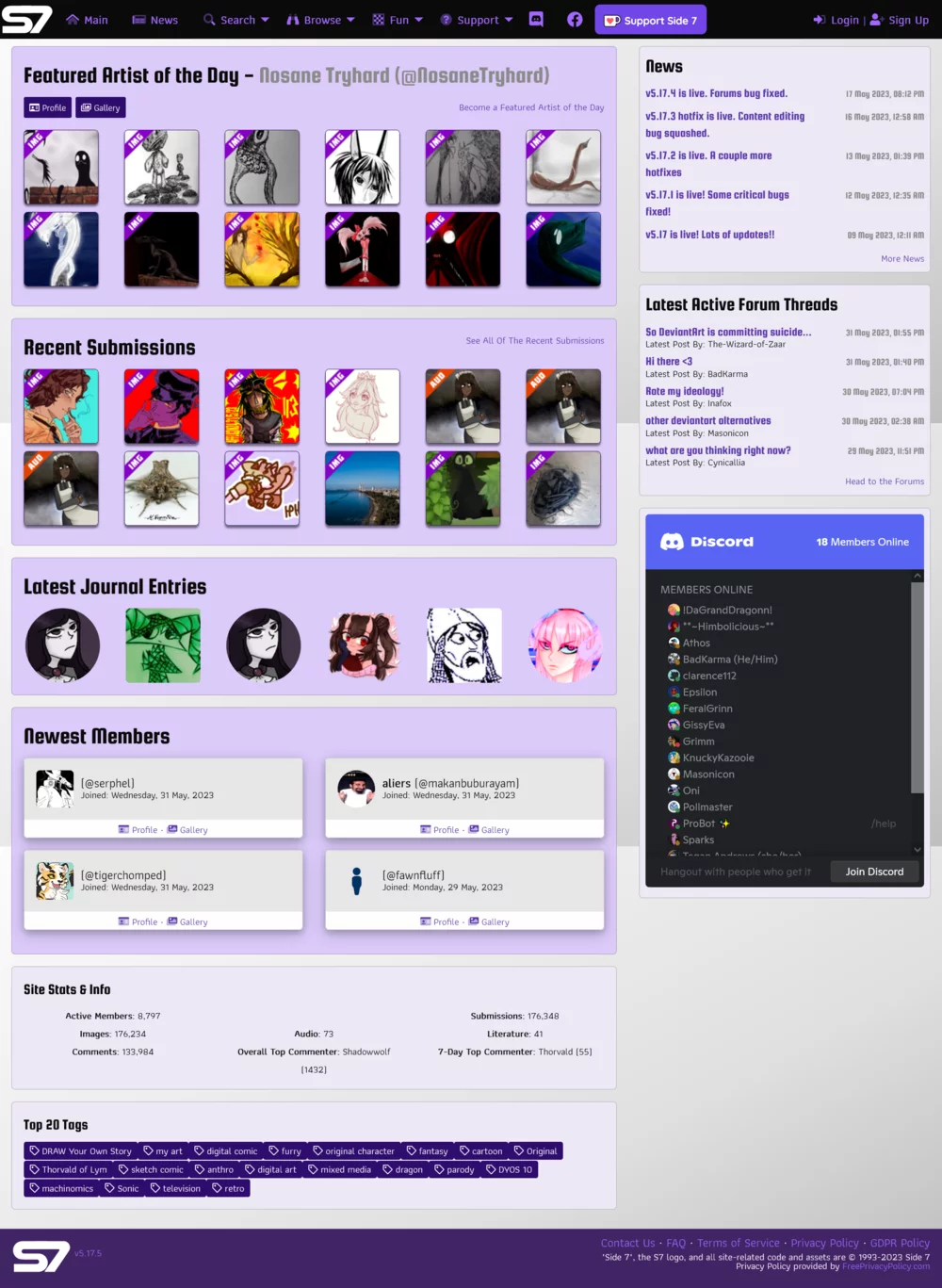
Surrounded by lighter shades of purple, the page categorizes artworks by time (Recent Submissions) and format (the newly-added Recent Journal Entries), plus recognizing new faces (Newest Members) and veterans (Featured Artist of the Day). With new individuals being specially recognized by their names, plus the promised equal exposure on artworks, this layout presents a more welcoming and homely attitude to DA, in line with the founder’s aspirations.
Despite different atmospheres, the two’s encouragement of uploading obscures them recording users’ tracks, especially for DA as its homepage depends on user login. Initially an assortment option, the Recommended for You algorithm analyzes users’ engagement records and recommends content closer to their preferences. It tracks user behaviour like search history, viewing history and duration to curate the feed and related ads. In contrast, Side 7’s frontpage remains the same regardless of login, but obtains information from users’ surf history after login to customizefor customizing content and maintaining it. In exchange for our affordance in sharing and viewing different ideas, we leave our tracks behind. As Recommended for You is now the default, our ‘preferences’ seems to form a distinct path, but it’s also one that “already shaped by the financial and, or, ideological interests” (Zuboff, 2015, p.82) of DA, monitoring our divergences and makes predicted moves.
Back to topKnowing you, knowing me
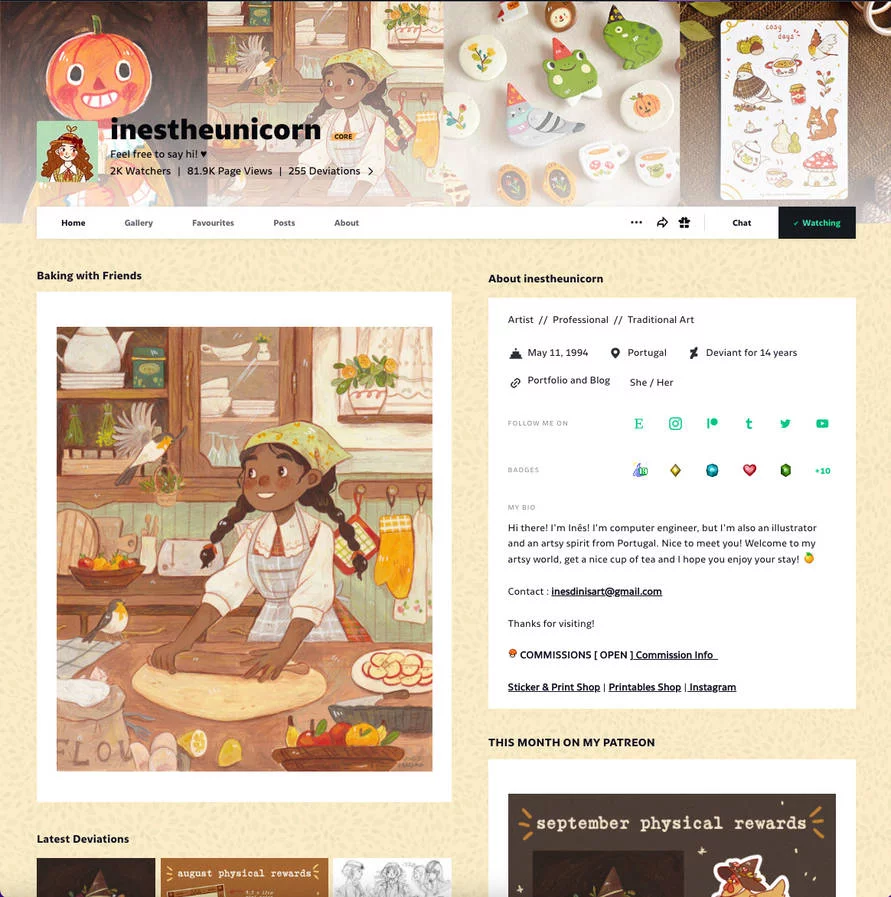
Looking at the artist profile, DA offers an overview of the authors’ work and personality in one place, but monetizes the majority’s lack of knowledge in making it prettier. Although artists can customize their main pages with additional sections, some, plus other functions like changing the background, needs a monthly Core subscription. Compared to the old interface that allowed custom HTML and CSS coding, its sunset upon the relaunch made them more homogeneous. It’s also exploitative, as the paywall forms an asymmetrical relationship (Zuboff, 2015, p.83) between DA, monetizing their ‘keys’ to make the artists’ portfolio more attractive, and artists, having limited knowledge on website coding and rely on the custom widgets. Constantly pushing the subscription, possibly a tactic from collecting data on the number of standard users, didn’t help either.

While one’s personality and ideas are split into two on Side 7, its smaller scale limits it to a basic overview with fairer communication. While the Gallery provides an overview of the artists’ illustrations, novels and folders, the Profile is a separate and text-based page with self-introduction and statuses. The two’s appearances are also fixed, with the only modification being font style changes in the self-introduction. Its administrator agreed on more customization, but the huge effort required prevents it from moving forward. Like DA, Side 7 offers paid functions, which are technical upgrades like scheduled posting instead. Alas, using forums to discussin discussing future directions, site news and chitchat heavily, the admin’s recognizable face contrasts with DA notifying users through journals. This thus gives users trust and knowledge on the matter, compared to users’ ignorance and corporate dominance in surveillance capitalism (Zuboff, 2015, p.83).
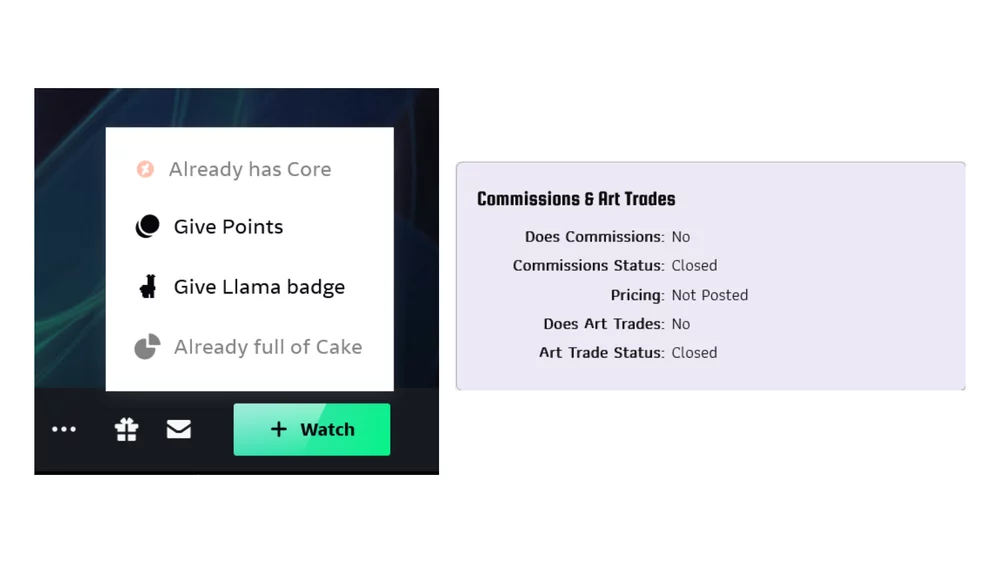
With different gifting and funding options, there arethere’re more nuances to ‘playbour’. On DA, users can gift artists free ‘Llama’ badges, and pay for a cake badge or a Core membership. Incentivized out of appreciation, ‘gift economy’ is seemingly at play, but with them proprietary to DA, they are “a formal and abstract kind of token” (Scholz & Wark, 2013, p.73) rewarding their active maintenance on their portfolios. Meanwhile, commissioning custom art is possible on both Side 7 and DA, plus the possible ‘art trades’ between artists, this tends to be ‘waged labour’ more than modders (Kücklich, 2005).
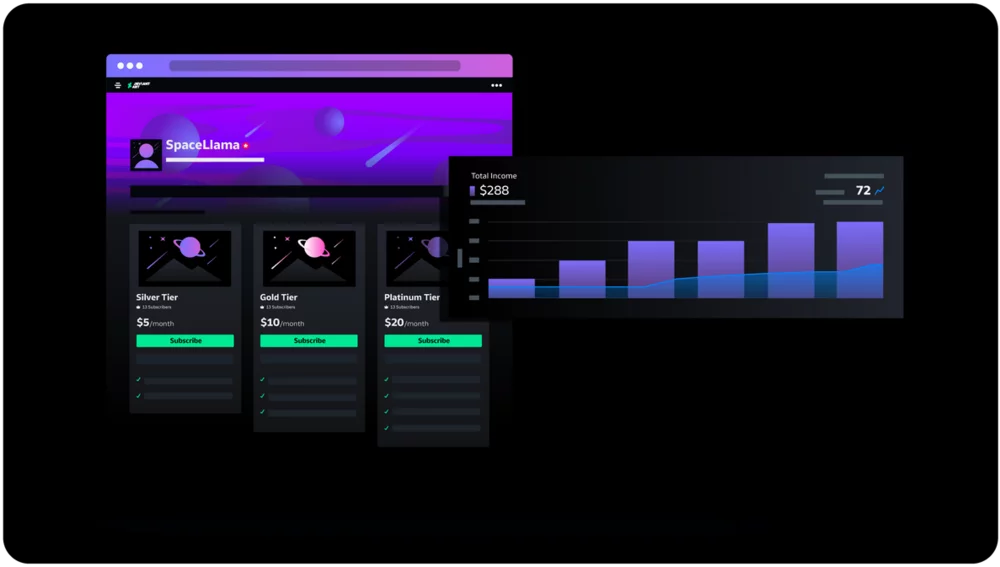
DA artists can also create art exclusive to the paying audience, which claims to be artists’ “new home for making money and connecting with your supporters”, but the site’s cut shows it’s more for its monetary gain than a new communal tie.
Back to topA different journey?
In reading DreamUp’s Terms of Service and FAQs, DA’s governance on copyright depends on third-party AI generators, which boils down to users’ trust and outsiders’ ‘good consciousness’. In addressing the ongoing concern with copyright, crediting DA artists in a referenced AI work is required in the Terms, or face account deletion if not followed. AcknowledgingStressing artwork’s on the site aren’t added to the training set, it also set up a tag on artworks, showing disapproval for third parties to appropriate it.
Yet, addressing artists who expected protection from DA, these solutions are flawed. For the former, it’s uncertain how will the offenders be executed, plus the lack of a report system for flagging them. Meanwhile, the latter plays on public ignorance like Google Now (Zuboff, 2015, p.83), as victims won’t notice their work being scrapped by AI generators, which has all the information – with ISIS execution and porn included Its reliance on other companies to respect the tag, plus possibilities of their work already in training sets, made the tags an incomplete solution. Especially after artists’ expectations being defied in the initial opt-out, later patches and corrections can still be seen as a “psychic numbing” (Zuboff, 2015, p.83) that coerces people into accepting the traceable generator.
In contrast, Side 7 actively banned the use of AI generated art, leading to a less complicated environment than DA’s. Citing artists’ (lack of) consent to be referenced in the generators, the site’s initial announcement of the ban was to avoid being amid polarized debates, especially when their influence is left to be understood. This discourse is later outlined in the updated rules, which also includes a link to report offending works. Without additional terms tailored to accommodate AI-generated works, the site runs on existing terms and rules. Whereas DA artists face a shift of position from “play for a living” (Kücklich, 2005) to themselves being monitored, their work being traced, and their behaviour forcefully changed to accommodate and co-exist with an overarching system.
Back to topFinishing Touches
Throughout the article, we've established DA and Side 7's different tactics in showing and handling user's artwork. Focusing on user submissions, the former encourages budding users to show what they love, while establishing a closer watch than the latter's showcase approach. Compared to modders' vulnerability in Kücklich's article, it's easier for artists to receive a monetary return from doing 'fun' things via commissioning on the two, but with DA being more top-down in controlling resources to attract an interested audience. DreamUp's launch further muddles the water, as it positions users to a more volatile position with AI art's copyright and ethical doubts unresolved, relying on others' good faith rather than being actively involved like Side 7.
Further research can be done on divergences in art platforms’ and users’ acceptance towards AI-generated art, in relation to its fast technological development. Yet, for now, trust seems to be the only thing artists can put amongst this uncertainty.
Back to topReferences
About DeviantArt. DeviantArt. (n.d.). https://www.deviantart.com/about.
Artists Beware! Please read if you have a DeviantArt account:. (2022, November 12). DeviantArt have just announced that they're launching their own ai art generator… [Tumblr post]. Retrieved April 22, 2023, from https://www.tumblr.com/drawingden/700684423624032256/probably-the-final….
DeviantArt, Inc. Privacy Policy. DeviantArt. https://www.deviantart.com/about/policy/privacy/.
DeviantArt. (2019, March 12). Welcome to DeviantArt Eclipse [Video]. Youtube. https://youtu.be/LnCmltGvCvc.
Does DreamUp use art submitted on the DeviantArt platform to train the AI models?. DeviantArt Help Center. (n.d.). https://www.deviantartsupport.com/en/article/does-dreamup-use-art-submi….
DreamUp: Terms of Service. DeviantArt. (n.d.). https://www.deviantart.com/about/policy/dreamup/.
Elgammal, A. (2019). AI Is Blurring the Definition of Artist. American Scientist, 107(1), 18-21. https://doi.org/10.1511/2019.107.1.18.
FelisGlacialis. (2019, August 13). Eclipse's Force - DeviantART is no longer Deviant. DeviantArt. https://www.deviantart.com/felisglacialis/art/Eclipse-s-Force-DeviantAR….
How do I customize my profile?. DeviantArt Help Center. (n.d.).
How do I submit my work to DeviantArt?. DeviantArt Help Center. (n.d.). https://www.deviantartsupport.com/en/article/how-do-i-submit-my-work-to….
How Do I… Upload images?. Side 7. (n.d.). https://side7.com/faq/4/68.
https://www.deviantartsupport.com/en/article/how-do-i-customize-my-prof….
Kücklich, J. (2005, December 5). Precarious Playbour: Modders and the Digital Games Industry. The Fibreculture Journal, 5 (FCJ-025). https://fibreculturejournal.org/fcj-025-precarious-playbour-modders-and….
Lamey, J. [BadKarma]. (2022, December 15). Rules update – No AI Art. Side 7. Retrieved June 1, 2023, from https://side7.com/news/item/195.
Lamey, J. [BadKarma]. (2022, November 11). All good questions. I just heard about the dA decision this afternoon, so I'm still looking into what that might [Comment on the online forum post So DeviantArt is committing suicide...]. Side 7 Forums. Retrieved June 1, 2023, from https://side7.com/forums/thread/654/1#5713.
Lamey, J. [BadKarma]. (2023, January 1). So much to address... RE: Customizable Profiles & Widgets Making the profile page more of a welcome page to the [Comment on the online forum post Spreading the Word]. Side 7 Forums. Retrieved June 1, 2023, from https://side7.com/forums/thread/674/1#5849.
Light, B., Burgess, J., & Duguay, S. (2016). The walkthrough method: An approach to the study of apps. New Media & Society, 20(3), 881–900. https://doi.org/10.1177/1461444816675438.
Lunden, I. (2017, February 23). Website builder Wix acquires art community DeviantArt for $36m. TechCrunch. https://techcrunch.com/2017/02/23/website-builder-wix-acquires-art-comm….
Robertson, A. (2022, November 15). How deviantart is navigating the AI art minefield. The Verge. Retrieved May 31, 2023, from https://www.theverge.com/2022/11/15/23449036/deviantart-ai-art-dreamup-….
Rules of Conduct. Side 7. (2023, January 8). https://side7.com/rules.
Scholz, T., & Ross, A. (2013). In Search of the Lost Paycheck. In Digital Labor: The internet as playground and factory (pp. 13–32). essay, Routledge.
Scholz, T., & Wark, M. (2013). Considerations on A Hacker Manifesto. In Digital Labor: The internet as playground and factory (pp. 69–75). essay, Routledge.
Side7.com Privacy Policy. Side 7. (2022, November 16). https://side7.com/privacy.
Site Questions: Which category receives the most exposure?. Side 7. (n.d.). https://side7.com/faq/3/37.
team. (2019, August 8). Customization, Contrast, Pagination, and Comments. DeviantArt. Retrieved June 1, 2023, from https://www.deviantart.com/team/journal/Customization-Contrast-Paginati….
team. (2019, September 19). The New Front Page Made Just For You. DeviantArt. Retrieved June 1, 2023, from https://www.deviantart.com/team/journal/The-New-Front-Page-Made-Just-Fo….
team. (2021, September 1). Subscriptions Beta: Make Money, Connect with Fans. DeviantArt. Retrieved June 2, 2023, from https://www.deviantart.com/team/journal/Subscriptions-Beta-Make-Money-C….
team. (2022, November 11). Create AI-generated art fairly with DreamUp. DeviantArt. Retrieved April 22, 2023, from https://www.deviantart.com/team/journal/Create-AI-Generated-Art-Fairly-….
team. (2022, November 11). UPDATE All Deviations Are Opted Out of AI Datasets. DeviantArt. Retrieved May 31, 2023, from https://www.deviantart.com/team/journal/UPDATE-All-Deviations-Are-Opted….
Vincent, J. (2023, January 16). AI art tools stable diffusion and Midjourney targeted with copyright lawsuit. The Verge. https://www.theverge.com/2023/1/16/23557098/generative-ai-art-copyright….
What are Profile badges?. DeviantArt Help Center. (n.d.). https://www.deviantartsupport.com/en/article/what-are-profile-badges.
What is a Core Membership?. DeviantArt Help Center. (n.d.). https://www.deviantartsupport.com/en/article/what-is-a-core-membership.
Xiang, C., and Maiberg, E. (2022, September 21). ISIS Executions and Non-Consensual Porn Are Powering AI Art. Vice. https://www.vice.com/en/article/93ad75/isis-executions-and-non-consensu….
Zuboff, S. (2015). Big other: Surveillance capitalism and the prospects of an information civilization. Journal of Information Technology, 30(1), 75–89. https://doi.org/10.1057/jit.2015.5.
Back to top
