


Paper
Chrissy Teigen's tragedy - too private or not public enough?
Chrissy Teigen shared news of her stillbirth via Instagram. The comments weren’t as loving as you might expect. This article aims to answer the question: 'why do people react so negatively towards something accused of being (too) private?'

Published date
Courses
New private and public spheres
Copyright
This work is licensed under a Creative Commons Attribution-NonCommercial 4.0 International License.
Read time
10 minutes

On October first, Chrissy Teigen (2020a) — former model and wife of John Legend — posted the heartbreaking news of her stillbirth on Instagram. he had been sharing her pregnancy journey on there, just as she has been sharing most of her life online before. However, the comments weren’t as loving as you might expect from someone sharing such a tragedy. Many accused her of seeking publicity or mentioned their incomprehension for sharing something so personal. This made me wonder, why do people react so negatively towards something accused of being (too) private? And something private that she had shared.
Back to top
Chrissy who?
Chrissy Teigen is known as a former model, television personality, cookbook author, and wife of “All of Me” singer John Legend (“Chrissy Teigen”, n.d.). She is considered the ‘unofficial queen of Twitter’ (Grinevičius and Jaruševičiūtė, 2020) and uses social media to show off her honest character. pictures of her stretch marks (Teigen, 2015) or vicious reactions on Twitter (Teigen, 2020b). Her posts feel authentic (Teigen, 2020c), relatable (Teigen, 2019a), and personal (Teigen, 2020d) and therefore Chrissy is loved by many. 32,8 million to be exact (Teigen, n.d.).
Teigen is also known for taking a political stand. Her Instagram bio mockingly reads: “making America great again” (Teigen, n.d.). In 2019, she got into a Twitter fight with the president himself (Fortin, 2019). Trump called her “filthy-mouthed” (Fortin, 2019) and her husband “boring” (Fortin, 2019), to which she responded with the — later trending — #presidentpussyassbitch on Twitter (Teigen, 2019b). All this publicity comes accompanied with a great price: many eyes on her, positively and negatively.
On September 14th, Chrissy announced that she and her husband were expecting their third child (Respers France, 2020). S the end of September, she ran into pregnancy complications. First, on September 20th, Teigen was put on bed rest (Teigen, 2020e). Nine days later, she updated her followers on new complications, for which she was in the hospital getting blood transfusions. However, “Baby and I are completely fine”, Chrissy wrote (Teigen, 2020b).
Halfway through her pregnancy (Ives, 2020), on October 1st, she shared the photos of her stillbirth to inform her followers of what had happened. She explains (2020a): “We are shocked and in the kind of deep pain you only hear about, the kind of pain we’ve never felt before. We were never able to stop the bleeding and give our baby the fluids he needed, despite bags and bags of blood transfusions. It just wasn’t enough”. Later in the caption she thanks her audience for the “positive energy, thoughts and prayers” and expresses her gratefulness for her two children (Teigen, 2020a). However, this day — and many to come — will revolve around grieve for her.
The comments below the post (Teigen, 2020a) show a big variation of feelings towards her sharing this loss on social media. Many show their empathy by telling how sorry they are and others applaud Chrissy for breaking the stigma that surrounds miscarriage and stillbirth. For those, it feels very liberating that a public person and motivates them to start sharing their experiences (Creativetantrums, 2020).
Others, however, back on the negativity of it all. They accuse her of sharing this only for publicity (Lady_eileena, 2020) since she is a celebrity, or that grieving is something you need to do in private (karenmajors4, 2020). For Chrissy herself, sharing this is a way to say: “this has happened, I want to put out the photos first in my own way” (Pocklington, 2020).

Back to top
Public, private, and ethical reactions
To answer the questions above — about the negative response on Instagram and whether it is something private that is shared —, one needs to fully understand why people do feel so uncomfortable. First, it’s important to define what private and public means and what the difference is between the two. According to Habermas (1997), the public is a place for rational debate and to “deal with matters of general interest without being subject to coercion”. It is open for all and holds the purpose of society becoming engaged in critical public debate (Fuchs, 2014).
The private is the realm of family and economy that is “free of the influence of government and other social institutions” (Crossman, 2019). According to Habermas (1997), the private and public spheres were realms that had to be separated in order to function and uphold a strong democracy. However, broadcasting and (social) media brought “public life into private life, and private life into public life, for pleasure and enjoyment as much as for information and education” (Fuchs, 2014). The boundaries between what is or should be public a private have become liquid with the emergence of social media (Fuchs, 2014) and therefore confused our boundaries and online behavior up until today.
Something that could explain this confused online behavior is the metaphysical worldview we project onto the world since the ancient greeks (Miller, 2012). This means we are disconnected from our physical selves. “The absence of physical bodies, cues and voices allowed one [us]” on the Internet “to construct a subjectivity free of such social constraints” (Miller, 2012). We are only moral beings because normally, offline, we can see, feel, and hear others. Online, however, we lose this consciousness and that allows us to objectify and instrumentalize our human relations (Miller, 2012). This makes it easier for commenters to ignore or neglect the person behind the post.
Another aspect that could explain our behavior, is the lack of precariousness that normally surrounds any celebrity (status). ‘Precariousness’ is a term introduced by Butler (2012) and revolves around the fact that “all humans are interdependent and therefore all are vulnerable” (Kasmir, 2018). It focusses on the fragile, complex, and uncertain state of human beings:
“bodily dependency and need, hunger and the need for shelter, the vulnerability to injury and destruction, forms of social trust that let us live and thrive, and the passions linked to our very persistence” (Butler, 2012).
Precariousness is therefore more associated with ‘normal’ citizens — not celebrities — who have little financial stability or less opportunity.
Back to topChrissy’s case
When we take all this information back to the post of Chrissy Teigen (2020a), we see that our ethical understanding and behavior is influenced by our online presence, especially those who have a negative opinion of the content. Butler (2012) explains that images about situations too far away from people's reality reveal a dead-end “Ethical responsibility presupposes ethical responsiveness” (Butler, 2012). In other words, if people are unable to relate, they are unable to respond (ethically). This is something lovely.rose.reborns (2020) fairly points out in the comments: “some of you haven’t lost a child and it shows”.
Like most, celebrities lose their physical presence over their online presence — especially in times of COVID-19, where self-isolation is the norm — and they have become alienated (Miller, 2012). Users like dorafrancez’s (2020) and ghetto_cinderella_. (2020) are unable to see the precariousness of Chrissy’s situation and are therefore unable to react ethically. We lose our presence in the digital society we live in today and are therefore losing our moral being and ability to react ethically. This fundamental contradiction is called a 'crisis of presence' by Miller (2012).
When we look closely at the images that Teigen (2020a) shared, we see five black and white photos of which all show Chrissy in multiple stages of her delivery. Captured on those photos you see emotions ranging from pain, sadness, exhaustion, grief, and hopelessness. In other words, they all are showing her human state of being in a precarious situation: “the reproduction of the material conditions of life, and the problems of transience, reproduction, and death alike” (Butler, 2020). These conditions and associations tie back to why people feel a certain discomfort when looking at Chrissy’s photos. r why it is r as ‘too private’.
This is because everything that relates to precariousness or a precious life belongs in the private sphere. Arendt (as cited by Butler, 2012) explains that the private sphere entails the questions of need and should therefore be unseen by the public. The private and public spheres are relevant for our understanding of privacy, it distinguishes “things that should be shown and things that should be hidden” (Butler, 2012). In other words, the private sphere entails the need of people and should remain hidden.
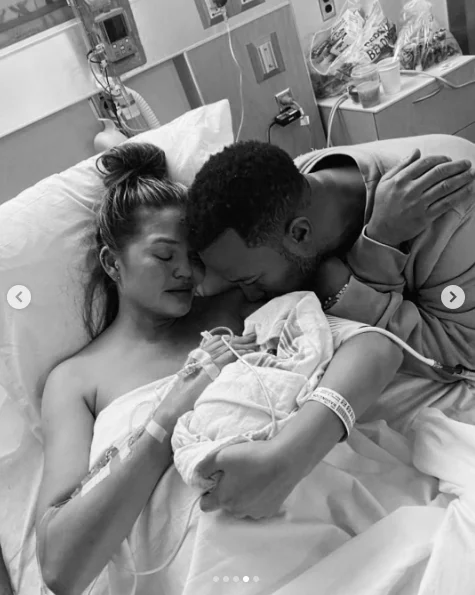
Only one of the pictures suggests the presence of little son ‘Jack’. Note how we, as the public, don’t really see him, only the suggestion of him in the cloth. While some comments focus most on the pose they strike (this must be staged!)(Msfk._, 2020) or the alias on her hospital wristband (this is not real!) (Mike_valiant, 2020), others praise her for breaking the stigma (Jojolabow, 2020) and shedding light on a feminist issue (Creativetantrums, 2020).
What no one seems to notice, however, is that she is preaching for something without actually going there herself. Chrissy is not showing her lifeless child. She is idolized by some commenters for sharing photos of her stillbirth, without actually showing her son. This would also mean that people’s outrageous reaction to her sharing something ‘too personal’ makes no sense. I would argue that this has to do with the fact that people online are always seeing what they hope to see.
Miller (2012) confirms this statement by explaining:
“our online presence is generally motivated by specific intentions and goals... when we search for things, we are engaging with the (virtual) world in a particular way, which revolves around the specific demands of a self-enclosed thinking subject”.
In this case, some users come intending to question Teigen’s sincerity and they are most likely to find arguments to prove their point. Just commenters with a more positive feeling toward Chrissy find something positive to comment on, without actual proof for it. Therefore, it doesn’t matter whether the child is actually seen online or not. It is the intention and suggestion alone, that is enough for the audience to form an opinion and comment.
Back to topThe essential balance in social media
The reaction to Chrissy Teigen’s post taught us a lot about our online behavior. When people are unable to recognize themselves in others, physically or situationally, they become less able to ethical responsiveness. We need a form of physical presence to respond to the precariousness of others. Since that is lacking in our digital environment, especially towards a celebrity that is ‘there’ and brought ‘here’ to our attention through the media, it is harder for users to connect with Chrissy.
What makes this case so interesting is not the lack of precariousness, but the surplus of it. By showing so many emotions that emphasize our fragile, complex, vulnerable, and dependent state, people experience an unease. They are taught to see it as something that “should stay hidden” (Miller, 2012) and out of the public sphere of which Instagram is a part of. Therefore, Chrissy’s post emphasizes the sensitive balance in social media. Without any sign of precariousness, users are unable to relate, but with too many, users are implied to look away and feel at unease. This explains why the comments are so divided in their response. Some can respond ethically and some are associating precariousness with privacy (something that should stay hidden).
Secondly, whether Chrissy actually showed something private remains a point of perspective. Although her son is not showed and therefore Teigen is not sharing the private matter in this situation, the suggestion alone is enough to motivate the audience into a specific intention or goal (Miller, 2012).
All in all, I would want to make a plea for maintaining these private posts in our public sphere. We need these reminders of physicality, material conditions, and death to stay able to respond ethically online (Arendt as cited by Butler, 2012). Without sharing our precariousness in the public, we are only left with a nihilistic perspective and “our sense of being beyond the physical, incorporeal, transcendent or abstract” (Miller, 2012) are likely to become alienated from ultimately humanity itself (Miller, 2012). So, keep sharing that goofy, humiliating, or even scary content and try to stay kind to one another online.
Back to top
References
Butler, J. (2012). Precarious Life, Vulnerability, and the Ethics of Cohabitation. University of California, Berkeley. Journal of Speculative Philosophy, vol. 26, nr. 2, 2012, 134-151.
Habermas, J. (1997). The public sphere in Robert E. Goodin and Philip Pettit (eds), Contemporary Political Philosophy: An Anthology, Oxford: Blackwell Publishers, pp. 105-108.
Miller, V. (2012). A Crisis of Presence, Online Culture and Being in the World. Space and Polity, 16:3, 265-285. Doi: 10.1080/13562576.2012.733568
Back to top
