


Paper
Autocorrect: the ultimate influencer
Autocorrect should be seen as a double-edged sword. On the one hand, it is perceived as empowering since it positively influences users' productivity. On the other, it decreases students' motivation to learn grammar.

Published date
Courses
Digital literacy
Copyright
This work is licensed under a Creative Commons Attribution-NonCommercial 4.0 International License.
Read time
12 minutes

On this page
- Autocorrect: an overview of its historical development
- Approaches of autocorrect
- Companies’ approach to autocorrect
- Language users and the influence of autocorrect
- Consequences for literacy
- Dialects disappear
- Consequences for education
- Interesting scenarios caused by Autocorrect
- Conclusion
- References
Autocorrect. A widely used phenomenon that goes back all the way to the 1960s. Nowadays, it is hard to imagine a life where a text has been sent without being checked by autocorrect. However, what do we know about this software? And is it really that handy or is it a tool that tracks our literate behavior. In which ways does autocorrect influence digital literacy lives?
Back to topAutocorrect: an overview of its historical development
In order to dive deeper into this subject, it is crucial to define the term ‘autocorrect’. There are multiple synonyms for this noun, such as spelling correct, text correction, or typo tolerance (Gregdevogo, February 6). According to Computer Hope (2017), "AutoCorrect is a software feature commonly found in word processing programs, such as Microsoft Word. As the name implies, this feature automatically corrects misspellings and common typos". It follows that it helps language users with correcting typos and also changes mistakes into words that the autocorrect is familiar with.
It follows that it helps language users with correcting typos and also changes mistakes into words that the autocorrect is familiar with.
As Stevens (2017) claims; "the system is descriptive at the surface; i.e., it amends and programs its rules based on trends in usage that it finds in the data it collects" from the language users. According to the New York Times (D. Engber, 2014), Warren Teitelman was the one who came up with the 'Do What I Mean'-philosophy whereas programs should recognize obvious mistakes. With this program, an obvious error could be recognized immediately and therefore would be corrected. Once this system became implemented, the auto-correction function became a well-known companion of everyone’s writing doing. With the invention of the touch-tone telephones, everybody became familiar with the tool where spelling errors would be corrected. Nowadays, it is hard to think of texting someone or typing a message, without using the handy tool.
Back to topApproaches of autocorrect
The mentioned above autocorrect -where the spelling checker is correcting your written words- is one way of how to approach autocorrect. Most commonly understood, it is the correction that happens automatically after you press the spacebar and your written word changes in a (correct) other word.
A different way of how autocorrect can be approached in terms of user experience is through a search engine that 'it takes it as a given and gives you suggestions afterwards' (Gredevogo, February 6). For example, when typing “best cell pone cho’, the first suggestion Google gives is “best cell phone choices”. Hereby, Google is assuming you meant phone instead of phone. As seen in image 1, the dark blue line is the autocorrection of Google. When a person types a word wrong, then the word will be underlined in red The last three letters don’t form a word yet, “cho”. Here, Google is automatically completing words that you could possibly use for your search. This is visible in orange square in Image 1. The search engine tries to guess the word you meant.
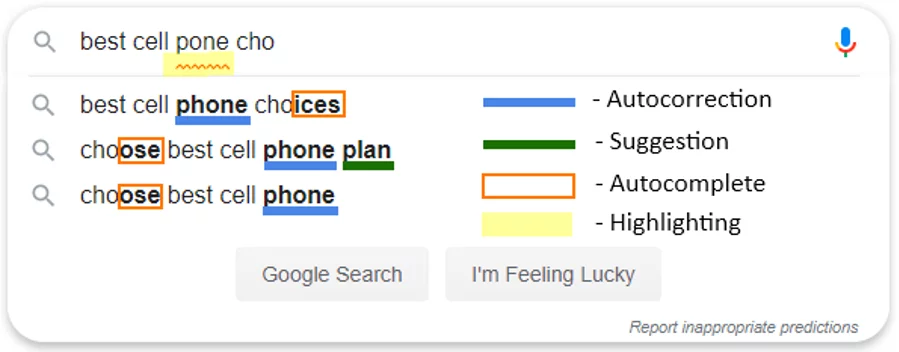
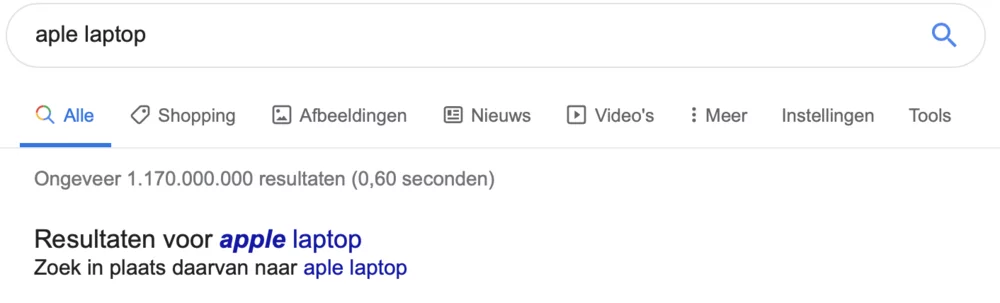
As Lee (n.d.) claims "You don't have to spell correctly to search productively on the Web if you use Google as your search engine". Hereby, he is referring to people who are searching for certain words but type these words wrong in the first place. Google's auto-correct algorithm can predict the word that you were intending to use. “These suggestions or predictions (as Google names that) are based on related web searches, your browsing history, and Google’s website ranking (Gredevogo, February 6). If you try to find a word in a search engine such as Google but you made a typo, then the search engine will suggest the word the machine thought you intended to use (see image 2).
Companies’ approach to autocorrect
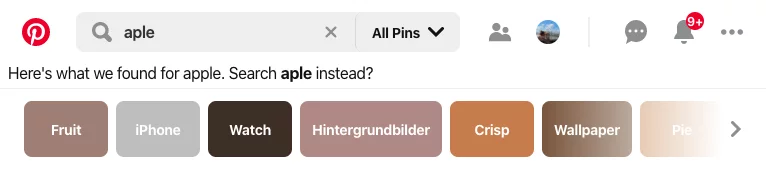
Something interesting to see is that almost every website has a different interest on how to use autocorrect. Whereas Google is trying to help the person to find the right word, and therefore suggests words and correct typo’s, is Amazon, a webshop, more focused on the commercial aspect of autocorrect. As the website Towards data science (Gredevogo, February 6) explains “In terms of Amazon’s autocorrect implementation it consists of all the previously mentioned components, but since it’s a marketplace its suggestions ranking formula seems to include the factor of how attractive a suggestion can be to you in terms of sales”. Not just Amazon uses a different type of autocorrect. According to the same website, Pinterest also uses its own algorithm with autocorrect “based on internal domain/pins/pinners relevance” (Gredevogo, February 6).
Language users and the influence of autocorrect
After defining what autocorrect is and how it works, it is important to realize how much we grew accustomed and attached to this tool. The degree of influence shows in the fact that autocorrect comes naturally, people aren’t aware of its action anymore. In addition, autocorrect also has some serious consequences for literacy. One of them is that certain dialects seem to disappear.
Back to topConsequences for literacy
A great example to visualize the influence that autocorrect has in our society is shown in research on the impact of digital tools on student writing (Purcell, Buchanan and Friedrich, 2013). Survey results revealed that 68% out of 2,462 participants say that “digital tools make students more likely—as opposed to less likely or having no impact—to take shortcuts and not put effort into their writing” and “46% say these tools make students more likely to ‘write too fast and be careless’” (Purcell, Buchanan and Friedrich, 2013). The automatic function that is correcting our spelling, takes away our assessment in learning to formulate and recognize correct spelling (Sanchez, 2016).
The automatic function that is correcting our spelling, takes away our assessment in learning to formulate and recognize correct spelling (Sanchez, 2016).
Someone may advance that it makes literate language users in westernised society less engaged or even lazy. They are not willing to put in any effort in order to write and spell correctly. Digital technologies like autocorrect are an important tool for becoming a digital and social included person (Ragnedda and Mutsvairo, 2018) and create many advantages for individuals and groups. Digital inclusion is defined as the “ability of individuals and groups to excess and uses information and communication technologies” (Ragnedda and Mutsvairo, 2018). Ragnedda and Mutsvairo (2018) claim that it’s related to connectivity, capability, content, confidence and continuity. Stated by the authors (2018): “Digital inclusion is a matter of access and connectivity but also a matter of skills, knowledge, opportunities, motivations and capacities to use ICTs to improve the quality of life”. Even though autocorrect might be a tool that makes people less engaged, the technology still connects people by making language more inclusive.
What makes this so interesting is that, although we don't want to do the work, society still very much cares about correct spelling. According to the BBC (2017), who did "A survey of 5,500 American singles in 2016 by online dating site Match.com found that 39% judged the suitability of candidates by their grasp of grammar – ranking that more important than their smile, dress sense or even the state of their teeth". Your image and persuasion will rely heavy on your ability to spell. People with an inability to spell suffer a prejudice of being ignorant and slovenly (Horobin, 2013). As well as, seen as an index of less intelligence and education social status (Horobin, 2013), which makes you less suitable for that ‘happily ever after’.
Dialects disappear
On top of that, like Way (2019) thoughtfully noted: autocorrect is “killing the vernacular.” When one looks at what Way denounces more closely, it does come to make some sense. Autocorrect is forcing the correct way of the written word (spelling) and is unable to recognize all, if any, dialects. Is our urge for correct spelling strong enough to be willing to sacrifice linguistic innovation?
Vernacular or dialects are most of the time based on regions. Where in each region has its own language and traditional communication range (“Dialect”, n.d.). Due to their non-dominant role and small scale, dialects lose favor over standard language (words). In our modern, digitalized, society, the vernacular is no longer supported. You can see that in the lack of vernacular vocabulary in autocorrection, which results in a chicken-or-egg problem. The lack of possibility to use vernacular influences the lesser use and so on. Much of the typical dialect language and expression becomes language history, whereas the correct language (which is embedded in autocorrection) will take over.
Back to topConsequences for education
As mentioned above, autocorrect might have an influence on the activity of people. They become lazy since they don't necessarily have to pay attention anymore to what they are writing because autocorrect will correct their typos. Hereby one another can also question the writing skills of children. Will autocorrect also make children lazy and will this influence the ability of their writing skills? Is it still worth learning children any grammar if it will be done for them in the near future? As stated before, autocorrect is taking away our assessment in learning and producing correct spelling (Sanchez, 2016).
According to associate professor of English Cynthia Ryan (Bakken, 2014), these changes should be embraced. "New technologies will, as they always have, influence how we gain and use knowledge". She continues: “When students text, they’re writing in a particular genre and for an informal audience. Texting as a genre has space considerations and expectations, which warrant using abbreviations for phrases such as LOL, symbols like 2 for two, and just as few characters as possible" (Bakken, 2014). Nevertheless, Bakken (2014) writes that "technology will not replace good, old-fashioned writing". Ryan, the teacher, claims that students should never fully depend on technology. "Context is key, and neither autocorrect, a thesaurus nor any other kind of resource can be counted on to do the work for the writer". Autocorrect should be seen as a double-sided sword. On one side it is a tool to be more skillful and productive, but on the other side, it questions the necessity for learning grammar at all and spending that much time and money on something that could or will be done for you.
Back to topInteresting scenarios caused by Autocorrect
Autocorrect is a very useful tool that helps a significant number of people with fixing some errors and predicting what one another wants to say. However, it might also cause some problems. One of the situations that have been caused because of autocorrect is a case with Hillary Clinton. In this case, Google was blamed “hiding negative autocomplete results for Hilary Clinton (Kastrenakes, 2016). According to Kastrenakes (2016) a “video pointed out that Google doesn't suggest "Hillary Clinton crimes" when you type in "Hillary Clinton cri," whereas both Yahoo and Bing do. Nevertheless, Google fully denies that this is true. Kastrenakes (2016) defends Google through the following argument: “The first being that Google does, for all people, filter out "offensive or disparaging" search predictions — and "crime" is one of the words Google consistently removes”. Another argument given in the article is that most people usually only type Clinton without the first name which makes it harder to find the negative news.
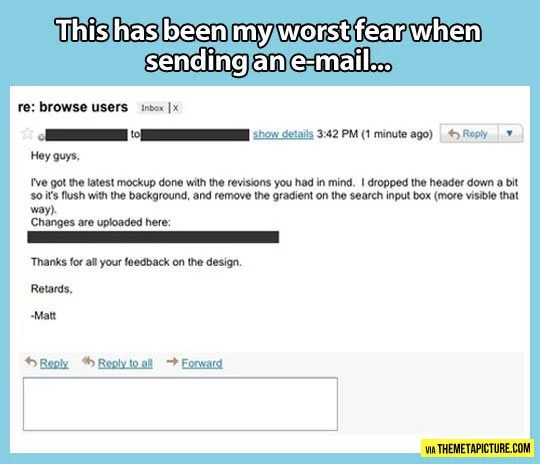
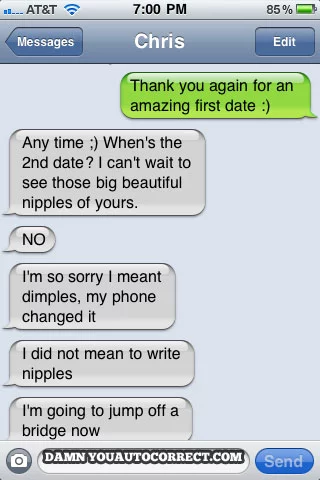
Another case where autocorrect comes into place is during intense chatting online via your mobile phone. Many of you may recognize the struggle of wanting to type a certain word or name that keeps being corrected. For example, autocorrect loves to change the name Kirsten, into ‘korsten’ (meaning: crusts), resulting in a very uncharming nickname. Most of the time we will notice these corrections, but when we don’t, it can result in some pretty entertaining conversations. These mistakes get shared all over the internet as very successful memes. Or even on television like the ‘Clumsy Thumbsy’ segment on the Ellen DeGeneres Show (TheEllenShow, 2001). These memes are so successful as a topic of laughter because of their relatability. Most can empathize with a situation where; what they sent was not what they meant.
Conclusion
So you might wonder, after seeing so many sides of autocorrect, is there any good to it? Very much so! It is a helpful tool for people with disabilities, such as dyslexia (Hiscox, Leonaviciute and Humby, 2014). Autocorrect is also received as empowering by many because it positively influences their productivity for the better (Branscombe, 2017 and Davis, 2002). They argue that one’s time checking spelling decreases and time focusing on your message increases. Nevertheless, this type of technology will remain a helping hand and keep in mind that you know your own idiolect better than autocorrect does.
Back to top
References
B, Sanchez. (September, 2016). This Is Why You Should Turn Off Autocorrect. Indiana University, The Odyssey. Retrieved on March 22, 2020
Bakken, J. (may 2014). Could texting and autocorrect affect kids' writing skills? Retrieved on March 22, 2020
Branscombe, M. (Febuary 6, 2017). Office 365 tip: Using 'Add to AutoCorrect' to make you more productive. ZDNet. Retrieved on April 17, 2020
Computer Hope (April 10, 2017). AutoCorrect. Retrieved on March 2, 2020, from
Davis, J. (March 19, 2002). The importance of using AutoCorrect. TechRepublic. Retrieved on April 17, 2020, from https://www.techrepublic.com/article/the-importance-of-using-autocorrec…
Denn, R. (January 29, 2019). In the era of spellcheck and auto-correct, does it matter that my son can’t spell? The Washington Post. Retrieved on March 2, 2020
ialect (n.d.). In Wikipedia. Retrieved on March 22, 2020
Engber, D. (June, 2014). Who made that autocorrect? New York Times Magazine. Retrieved on March 2, 2020
Google (March 2020). Google. Retrieved on March 2, 2020
Gregdevogo (February 6). Autocorrect in Google, Amazon and Pinterest and how to write your own one. Retrieved on March 2, 2020
Hiscox, L., Leonaviciute, E., Humby, T. (2014). The effects of automatic spelling correction software on understanding and comprehension in compensated dyslexia: improved recall following dictation. Dyslexia 20 (3) , pp. 208-224. Retrieved on April 17, 2020
Horobin, S. (2013). Does spelling matter?. Oxford University Press.
K, Way. (October, 2019). Autocorrect is for Cowards. Vice Media Group. Retrieved on March 21, 2020, from
K. Purcell, J. Buchanan and L. Friedrich. (July, 2013). The Impact of Digital Tools on Student Writing and How Writing is Taught in Schools. Pew Research Center. Retrieved on March 21, 2020
Kastrenakes, J. (June 2016). Google denies altering search suggestions for Hillary Clinton. Retrieved on March 22, 2020
Lee, K. (n.d.). How does Google's Auto-Correct work? Retrieved on March 22, 2020,
Morrison, L. (August 2017). The true importance of good spelling. Retrieved on March 2, 2020
Ragnedda, M., Mutsvairo, B. (2018), Digital Inclusion: Empowering People Through Information and Communication Technologies (ICTs), In Ragnedda, M., and Mutsvairo, B. (eds) Digital Inclusion. An International Comparative Analyses, London: Lexington Book, pp. Vii--xx.a
Stevens, J. (September 2017). How autocorrect influences language. Retrieved on March 2, 2020
TheEllenShow. (September, 2011). Clumsy Thumbsy [video file]. Retrieved on March 22, 2020
Back to top

