


Essay
‘You Are the Media Now’: How X Created a New Reality Where Truth and Fiction Converge
The platform X (formerly Twitter) presents a unique case of the interplay between truth and fiction. Elon Musk, the owner of X, positions his platform as a digital public sphere, where everyone is invited to become the media themselves. Addressing his 212.5 million followers (data as of January 2025), he states: "You are the media now." But are we? This paper analyzes the complex relationship between truth and fiction on X, using the concept of immediacy as a central framework for analysis.

Published date
Courses
Reading and writing in online culture
Copyright
This work is licensed under a Creative Commons Attribution-NonCommercial 4.0 International License.
Read time
9 minutes

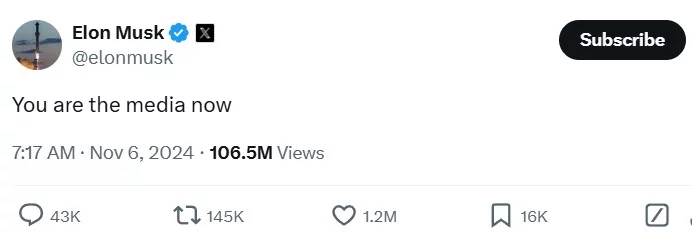
On the day after the American elections, Elon Musk (2024a) addressed all X users with the statement: "You are the media now," shared on his platform X (formerly Twitter). The uptake of the message was huge: 106.7 million views and more than 1.2 million likes (as of January 15, 2025). However, the backlash soon followed. Despite Musk’s seemingly inspiring claim, one of the most prominent British newspapers, The Guardian, announced several days later that it would no longer post on X from its official accounts, which boast approximately 27 million followers. In their statement, The Guardian described X as a toxic media platform where far-right conspiracy theories and racism are disseminated, which Elon Musk uses to influence political discourse (Why the Guardian Is No Longer Posting on X, 2024). This decision set a precedent, raising questions about the platform's reliability and prompting similar actions from other media outlets. Recent coverage by Le Monde, titled 'The Dilemma: Should You Leave X?,' further highlights the ongoing debate (Faure, 2024).
While the claim "you are the media now" might initially seem appealing, as it evokes some libertarian core ideas, it also appears quite disturbing. In a later post, Elon Musk (2024b) elaborates on his perspective: ‘’Journalism is dead…That is why X is the future. It is citizen journalism, where you hear from the people, it is by the people, for the people.’’
This paper challenges Musk's statement, "You are the media now," arguing that the social media platform X blurs the line between truth and fiction—a phenomenon driven by the platform's algorithms, its affordances, and, most significantly, Musk’s personal convictions that amplify misinformation under the guise of empowerment. Using the example of Elon Musk's page on X, the paper demonstrates how the platform fosters a hostile epistemic environment where information is distorted.
The Power Struggle on X
In August 2024, a former technology editor for The Guardian reported that Elon Musk created nearly 650 posts—an average of approximately 93 posts per day (Hern, 2024). A month later, In September 2024, New York Times reporter Stuart Thompson spent five days analyzing Elon Musk's activity on X. He revealed that nearly a third of the 171 posts the platform's ownermade were false, misleading, or lacked context (Thompson, 2024). It is essential to acknowledge that Elon Musk is not just a businessman; he is an influencer. In fact, he is officially the most-followed influencer on X, with 212.5 million followers (as of January 15, 2025). Mr. Musk does not fit the common understanding of an influencer within the broader influencer culture: he does not produce content for monetization. As the richest person in the world, he has no need to. Instead, what Elon Musk gains is indisputable influence over public discourse. Still, his role is difficult to define: Is he a businessman who shares his ideas online? A political activist? Or a political commentator?
In too-late capitalism, an individual does not need to be hired by a newspaper to publish ideas: why, if they can simply post on X? This is precisely Elon Musk’s message.
Since the acquisition of Twitter in 2022, the social media platform has undergone significant changes under Elon Musk's leadership. Once a favorite platform for millions of users, it was rebranded as X and introduced new rules of order. First of all, the platform’s algorithms were drastically changed. It is worth noting that X, like other social media platforms, is not transparent about how its algorithms work and remains tight-lipped on the matter. However, several investigations shed light on X’s algorithmic bias. For instance, Elon Musk’s posts are almost unavoidable, as they are constantly pushed by the platform’s algorithms (Conger et al., 2024). This has resulted in his account growing from 133 million followers in March 2023 to 212.5 million in January 2025 (an approximate 59.77% increase). Furthermore, research conducted by the Queensland University of Technology revealed that, in addition to the amplification of Elon Musk’s posts, there was a significant boost in Republican-leaning accounts starting in July 2024, when Donald Trump was officially nominated to run for presidency (Davis, 2024).
In the context of Web 2.0, being granted visibility is a ‘highly contested game of power’ (Bucher, 2012, p. 1165). In this case, the social media platform X holds algorithmic power, determining ‘what can and should be seen and what should not and cannot be seen, and who can and cannot see whom’ (Bucher, 2012, p. 1165). While granting visibility to some accounts, algorithmic power silences others, leading to their invisibility. This results not only in the invisibility of some but also in the inability of others to see them. X’s algorithms grant visibility to Elon Musk’s posts and far-right accounts, inevitably resulting in a power imbalance on the platform. Silencing others and granting visibility to more appealing ideas does not contribute to a trustworthy epistemic environment but, on the contrary, fosters a hostile one.
One might argue that traditional media outlets, such as The Guardian or The New York Times, are left-leaning, and therefore all media are somewhat biased. This raises the question: What is the difference between X amplifying Elon Musk’s posts and far-right accounts and these outlets amplifying left-leaning ideas? The answer lies in the content itself. While these traditional media outlets attempt to provide readers with accurate information or opinions guided by truth, X is shaped by Elon Musk's personal convictions and political interests, resulting in the creation of an entirely different reality driven by fiction. The owner of X actively spreads fake or misleading information, and in this regard, he seems to send the following message to other X users: You can do it too; now it is permitted because you are the media. Musk’s populist stance, with journalistic institutions framed as enemies of truth and X as the last bastion, is supported not only by the platform’s algorithms but also by other affordances, such as blue checkmarks. Once reserved exclusively for well-known individuals or organizations, checkmarks are now available to everyone, including accounts that spread fake news and conspiracy theories. This feature legitimizes these accounts in the eyes of X users, granting them false authority. Additionally, Mr. Musk amplifies these accounts by frequently reposting fake information from them, thus legitimizing them further.

Immediacy
Immediacy, as described by Anna Kornbluh (2023), is not merely a style but a negation of style, dominating in the era of late capitalism, or as the scholar puts it, too-late capitalism. Kornbluh (2023) critiques the shift toward this aesthetic, characterized by the rejection of mediation. Immediacy entails the absence of a mediator between the message and the receiver, prioritizing direct experience over interpretation.
While X promotes unfiltered expressions, it remains deeply mediated, creating an environment where truth and fiction are increasingly difficult to separate.
The rise of social media platforms like Twitter, now X, aligns with the logic of immediacy. X emphasizes first-person narration while embracing the rejection of third-party mediation. On X, individuals can share their ideas directly, bypassing traditional intermediaries like editors, which can be considered as both positive and negative developments. This shift promotes freedom of expression and independence from institutions, which can be viewed as positive. For instance, in too-late capitalism, an individual does not need to be hired by a newspaper to publish ideas: why, if they can simply post on X? This is precisely Elon Musk’s message: he argues that institutions are no longer necessary because all X users are media themselves, eliminating the need for mediators like the 'hostile' New York Times to consume and interpret information.
However, these direct messages on X are not truly unmediated. The idea of non-mediation on X is an illusion, as messages are mediated, though not by traditional media outlets but by the platform itself. X posts are shaped by the platform’s affordances (some content is exposed to millions of X users, some is silenced), the economic logic of the media company (how to monetize the platform), and ultimately Mr. Musk’s ideology.
Blurring Lines Between Truth and Fiction
At first glance, "You are the media now" might seem like an empowering statement championing freedom of expression and speech. However, when examined more closely, it reveals itself as little more than a catchy poetic phrase. The platform X blurs the boundaries between truth and fiction, fostering confusion between the two realms. If X users are the media, does that imply everything they say is true? Elon Musk appears to suggest so: X users, uncorrupted by third-party mediators, supposedly have no reason to lie and thus convey the truth. According to Musk, traditional media companies suppress these voices, while X gives them a platform. The content moderation system of X relies on the so-called "community notes," a fact-checking mechanism dependent on the platform's community, or in other words, its users. In this case, the news is not verified by an independent third party, which aligns with Musk's stance on rejecting third-party involvement. In other words, Elon Musk seems to suggest that X gives all power to the people—we are the power, we are the media.
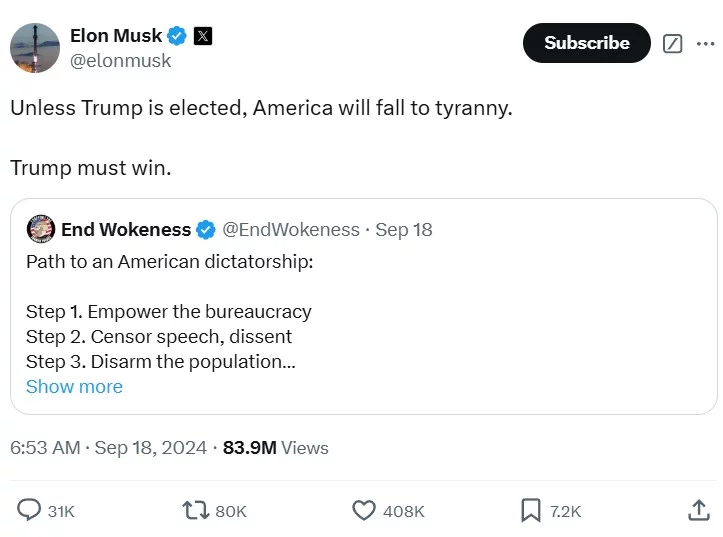
What the owner of X forgets to mention, however, is that his platform effectively mediates the X posts. The platform's algorithms, capitalist principles, and Musk's own ideology determine which posts gain visibility, which are silenced, which accounts possess authority, and which do not. For instance, Musk's recent campaign on X in support of Donald Trump and the boost of pro-Republican posts demonstrates that X is not a neutral platform but one shaped by its owner's ideology.
Conspiracy theories, deepfakes, misleading information, and fake news are the new reality that X embraces—a realm where the lines between truth and fiction are blurred, making it almost impossible to distinguish between them.
Back to topFinal Thoughts
Elon Musk’s provocative claim, "You are the media now," pretends to cherish freedom of speech, though demonizing traditional media outlets, especially those he does not like. This paper examined platform X and its affordances through the lens of immediacy. The owner of X disguises the fact that the platform is itself a mediator between the messenger and receiver, influencing the visibility and reach of content through its algorithms, economic incentives, and Musk's own ideological stance. While X promotes unfiltered expressions, it remains deeply mediated, creating an environment where truth and fiction are increasingly difficult to separate. This fosters a hostile epistemic environment, potentially leading to problems in forming individuals’ beliefs and knowledge.
The idea of a digital public sphere is attractive, but today's X is not able to fulfill this function. Instead, the X of today represents an alternate reality of Elon Musk where truth and fiction converge.
References
Bucher, T. (2012). Want to be on the top? Algorithmic power and the threat of invisibility on Facebook. New Media & Society, 14(7), 1164-1180. https://doi.org/10.1177/1461444812440159
Conger, K., Krolik, A., Nerkar, S., & Freedman, D. (2024, November 3). How Elon Musk’s own account dominates X. The New York Times. https://www.nytimes.com/2024/11/03/technology/elon-musk-x-election.html
Davis, W. (2024, November 17). A study found that X’s algorithm now loves two things: Republicans and Elon Musk. The Verge. https://www.theverge.com/2024/11/17/24298669/musk-trump-endorsement-x-boosting-republican-posts-july-algorithm-change
Faure, V. (2024, December 2). The dilemma: Should you leave X? Le Monde. https://www.lemonde.fr/en/intimacy/article/2024/12/02/the-dilemma-should-you-leave-x_6734835_310.html
Hern, A. (2024, August 17). A week in tweets: Elon Musk doesn’t stop posting but what is he saying? The Guardian. https://www.theguardian.com/technology/article/2024/aug/17/a-week-in-tweets-elon-musk-x
Kornbluh, A. (2023). Writing. In Immediacy or, the style of too late capitalism (pp. 64–112). Verso.
Musk, E. [@elonmusk]. (2024a, November 6). You are the media now [Post]. X. https://x.com/elonmusk/status/1854045379408326909?lang=en
Musk, E. [@elonmusk]. (2024b, November 10). You are the media now. Reposted: [Elon Musk: Something's wrong with the press. Citizen journalism is the future]. X. https://x.com/elonmusk/status/1855468171043770740
Thompson, S. A. (2024, September 27). 5 days with Elon Musk on X: Deepfakes, falsehoods, and lots of memes. The New York Times. https://www.nytimes.com/2024/09/27/technology/elon-musk-x-posts.html
Why the Guardian is no longer posting on X. (2024, November 13). The Guardian. https://www.theguardian.com/media/2024/nov/13/why-the-guardian-is-no-longer-posting-on-x

