Review
Wie is de Mol?, more than a TV show
"Wie is de Mol?" is a reality show with a very active and partecipative fanbase. Learn about how the fanbase and the production are creating a collective culture.

Published date
Courses
Intermediality
Copyright
This work is licensed under a Creative Commons Attribution-NonCommercial 4.0 International License.
Read time
6 minutes

I have been a fan of Wie is de Mol? as long as I can remember. Wie is de Mol? is a Dutch TV show, originally from Belgium, in where competitors try to guess who the mole is. The competitors are always Dutch celebrities. Based on assignments with which they can earn money, they try to guess who sabotages the game and try to get as little money as possible. (Wie is de Mol, 2019)
Back to topParticipating in the 'Wie is de Mol?' culture
Wie is de Mol? is very popular. In 2018 the show had weekly 2.6 million(!) viewers, which has lead to an immense following. (Wie is de Mol, 2019) Like many other fans, I’m participating in the culture of Wie is de Mol?, even in many ways. A real fan does not only watch the show, he or she actively follows all things around the show. There is even a name for these people: ‘Molloten’, what is a contraction of the word Mole (Mol in Dutch) and Fool (malloot in Dutch). The word even got included in the Dutch dictionary 'De Dikke van Dale'. The description reads: "A loyal fan of the TV show Wie is de Mol?". (Ze zijn met veel en ze zijn fanatiek, 2017)
With colleagues from my side job we compete in the app from Wie is de Mol?. I watch the live commentary after the episode, which follows immediately after Wie is de Mol?, called ‘MolTalk’. Wherein two presenters discuss with former candidates from the show, about the assignments, conspiracies and theories. (Moltalk, 2019) In addition, I also watch various YouTubers who discuss the episodes and try to guess hints. One of those YouTubers is Wouter, throughout the year he makes other YouTube videos, but during the Wie is de Mol? season, he only makes videos where he tries to unmask the mole on his channel. Wouter has a big fanbase and over 194.000 subscribers. In total, there is a lot you can follow in addition to the TV show and become a Molloot yourself.
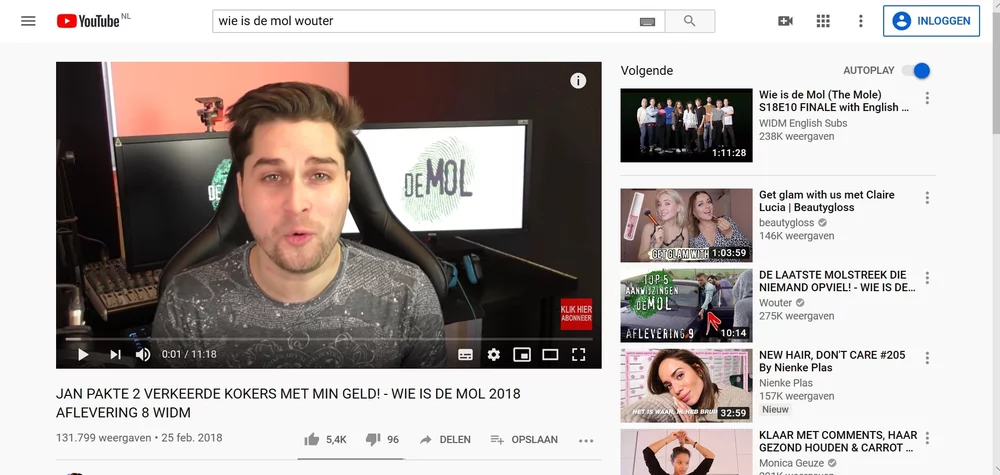
Wouter’s YouTube channel (JAN PAKTE 2 VERKEERDE KOKERS MET MIN GELD! - WIE IS DE MOL 2018 AFLEVERING 8 WIDM, 2018)
Wie is de Mol? is a is a great example of participatory culture and convergence as Jenkins describes it. (Jenkins, 2003) More than ever the consumption of Wie is de Mol? has become a collective process due to the fact that there are more and more ways to share knowledge and absorb information through channels other than TV. The consumers are encouraged to seek out new information about the show and make connections between dispersed media content. Not only through the show on TV anymore, Wie is de Mol? has its own website, App, Twitter and Facebook account, podcast, and talk show. Through social media it is easy to have social interaction with others about Wie is de Mol?, and debate about theories and hints. This online community develops a collective intelligence because of all the information which is shared online. While I’m actively seeking for information, I’m not sharing any information online. I will talk to my friends offline about who I think the mole is. So, I am participating in the online convergence, but I am not producing any content.
Back to topWie is de Mol? App
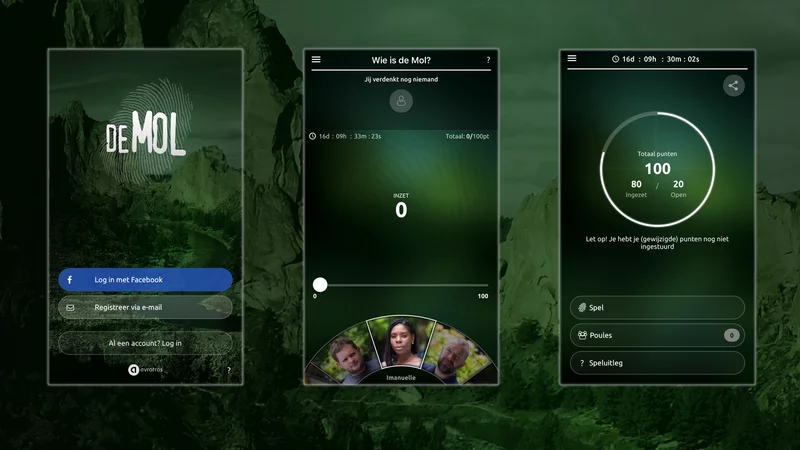
The show has a wide range of different transmedia storytelling platforms. Not only fans are initiating this, but the show itself has a lot of transmedia channels. For example, the ‘De Mol’ app. In this app you can make a group with friends. Every week you have to spread your points over the participants that you think might be the mole. You will start with 100 point if all participants on which you have placed points are still in the race, your points will double. And this every week again. This is not the only purpose of the app. With the app they can also measure who the players of the app think the mole is. These statistics are then shared with the whole of the Netherlands in the talk show ‘Moltalk’. The app is a brilliant way to let your audience participate in the game. In this way, Wie is de Mol? gives his fans the feeling of being part of the show.
Collective intelligence with a negative effect
There is also a negative side of the large fanbase of Wie is de Mol? and the development of collective intelligence around the show. Due to all social media platforms where fans are actively sharing knowledge on, it has become more difficult for the producers of Wie is de Mol? to hide who the mole is. Every little detail is displayed online and each fragment is extracted to find out who the mole is. And because there are so many fans and online forums, it is easy to share all the information and consumption has become a collective process. This phenomenon is called ‘collective intelligence’, a term by H. Jenkins. None of us can know everything, each of us knows something. And we can put the pieces together if we pool our resources and combine our skills. This is exactly what is happening online between the fans.
"None of us can know everything, each of us knows something. And we can put the pieces together if we pool our resources and combine our skills." - Jenkins
The creators of the show are of course familiar with this phenomenon and the ever-growing fanbase online and offline. They have to be very carefull with what they are showing in the show. An easy findable hint would be recognized very quickly by the many fans, and with the help of social media immediately spread throughout the country. Then the whole idea is gone, and it can just as well be told in advance who the mole is. I have the idea that in recent years they have made hints more and more difficult because they know that all information is distributed so quickly that it is difficult to make a mistake by showing too easy hints. For the producers of the show, convergence is a beautifull phenomenon because it gives the show a lot of attention and creates new platforms off and online, but the negative effect is that it is harder for them to keep it a secret for the viewers to find out who the mole is.
Still, with the convergence of Wie is de Mol? every year again the show is very entertaining to watch, also because the show is recorded in the most beautiful places in the world. Despite the collective intelligence online, it remains difficult every year to find out who the mole is. And in my case, I’m always in the wrong direction…
Back to topReferences
JAN PAKTE 2 VERKEERDE KOKERS MET MIN GELD! - WIE IS DE MOL 2018 AFLEVERING 8 WIDM (2018). [Motion Picture]. Retrieved November 20, 2019, from https://www.youtube.com/watch?v=_M5DtvELSoc
Jenkins, H. (2003). Introduction: "Worship at the Altar of Convergence". In J. Henry, "Worship at the Altar of Convergence". The New Orleans Media Expierence .
Molloot. (2017, November 15). Retrieved November 20, 2019, from Detunnelvisie: https://detunnelvisie.wixsite.com/tunnelpedia/molloot
Moltalk. (2019). Retrieved November 10, 2019, from wieisdemol: https://wieisdemol.avrotros.nl/moltalk/
Uitleg wie is de mol app. (2016, December 22). Retrieved November 20, 2019, from Wieisdemol: https://wieisdemol.avrotros.nl/nieuws-item/uitleg-wie-is-de-mol-app/
Wie is de Mol. (2019, November 19). Retrieved November 20, 2019, from Wikipedia: https://nl.wikipedia.org/wiki/Wie_is_de_Mol%3F
Back to top