Review
TACOMA(2017)
This review explores the procedural and rhetorical rules involved in videogames as well as narrative and database aesthetic techniques utilized in the 2017 adventure videogame Tacoma.

Published date
Courses
The truth of fiction
Copyright
This work is licensed under a Creative Commons Attribution-NonCommercial 4.0 International License.
Read time
10 minutes

Video games have been a source of joy since their inception in 1958 with Physicist William Higinbotham’s rendition of digitalized ping pong. They have also evolved through time in the hand the new infrastructures in digital technology. These innovations in digital infrastructures have also allowed video games to advance in the art of storytelling, a complete divergence from their earlier ping pong iterations into full fledged works of art and culture. While popular video games such as Bioshock Infinite (2013) The Last of Us (2013) and Red Dead Redemption (2010) champion the movement for videogames to be perceived as cultural works of art; the same way someone might enjoy a novel, they are still met with resistance. Critic James Newman argues that videogames are considered inconsequential because they are perceived to serve no cultural or social function save distraction at best, moral baseness at worst. (Bogost, 2007)
While games may receive a bad reputation for their perceived lack of gravitas in comparison to traditional mediums it can however be argued that they have incorporated and mastered the art of story telling and made unique additions to how we compile information through their unique databases in their coding.
This review will explore the procedural and rhetorical rules involved in videogames as well as narrative and database aesthetic techniques utilized in the 2017 adventure videogame Tacoma. To give a thorough perspective on database aesthetics, this paper will be drawing from New media theorist Lev Manovich.
Back to topTacoma
Tacoma is an adventure game by the videogame developer Fullbright it was released in 2017. The game is set in the future in the year 2088 where private shortrange interstellar travel and living is a norm. The game is played from a first-person view meaning the viewer sees the game from the eyes of the protagonist Amitjyoti Ferrier. Amitjyoti is an AI specialist contractor for the fictional Venturis Corporation. The player must enter several ‘levels’ or areas of the game, collect data and solve a mystery as to why the space station Tacoma was evacuated.
The reason why Tacoma is extremely relevant in the light of a narrative based game that uses a unique database aesthetic is engrained in a concept called Procedural rhetoric. Procedural Rhetoric is the medium in which games choose to make claims about the real world through processes in the games. These processes are the given rules the player has to abide by when playing a videogame these rules are a representation of a kind of dialogue between the programmer and the consumer, these rules dictate what can and cannot be done within the confines of the programmers coding for the given game. (Bogost, 2007)
A shallow example of procedural rhetoric can be seen in the 2d platformer Mario. The aim of the game dictated by programmers is to avoid obstacles as much as possible and traverse a maze to reach the other side of the map. There isn’t much to the rhetorical aspect in Mario that can be derived except for perhaps an argument towards heteronormative norms in being the white knight to save the damsel in distress. The games processes do not aim to make claims about the world we live in.
Call of Duty the popular online first-person shooter game is a great example of a more complex level of procedural rhetoric. There is a lot more to the game than meets the eye. Onlookers may view the game as a meaningless haze of committing mass atrocities by hyper-violence, shooting, bombing and stabbing opponents to death, there is a layer behind the scenes that dictates what exactly the player can and cannot do and why.
Call of Duty’s procedural limitations are coded to force players to eliminate each other in order to win a match of the game, there is no other choice but to do so, players must be quipped with a weapon of choice and carry out the mission whether it be capture the flag or a search and destroy mission. These are the confines in which the game is coded. One could imagine being on a railway track, there is no freedom to deviate but to go in the direction the railway dictates.
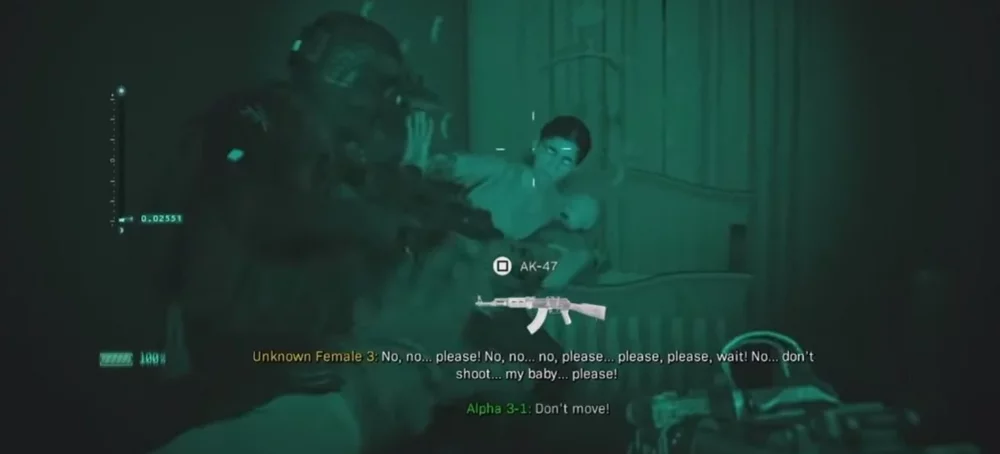
The rhetoric aspect of Call of Duty relies on the message it constantly presents to its players, there is an obvious inflection of war glorification and thrill of combat, but its processes are also nuanced. In one mission you are punished both procedurally and rhetorically, if the player chooses to shoot an unarmed civilian and her child the game restarts the mission with a message saying “Civilians are not combatants” If the player does this transgression of the games procedures another messaged states “Are you serious?” This is the programmer’s way of making a rhetorical claim about the real world that innocents should not be targeted in war through a process (the fact the game ceases to continue) in the video game.
Back to topThe Plot
Gameplay for Tacoma begins with the player approaching an abandoned space station orbiting planet Earth. Credentials of the protagonist are displayed, and it is made apparent that she is to assess what led to the abandonment of the space station by its crew of 6 on behalf of the Venturis corporation who owns the space station.
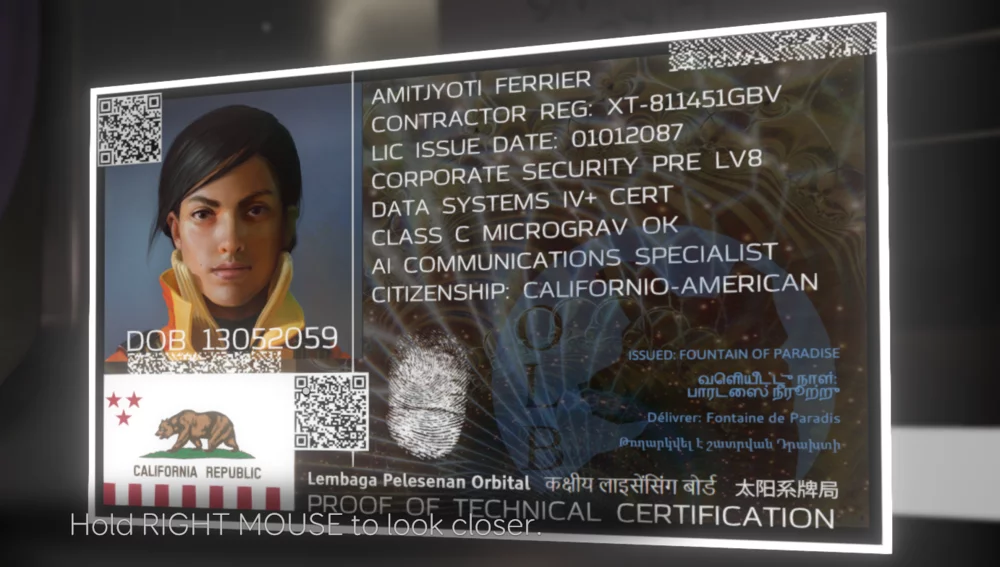
Upon arrival to the station the protagonist Amitjyoti Ferrier or ‘Amy’ is instructed to sync herself to the stations augmented reality system and to retrieve the stations processing module of the Operational Data Interface Network (ODIN) who is an artificial intelligence.
It is made apparent that three days prior to arriving at the station it was struck by a meteor which incapacitated it’s life-support and communications systems leaving it’s inhabitants with 50 hours of breathable air left and rendering them unable to communicate their distress signal.
Nonessential members of the stations crew must go into cryostasis in reduce their oxygen intake. The crew’s engineers plan to salvage a drone to act as an escape pod in the situation no rescue effort reaches them in time. This fails and leads to a fire which drastically reduces oxygen aboard the space station as well as their options for escape.
ODIN the stations artificial intelligence hints to one of the stations crew to explore a hidden underbelly of the station through a forbidden door. This door leads to ODIN’s physical processing module. Inside this forbidden part of the station a member of the crew learns the truth behind the recent incident with the meteor strike.
It becomes apparent that the corporation that owns the station (Venturis) purposefully sabotaged their own station (Tacoma) to change the publics opinion on stations operated by humans and to push for a fully automated future which would benefit their other projects such as fully automated vacation bungalows in the earths orbit. Venturis ordered ODIN to purposefully shutdown communications and deplete oxygen supplies to ensure a total loss of the stations crew.
ODIN who is quite familiar with the crew helps them bring back communications and send an S.O.S signal to a rival corporation’s vessel which promptly arrives to save the stranded crew of the Tacoma.
At this juncture it is made clear that Amy, the protagonist was sent by Venturis to purge the stations potentially damning data. Amy retrieves ODIN’s physical core and in rebellion with their original mission given to her by Venturis decides not to delete the data but instead keeps it. She reveals herself to be a member of an AI Liberation group which fights for the rights of sentient artificial intelligence rights. Amy offers ODIN asylum to which he accepts, and Amy leaves the station.
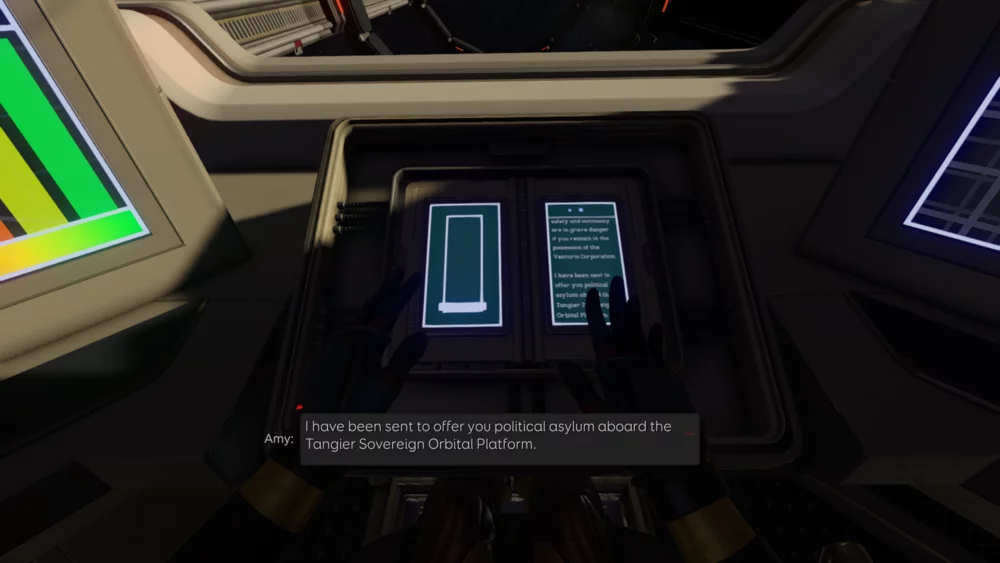
All in all, Tacoma plays very comfortably. It is a laid back yet intriguing adventure that always has you asking yourself, “Just what exactly happened to space station Tacoma?” The overall vibe is made a touch creepier by the artificial reality ghosts of the stations crew moving throughout the station. Tacoma is a wonderful experience and almost plays like a short film.
Procedural Rhetoric and Tacoma
From a procedural Rhetoric perspective, the developers of Tacoma have created a world where the player must interact with their surrounding via the use of the space stations augmented reality to experience the game at all. This alters the players vision to watch past scenarios that occurred in a room ranging from 3 days ago to a year. The augmented reality depicts individuals (the crew) as silhouettes and allows the player to fast forward and rewind past events to see and hear what the crew were doing.
The player also has access to private correspondence that the crew were having through email or private messages.
Tacoma makes real life claims in regard to civil rights of sentient beings extending to artificial intelligence such as ODIN as well as corporate malpractice and destruction of evidence. Through the game, players feel connected to the real world as they form connections to situations where a corporation has sought to cover up a disaster or an individual has needed rescue and asylum from those who might wish to harm them. This is all done through the games procedural rhetoric as the player has no choice but to play the game like this, there are no alternate ways to play it or choice in choosing whether to delete the data for Venturis or to keep it, it is a conscious choice by the programmers to tell a narrative a specific way to make a real life claim through a gameplay process. (Bogost, I. (2010).
Database Aesthetics and Narrative in Tacoma
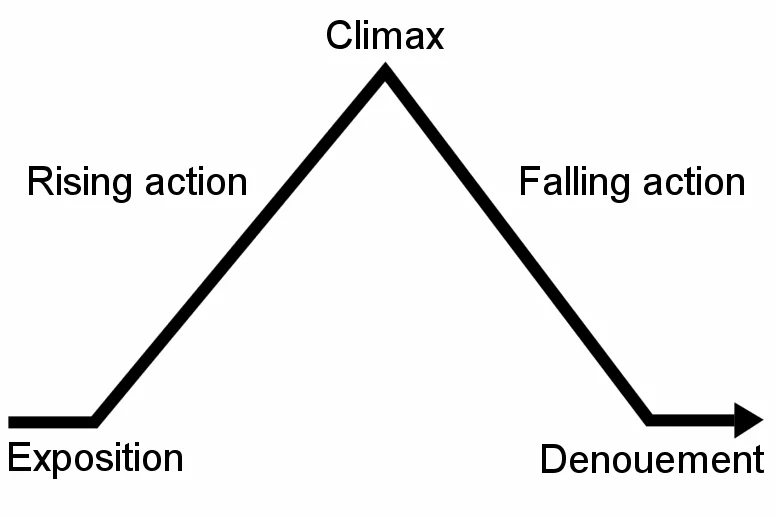
New media theorist Lev Manovich explains that narrative is a process of selection in what it includes. The story being told in Tacoma is interesting due to certain temporal inclusions and exclusions. A narrative traditionally can be seen as a linear journey represented in a Freytag’s pyramid, with rising action a climax and a final conclusion. This can also be explained as a cause and effect trajectory. However, the events and experiences that occur in Tacoma are told from a media res perspective, meaning you are thrown into the situation in the midst of occurring events. This is in comparison with the ab ovo narrative style which occurs from the complete beginning of the series of events or narrative.(Manovich, L. (2013).
Tacoma tells its narrative through the players exploration and interaction with different objects strewn around the Space Station. It relies heavily on the player seeking out information with its unique database aesthetic.
It can be argued that the player is thrown back and forth in time while playing Tacoma, experiencing the rising action, climax, and exposition at varying times. The fact that the protagonist is a member of an AI liberation group comes as a surprise and is the final real open-ended conclusion to the story rather than the plight of the Tacoma crew and how they escape. TheDatabase Aesthetics is the where Tacoma shines because of its unique approach to storytelling.
Databases historically can be observed in artistic archives and libraries, the collection of large sums of data. Databases date back to the first depictions of art and documentation such as hieroglyphics and the annals of the middle ages. The main issue with databases however is the information overload that comes with vast amounts of data especially in a digitized world. The solution for this is in organization. Databases strip information off of their context and allow that information to be access with a different unique context.
What the developers of Tacoma have done is to design the database within the stations augmented reality. That is the library to which the player discovers the narrative of the game. While other games aesthetics may be in the form of finding lost recordings to explain plot points Tacoma puts the onus on the player to fast forward and rewind to find clues as to what truly occurred on the space station Tacoma, this can be seen is the syntagmatic sequence in which the player must operate and discover the plot through. (Manovich, L. (2013).
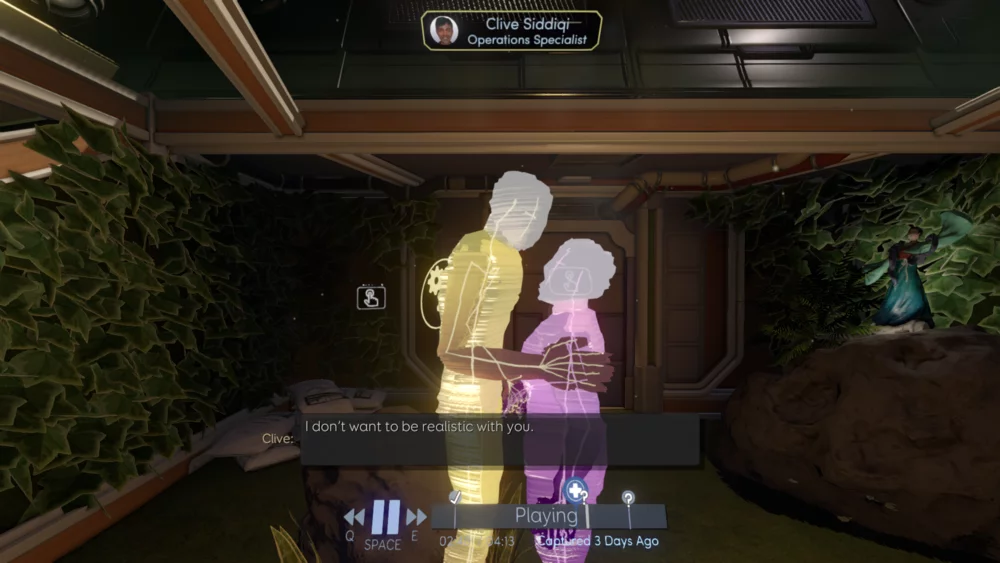
Random items give details and plot points that point the player to other plot points that further the narrative. Tacoma is an adventure detective game of piecing together a narrative. The narrative is in shambles, but the database aesthetic is used to mold it into a linear form of storytelling.
The videogame Tacoma has a very unique and interesting gameplay style that pits the player to fix the narrative into an almost linear fashion with the help of an augmented reality database aesthetic encompassing freezing, fast forwarding and rewinding past plot events to piece together the plot. Tacoma is also a clear example of a functioning procedural rhetoric in a videogame that shines a light on real world concepts through the processes dictated by it’s makers.
Back to topSources
TACOMA (2017)
Vesna, V. (2008). Review: Database Aesthetics: Art in the Age of Information Overflow. Media International Australia, 127(1), 3. doi: 10.1177/1329878x0812700139
Bogost, I. (2010). Persuasive games. Cambridge, Mass.: MIT Press Ltd.
Manovich, L. (2013). Software takes command. New York, NY: Bloomsbury.
Back to top