Article
Superdiversity within the Swifties
The fandom of Taylor Swift consists of people from places all over the world. However, they do wear the same merchandise and interact with each other on online platforms, so in what way exactly are Swifties superdiverse?

Published date
Courses
Social groups in the digital world
Copyright
This work is licensed under a Creative Commons Attribution-NonCommercial 4.0 International License.
Read time
10 minutes

Music is an international language that everyone speaks, it brings people together. Members from fandoms come from places all over the world, they all have different nationalities, speak different languages and come from different cultures. The fandom of Taylor Swift - Swifties – therefore is a superdiverse group.
Superdiversity 'diversification of diversity' (Vertovec, 2006). In contrast to this, one could argue that despite this superdiversity, some characteristics of the members are similar all over the world. For example, when members of the group communicate with each other online, the main language used is English. Moreover, Swifties buy and wear the same merchandise and listen to the same music no matter where they live or where they come from. Accordingly, we could ask ourselves the question: in what way Swifties are superdiverse?
Back to top
Taylor Swift, outsiders and the Swifties culture
Taylor Swift is a 27-year old singer songwriter from the United States. She has had multiple number 1 singles and has won multiple Grammy Awards. ("Taylor Swift", 2017). She has a huge number of fans, who call themselves Swifties. The Swifties are a social group in the way that social groups are described in Howard Becker’s Outsiders (1963); the group has norms that members of the group have to obey, they are not particular written-down rules, though there are social standards and norms that need to be obeyed.
Looking at the group in an online environment, for example Twitter, a rule is that it is not allowed to bully another fan. Fans who notice people being rude to others will stand up and criticize the bully. Curse words are not appreciated and hate towards others gets heavily criticized. Lastly, imitating Taylor Swift is a total no-go, and will not be respected by other fans. (Hannah Jorissen, personal communication, 2017).
Moreover, the group contains crusaders who guide and ‘rule’ the group. They basically are the leaders of the group. According to Becker, it is important in social groups that the members of that group obey certain rules. (1963). The main crusader of the Swifties is Taylor Swift herself. She obviously is the most important person in the fandom, with an enormous powerful position to control the group. If Taylor Swift makes a decision regarding the fandom, the Swifties will obey this and follow her ideas. Furthermore, fans with a big following online function as crusaders since they also have much power within the fandom. The fandom Swifties thus is a social group with norms and social standards, ruled and guided by crusaders which are Taylor Swift herself and the more well-known Swifties.
Subcultures exist through people who engage in activities regarded as deviant in their social group.
In his book Outsiders, Howard Becker describes that in order to “understand the behavior of someone who is a member of such a group it is necessary to understand that way of life.” (1963, p.97). As mentioned in the book, “whenever some group of people have a bit of common life with a modicum of isolation from other people, a common corner in society, common problems and perhaps a couple of enemies, there culture grows. (Becker, 1963, p. 80). In the case of the Swifties, the group of fans do not live isolated from other people, though they do deal with common problems in certain cases regarding the fandom and their idol and do sometimes share a couple of enemies which could be people from other fandoms etc.
There is an actual culture regarding this fandom with its own social standards. Within this culture, there are multiple subcultures. These subcultures exist through members of the group's behaving differently than the norm: “people who engage in activities regarded as deviant typically have the problem that their view of what they do is not shared by other members of the societies. (…) Since these cultures operate within, and in distinction to, the culture of the larger society, they are often called subcultures. (Becker, 1963, p.81-82). These subcultures within the fandom of the Swifties exist through all of these fans coming from different places in the world, speaking different languages and experiencing their own, local culture which causes this 'deviant' behaviour.
Back to top
Superdiversity and the Swifties
Pop music is accessible everywhere in the world and so is Taylor Swift’s music. When looking at the sales of her albums, the sales are from all over the world. The most significant ones vary from the UK to the US and from Japan to Australia ("Taylor Swift Discography", n.d.). It is therefore no surprise that Swifties are a superdiverse group as well. All of these people from all of these different countries listen to the same type of music, though still behave towards their culture. For instance, at most concerts in Japan it is not allowed to take pictures or videos during the concert. This is not because of copyright reasons, but it is a rule because a ton of phones and cameras will block people’s vision. Not taking pictures or videos is seen as an act of politeness. (Japan Today, 2015). This is an example of the superdiversity within a fandom, which also counts for Swifties.
In the Netherlands for example, it is very common to take pictures and videos during concerts. After a concert of any musician or artist in the Netherlands, footage is available everywhere. Therefore, during the same world tour of Taylor Swift, the concert in Amsterdam might be an arena full of fans recording her and taking pictures, while the concert in Tokyo might look completely different.

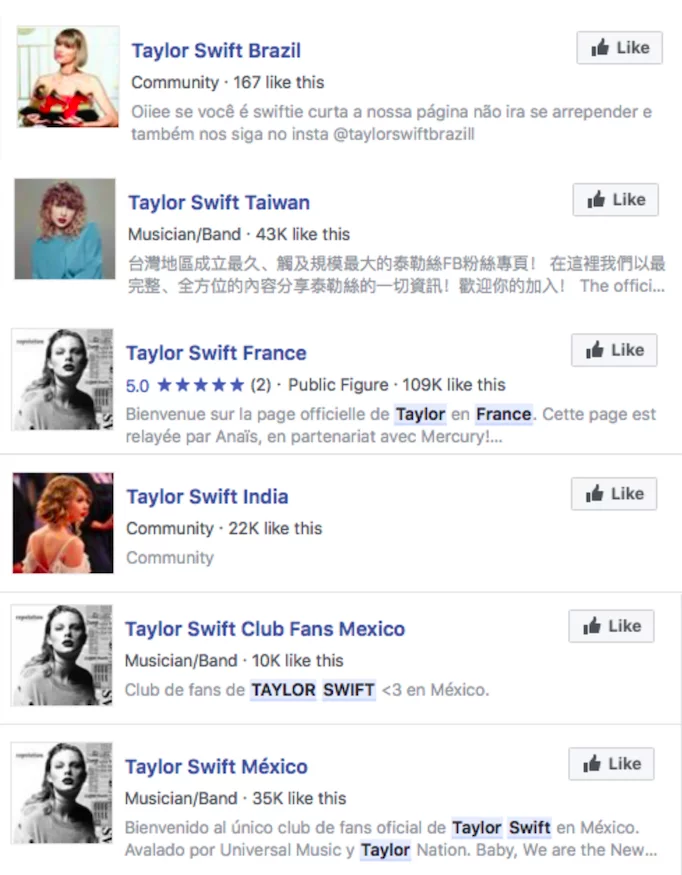
Moreover, there are tons of national fan pages for Taylor Swift. When having a quick look on Facebook, I already found pages from France, Taiwan, Brazil, Mexico and many more. This is a very clear representation of the superdiversity in this group. A couple of these fan pages have Taylor Swift’s latest album “Reputation” as their profile picture and others have used another picture of her. This proves that the fan pages contain the same type of content and are all revolving around Taylor Swift,
s thus of, though the biographies of these pages are all in their own language, and are therefore targeted at fans from that particular country. . Aare a transnational phenomenon, and thus not a homogenous sub-national-culture.
Social media platforms are important infrastructures of this social group. are,The past decade, our world structure has shifted. Our society is now super-diverse in which diversity itself, became even more diverse (Vertovec, 2006). Due to this, the super-diverse group Swifties is connected with social media. People from all over the world have the opportunity to communicate with each other via social media platforms. ,s
When Swifties attend meetups in their own country, they are most likely to speak the national language with each other, just like this is done in these national fan pages. This also happens when Taylor Swift gives a concert in a particular city. When taking that aspect into account, there is much diversity between the different nationalities of the Swifties and their way of communicating with each other.
All of this diversity within the diverse fandom is a result of new migration patterns, the rise of digital media and the changing of economic paradigm. This fandom is the perfect example of what Maly & Varis (2016) call superdiversity. Digital media created ‘’new forms and scales of identity construction and culture production’’ (Maly on Digital Ethnography, 2017). Swifties are a clear example of these forms of identity production on new scale. Swifties are connected to digital media in the way they communicate with each other via these social platforms. Their community is largely formed online. All of these diverse fans form new groups thanks to these online platforms. Due to this, they can reach many people and can quickly access information. As a result, people will get more easily involved in new groups, such as Swifties.
In contrast to these national fan pages using their own language, when Swifties communicate with other fans from different countries on online platforms, the language that is spoken is English. By using English, Swifties from all over the world are able to unite and communicate with each other and as an effect of this, their messages and ideas will reach more people than just fans from their own country. Moreover, Taylor Swift (just like other artists) sells the same merchandise everywhere at her concerts and her online store is international. This causes her fans – no matter where they come from – to all wear the same merchandise and buy the same items.
All of these factors make the superdiversity in this group so interesting; the Swifties have their own norms and rules that apply within the fandom as mentioned earlier. They have their own culture where these rules apply. Though in contrast to this, the Swifties do come from different cultures and speak different native languages. This causes these subcultures to exist within this fandom and this results in a superdiverse social group.
It is important to note that the digital infrastructure is crucial in establishing the superdiverse nature of the Swifties. It is by using digital platforms like Facebook that the different local Swifties become part of this transnational culture. Digitalization, just like migration, is a constitutative element of what we call superdiversity. The structure of this culture, its layered and translocal character reflects the affordances of the digital platforms.
Back to top
Swifties, digitalization and superdiversity
To conclude, it is very clear that the Swifties are a superdiverse group. diverse
The group has its own culture on a global scale by wearing identical merchandise, admiring the same artist, enjoying her music and speaking English when communicating with each other on online platforms. On top of this, the group has rules and norms that are thought of and regulated by crusaders in the group which are ‘popular’ fans and Taylor Swift herself. This global cultural dimension of the Swifties gets appropriated locally. The Swifties are thus not a homogenous social group, but is a layered cultural phenomeon orienting towards different centers of normativity on different scales. Even though English is the lingua franca on the global scale, we see different Swifties pages organized on a nationale scale: most countries have their own national fan page for Taylor Swift. In these communities, Swifties speak different native languages. And in every country, there are different cultural values that are operational and interact with the global Swifties culture.
The Swifties are thus not a global group, nor is it a national subculture, it in an inherently superdiverse transnational micro-population. All of these different cultures within the fandom create superdiversity within the social group of the Swifties. And that superdiversity is not erased because of their fandom, it interacts with the global operating crusaders. It is in this interaction that the Swifties come into being.
Back to topReferences
Becker, H. (1963). Outsiders: Study in the Sociology of Deviance. New York: The Free Press
Jorissen, Hannah. Interview through WhatsApp. 2017
Maly, I. (2017). Knowledge in the Digital World. Notes from lectures. Tilburg University.
Maly, I. & Varis, P. (2016). The 21st century hipster: on micro-populations in times of super-diversity. Tilburg papers in Humanities.
Miller, KK & Rocketnews24. (2015, March 5). Why do most concerts held in Japan prohibit taking pictures? Japan Today.
Taylor Swift Discography. (n.d.). Wikipedia. Retrieved November, 2017.
Taylor Swift Store. (n.d.). Retrieved December 30th, 2017.
Taylor Swift. (n.d.) Biography. Retrieved November, 2017.
Vertovec, S. (2006). The emergence of super-diversity in Britain. Centre of Migration, Policy and Society, Paper 25.
Back to top