

Article
Squatting Slavs: a culture, a stereotype or just a meme?
Is the Squatting Slav phenomenon helping Slavs express themselves or is it ruining their reputation? This article explores the emergence, historical background, popularization, culture and language of the meme.

Published date
Courses
Language, Culture and Globalization
Copyright
This work is licensed under a Creative Commons Attribution-NonCommercial 4.0 International License.
Read time
16 minutes

On this page
- The globalized online world
- Memes forming identities
- Contemporary identities as 'patchworks'
- Do all Slavs squat?
- Squatting Slavs and Russian vernacular language
- How did it all become a meme?
- Adidas - Squating Slavs' favorite brand
- The Squatting Slav is becoming an identity on a global level
- Not every Eastern European is a Squatting Slav - it is a joke
- References
This paper is going to be analyzing the emergence, the historical background and the popularization as well as the sociolinguistic and cultural implications of a widely popular among Eastern Europeans e – the Squatting Slav. Itis also going to try answering the question if this meme is a positive or negative consequence of globalization, whether it is merely an example of the unification of an ethnic group in virtual reality or also a contribution to the marginalization of the same ethnic group.
Back to topThe globalized online world
There is a common feeling that in the 21st century we are more ‘globalized’ than ever before. This may be true from a certain point of view, but there is nothing new about the phenomenon of globalization being around. Therefore, what we are witnessing now is a new phase of a process which began centuries ago. However, globalization does in fact change over time. Which explains why this current stage of development of the phenomenon is indeed specific and is surpassing all of the previous ones in terms of intensity, scope and scale. (Blommaert, 2010)
The term itself, as Blommaert has formulated it, is a ‘shorthand for the intensified flows of capital, goods, people, images and discourses around the globe, driven by technological innovations mainly in the field of media information and communication technology’ (2010). Undoubtedly, it leads to new patterns of global social behavior and community formation and has large political and cultural impact.
What is often seen as the most specific feature of the present-day globalization is that it is mainly about being connected online. The Internet and, more specifically speaking, the emergence and subsequent popularity of social media platforms has given us the chance to connect and communicate with people all around the world and this has resulted in, amongst other things, the appearance of a new way for identity formation and the need for new approaches to language and semiotics.
Back to topMemes forming identities
To statementsprove this, I am going to put forward the example of the Squatting Slav meme. For the general Internet user, the understanding of the essence of a meme ends with it being an image or a video, almost always accompanied by a piece of text, which is shared rapidly on all kinds of online platforms because of it typically being humorous. It can be somewhat altered, but its main concept remains the same, no matter how much it is reproduced. However, a more profound definition can be formulated as ‘an element of a culture or system of behavior passed from one individual to another by imitation or other non-genetic means’ (Oxford Dictionaries,2017)
.
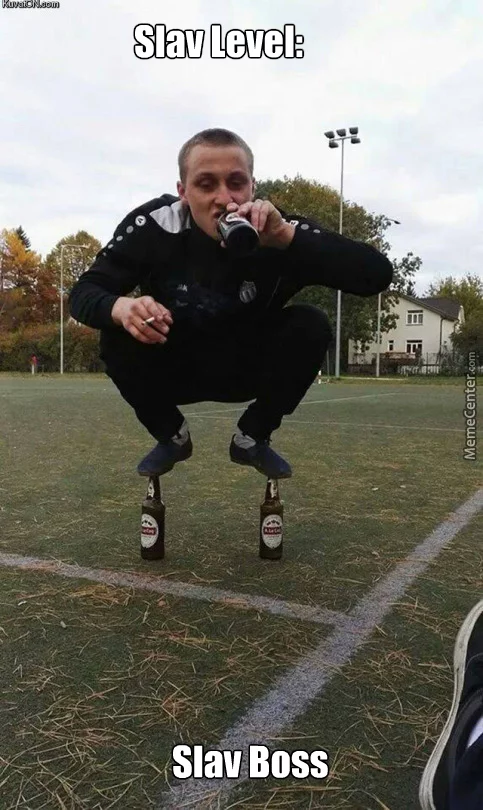
This elaboration is necessary, because the Squatting Slav is not about merely being from a Slavic descent and posing for a photo in a squat position, although this is the most commonly attributed feature to the meme. It is a contemporary online recreation of a particular subculture of a social group which developed in the second half of the last century in the suburban areas of Eastern European countries, the so-called ‘gopniki’ and their other Slavic equivalents. So, the meaning of the meme goes beyond the visual representation to a whole identity practice evolving in a virtual context. It has given the chance for many to identify as Squatting Slavs and be perceived as such.
For this reason, the sources for my research are not only images of the meme, but also YouTube videos discussing it and articles exploring the history and culture behind it, as well as its impacts on today’s society. Immanuel Wallerstein suggests that an essential tool for understanding every issue is to look at it from a global perspective, that to really understand what is going in a specific part of the world, one has to see it as a part of a world-system. (2004) This is a theory which can be well adapted to the topic of this paper, because we will see how a process of a seemingly local identity formation is substantially taking place on a global scale-level and its consequences might turn out to be influential for the revival of a cultural practice and the global familiarization with it.
Back to topContemporary identities as 'patchworks'
As the term ‘identity practice’ has been already mentioned a considerable amount of times, I owe the reader an explication of it as well. Articulating a certain identity can be summarized as having recognizability as something. Moreover, what generates this recognizability as a particular someone is an arrangement of a set of emblematic features in a way which guarantees ‘enoughness’. Enoughness here stands for a critical tool for judging who possesses the proper variety of features and especially if he/she is displaying the ‘defining’ ones which are ‘sufficient to produce the particular targeted authentic identity' (Blommaert & Varis, 2015) These features can be all kinds of self-expression varying from style of clothing or makeup, language use, preferences for art or aesthetics to ways of behavior and preferences for brands and products.
Nonetheless, the rapidly changing sociocultural background and the increasing use of social media platforms are constantly changing the nature of identity processes, making them more dynamic and complex. As a result, contemporary identities are more commonly comprised of acts of orienting towards ‘entirely different logics in different segments of life.’ (Blommaert & Varis, 2015) In other words, one can put forward different version of oneself in various domains of life while still remaining in the limits of one’s complex identity. It is a matter of choosing which aspects of it to put forward depending on the situation and circumstances.
A person identifying themselves as a Squatting Slav by recreating the meme is indicating that this person is a part of or is at least aware of the so-called gopnik culture, but it does not necessarily mean that this defines who he/she is as a whole.
So, returning to the topic of this paper, a person identifying themselves as a Squatting Slav by recreating the meme is indicating that this person is a part of or is at least aware of the so-called gopnik culture, but it does not necessarily mean that this defines who he/she is as a whole. On the contrary, this person may in fact view and portray themselves as possessing a bigger set of features typical for another identity. Yet again, the global popularity of the meme lures others to think of him/her as a Squatting Slav before anything else. I suggest we dig deeper into this issue.
Back to topDo all Slavs squat?
Before the spreading of the meme, being Slav meant simply that you belong to this Indo-European ethno-linguistic group living in Central, Eastern and Southeastern Europe, North Asia and Central Asia, who speak the Indo-European Slavic languages. But if you type in the word ‘slav’ in Google today, you will receive results mostly related to Squatting Slav meme.
‘How to Squat like a Slav?’, ‘Why do Slavs squat?’ and ‘Why do Slavs wear Adidas?’ are just some of the titles of the articles and YouTube videos that appear. And if you go to the images section, you will only see pictures of Slav-looking people, squatting while wearing Adidas tracksuits. But, surprisingly for many who have never visited a Slavic country or met a person of this origin, this is not a typical representation of a Slav. It is a meme which has recently gained global popularity and is promising to not fade away soon. Therefore, a further analysis of the meme, provided with examples, is needed.
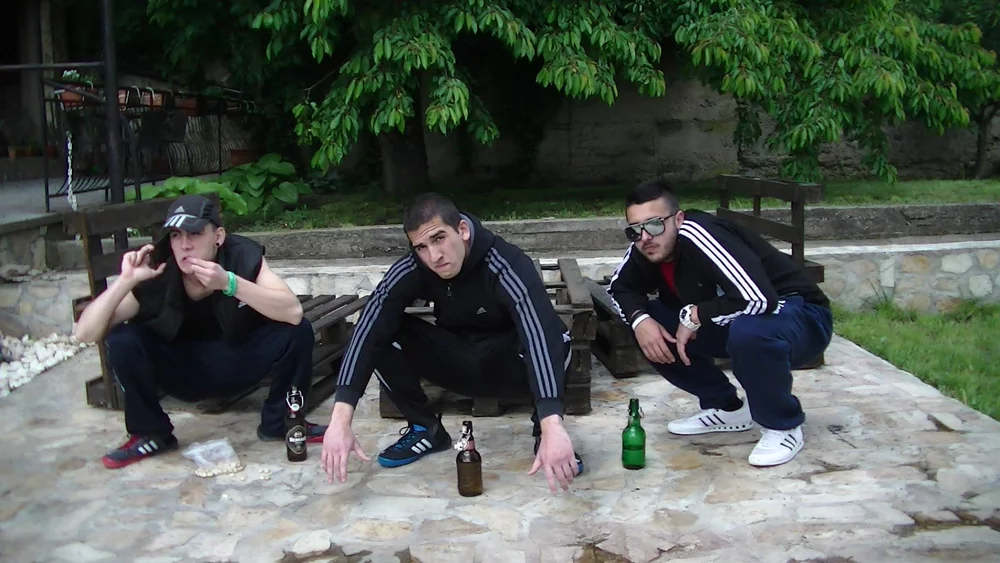
Being a Squatting Slav is all about being immersed in the street criminal gopnik subculture. The gopnik, plural "gopniki", are originally, ‘Russian lower class youth from the criminal regions of Moscow, who were controlled by the local mafias. In 1980s and 1990s, they developed into a youth subculture that opposed other subcultures such as the bikers, the punks, the KPSS, etc. just for the hell of it’ (Wax, 2007).
Typical of their contemporary representatives is the outlaw behavior, the drinking of cheap beer or vodka, smoking cigarettes and ‘being as productive to society as an expired slice of bread’(Life of Boris, 2016). Their preferred choice of clothing is the tracksuit, because of the comforts it provides, especially if one has to squat a lot, which is how a gopnik chooses to rest instead of sitting.
This explains why the Squatting Slav meme can be spotted on the Internet mainly in the form of pictures of people squatting down, giving a haughty look, most usually wearing an Adidas tracksuit. The preferred background is an unpleasant one - a scenic poor neighborhood for instance. These are the ‘defining’ features producing the targeted identity of a Squatting Slav, of which the squat position is the most emblematic one, of course. After all, this is what these people are famous for. In addition, a Squatting Slav preferably holds a bottle of cheap beer or vodka, which are typical drink choices for the Slavic youth, and smokes a cigarette.
Back to topSquatting Slavs and Russian vernacular language
A sociolinguistic analysis of examples of the meme is beneficial as well, because it exhibits the vernacular language – ‘the form of a language that a particular group of speakers use naturally,especially in informal situations’ (Cambridge English Dictionary), used in the Squatting Slavs memes. It is composed of a set of Russian words, which have proven to be understandable not only by those who speak Russian, but by everyone who recreates the meme. They are different from their equivalents in the other Slavic languages, but at the same time they do sound similar enough to be comprehended by Slavic speakers (бабушка/babushka// in Russian, babcia or babka in Polish, бабa/baba// in Bulgarian and so on).
A specificity of the Squatting Slav vernacular is that these Russian words are written using the Latin, not the Cyrillic alphabet. This alteration helps for grasping their meaning, because not all Slavic languages use Cyrillic words, and thus mitigates the differences between them. As a result, everyone following the Squatting Slav meme trend has expanded their vocabulary with a couple of Russian vernacular words (see
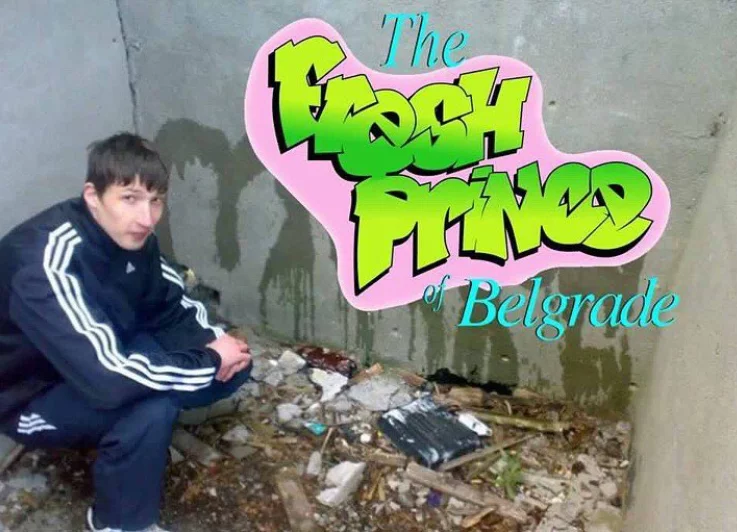
The photo itself is not the most vivid example of a Squatting Slav, although it has the three main ‘trademarks’ which guarantee the ‘enoughness’ of the identity of the person on it. The stress of this image, however, is not on the Slav, but on the added text on it – ‘The Fresh Prince of Belgrade’ and the description provided with its upload on Facebook:
Now this is a story of all about how
My gopnik life got turned upside down
So I'd like to take a minute
Just squat right there
I'll tell you how I became the prince of Belgrade
In eastern Europe born and raised
On grey playgrounds was where I drank vodka all day
Smoking marlboros lookin all cool
And spraying graffiti all over the school
When a couple of guys they were up to no good
Stole all pickles and borsch from my neighbourhood
I got in one little fight
And babushka got scared
She said you're moving with your uncle and aunt in Belgrade
I whistled for a cab and when it came fast
The driver was drunk and the taxi had rust
He offered me krokodil which I thought was rare
I said "nyet blyat" go straight to Belgrade
I pulled up to the bloc around 7-8
And I yelled to the driver "pizdyet I'll pay later"
I went into stairwell and took a piss in there
I was ready to be the fresh gopnik of Belgrade.
Here we have an intricate play of words in which the author has used the original logo and intro song of well-known 90’s American sitcom ‘The Fresh Prince of Bel-Air’, starring Will Smith. He has changed a lot of its words in relation with the lifestyle of the Squatting Slav, using the meme’s vernacular form of language. Examples from the text are borsch (a vegetable soup typical of Eastern European cuisine),"nyet blyat" (meaning “there is no point”) and "pizdyet" (an expression of anger).
As depicted in this example, the use of vernacular language in the meme is not often displayed on the photos themselves. It is a practice usually happening in the description section of social media platforms and in the comments section, where followers of the trend try to showcase their Squatting Slav identity by inserting some of those Russian words in their sentences.
Back to topHow did it all become a meme?
Trying to discover if Slavs began squatting for photos because of the meme or it' is a digital expression of an already existing cliché pose Slavs choose for photos is quite similar to trying to settle the question if the egg or the chicken came first. The gopnik subculture did exist long before the meme and helped establishing the Slavic pre-internet stereotype of Slavic people being mainly low class general population, who are physically strong and durable, but highly unintelligent.
The meme itself can be traced back to 2012, when it reportedly originated in the international board of the website 4chan, ‘a simple image-based bulletin board where anyone can post comments and share images ’ as a combination of jokes about Slavs. So, Slavs were squatting before it became a thing, but pictures of this act only started massively popping up on the Internet after Slavs decided to finally give up fighting the prejudices of Westerners against them and ironically embrace the stereotypical image that they were given.
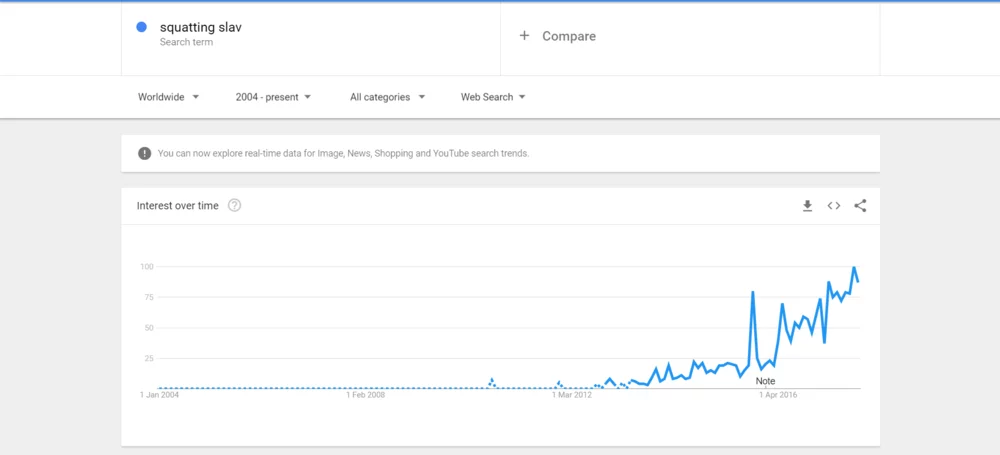
A quick look at the results ifrom a Google Trend search on the topic ‘squatting Slav’ points August 2014 as the time when the trend started getting a considerable amount of searches, reaching a peak in October 2017. The Facebook page Squatting Slavs in Tracksuits, which as of November 2017 has almost 770,000 likes, was created in 2014 by Romanian teenager Alexandru Matesan. In an interview for Paper Magazine in 2016, he says that he did not come up with the idea himself, describing culture behind the meme as ‘a really old thing’, the meaning of which few people could grasp before, so he felt he had to make it more appealing and easy to understand.
The first to like the page were all people who Matesan knew and they formed a Squatting Union group, who direct the page in the wanted direction. He is also behind the page Scenic Depictions of Slavic life, which has itself accumulated over 215000 likes. So, the Russian gopnik subculture did transfer into an internationally recognized meme with the help of a Romanian boy and his friends.
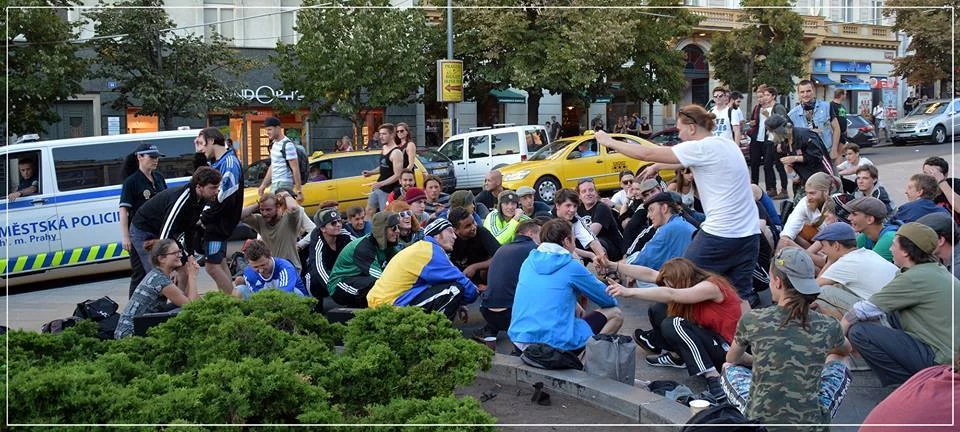
The pages are no longer only meme generators. They have organized a community around them which transformed into a movement, manifesting the Squatting Slavs meme. Its followers have even started gathering at meetings, such as the Prague Gopnik meeting in August 2016 in the Czech Republic.
Adidas - Squating Slavs' favorite brand
In addition, as if the Squatting Slav meme was not a result of globalization enough, we have the Adidas tracksuits, one of the top three defining features of ‘enoughness’. Adidas is a German sports company, the biggest manufacturer of sport equipment in the world. The brand was chosen as the official sportswear for the Soviet team for the 1980’s Moscow Olympics and was quickly adopted by the general public. These were mainly poor people who did not care if the product they received was authentic or not, and Russia at that time was trading only with socialist states such as China, which provided a lot of fake Adidas tracksuits.
The gopniks, mimicking the prison subculture and opting for comfortable clothing to wear while sorting their street business, naturally started wearing counterfeit Adidas products as well. Based on this, now Adidas has become the favorite brand for all Slavs who want to embrace this culture and it has gotten to the point where Westerners start to associate it mainly with Slavic people.

The Squatting Slav is becoming an identity on a global level
All of this leads us to the final question of this paper – are Slavs fighting the Slavic stereotype by popularizing it as a meme, or is this festering the wound? The Squatting Slav meme is becoming a larger and larger global phenomenon with every new post on one of the many Facebook pages or Instagram accounts related to it. The Instagram profile @squattingslavs has 41500 followers and the hashtag with the same name returns almost 5000 posts. Dozens of articles and videos informing Squatting Slav wannabes how to squat properly and adopt the behavior, culture and language of a gopnik appear everywhere on the Internet now. YouTuber 'Life of Boris' reugarly posts such videos. He has more than a million subscribers and his video ‘How to squat like a Slav’ has gained almost 3,9 million views as of November 2017.
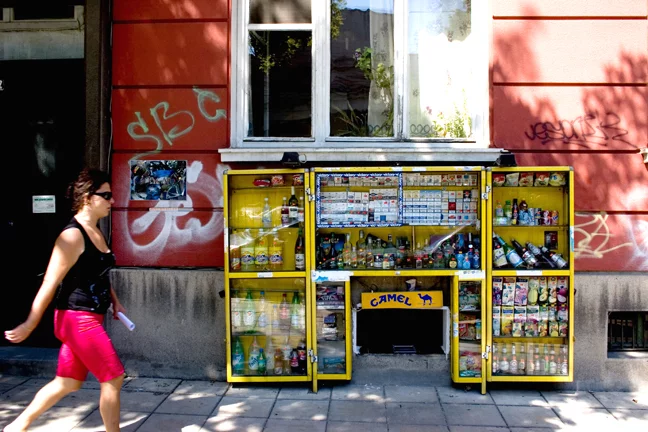
This popularity would have been only a positive thing if it had stayed within the borders of Slavic countries, because it does help Slavs unite. It reminds them how similar their cultural backgrounds are, how they all have ‘babushkas’ (grandmothers) who make ‘kompots’ (a non-alcoholic sweet beverage made from fruit) and how they all are very used to squatting, whether it is due to lack of benches in their over-populated poor neighborhoods, to the mass distribution of squat toilets or, in the case of Bulgarians, the squat shops, which have now become a tourist attraction.
These shops in particular deserve some more attention, because not only are they very attractive as a sight to witness, being positioned on basement windows of buildings on numerous streets in the country, but they also offer on display products very much prefered by a Squatting Slav - cheap alcohol and cigarettes. And most importantly, in order to buy something from them, a person inevitably has to squat. This is yet another example proving that Slavs do not find anything unusual in squatting. Figure 7 is a photo of a typical squat shop on a street in Sofia:
However, information provided by Google Trend shows how the term ‘squatting slav’ has been searched the most in Canada, followed by the UK and the USA.
This global interest in the meme has proven to be problematic. This is because of the fact that although they result from the gopnik subculture, most of the memes are framed as Slav memes, not gopnik memes.
The main issue that critics find is discrimination against Slavs- they think that the jokes can do real damage by spreading ethnic stereotypes and generalization about an entire ethnic group. Because 'gopniks' have their equivalents in every country and language, chavs in the UK, for example, but their behavior is now usually ascribed to Slavs, and even to Eastern Europeans as a whole, as seen in Figure 8, a post from the popular jokes website 9gag:

Not every Eastern European is a Squatting Slav - it is a joke
On one hand, the community which the Squatting Slav meme has created is a great way for Slav people to feel that they have more things in common and strengthen the bond between them. Relationships between Slavic countries are in a constant flux - sometimes they support each other publicly, but more often they can be seen having public disputes about their common history and cultural authenticity. At the same time, many countries are being accused of not being actually Slavic and are being excluded from the community, when in fact a big part of their population can identify with the identity of a Squatting Slav.
Every aspect of the popularity of the meme is helping Slavic countries overcome the conflict between them. It makes them see the good side of coming from the same background, having the same memories and embracing the same culture. By giving them a chance to laugh at their own stereotypes, it unites them and gives them more reasons to be proud of being part of a big Slavic community than to feel ashamed of it.
On the other hand, it is contributing to the separation between Western and Eastern Europe, making Slavs feel even more excluded and marginalized from the global world. It is hurting the reputation of people with Slav origin and reassuring westerns' prejudices about them. As a result, many Slavs feel discriminated and fear that the more globally-spread the meme becomes, the less chances they have of being accepted as equally civilized and educated as people born in western countries. Moreover, there is also an evident division between Slavs as well, because many of them do not want to associate with any feature of the meme and are doing their best to distance themselves from it.
The big problem behind this is that not everyone seems to be getting that it is all done in a purely ironic way. Every Squatting Slav who is seen on the photos of the meme is simply doing it for fun. When something so usual and trivial for you turns out to be somewhat special and becomes a trend, there is nothing wrong about recreating it. However, despite being done merely for enjoyment, it does appear to be inappropriate if you care about your public image, because it starts to define who you are as a whole. You cannot ever be sure that others will not judge you on the basis of only one of the parts of your identity which you have shown. In other words, it is of no harm to joke about stereotypes when those stereotypes are about you, but at the same time this trend is already having some serious consequences and the meme might affect how the whole world envisions Slavic people in the future.
Blommaert, J. (2010)."The Sociolinguistics of Globalization". Cambridge: Cambridge University Press
Blommaert, J. & Varis, P. (2015). Enoughness, accent and light communities: Essays on contemporary identities. Semiotica 203: 153-177
Life of Boris (2016). What is Gopnik?. YouTube. Retrieved November 15, 2017
Meme (2017). Oxford Dictionaries. Retrieved November 16, 2017
Vernacular (n.d.). Cambridge English Dictionary. Retrieved November 16, 2017
Wallerstein, Immanuel (2004). World-Systems Analysis: An Introduction. Durham: Duke University Press
Wax, W. (2007). Gopnik. Urban Dictionary. Retrieved November 10, 2017
Back to top
