

Article
Salmon sushi is not a Japanese invention?!
Salmon sushi was not a Japanese, but a Norwegian invention. Before calling it one of their favorite sushi toppings, the Japanese had to have salmon sushi introduced to them by Norwegian businessmen motivated by hard globalization imperatives.

Published date
Courses
Language, Culture and Globalization
Copyright
This work is licensed under a Creative Commons Attribution-NonCommercial 4.0 International License.
Read time
12 minutes

Raw salmon with rice, not a Japanese invention
Japan is worldwide famous for their sushi. Sushi is a typical Japanese dish that can be found all over the world. You don’t have to travel to Japan anymore to eat the best sushi in the world. Until recently, raw salmon with vinegar rice "sake nigri" came on the Japanese sushi menu. The idea to put raw salmon on vinegar rice "didn'tcome from Japan though. The Japanese couldn't even imagine to eat raw salmon before the 1990s. Is raw salmon with vinegar rice “sake nigri’’ even embraced by the the Japanese society? history of this Japanese disha differentconclusion.
Back to topA bit of sushi history
It is generally believed that the earliest form of sushi was developed in South-East Asia in the 8th Century A.D. At that time, refrigeration had not been invented yet. Locals salted their fish, wrapped it in fermented rice and left it for several months until the protein in the fish was broken down into amino acids. Thereafter, they discarded the rice and consumed the fish which usually remained safe to eat for several months. The Japanese liked to eat their fermented fish with steamed rice called namanare. Namanare grew in popularity during the Muromachi period (from 1336 to 1573). It was during this period that people began to eat raw fish that is wrapped in rice and eaten fresh before it lost its flavour. The emphasis shifted from preservation to a new method of combining fish with rice for consumption.
As for today, many people all over the world have the possibility to try this typical Japanese dish. However, the idea to consume vinegar rice with raw fish or other toppings was not embraced by Western societies initially. There were several hurdles to be taken by Japanese immigrants and business men to introduce sushi to Western societies.
Back to topFamiliarization of sushi
Sushi had been introduced to the West by the early 1900. This Japanese dish became more popular in the United States after the conclusion of World War II. Many restaurants began experimenting with new taste combinations and sushi rolls. The idea was to help the Americans to get used of eating sushi. One of the rolls that became the most popular among the Americans was the California Roll, which is an inside-out “makizushi” roll with cucumber, crab meat (or imitation crab meat) and avocado with white rice.
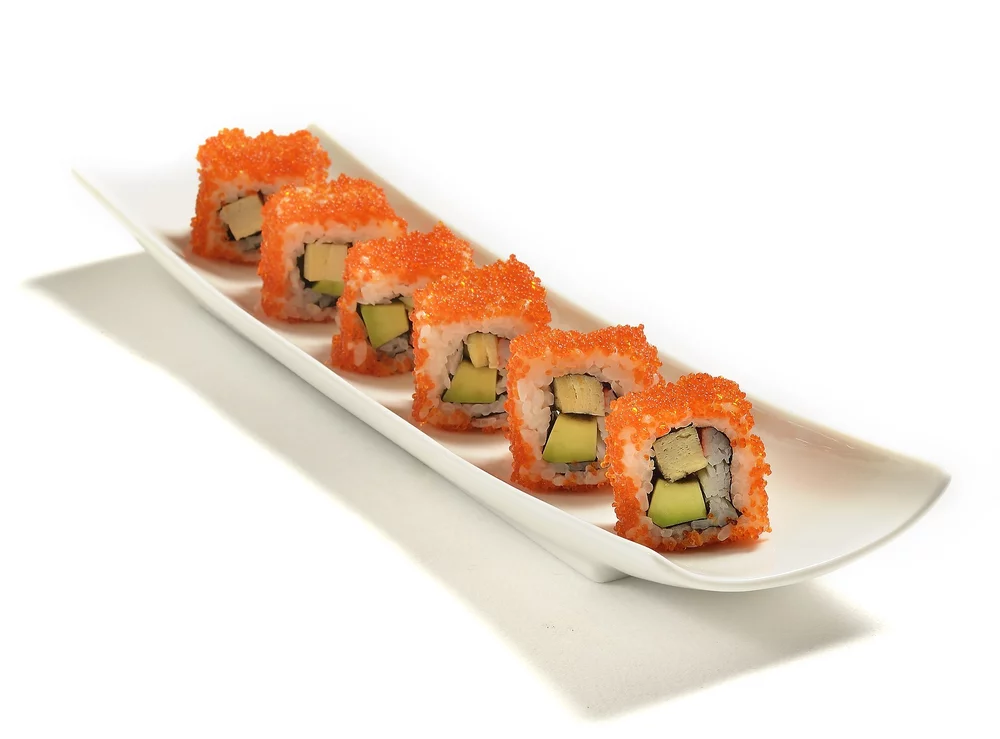
The flavour combination was appealing to diners. They didn’t hato be squeamish about eating raw fish, because the crab meat was cooked in the roll. Americans getting used of the idea consum sushi. Eventually they were able to try out more traditional sashimi and nigiri dishes. And just like that, sushi restaurants became a national phenomenon in the United States.
This approach by experimenting and familiarizing Americans with the taste of the California oll worked very well. The California roll helped Americans to familiarize to try and eat Japanese sushi. This was the start of a great success story of sushi as a globalised dish. Sushi has become a global food scape, this traditional Japanese dish got introduced to the Americans by applying local familiar features. The Americans have mixed their own familiar local ingredients with this global phenomenon.
The succes of the California Roll is the reward of the convergence of global cultures that is brought in the American society. Appadurai proposed a theory about how globalization can create transnational cultural scapes. These scapes create convergence in global culture, emerge in global patterns of cultural and social behaviour and generate new dynamics of global and local culture. Globalization does not necessarily or even frequently imply homogenization or Americanization, it is the adaptation of global scapes that are enacted locally (Appadurai, 1996). Appadurai's explanation also applies to the spread of sushi to other regions in the world. Appadurai argues that various cultures and ideologies are brought into new societies and they tend to become indigenized in one way or another. In the next chapter we will discuss how Appadurai's argument of indigenization and ideologie has changed the sushi culture within Japan.
Back to topThe initiation of salmon sushi
The most popular topping for sushi in Japan was raw salmon for the sixth year in a row between 2012 and 2017, according to a 2017 survey conducted by the seafood company Maruha Nichiro. This is a quite surprising salmon is relatively a new addition to the sushi menu car. As mentioned earlier in the introduction, salmon sushi could not be found on menu cars in Japan until the 1990's. Salmon was regarded as a garbage fish you only ate cured, fully pan-fried or grilled for the Japanese before the 1990's. Salmon was used to fill out cheap meals. It was never used in the traditional Edo-mae style of sushi and eaten raw, because of the Pacific salmon’s tendency for infections by parasites. It have been pretty risky to consume salmon raw before modern refrigeration and aquaculture techniques were available.
Japan enjoyed a self-sufficient seafood industry in the 1970’s, they produced around 7 million tonnes and consumed 60 kilograms of seafood per capita annually. In the 1980’s, this picture has immensely changed. Japan was only for 50% self-sufficient and they needed new suppliers to satisfy their huge demand domestically. Two major reasons for this fall was overfishing their own stock due to their lack of a quota system and Japan was told by the United Nations to remain in their fishing zone and not to fish in fishing zones of other nations.
In the 1970’s, Norway began commercial salmon farming. However, they had a decreasing salmon consumption domestically. Salmon was filling their freezers across the country. Norway was looking for opportunities for a new market outside their borders by the late 1980's. Japan stood out as an ideal market for Norw salmon. However, they faced many challenges on their way to introduce salmon as sushi or sashimi, which could be priced up ten times higher than for the grill market.
The attempt of the Norwegians to sell their salmon to the Japanese as sushi is a form of hard globalization. The Norwegian's economical motivation ha to be translated to the implementation of consumption of raw salmon as sushi in the Japanese society. They first had to understand the domestic Japanese market. Many organizations have tried to replicate their domestic market in emerging markets and failed, because they did not understand the local customs and practices. "To succeed in the global bazaar requires a global mindset.” Project Japan was initiated by the Norwegians to learn and understand the Japanese local customs and practices.
Back to topProject Japan
Bjørn Erik Olsson, head of Project Japan, landed in 1986 in Tokyo to take a look into the Japanese seafood consumption habits. He knew that he ha to target the raw consumption market for economic reasons. This would not be an easy task, because salmon was considered a garbage fish in Japan. However, this doesn't concern all type of salmon. There is an indigenous salmon in Japan called amago masu, a red-spotted salmon that only lives in the cleanest riviers. Amago masu is considered a Japanese specialty, it is a sweet and delicious fish. The Japanese consider amago masu as a delicacy and are willingly to pay good money for this type of salmon. Replacing the expensive amago masu delicacy by the cheaper Norwegian farmed salmon would enable to reach out the masses of the Japanese society.
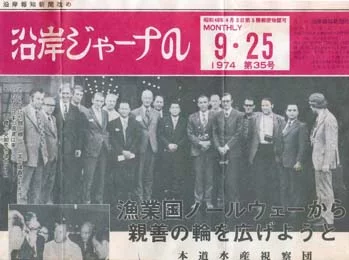
Although the Japanese adore the salmon flavour of the amago masu, the majority of the Japanese salmon are caught from the Pacific and were exposed to parasitethis salmon could not be consumed raw. Norwegian farmed Atlantic salmon was fatty and parasite free as Norwegian farmed salmon are not exposed to the elements. However, Mr. knew by by only saying that Norwegian farmed salmon was parasite free would not be sufficient to convince the Japanese society to consume Norwegian farmed salmon. In an interview to the NPR, answered the following on the question on how the did the did Japanese people react on the idea of salmon sushi. They said: "'It's impossible. We Japanese do not eat salmon roll. It doesn't taste good". They also said: "the colour is also wrong; it should be redder. It has a smell. And the head has the wrong shape".
We Japanese do not eat salmon roll. It doesn't taste good, the colour is wrong, it should be redder and also it has a smell.
Mr. Olsen found out that the Norwegian embassy in Tokyo served raw salmon as a delicacy, even Japanese visitors seemed to like it. He knew that the taste of raw salmon was not the problem, but the perception of the Japanese on raw salmon would be his biggest challenge. Mr. Olsson used commercials and advertisements to reach the Japanese, to inform that Norwegian raw salmon was healthy and tasty. However, the Japanese remain sceptic, they were not convinced. At the same time the Norwegian consumers turned to red meat and poultry. According to Mr. Olsen: the Norwegian seafood industry found itself “on the brink of collapse”. There was a lot of pressure to give up the salmon sushi idea. The Norwegian seafood industry was pushing Mr. Olsen to try to sell the salmon to the cheaper grill market.
In 1992 Mr. Olsen got lucky, the company Neichirei took him on an offer to buy 5000 metric tons of salmon for next to nothing. There was only one condition, it could only be sold as sushi. The ball began rolling with raw salmon as sushi once it had arrived in the Japanese market. Japanese chefs began to endorse raw salmon with its dews, smooth texture and tasty fat. The Japanese began to catch on and started to demand Norwegian salmon in restaurants across the country.
Back to topAuthentic Japanese sushi
Sushi is considered to be part of the the Japanese identity. Adding to m details to this Japanese dish will losing cultural identity. SDue to soft globalization, countries are redefining the interpretation of sushi. Nations are adding their own accent on the concept of sushi to familiarize this dish to their local audience. They have to consider to implement a small dose of their familiar local substance to hold the Japans identity within their locally enacted sushi. The Norwegians have well thought of this concept by rethinking the implementation of salmon as a sushi dish. Raw salmon with vinegar rice has kept Japanese identity, without losing traits of the traditional Japanese culture.
Sushi seem to be dominated by perceptions and enactments of 'authenticity'. An implicit benchmark can be applied of ‘enoughness’. Salmon sushi has to have enough of the emblematic features (Blommaert & Varis, 2014) in order to be ratified as authentic Japanese sushi. eatures that define authentic sushi is putting toppings as vegetables or (raw) fish on vinegar rice. The defining feature of sushi is the vinegar rice. The word sushi actually means ‘’it’s sour’’ in Japanese. Which reflects on the fermented fish with rice preserved in salt. Adding to m features to this concept will lose authenticity that sushi is based on. To enhance the authenticity of sushi, it should be offered in an surrounding that represents the Japanese culture. It needs to gather objects that culturally bespeaks authentic Japanesen the same way that a green top hats, shamrock coasters andGuinness beer bespeaks authentic ‘Irishness’.
Back to topThe future of sushi
The popularity of sushi seem to increase due to the high interest Japanese cuisine. There were more than 100.000 Japanese restaurantsoutside Japan as of October 2017 outside Japan according to the Japanese government. They are mentioning that foreign tourists visit Japan fuelling the rise of Japanese restaurants all over the world. The increasing demand of sushi will result in a higher amount of sushi restaurants worldwide. According to Technavio, the amount of sushi restaurant going to increase over 5% between 2018 and 2022.
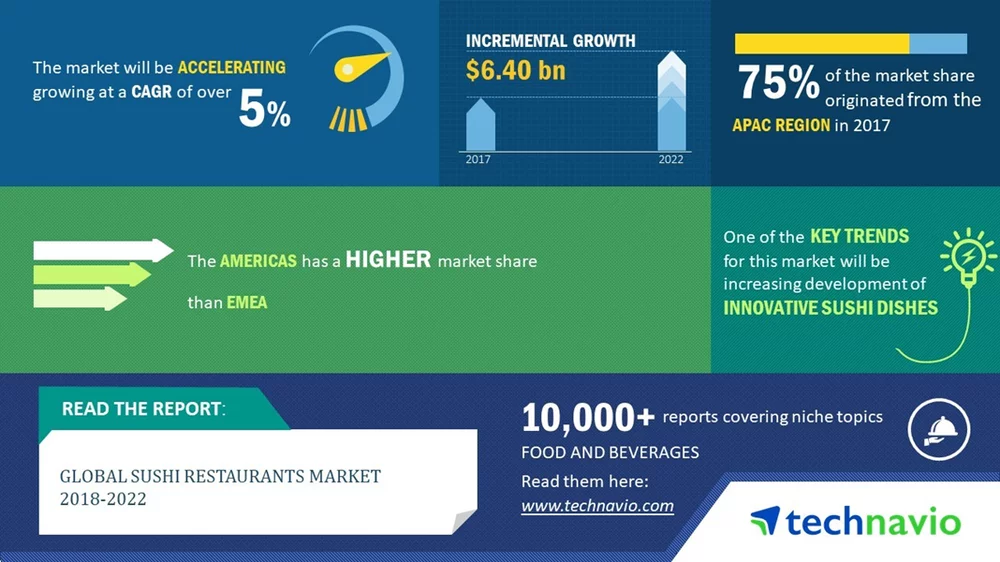
An interesting part of Technavio's research is that one of the key trends of this market is the increasing development of innovative sushi dishes. Examples of innovative sushi products that currently exist are the barbecue beef rolls, Teriyaki chicken r, American sport rolls, Philadelphia roll and many more.
The Norwegians had a global mindset when they came with the idea of raw salmon with vinegar ricemotivated by hard globalization. The Norwegian food culture has been brought into the Japanese society by initiating Project Japan. The Japanese have indigenized the Norwegian salmon sushi concept. They even have declared salmon to be the best sushi topping between 2012 and 2017. The Norwegians have changed the concept of sushi slightly by adding an implicit benchmark of ‘enoughness’ to keep this dish having the Japanese identity. Sushi restaurants all over the world have to keep and understand this global mindset, to be able to offer sushi that still remains part of the the Japanese identity.
Back to topReferences
Appadurai, A. (1996). Modernity at Large, Cultural Dimensions of Globalization. Minneapolis: Public Worlds, volume 1.
April. (2018, November 19). A brief history of sushi and why its so popular today. Retrieved from Rokaakor
Blommaert, J., & Varis, P. (2014). Enough Is Enough: The Heuristics of Authenticity in Superdiversity. Linguistic Superdiversity in Urban Areas. Research approaches 144-158.
Businesswire. (2019, October 4). Global sushi restaurants market 2018-2022 innovative sushi. Retrieved from Businesswire
Chung, W. (2017, October 23). Salmon is not a japanese invention. Retrieved from Medium
Jiang, J. (2015, September 18). How the desperate Norwegian salmon industry created a sushi staple. Retrieved from NPR
Loew, C. (2017, September 27). Salmon tops sushi survey. Retrieved from Seafoodsource
Media Digital AS. (2011, April 8). Norway’s introduction of salmon sushi to Japan. Retrieved from Norwayexports
Nippon.com. (2018, June 15). Number of overseas Japanese restaurants top 100000. Retrieved from Nippon
Perrin, C. (2015, March 15). Unique American sushi rolls. Retrieved from Sheknows
Sollesnes, O. (2018, March 10). The Norwegian campaign behind Japan's love of salmon sushi. Retrieved from Japantimes
Sushiref. (2016, October 17). The World-Wide Sushi Reference. Retrieved from Sushiref
Tappin, S., & Cave, A. (2009, March 1). Hard globalization. Retrieved from London.edu
Womack, L. (2019, September 19). Best sushi restaurants in the world. Retrieved from Thetravel
Back to top
More from this author