Article
Riding the NEUE Neue Deutsche Welle with Paula Carolina
Through her music, Paula Carolina's embodies the national socio-political climate and hopes for the future of young Germans through the artistic lens of the "Neue Deutsche Welle" of the 1980s. Looking at her first EP "Heiß/Kalt", this article discusses how her music career contributes to the re-emergence of the genre and its political implications.
Published date
Courses
The multicultural individual
Copyright
This work is licensed under a Creative Commons Attribution-NonCommercial 4.0 International License.
Read time
9 minutes

Now 25 year-old Paula Carolina has only set foot onto the German music scene rather recently but the more she releases, the more her listeners are brought back to the time of the "Neue Deutsche Welle" music genre of the early 1980s. With progressively more absurdist, yet critical, lyrics and music, she has already hugely contributed to the (re)emergence of a NEUE Neue Deutsche Welle - the resurrection of music style that seems to be needed more than ever. Carolina's embodiment of current concerns, the national socio-political climate and hopes for the future through the artistic lens of the previous uncertainty of a split Germany make us wonder: Why are young Germans suddenly so drawn back to a time and national identity they never themselves experienced? Let's look at her first EP "Heiß/Kalt" and find out!
Back to topPaula Caro-WHO NOW?
A classic "Gen Z"er, Paula Carolina was born in 1999 and throughout her life has moved across multiple German cities with a pitstop in England until finally settling back in between Mannheim and Berlin (DIFFUS, 2023) , where she now produces music, plays festivals and tours with her band. Having played the piano since she was about five years old (Alex, 2023), the urge to express herself musically had not left her when she started and quit studying English language, music and social sciences in Augsburg (Bilevitz, 2021). In 2021, while still in her studies, Carolina released her first single "Du und das schwarze Loch" (literally: "you and the black hole"), thematising domestic abuse of women. Continuing onto this expression of female struggles and liberation, she released her EP "Aus der Blüte des Lebens" (literally: "From the bloom of life") a year later, letting soft, indie-pop sounds fuel her ideas on same-sex relationships, expressing femininity under patriarchy and polygamy. Since then, her sounds have received a louder, more rebellious edge, reflecting a more honest, critical and provocative approach to her music, shouting "Nein, nein, ich will nicht deine Trophäe sein! Häng doch die ander'n an deine Wand ran!" ("No, no, I don't want to be your trophy! Go ahead and hang the others on your wall!") in her 2022 song "Trophäe" about a possessive relationship.
Carolina's 2023 EP "Heiß/Kalt" (Hot/Cold) marks her final transition into the style of the "Neue Deutsche Welle". Having listened to her father's old vinyl records of the time (Alex, 2023), her lyrics and instruments became suddenly more diverse, genre bending and generally louder and more immodest.
Carolina reflects this progressive change in her style in an interview, saying: “Piano would make my lyrics very serious and sombre. And the guitar always somehow has this uplifting moment. That's why I'm becoming more and more guitar-heavy.”
But why did the inital "Neue Deutsche Welle" movement even come to be? What are its core characteristics? And how does this period in recent German history inspire music now, over 40 years later?
Back to topNeue Deutsche WHAT?
Initially a nameless and diversely driven genre, the "Neue Deutsche Welle" emerged in the late 70s from multiple underground creative scenes in West-Germany. Cities with flourishing avant-garde and art scenes such as Düsseldorf, Berlin and Hamburg invited genre experimentation in their local clubs and venues, motivating the formation of many bands and groups made of young adults and teenagers who were often still in high school (Schäfer & Daniel, 2016). Out of frustration at the end of Germany's economic boom and a growing distrust in the socio-political progress of the country, many young people found themselves looking for a vessel to give voice to their scepticism and found this in these decentralised music communities (Schäfer & Daniel, 2016).
As the literal translation of the name Neue Deutsche Welle,"new german wave", already elicits, the genre partially sprung off of the new wave music of the time. Mixed with inspirations from punk music's heavy guitar and scream-like singing, new technologies like the synthesiser were also not shy of making an appearance and could often be heard across the genre. While Nina Hagen became the "Godmother of Punk Music" (Aylmer, 2016) and used guitar heavy features in the early "Neue Deutsche Welle", songs such as Geier Sturzflug's "Bruttosozialprodukt" ("GNP") were composed with a more electronic focus and more satirical lyrics such as "Ja, jetzt wird wieder in die Hände gespuckt! Wir steigern das Bruttosozialprodukt" (loosely meaning: "Now it is time to get back to work, we are increasing the gross national product"). As an alternative to the out of fashion hippie mindset, the newfound roughness presented an ambiguous way of expression, which was often met with distaste by older, more mainstream audiences.
Beyond the West-German borders, the music-movement found international popularity and mainstream success in the 1980s with songs such as Nena's "99 Luftballons" (or its German-accented version "99 red balloons") as well as Peter Schilling's "Major Tom". These songs dreamt of escaping a socio-political climate strained by cold-war anguish and a Germany that was still waiting to be reunited, yet simultaneously also marked the end of the genres popularity with its underground originators in 1983 (Zimmer, 2013).
Back to topFrom Old to New
Carolina directly makes use of these iconic figures of the "Neue Deutsche Welle". Besides the eccentric, colourful yet grungy 80s punk inspired clothing, she styles her hair like Nina Hagen (as sung in "Heiß/Kalt" off of her 2023 EP), alternating between her mullet-like hair cut and half-bleached, gelled up spikes, completing her look with charcoal eyeliner.
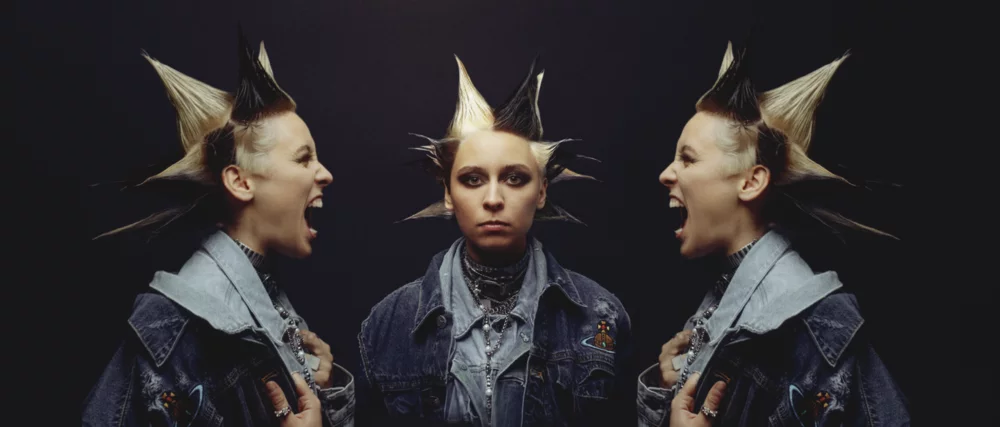
Dressed in neon-orange safety vests, she also covered Geier Sturzflug's "Bruttosozialprodukt" with her band for "Startrampe COVERED", a YouTube channel connected to German state television, in September 2023, breathing new life into the spirit of the 80s working class. Safe to say, Carolina has a good understanding of her musical roots and is not afraid to name them.
Similarly, other emerging "Neue Neue Deutsche Welle" artists such as the band Tränen employ a similar sense of loudness to communicate this notion of female emotional expression akin to Paula Carolina. On the second verse of song "Mitten ins Gesicht" (literally: "Right in the face") the band's front singer for example screams "My anger is not comfortable. My feelings are not decent. I roar and I scream. So that I don’t drown in pain".
Back to topSCHREIEN!
Carolina has that same tendency of being incredibly expressive. One of her more recent songs, named "Schreien!" ("Screaming!") counts as one of her more popular releases. That is in part thanks to the "Turbo Remix" of the piece, a techno/ happy hardcore inspired rethinking, genres that are currently also popular in other countries such as with the Dutch Joost Klein and his Eurovision hit "Europapa". As of April 2024, Paula Carolina's track sits at about 1.8 Million views on YouTube and almost 12 million on Spotify. For her, compositions like "Schreien!" are a mixture of absurdist encounters combined with the deep urge to release strong emotions, the way she used to scream at trees to let out her anger, as she says on a podcast:
“It is important to scream out anger, before it builds up and you will get sick.”
Especially in a world that is currently flooded with stimuli from media all over to the bustling streets of metropolis such as Berlin, "Schreien!" invites its listeners to break out of social conventions, sneak onto a rooftop at night and scream out all of this accumulated pressure once and for all. Carolina does this quite actively in her live shows, letting her audience wildly scream along, form mosh pits and just let loose for once (Alex, 2023 & Selcuk, 2024). Another, more feminist layer to this song is the idea of Carolina as the front-facing woman going against proper social norms, abandoning the idea of the quiet, polite woman in the background and swapping this with a loud, confident roar of conservative norm resistance. Much further than the rough screams of imperfect voices, Carolina calls for a more "raw", audience-connected and less clean way of making music.
"Do you have a bit of change for a six-pack carrier Pepsi light?"
...is how she starts off this song. A notebook-romance picked up on the Underground tram and thus an homage to taking off one's headphones and reconnecting with the world here and now (ALEX Berlin, 2023). Absurdly detailed, like her predecessors in the early 80s, Paula Carolina brings to the forefront a kind of thinking away from big global headlines back to the quirks of daily living, reminding her audience that even though there are a lot of things to be cared about in today's socio-political climate, we are also allowed to treasure the minuscule and seemingly unimportant.
Back to topNEUE Neue Deutsche Welle on the Rise
Overall, the emergence of artists like Carolina and the resurrection of the "Neue Deutsche Welle" are no coincidence. Similar to the late 1970s/ early 1980s, German teens and young adults in the 2020s are faced with a lot of economic and cultural uncertainty. A decade that started off with a pandemic right at the end of high school and climate justice movements that brought with it little optimism for the future while the later economic inflation has limited the financial freedom of those just trying out "adulthood". With especially right-wing populism and extremism finding a lot of approval of the older generations in Germany again, a mixture of dread and pressure has built up in many young people that Carolina's lyrics express. Additionally, she remediates the genre to include a more contemporary and feminist perspective, letting nonsense strike through an absurdist lens calling for social change and equity, while briefly creating a fun, danceable utopia through sarcasm, screams and new ideas that get her and the listener back "in touch" which the simplicity of everyday life, community and human connection.
At the same time, indie-music has moved away from being a stripped down DIY-genre into a commercialised mainstream industry, explaining why the style of the "Neue Deutsche Welle" found its way back into current discourse. Wanting to get back to the "rawer", more authentic mindset behind independent and alternative music, the old style offers a familiar transition point symbolising a call for more "underground" music once again.
Beyond the recognisable and potentially nostalgia-inducing style Paula Carolina (re)presents, her artist discography has a lot to offer to her young German audience; may that be a place to let out frustration at the state of the world, deep political undertones and/or the sense of finding a common place identity in her music's idea of appreciating and finding empowerment in all the minuscule that make up commonplace German living. Carolina thus manages to bring together German youths in the hope of finding good in their current national identity while not being shy of imagining a better world through music that never becomes not enjoyable to come back to after a while. With her first album released in summer 2024, the artist is sure to continue in spreading the "Neue Deutsche Welle's" legacy.
Back to topReferences
ALEX Berlin, Besel, H., & Poensgen, A. (2023, September 2). Paula Carolina im Interview I Bergfunk Open Air 2023 [Video]. YouTube. https://www.youtube.com/watch?v=0qwqV7Zqub0
Alex. (2023, February 20). Paula Carolina – Schreien! LOHRO. https://www.lohro.de/paula-carolina-schreien/
Aylmer, O. (2016, November 16). An ode to Nina Hagen, the godmother of punk. AnOther. https://www.anothermag.com/fashion-beauty/9272/an-ode-to-nina-hagen-the…
Bilevitz, C. (2021, July 15). „Zwei Frauen. Eine Mundharmonika und Amore“ – Ein Interview mit Paula Carolina. Presstige – Das Augsburger Hochschulmagazin. https://presstige.org/2021/07/zwei-frauen-eine-mundharmonika-und-amore-…
DIFFUS. (2023, July 22). @PaulaCarolina über den „Turbo Remix", Moshpits und ihre Songtexte | DIFFUS [Video]. YouTube. https://www.youtube.com/watch?v=dLLdw_9EfW4
Schäfer, F.L., & Daniel, A. (2016). 1.5. The emergence of Neue Deutsche Welle – a sociological study on an efficacious practice ascending from underground music to everyday culture.
Selcuk, E. (2024, April 3). #17 Paula Carolina. ARD Audiothek. https://www.ardaudiothek.de/episode/starthilfe-der-musik-podcast-mit-de…;
Zimmer, A. (2013, July 14). Neue Deutsche Welle. dw.com. https://www.dw.com/en/neue-deutsche-welle-german-lyrics-gone-pop/a-1694…;
Back to top