Refusing Moral Panics/Defending Education and the Right to Protest
Invoking “indications” of “pro-Palestinian violence”, Dutch authorities partially succeeded in demobilizing a national protest against the severe higher education budget cuts. According to Sarah Bracke, this is not an isolated incident. Throughout history and around the globe, far-right political positions are shaped by anti-intellectualism and invested in curtailing educational institutions. And moral panics — in this case “pro-Palestinian violence” — are always used in the process.
If education is the midwife of democracy, as U.S. philosopher John Dewey once argued, then authoritarian political visions have a stake in dismantling institutions of education. Throughout history and around the globe, far-right political positions are shaped by anti-intellectualism and invested in curtailing educational institutions, from tighter political control over curricula, staff, and tenure, to outright censorship in the form of banning books, research, and teaching programmes. When this far-right Dutch government came into power just before the summer, there was no doubt that they would be going after (higher) education as soon as possible. It was also clear that they could tread on fertile grounds. Over the past year, the so-called “internationalization in balance” (WIB) bill, which can count on broad political support, has solidly reframed a problem of resources (notably a lack of housing) into a problem of nationality (too many foreign students) and proposes to drastically cut back bilingual programmes and education in English as the “solution”. This framing conveniently obscures all the political decisions that create and sustain a real housing crisis, including many years of neoliberal and right-wing governments dismantling social housing. More importantly for the argument here, de-internationalization is deeply at odds with how our universities work, both in the way we do scholarship that is not bound by the borders of the nation-states and in the international composition of our students and staff.
The new far-right government could equally rely on several years of manufacturing and fanning the flames of moral panics about purported “wokeness” that would be pervasive at the universities, and in primary and secondary schools (with regular moral panics about sex education or how Dutch colonial history is taught). These moral panics cultivated the grounds for the recent calls for political interference in education – in the name of tackling “political indoctrination”, as Wilders’ PVV electoral programme of 2023 puts it. In addition, university campuses over the past year have been one of the significant sites of pushing back against the deep entanglement, both discursively and materially, of the Dutch establishment with Israel’s ongoing genocide in Gaza and the annihilation of life in Palestine.
The severe government budget cuts in higher education that this far-right coalition is shoving down our throats, is a political attack on the universities.
Universities, in sum, are a thorn in the flesh of the far-right visions championed by Wilders & co: they are sites of academic freedom, knowledge production, and critical thinking that make it possible to speak truth to power and sites where the current attack on internationalism is resisted, in theory and in practice. Lest there be any confusion about this: the severe government budget cuts in higher education that this far-right coalition is shoving down our throats, is a political attack on the universities. Against the attempts to justify the cuts in economic terms, Ingrid Robeyns has convincingly argued that these budget cuts are unnecessary in economic terms, besides being ill-advised, unwanted, and illegitimate. Rather, austerity measures are deliberately deployed to discipline and reshape the universities, or in the cynical words of a PVV representative in Lower House, the budget cuts are needed to “provide educational institutions with an opportunity to rethink their priorities.”
In the face of 1 billion euros cuts the universities began organizing: notably WO in Actie, which has been on the forefront of pushing back against austerity politics in higher education for many years now, as well as the trade unions, student unions, and organizations of precarious staff. A national demonstration against the cuts was planned for November 14 in the city of Utrecht, and on campuses all over the Netherlands various groups mobilized to prepare. On November 13, less than 24 hours before we would begin marching, a disturbing message ran like fire through these networks: the consultative body between the Mayor of Utrecht, the representatives of police, and the public prosecutor – the so-called driehoek or security triangle – pulled the plug. The mayor just fell short of formally banning the demonstration, but “strongly advised” the trade unions against it. Feeling they had no choice, the unions went along with the mayor’s advice, while the other members of the organizing coalition were not even invited to this consultation.
The trade union’s response was a mistake. If they had not “agreed” and the demonstration would have been formally banned, we could have proceeded with legal action. The question whether an intervention of such caliber could be justified, revolves around the reasons invoked to cancel a national demonstration of an entire sector already under political attack. These reasons were rather predictable: “indications” that there might be “violent pro-Palestine action” at the demonstration. At no point did the security triangle present any kind of evidence for these “indications”. All requests for more substantial information, that might justify this severe restriction of civic and political rights – and this insane attempt to demobilize, in less than 24 hours, many thousands of staff and students who had been mobilizing for months – remained unanswered.
In other words, unsubstantiated “indications” were deemed sufficient to do the (legitimizing and demobilizing) work of curtailing the right to protest, and this is alarming. What kind of power does “pro-Palestinian violence” exert when these unsubstantiated “indications” can cancel a national demonstration? This power is of course situated, not only in the larger context of Israel’s ongoing genocide in Gaza but also in the immediate aftermath of the disruptive visit of Maccabi Tel Aviv hooligans to the city of Amsterdam. While more elaborate critical analyses of Maccabi Gate can be found elsewhere, suffice to emphasize the following. The racist and pro-genocidal hooliganism of Maccabi fans that upset and harmed (including physical harm) many citizens of Amsterdam was given free rein in the city on November 6, before locals took matters in their own hands and pushed back – with responses that included racism and violence – in the following days. Politicians and media were more than eager to frame everything that happened in terms of antisemitism (even using the term pogrom, although the mayor of Amsterdam has in the meantime reconsidered her usage of the word), failing, once more, to treat all the disturbing racism (pro-genocidal, Islamophobic, antisemitic) and violence that occurred with equal measure. The rule of law was further eroded by repressive measures including a demonstration ban in Amsterdam, which was enforced in violent and disturbing ways on those who protested double standards with respect to racism and violence, genocide denial, and repression of constitutional freedoms.
Moral panics are instruments of disciplining and controlling the population.
All of this played in the background when the security triangle decided to prevent a national demonstration against this government’s onslaught on education. But to understand well how this played, the safety or security logic that was invoked cannot be trusted. Let’s for a moment think along with the “indications” that were causes of concern for the mayor. Surely, in a country where rather recently ago Amnesty International signaled that the right to protest is under pressure, one might expect that the authorities would have a stake in affirming the right to protest and protecting a demonstration with all their might – as if democracy depends on it, because it does. If the authorities had substantive reasons to expect that violent action would disturb this national demonstration, one might expect that additional police forces would be mobilized to protect the constitutional right to protest of an entire sector under attack. Evidently this is not what happened. Instead, “indications” were used to justify more repression. And this trick was possible because “pro-Palestinian violence”, or rather, mere “indications” of it, had acquired the power to function as a moral panic.
A moral panic refers to a deliberate attempt to arouse concern and fear over a social issue. Moral panics are instruments of disciplining and controlling the population and they do so in at least two ways. At the heart of moral panics are the so-called “folk devils”, or a part of the population that is delineated and targeted as responsible for the breakdown of a social order which those in power seek to maintain or establish. This part of the population gets criminalized through the moral panic. But moral panics also deeply affect the population at large. They are deployed to justify “exceptional measures”, such as new bans, regulations, and laws that push against the edge of legality, or breach it all together. The writing was on the wall during the tiresome cabinet formation of this far-right government, when so much time and effort was needed by the coalition partners to figure out whether they would be able to get on the same page regarding the constitution. Moral panics, moreover, work to divert attention. In the context of the pervasive Dutch institutional complicity with Israel’s ongoing genocide, the reigning moral panic about “pro-Palestinian violence” both criminalizes an entire part of the Dutch population – seeking to render the racialized minorities among the “folk devils” as non-Dutch, both symbolically as well as in terms of revoking citizenship – as well as curtails civic and political rights at large. And while the “folk devils” are the talk of the town, attention is conveniently diverted away from the significant increase in Dutch military expenditure, with a substantial part of weapons and military equipment for the Dutch army bought in Israel.
The thing with moral panics is that they reframe reality. When the smoke screen of the moral panic evaporates, things always turn out quite different from how they were presented to be. At the very least, moral panics exaggerate and partially fabricate, and often the fabrication is more extensive or almost complete. But by the time that becomes clear – in the subsequent investigation, report, freedom of information request, etc. – political gain has been made, a part of the population has been harmed, freedoms at large have been curtailed, and our sense of reality has been compromised. Moral panics are powerful tactics of gaslighting, deployed to push a political project or vision forward.
We need to consider all forms of racism with equal measure, recover antisemitism from its weaponization and cynical use in moral panics, and build rational and affective buffers against moral panics at large.
While moral panics pertaining to Israel/Palestine in the Netherlands take different shapes, they are consistently marked by a dangerous weaponization of antisemitism. We need to push back hard – such instrumentalization is dangerous, not only in the way “folk devils” are criminalized but also in how antisemitism is gradually emptied out of any real meaning along the way. In a time and space where racism is relativized – and has just been renamed “polarized etiquette” in the wake of secretary of state Nora Achahbar resigning because of the unbearable ways in which Maccabi Gate was discussed behind the closed doors of cabinet meetings – we need to consider all kinds of racism with equal measure, recover antisemitism (which is indeed on the rise) from its weaponization and cynical use in moral panics, and build rational and affective buffers against moral panics at large.
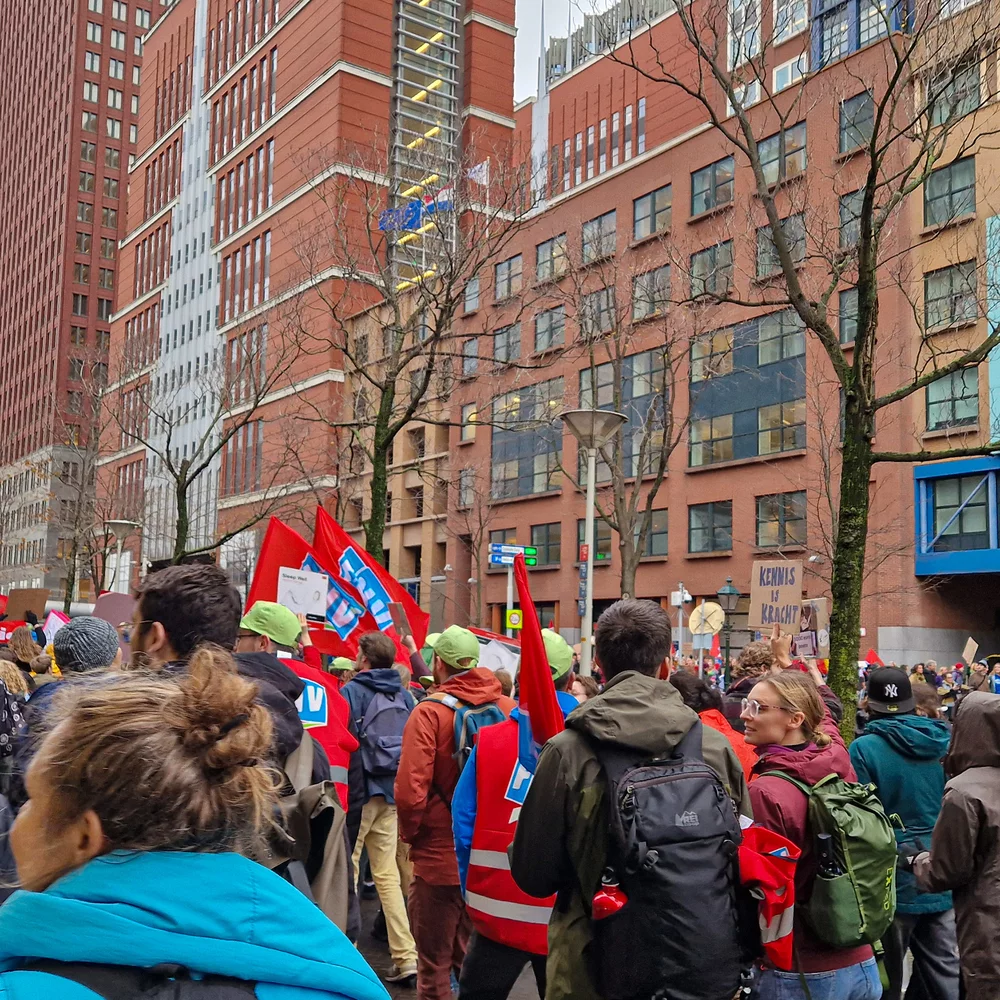
This is what the student unions managed to do last week, in the heat of the moment. They refused to go along with unsubstantiated “indications”. And there was a silver lining in the security triangle pressuring the trade unions, but only them, into obedience: the student unions were not bound by that “agreement”. Student unions and other organizations took a leading role in calling upon everyone to simply show up as planned. They didn’t budge. Eventually the mayor confirmed that the demonstration could proceed, and it did so without more police presence than usual. In other words, within hours, “indications” that were presented as solid (yet not substantiated) had melted into thin air. On November 14, between 4000 and 5000 students and staff marched through the streets of Utrecht.
At the same time, the trade unions and WO in Actie had already shifted gears and mobilized for local gatherings, including demonstrations, on the different campuses across the country. The dramatic cancellation pushed representatives of opposition parties to invite the organizers to deliver their planned speeches in Parliament. These speeches were live streamed at the campus protests, where a total of about 10.000 staff members and students gathered across the country. The organizing coalition, moreover, called for a national demonstration in The Hague, on November 25. As the truth and movement of a collective body was repressed, e pur si muove, in different directions. Or in the words of an apt slogan from the Maagdenhuis occupation at the University of Amsterdam in 2015: Screw us and we multiply.
As we now mobilize for the national demonstration in The Hague, we must pay attention. The concerted efforts of last week to ban a national demonstration to defend higher education came straight out of a totalitarian screen play. And this screen play relies heavily on moral panics. It’s the “pro-Palestinian violence” moral panic that made the authoritarian script possible, and even seemingly plausible or inevitable. Attacks on our universities have already been justified through moral panics about “wokeness”, “too many foreigners”, “antisemitism”, or “pro-Palestinian violence”; we must understand the modes of attack well and incorporate this understanding in our strategies of resistance.
This is crucial, because moral panics is an essential mode of functioning of this far-right government. There seems to be a new one every week, whether it’s about asylum, migrants, integration, antisemitism, Muslims, “wokeness”, gender, sexuality. Each time reality gets distorted and each time we go into damage control mode and come up with more reliable figures and better-quality arguments. There is no unprecedented high number of asylum seekers; Muslims are not “replacing” those who understand themselves as entitled to Dutchness; critique on Israel and antizionism are not antisemitism (and let’s keep in mind that most Zionists are Christians); children are not taught to become nonbinary nor masturbate in school, and the list goes on, ad nauseam. Damage control is necessary, as we can’t concede this territory to authoritarian forces that are seeking to implement disturbing oppressive political projects – too much and too many get harmed by these moral panics. Yet running behind moral panic after moral panic in a mode of damage control and harm reduction is exhausting, and in a sense, we always arrive too late. Beyond damage control and harm reduction, we must get immunized against moral panics and learn how to disarm their cynical and destructive power.
This involves grounding ourselves and our movements in a sense of reality, solid cartographies of the present, that can weather the storms of moral panics that this government keeps throwing at us. What is real, is that we are living under a far-right regime that is severely attacking (higher) education while dismantling democratic freedoms, as they are rolling out systematic programmes to criminalize racialized minorities (with a focus on Moroccans/Muslims/Arabs) while dismantling the right to asylum and pushing back as hard as they can against migration. What is real, is that Wilders is pursuing a vision of turning the Netherlands into a racial ethnostate, which, as Merijn Oudenampsen recently argued on point, accounts for his attachment to Israel as a model. What is real, is that “pro-Palestine” is the “folk devil” of the day, facilitating the rolling out of far-right and totalitarian visions. “Pro-Palestine” is the new “woke”, the new Islam, the new communism, the new Judeo–Bolshevism, the new homosexual, the new witch, the new Jew.
A far-right government that relies on moral panics to reshape reality and usher in a new social order knows precisely what it is doing when it targets established sites of knowledge production, where their authoritarian reframing and reshaping of reality might meet resistance.
Making reliable cartographies for our time and space requires knowledge, and notably many kinds of disciplinary and interdisciplinary knowledges that are produced and transmitted at our universities in conditions of academic freedom. A far-right government that relies on moral panics to reshape reality and usher in a new social order knows precisely what it is doing when it targets established sites of knowledge production, where their authoritarian reframing and reshaping of reality might meet resistance. Working under such a political regime, it is important that solid scholarship is joined by a deliberate politics of refusal. A refusal of moral panics: one way to disarm these moral panics, is not to buy into them, as the student unions did last week. A refusal of repression: the new demonstration bans were defeated in the streets last week. And a refusal to “obey in advance”. Most power to authoritarianism is given up freely in liberal democracies, Timothy Snyder argues, which is why not obeying in advance is On Tyranny’s lesson number one.
The stakes are high. And we must reckon with the fact that the Dutch liberal political arena has few built-in protections against these authoritarian forces. Under the auspices of “both sides”, “safety”, “dialogue”, “agreement”, “neutrality”, “keeping the peace”, and with alarming new speak (racism as “polarized forms of etiquette”…), we are descending into fascist swamps at a rapid pace. As scholarship on totalitarianism teaches us, political rights and democratic institutions cannot be taken for granted and must be fought for anew in every generation. Higher education in the Netherlands needs our commitment and mobilization, and this includes a full recognition of how and why we are being attacked as well as a refusal of the dominant frames and their “folk devils” tricks. This makes the entanglement of different layers of the Dutch establishment, including the universities, with the ongoing genocide in Gaza as well as the rejection of genocide and complicity by so many in our communities de facto an integral part of both the budget cuts and the protests. In whatever way, we all should get up to speed on how authoritarian forces can take over democratic societies, and the role of moral panics along the way. Because the scenarios are being played out in real time.