Article
The online world of Thierry Baudet and Forum voor Democratie
A paper focusing on the online world of Forum Voor Democratie, a right wing Dutch political party, and its leader Thierry Baudet. What do their online activities tell us about the party's goals?

Published date
Courses
Digital media and Politics
Copyright
This work is licensed under a Creative Commons Attribution-NonCommercial 4.0 International License.
Read time
13 minutes

Digital media have an incredible impact on the lives of everyday beings but if you’re already famous, the spotlight tends to shine a little brighter. In this paper I will be focusing on the online world of Forum Voor Democratie, a right wing Dutch political party and Thierry Baudet, their frontman. Through exploration of social media, analyses of posts, and how Baudet asserts himself as someone who is pro-freedom and equality while simultaneously portraying aspects of nationalism through the use of sarcasm, I’ll be analyzing the virtual worlds in which both Baudet and Forum Voor Democratie use various social media platforms to connect with their audience.
Back to topAn Introduction to Forum Voor Democratie
A public right wing political Facebook account that has 129k followers is sure to gain attention online and Forum Voor Democratie (FVD) has a timeline that isn’t shy of controversy. The posts are purely political and admins of the page are incredibly interactive with their audience, sharing various communication mediums such as videos, interviews, and images of members in parliament. This is clearly expressed in the way topics are addressed in posts as well as the captions that accompany them, often placing emphasis on the influx of immigrants, addressing other politicians through articles linked from the FVD website and encouraging users to vote, support, and join the FVD team.
The party is incredibly vocal about what they stand for. For example, FVD is against Islamic culture integrating with the Dutch society in fear of it threatening the Dutch identity. Their nationalistic viewpoint also opposes the European Union (EU), campaigns for a referendum on Dutch citizenship and like most political groups, also practices mudslinging against other politicians whose views they may disagree with. as can be seen in Figure 1 of their Facebook page. This is a way for FVD to advance their own political party’s progress as they share their views on the establishment, or ‘partijkartel’, by utilizing mudslinging to make themselves more appealing to their audiences.
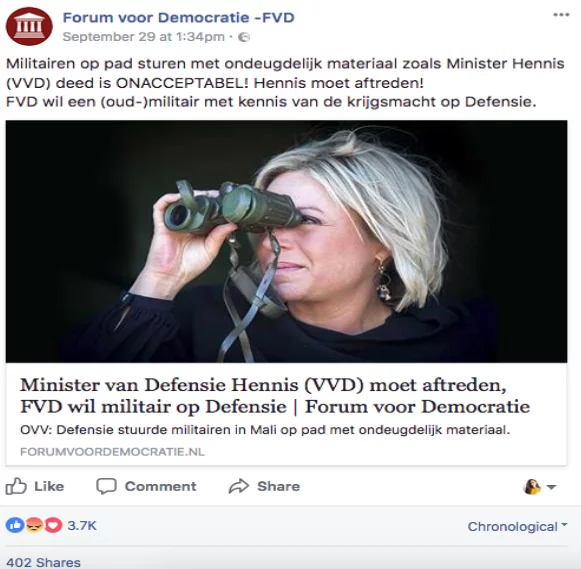
Forum Voor Democratie's (FVD) has a timeline that isn’t shy of controversy
The post addresses an opposing party, Volkspartij voor Vrijheid en Democratie, a conservative and liberal political party, by stating that the minister of defense, Jeanine Hennis-Plasschaert, should step down from her position. The post received online attention, with 3.7k reactions, 923 comments and 402 shares. The types of reactions showed that not all of the users are in favour of this opinion, as can be seen by the angry reaction button in the middle. This shows that although FVD is supported by many, not all of the ideas are supported and although the party is active, the ratio of followers to public interaction isn’t as engaging as one would expect. One reason for this is algorithmic populism (Maly, 2018) as social media relies on engagement, with the voice of the audience in relation to the algorithms.
Videos To Share A Message
Videos are another one of the most popular communication tools used by the party. There are lots of videos shared where Baudet is directly addressing the FVD’s Facebook followers and these are the ones which often get the most reactions, with the highest being 12,000. This is possibly because it feels more personal when someone is talking to you - even though it may be through a screen - about their goals and what they wish for the future of the Netherlands. But more important is the algorithmic bias (Maly, 2018) of these social media.
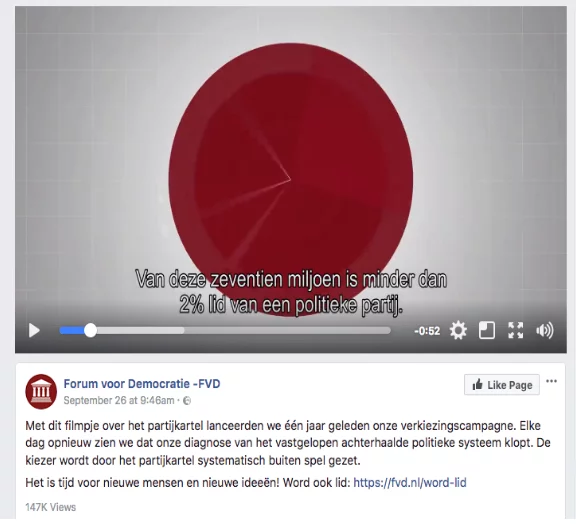
The algorithms of Facebook and other social media platforms such as Twitter, Instagram and Snapchat all promote the use of videos as a medium to attract attention and convey information. By packaging the voice of Baudet and his Forum voor Democratie in video they use the algorithms to spread their voice. The party also recently shared a celebratory video about their one year anniversary, pictured in Figure 2, as FVD has officially been active for a whole year. The video addresses the audience personally and thanks them, informing them about politics in the Netherlands by stating facts such as “There are 17 million people in the Netherlands, but only 2% of the population is involved in politics.” This is a subtle promotion, as a link to become a member of FVD is attached in the caption underneath the video.
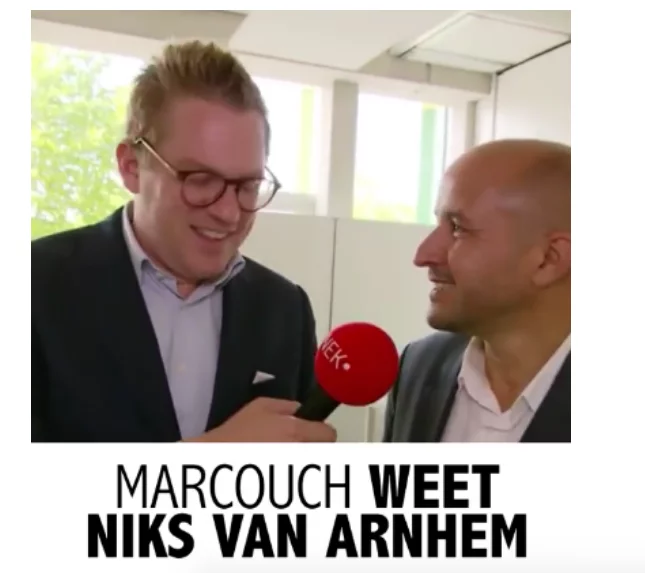
Other videos which are interesting to view include Baudet insulting Ahmed Marcouch, a Dutch politician with Moroccan roots, who is part of the political party Partij van de Arbeid (PvdA). The video is labelled ‘Marouch weet niks van Arnhem’, translating to ‘Marcouch knows nothing about Arnhem’, Arnhem being a city in the Netherlands. The video is an example of intertextuality with ‘geenstijl’ as Marcouch is interviewed about the history of Arnhem and the interview consists of questions he can’t always answer. There are boundaries to humor and according to a short clip of Baudet at the end of the video, Marouch is unfit to be labelled as a Dutch politician. This rude statement quickly allowed for a heated discussion in the comment section as those with a similar sense of humour agreed with Baudet while PvdA supporters weighed in on the controversial post and shared their opinions, claiming that the real reason that Baudet has created this video is to discriminate against Marcouch being Moroccan and that it has nothing to do with Marcouch not always being able to answer the questions about Arnhem’s history.
Back to top
Social media relies on engagement, with the voice of the audience in relation to the algorithms
Exploring The Online World of Thierry Baudet
Thierry Baudet’s voice and representation of FVD clearly appeals to many, as can be seen on his social media platforms. With 74.3k followers on Twitter and 16.6k followers on Instagram, Baudet’s voice is heard throughout the Netherlands. Twitter, the main medium used for Baudet’s communication, shares not only personal information but often also posts of him retweeting from the political party’s account as means of promotion. Baudet’s larger platform on Twitter could be an indicator that his content is taken more seriously (possibly because politicians are more likely to use Twitter) as opposed to his Instagram. The main difference between the two social media platforms is that Baudet’s personal life is more private on Twitter; often only discussing general politics, updates about Forum Voor Democratie, information regarding the Netherlands and the European Union (EU).
Public vs Private
His Instagram shows a very different side to him and he appears more likeable as this account shifts dynamics from public to private, allowing us, as the outsiders, a closer look into his life. Baudet becomes relatable, posting memes - often ones of himself - that a large majority of online users enjoy, shown by the number of ‘likes’ and comments beneath each update he posts. His interests are expressed through pictures and videos of him paintballing and fishing with friends, playing music with his family and having fun with his dog, all of which assists in the creation of his ‘family man’ identity. There are also a few selfies added to his Instagram feed. By including these photos, he appears to not take himself too seriously which is important to note as people have a set mindset about what politicians are supposed to be like, ie, serious and formal, not only in way of speech but also clothing choice, usually by wearing a suit and barely smiling. In Baudet’s pictures, he is laughing, joking around and wearing everyday clothes such as jeans and a t-shirt, showing that he is “normal” too. In addition to him as a person, the type of content Baudet posts reveals a lot about his political views and the aims of Forum Voor Democratie and he clearly asserts his position on certain topics. Something he is very vocal about is his goal to reduce the number of migrants. As can be seen in the screenshots attached, all of which are from his Twitter account, Baudet regards them [the migrants] as ‘nasty travelers’.
This is a sign of nationalism as it showcases that Baudet feels threatened by the increasing foreigners and is determined to keep the Dutch identity 'pure'.
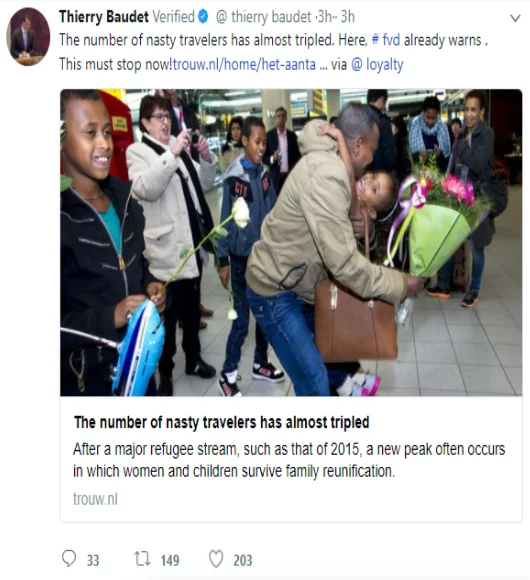
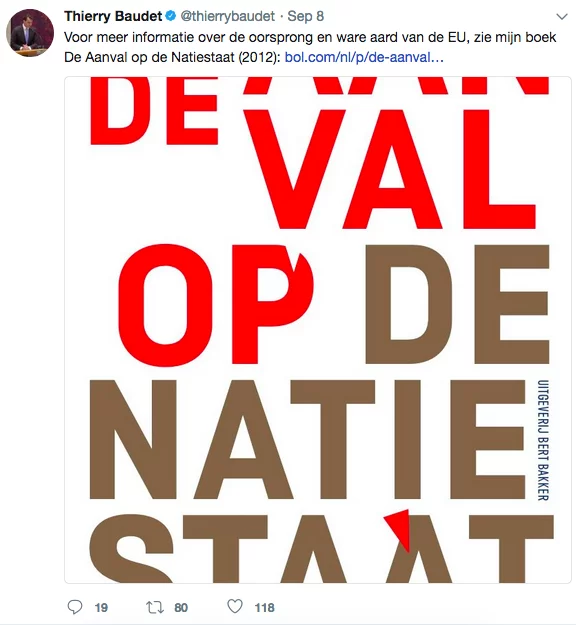
He expresses disgust as he includes the fact that population numbers have nearly tripled since the influx of refugees, which started in 2015. Baudet often also promotes his book, De Aanval op de Natiestaat, on his Twitter as can be seen in Figure 5. This sign of nationalism showcases that he feels threatened by the increasing foreigners and is determined to keep the Dutch identity 'pure'.
Threatened By Foreigners
In the book, it is stated that ‘European unification and multiculturalism has weakened the nation state’, a clear indication about his beliefs regarding not only the refugee crisis and the impact it has had not only on the EU but also supranational institutions as one of the key features of supranational institutions include nominating various individuals to assist and embody the cumulative 'European' interest (Krase,2017). In Figure 6 below, a niche audience is addressed where Baudet indirectly states that he supports Muslim activist Shirin Musa who is fighting for equal rights amongst Muslim women. Through this, a message is given to the audience as it is in favour of Islam by targeting the Muslim community in the sense that it creates the image that Baudet is inclusive and accepting of minorities. In other words, Baudet is positioning himself as someone who is pro-freedom and equality.
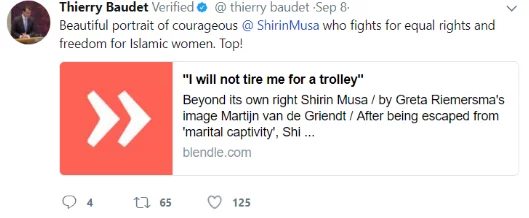
In a time like 2017, this is incredibly important to acknowledge as minorities have been marginalized for years but it has only recently become a topic that is addressed and highlighted in mainstream media and much less so by right wing politicians. This comes across as Baudet addressing minorities, however, when looking at previous tweets and statements, one can deduce that Baudet is a clever and carefully curated political figure who utilizes social media as a tool to spread a positive message, or 'maverick' (Lempert and Silverstein) that is most likely constructed by FVD as a way to feed into the enlightenment ideology (Sternhell, 2010) where the audience are the ones enlightened as Baudet is speaking to those who believe that the Islamic faith is oppressive. The tweet does, however, differentiate him from another right wing Dutch politician and Partij Voor de Vrijheid (PVV) leader, Geert Wilders, whom he often gets compared to regarding their political beliefs about immigration which leaves room to believe that there are not many differences between the two (Akkermans, 2017). Wilders, however, is openly against Islam and that is where the difference is between him and Baudet, as here Baudet is distancing himself from Wilders yet still giving the Muslim population a poke, specifically because there could be implications on how the some members of the Islamic community view women and the dissonance between that view and the Western perspective.
He is aiming right for his target audience; those who are against Islam, foreigners and pro-homosexuality.
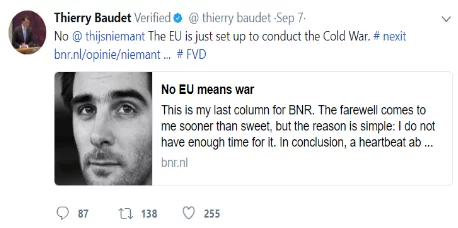
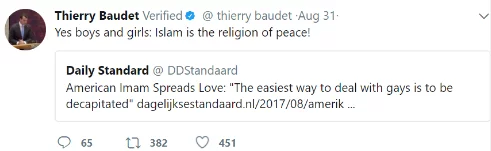
In Figure 7 above, Baudet is taking a nationalistic stand against the EU, where it looks like he is reinforcing his main idea of NEXIT, a situation where the Dutch would hypothetically withdraw from the EU. It is common for right wing populists to oppose the 2015 migrant crisis that brought thousands citizens from mainly Muslim countries to European countries; a controversial time and a reason why many right-wing populists are against migrants and in favour of NEXIT. A sarcastic comment is made in Figure 8 below and used to draw attention to the negative side of migration. Baudet attempting to advance his argument through his comment which has been retweeted 382 times, favourited 451 times and received 65 comments. It’s clear to see his use of sarcasm has made an incredible impact. Not only is he sharing a retweeted post, where he is against Islam’s views of peace in relation to homosexual individuals, but he is positioning himself once more and aiming right for his target audience; those who are against Islam, foreigners and pro-homosexuality.
Back to top
2.2K Facebook Followers, But How Many Thumbs Up For Baudet?
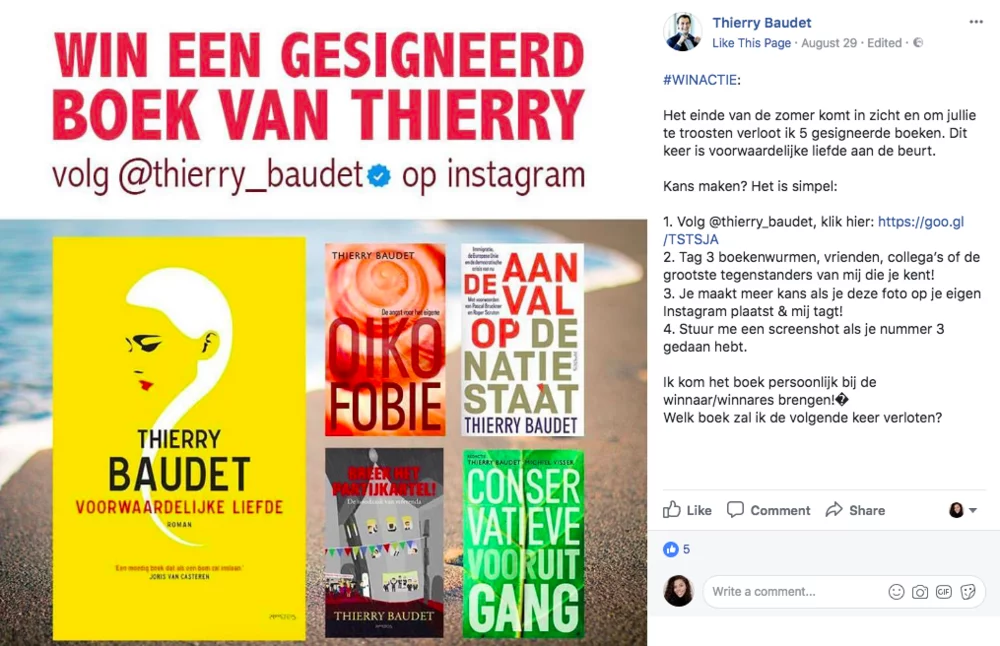
Baudet is also active on Facebook, where his personal Facebook account is ‘exclusive’ as one has to send a friend request and cannot simply follow his page in order to stay updated with his posts. In the first public post below, he is organizing a giveaway of his own book as a way of promoting his Instagram account. Those who follow his Instagram stand a chance to win his book and feed into his ideas of anti-islam, anti-immigration and pro-purism. The title of the book is noteworthy as ‘De Aanval op de Natiestaat’ translates to ‘Attack on the nation’, stipulating that Baudet, as aforementioned, sees the influx of migrants as a threat on not only the country but also Dutch culture. The post about the book reinforces his beliefs about migration and that he is proud of what he has to say about it. What is interesting to note is that the post only received 5 ‘likes’ while his page has 2.2k followers. This could be due to the algorithm of Facebook's as more popular figures and sponsored posts are usually shown first.
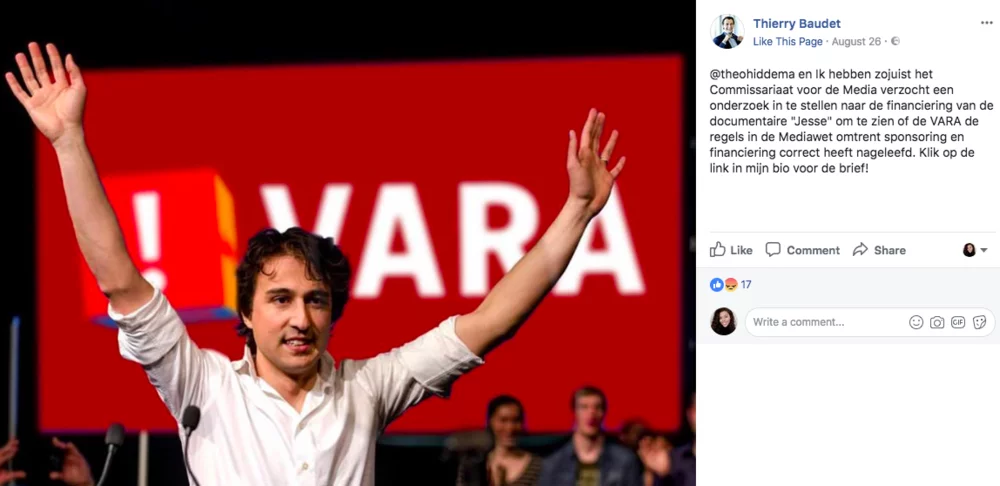
In the second public post, Figure 10, he is questioning the funding for the documentary about Jesse, a candidate of the opposing party, GroenLinks. Naturally this adds fuel to the fire as it is no longer about Baudet calling Jesse out, but about the two well-known political parties and their supporters who will inevitably get involved in the comment section to defend who they think is right. In addition to Baudet’s position on the ‘partijkartel’, he is suggesting that GroenLinks is corrupt. The post, which should have made more headlines as it’s about an active investigation and an accusation about corruption, received a mere 17 reactions, 16 of those in favour of what had been said. This is classical political move that is usually intended to shed light on a situation or topic politicians find to be unsuitable and an example of how campaigns hope citizens think twice about a politician's character before casting their vote in the next election round (Lempert and Silverstein).
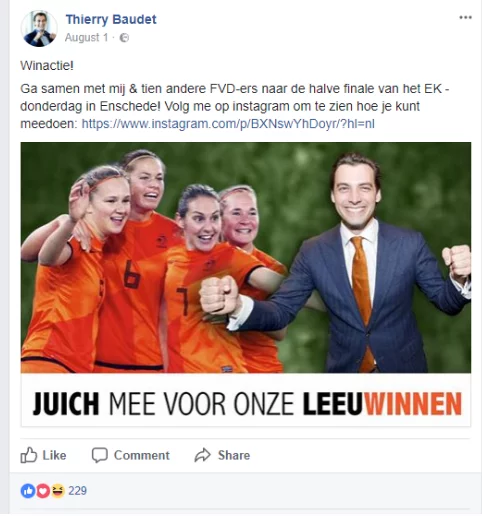
Baudet’s nationalistic attitude makes another reappearance in Figure 11 below, a post aiming for virality and a commercial communication as he is promoting not only his instagram account but also supporters of the FVD in a giveaway where he allows for his audience to attend the semi-final of the Europees Kampioenschap (EK) in Enschede.
In the last picture, Figure 12, he is once again aiming to advertise his instagram account by posting a photo of himself in an Instagram cutout. The post was much more popular online as it received 105 reactions. Baudet is attracting attention, thanking his followers and encouraging citizens to celebrate with him by following not only him but also FVD and a few other accounts. One user even commented "Thierry Baudet, you Insta-slut". An 'insta-slut' term that is used for those who want to gain likes, comments and followers quickly by means of self-promition. All of these aforementioned tweets and messages Baudet is sharing with the public act as building blocks in creating a puristic society, one where the language, cultural norms, values and people are kept pure as purification implies little to no migrants nor minority cultures that serve as a threat to Dutch culture.

Keeping the Dutch identity pure
Forum Voor Democratie is a Dutch right-wing party that has a nationalist view, with Thierry Baudet as the frontman. The aims of this national conservative political party are clear; keep the Dutch identity pure by protecting the Dutch culture in terms of reducing mass immigration as can be seen in the numerous posts aimed towards immigrant groups, minorities and believers of Islam. These are all points which their targeted audience firmly stand behind, as seen in Dutch general elections of 2017 when FVD first participated and managed to obtain two seats in de Tweede Kame. Following this victory, support has rapidly increased as can be seen in the statistics of both FVD’s public page and Thierry Baudet’s personal Instagram account, public Facebook and Twitter.
Algorithmic populism indicates that while both accounts may have thousands of followers, neither receive many reactions and when they do, it is often in terms of giveaways or mudslinging and publicly calling out other politicians or political parties whose views FVD opposes, such as the example of Marcouch and GroenLinks. Every FVD, similar to PVV, post has a ‘take-home’ message that is calculated, one which encourages the audience to question what lengths they are willing to go to protect their Dutch identity and how important their Dutch identity is to them.
Back to top
References
Website Forum voor Democratie Retrieved October 22, 2017.
Facebook Forum voor Democratie (n.d.). Retrieved October 22, 2017.
I. M. (n.d.). De Nieuwe Recht
Forum voor Democratie -FVD. (n.d.). Retrieved October 21, 2017/
Recensie Thierry Baudet: veel gespin, weinig wol | DeJaap. Retrieved December 08, 2017/
NTR, O. (n.d.). Wat is Forum voor Democratie? | NPO Focus. Retrieved November 02, 2017/
Lempert, M. (n.d.). Lempert, Michael, and Michael Silverstein. Creatures of Politics: Media, Message, and the American Presidency. Retrieved November 02, 2017/.
Maly, I. (2018). Nieuw Rechts. Berchem: Epo.
Back to top