Article
The Mass Shooting Generation
Young people in the U.S. have been left distraught and disempowered by the waves of mass shootings and other gun violence. But can their use of social media to organize lead to real change, or is it simply "slacktivism"?
Published date
Courses
Online writing and publishing
Copyright
This work is licensed under a Creative Commons Attribution-NonCommercial 4.0 International License.
Read time
17 minutes

Sparking A Movement
Youth are unable to enact real political and social change. This is a belief that many share and because of this statement, the aim of this paper is to show how youth have utilized social media to promote social and political activism, namely centered around gun control and mass shootings in the United States of America. For us to do this, we need to ask two important questions: why do people think youth can't affect social change and why do they think social media causes "slacktivism" and not activism?
To answer the first question, arguably adults often think youth are too young to enact real change but time and time again this has proven to be incorrect as youth have often been the first to implement it. Some examples of young individuals include Greta Thunberg, Malala Yousafzai, Anne Frank, Nkosi Johnson, Elif Bilgin and Louis Braille, who invented the Braille system at 15 years old for visually impaired individuals.
In response to why people may think social media causes "slacktivism" and not activism, we could argue that it is because older generations mostly see millennials as online activists who don't actually contribute. This is largely because most contributions are financial and if you're a millennial drowning in inevitable debt and a plastic earth, donating $30 may not be at the top of your bucket list. However, millennials have found alternatives and the most convenient one has proven to be raising awareness. While this activism does take place online, it has started contributing to change. Though it is clear that social media has become a platform for discussion as activists of all ages aim to ignite change on a global scale, but how much of a difference do their voices really make?
This is largely because most contributions are mostly financial and if you're a millennial who is drowning in inevitable debt and a plastic earth, donating $30 may not be at the top of your bucket list
The abundance of children, teenagers and college students participating in movements such as Black Lives Matter, protests against gun violence and online feminism, have sparked heated debates and fueled discussions that may result in enormous social changes, not only through online activism but also activism within schools and public institutions. However, we must also look at these social platforms and be realistic about them
because the power of social media usually begins with a text; Facebook status, a tweet, an Instagram caption, a hashtag. These social media platforms have made it easier for users to connect with one another and recently, users are connecting for important social and political issues. For example, in February 2012, Trayvon Martin, an unarmed fifteen year old boy was fatally shot on his way home from buying Skittles and Arizona Iced Tea due to a local police officer, Goerge Zimmerman, finding his behaviour suspicious (Bates, 2018). Martin died of a gunshot wound and Zimmerman was charged with second degree manslaughter in 2013.
At the time, it was a murder. Right now, it’s a movement. Trayvon Martin’s death in 2012 was a key factor in the #BlackLivesMatter movement but today, in 2018, it’s another reminder of liberal gun laws which also took 17 lives at Marjory Stoneman Douglas High School in Parkland, Florida. The viral world spun out of control at both incidents and more people started speaking up, claiming there should be sensible gun laws and equal rights for all; men, woman, child, no matter the race or the gender. Instagram feminists started online protests and those with larger followings arranged meetups for both #BlackLivesMatter and #MarchForOurLives, both of whom were flooding every social media page from Snapchat to Facebook.
Political figures such as Donald Trump were called out and members of the National Rifle Association (NRA) were even having debates about gun reform with school children (Moran, 2018). These were just two incidents that have motivated a world of change, both sparked by youth and online activism against not only the NRA but also towards Trump's reactions towards the shootings occuring nationwide. Online outrage sparked as Americans questioned why Trump was not helping school children. Even those who had voted Trump in were livid that he was not protecting them; they were seeking justice and begging Trump not to turn a blind eye. Democracy had been seen as politicians giving back to the people and being the voice of the people, yet many politicians like Trump were ignoring democratic values and undermining human rights (Maly 2012).
Back to topThe Parkland Survivors: A Vocal Movement
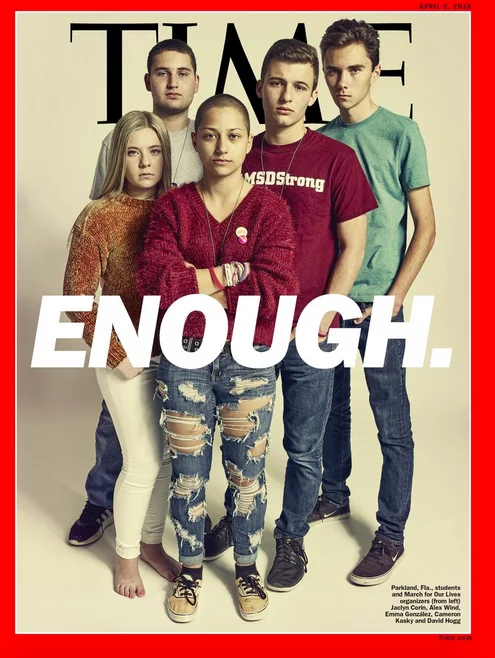
On February 14th 2018, 17 students were murdered at Marjory Stoneman Douglas High School in Florida, the United States (US) of America. Reading about the latest mass shooting in America, as sad as it was, was no surprise. Mass shootings are a common occurrence. 19 years ago, April 20th 1999, the shooting massacre at Columbine High School was one of the deadliest attacks in American history as it took the lives of 24 people. Today, it barely makes the "mlist due to increasing amount of gun violence and mass shootings in the US.
The gun laws in America are like no other in the world. According to the Small Arms Survey conducted in 2007, America only contributes 4.4% of the world’s population, though it counts for 42% of the worlds firearms, with an estimated 32% of the world’s mass shooters being American (according to a University of Alabama study). A gun is seemingly the easiest purchase to make, no matter how old you are. Although the legal drinking age in the US is 21, a 13 year old boy from Virginia was still able to purchase a .22 caliber rifle from a private seller - after the mass shooting at Pulse, a gay nightclub in Florida, which took 49 lives.
Naturally, the controversial topic of gun control has been discussed numerous times, especially after Columbine because it was deemed the deadliest shooting to date, but the controversial topic has also been swept under the mat repeatedly. Despite there having been an abundance of mass shootings since Columbine, three of the most shocking being Sandy Hook Elementary School in 2012, Pulse Nightclub in 2014 and the Las Vegas Massacre in 2017, gun rights are a third rail issue due to the United States’ Second Amendment. This is because almost 90% of Americans agree on “common sense” gun laws such as universal background checks and yet those same Americans are more likely to die from gun violence than any other leading causes of death combined. This means that gun violence is the cause of death for an estimated total of nearly 11,000 people in America each year, though in 2017 the record was at an all time high at 40,000 gun related deaths (Mervosh, 2018).
When the Parkland survivors started speaking out about gun violence and gun reform, it was clear the world was watching. Marjory Stoneman Douglas was recovering from a traumatic experience and perhaps we all thought that the survivors would grieve and attempt to move on because that was the norm. After all, that was what we were taught to expect.
This means that gun violence is the cause of death for an estimated total of nearly 11,000 people in America each year, though in 2017 the record was at an all time high at 40,000 gun related deaths
But this time was different.
Many students were incredibly vocal about gun laws and gun violence after the shooting. A few students in particular made headlines. Emma Gonzalez, Cameron Kasky, Delaney Tarr, David Hogg and Jaclyn Corin are just a few of the brave teenagers who have been featured on various media platforms as they share their experiences and challenge political figures to change their course of action. When Gonzalez took to the platform at an Anti-Gun rally a few days after the shooting, she directly called out President Trump by stating that her and her fellow classmates “call BS” on school shootings.
She furthered her fiery speech by stating that this will be the last generation of school shootings and indirectly called out Trump by telling the audience, “If the president wants to come up to me, and tell me to my face that it was a terrible tragedy, and how it should have never have happened, and maintain telling us how nothing is going to be done about it, I’m gonna happily ask him how much money he received from the National Rifle Association (NRA) but you wanna know something? It doesn’t matter because I already know - 30 million dollars.”
This could be seen as a direct response to Trump’s reply after the shooting at Marjory Stoneman Douglas as he did not mention gun violence. Instead the president tweeted that he was sad that “the FBI missed all of the many signals sent out by the Florida school shooter.” He went on to say that it was unacceptable and too much time is spent trying to prove Russian collusion with the Trump campaign, ending with the statement that the FBI should get back to the basics and makes us all [Americans] proud.
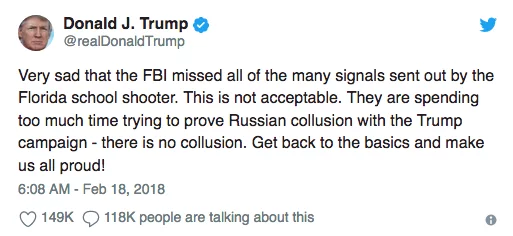
The tweet barely addressed the tragedy and it seems like although Trump wasn’t paying attention, another organization was. The NRA had been receiving a lot of questions and were being called out on viral social media platforms by teenagers, no more than ever. In fact, many representatives went to the gymnasium at marjory stoneman douglas to answer questions some of the survivors, their teachers and parents had. This was interesting because it was the first time that the NRA had gotten directly involved, despite there having been hundreds of mass shootings. Even after the Sandy Hook Elementary school shooting in 2012, the NRA had agreed that schools should be ‘battle ready’ (Bump, 2018). The NRA had arranged for a team of experts who could recommend ideas to make schools safer, but none of them said anything about actual firearms.
"We need to pay attention to the fact that this isn’t just a mental health issue.”
Instead, suggestions ranged from a single entry point to access the school as well as planting trees and bushes away from walls so a shooter can’t climb over them to access school buildings. In the end, almost six years later, it has been decided that teachers should be armed (ibid). This is a policy that has received a lot of attention from both students, teachers and parents. Many students feel uncomfortable with a gun in the classroom, especially those who have been victims and survivors of school shootings before, parents insist it’s not the way to go and teachers claim they are inexperienced or that do not want to carry a gun.
What’s even more troubling is that Trump has stated those [teachers] who do carry a gun will receive a bonus (Davis, 2018). This created a national outrage as the financing of public school systems within America is already questionable, with many teachers purchasing supplies and classroom decorations from their own pockets due to schools stating there hasn’t been enough money. Consequently, students and teachers took a stand against gun violence and school massacres on March 14, 2018. The nationwide protest, which was organized by Women’s March youth groups, addressed the topic of gun violence and school safety. There were more than 750,000 students who marched, claiming the hashtag #MarchForOurLives.
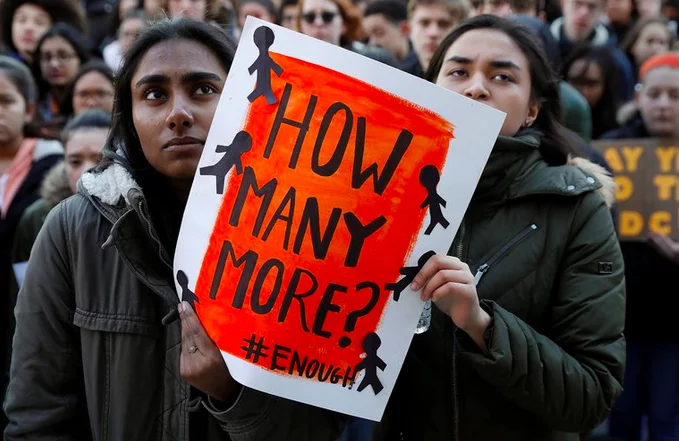
The march was the largest gun-safety protest in the history of the US, commemorating the one month anniversary of the massacre at marjory stoneman douglas, where the suspected shooter, Nikolas Cruz, had been put on trial for 17 accounts of premeditated murder and 17 counts of attempted first-degree murder. To the frustration of those who had peacefully protested, Trump dismissed any talk of gun control by stating that it could be a mental health issue of the shooter, denying that the easy access of gun control plays an important role in a shooting.
Again, Gonzalez fired back by stating that, “We need to pay attention to the fact that this isn’t just a mental health issue.” She further went on to argue that “He [Nikolas Cruz] wouldn’t have harmed that many students with a knife” and that it was “imperative to note also that the Florida shooter bought his gun legally, passing the required background checks despite a violent history. The amount of attention this shooting has received, compared to previous ones has shocked the world to its core. This was the first one where visible action was taking place. Kris Brown (co-president of the Brady Campaign to Prevent Gun Violence) stated that “What’s different here is that the children who are impacted are older, and they are able to give voice in a way that could not happen before.”
Back to topSocial Media As A Weapon
The youth of today, especially those who have survived such tragedies are social media geniuses. They take to Twitter and Instagram to voice their opinion, with Marjory stoneman douglas survivor Jaclyn Corin stating that “People always say, “Get off your phones, but social media is our weapon. Without it, the movement wouldn’t have spread this fast.” Though there are arguably many negative sides to social media such as cyber-bullying, trolling or others using it as an online platform to humiliate, the high school students of Marjory Stoneman Douglas have been using social media, Twitter especially, by calling out powerful figures, namely members of the NRA, US senator Marco Rubio and even Trump himself.
The students call out these people, shrugging off any criticisms and sticking to their mission which is achieving sensible gun laws. The tweets get a lot of attention, especially since the students utilize Twitter to shut down conspiracy theories that they’re paid ‘crisis actors’ , trolling political figures, vocalizing their opinions and memorializing victims of the massacre. One tweet that certainly got my attention is Figure 4, where Gonzalez directly calls out NRA CEO and Executive Vice President Wayne LaPierre Jr.
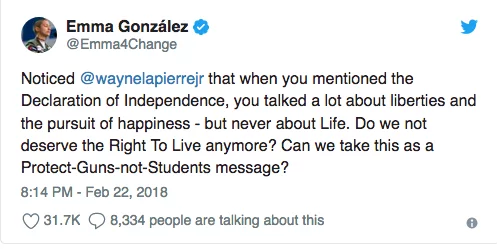
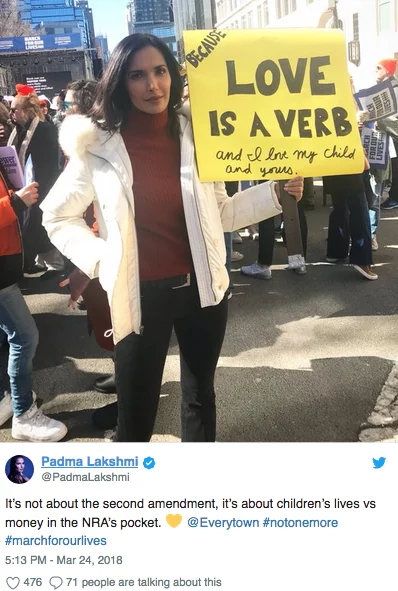
The tweet reads that LaPierre Jr never spoke about life in his speech regarding the Declaration of Independence, stating that she took it as a message that guns are more important than the lives of students. At the #MarchForOurLives walkout, many celebrities showed up to support, capturing even more online attention. Padma Lakshmi attended as well, as can be seen in Figure 5, where she tweeted that the marches and protests for gun reform and sensible gun laws were no longer about the second amendment but about how much money the NRA was receiving with each purchase.
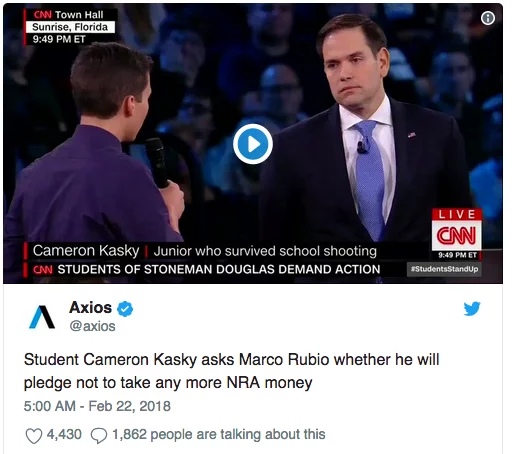
This directly tied into the day when members of the NRA, including Marco Rubio, attended a question and answer (Q&A) session at Marjory Stoneman Douglas, to answer any of the questions the students had (Moran, 2018). Many had been hopeful that Rubio, who was previously a speaker of the Florida House Representatives, would understand the situation through their perspective. Survivor Cameron Kasky even went as far as to directly ask Rubio if he would pledge to no longer take money from the NRA on national television. Rubio swiftly avoided the question, instead trying to sympathize and explain why the NRA worked the way they did, but the survivors wanted an answer which created tension in the building.
Other instances of survivors calling out authorities include Dalvin Hogg tagging Trump in a tweet (Figure after a website reported him playing golf while a victim who had passed was being buried nearby. Hogg stated that “This is why we must take action because these politicians won’t.” as can be seen in Figure 7 below.
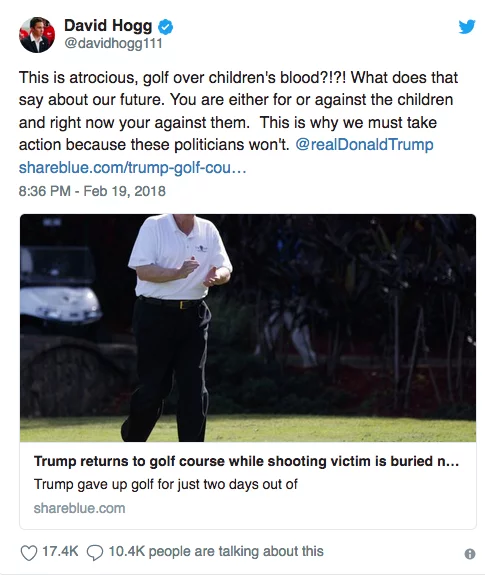
This is a sentence that has resonated with so many students as it has been repeated over and over again. We forget that many of these survivors are under eighteen years old yet they are not only the leaders of a gigantic movement but also the future of America and in a year, they will be old enough to vote, something that Hogg wasn’t shy to remind the public of when he posted this tweet [Figure 8].
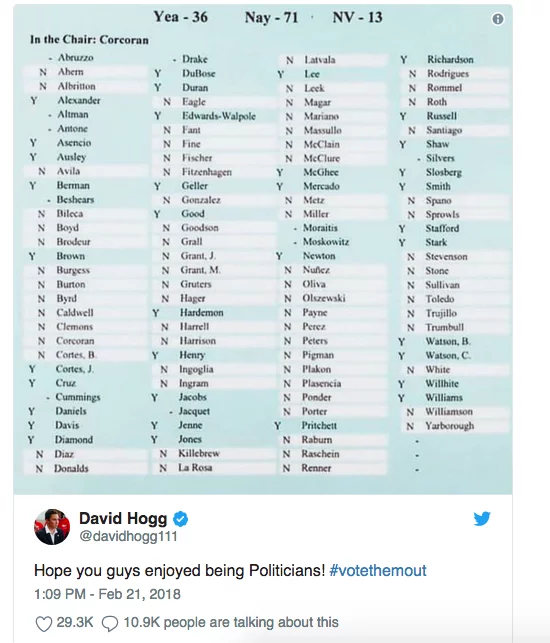
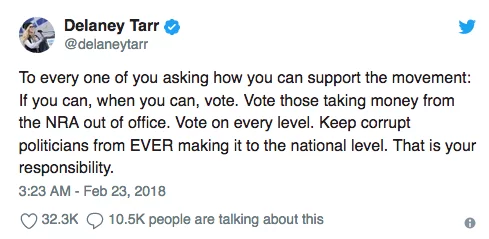
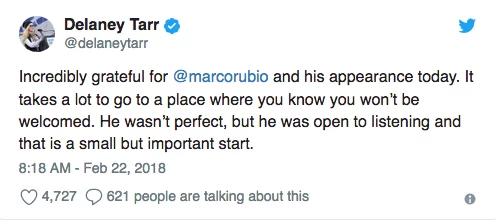
The tweet received over 29,000 likes and almost 11,000 people were talking about the topic. Hogg’s statement was backed up by fellow survivor, Delaney Tarr, who stated that “We've had enough of thoughts and prayers...we are coming after every single one of you and demanding that you take action, demanding that you make a change." on live television. She also took to her personal account on Twitter and told her large following that the need to vote was crucial in order to keep the NRA out of office [Figure 9] and even thanking Rubio for listening to the survivors. [Figure 10]
Along with Hogg, Tarr and Gonzalez, other faces of the #NeverAgain movement (as the survivors have named themselves), Jaclyn Corin and Sarah Chadwick also had something to add. Many Americans feel as if the survivors are aiming to take away their guns. Both Chadwick [Figure 11] and Corin [Figure 12] tweeted to clarify their point and what they were fighting for.
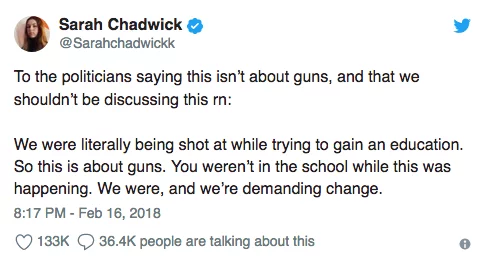
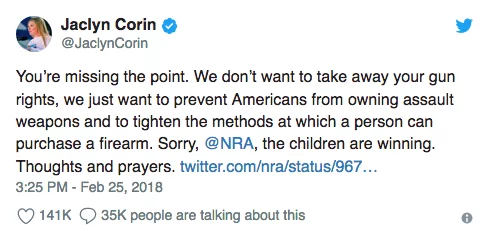
Corin’s tweet ended with a sarcastic ‘thoughts and prayers’, alluding to the fact that after every mass shooting, condolences are sent and everyone prays but they mourn and move on until it happens a second time. These students are saying there should not be a second time, and they seem to have some powerful people in their corner as Barack Obama, 44th president of the United States, also tweeted out a supportive message.
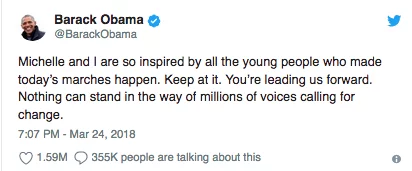
Obama’s support shows that there are influential people listening, which is exactly what these students needed and they have clearly received that as they’ve raised more than four million dollars on GoFundMe as well as received donations from Steven Spielberg and Oprah Winfrey. In addition, Everytown for Gun Safety (a gun reform advocacy group) has been backed by former New York City Mayor Michael Bloomberg who has donated more than one million dollars to local organizers planning marches nationwide.
Back to top#AllLivesMatter….Don’t They?
One topic that has been discussed was gun violence in black communities. With the movement #BlackLivesMatter, which aspires to bring attention to police brutality towards people of colour in the US, one has to wonder about gun violence and how it affects black activists in urban environments who may not have received the same financial support or viral attention. Tarr, who recognizes her white privilege, states that she and many of those who have survived the shooting with her, “come from an affluent area, and we’re mostly white, and we have to use that privilege.”
The Marjory Stoneman Douglas activists invited anti-violence group from Chicago to their high school in Parkland, Florida to try and find a balance to coordinate their efforts. The Dream Defenders, group fighting for racial justice after the death of Trayvon Martin had also sent a letter to the survivors which hangs in their office wall, a constant reminder of how many movements and challenges gun violence brings. One of the high school students who visited from Chicago, Arieyanna Williams said that they were fighting for the same thing and that they found their voice in Parkland.
Other activists of colour include the youngest activist to date, eleven year old Naomi Wadler, took to the stage during the #MarchForOurLives rally. Although merely eleven, she had a powerful message as she spoke out about black females who had died due to gun violence. “I am here to acknowledge and represent the African American girls whose stories don’t make the front page of every national newspaper, whose stories don’t lead on the evening news,” She added that she was there to “represent the African American women who are victims of gun violence, who are simply statistics instead of vibrant, beautiful girls full of potential.”
These eloquent, black voices allowed for the world to look at things from a different angle, as minorities are often ignored or silenced. Wadler’s speech was recorded and went viral, gracing numerous feminist Instagram accounts, getting thousands of retweets and gained so much attention that she ended up being featured on The Ellen Show. The amount of power social media has is ridiculous - there have been a variety of things happening all at once, but has any change been made?
Back to topConclusion
Social media has spurred the efforts of the young activists, creating a larger platform and making room for bigger audiences. School shootings, so common that they have become the norm. This was a problem that youth were recognizing and they started solving it the way they knew how to: social media. But how much of a change has been created since the shooting? Millions of dollars have been donated, thousands of people have marched, we know the names of the dead, the names of the survivors, we are paying attention to minorities, sharing articles, retweeting hashtags and showing online support. The world was confused at Trump's responses and why he wasn't taking action, often thinking that his reactions didn't make sense. When it boils down to it, Trump does make sense - especially to those who put him in power and can relate themselves to him; Trump is one of them (Maly, 2012). This movement started by the survivors of Marjory Stoneman Douglas has undeniably allowed for activists of all ages to spark changes that resonate on a variety of scales.
No matter how young the activist, nor how small the change, people are taking action and people are listening. The activism of youth, or so called millennial activism, is much different than that of any other generations. This type of activism takes place online, but we must also question the reliance of social media. For example, the Marjory Stoneman Douglas survivors are utilizing Twitter as a tool of communication and while they are also leading protests and rallies, many who support them exclusively support them online. This allows for critics to see that young people are merely online activists who scroll, retweet, like and share but don’t actually contribute to any change.
Many young people like to think of themselves as activists, especially when they are truly passionate about a cause. But many young people also don’t know what to do or are unable to donate large sums of money so they stick to raising awareness. While this is an honourable effort, this type of effort only has an online presence. As we have seen from various youth activists over the years - namely activist for female education Malala Yousafzai, eleven year old Janna Jihad who reports about the conflicts in Palestine on her mother’s mobile phone and fifteen year old Blair Imani who was arrested for protesting the shooting of Alton Sterling - youth activists have the potential to discuss and create change in important societal issues, activism has no age.
Back to top
References
Bates, K. G. (2018, July 31). A Look Back At Trayvon Martins Death, And The Movement It Inspired.
Davis, J. H. (2018, February 22). Trump Suggests Teachers Get a 'Bit of a Bonus' to Carry Guns.
Maly, I. (2012). N-VA. Analyse van een politieke ideologie. Berchem: Epo.
Mervosh, S. (2018, December 18). Nearly 40,000 People Died From Guns in U.S. Last Year, Highest in 50 Years.
Retrieved from https://www.npr.org/sections/codeswitch/2018/07/31/631897758/a-look-bac…
Moran, L., & Moran, L. (2018, March 17). Parkland Shooting Survivor Calls Out Lawmakers In Chilling NRA-Style Ad.
Trump, the celebrity-businessman and vox populism. (2016, October 17). Retrieved from https://www.huffpost.com/entry/parkland-shooting-survivor-nra-style-ad_…
Weapons and Markets. (2018, February 22). Retrieved from http://www.smallarmssurvey.org/weapons-and-markets.html https://www.nytimes.com/2018/12/18/us/gun-deaths.html
https://www.nytimes.com/2018/02/22/us/politics/trump-guns-school-shooti…
Retrieved from https://www.diggitmagazine.com/articles/trump-celebrity-businessman-and…
Back to top