Article
Overnight celebrities and virality
In the past few years certain music videos were impossible to miss. Whether you go viral or not can make or break you. In this paper you can find some world-famous examples.

Published date
Courses
Language, Culture and Globalization
Copyright
This work is licensed under a Creative Commons Attribution-NonCommercial 4.0 International License.
Read time
12 minutes

Is Of course, ugain success iwould like tofurtherget it even only
Nowadays, a singer’s or band’s success is not dependent on how many times their song gets played on the radio. Today, I think that radio is merely an instrument to make the artist and the songs they produce even more popular than it already is. In the following decades after World War II radio lost its dominant position (Castells, 2010). With the rise of the Web 2.0 all kinds of creative content sharing websites came along. And it is with no doubt that Youube, founded in 2005, is the most popular of them all.
"It was uploading more content per month than all three major U.S Television networks combined" (Van Dijk on YouTube)
Youube grew up in a time where the media was mostly ruled by elevision. But throughout the years, Youube developed itself as the new elevision. As mentioned by Van Dijk (2013): ‘It was uploading more content per month than all three major U.S Television networks combined.’ I think this shows how much more accessible Youube is, especially for upcoming artists, than television or radio network.
Whereas you have to be asked to play on television or radio, or at least work really hard for your five minutes of fame on these networks, on YouTube it' is as simple as uploading your video where and whenever you want. This makes it also easier for people living in the margins, because the music industry is settled in big cities as London, Los Angeles, etc. These people may not be living in the center of the music industry, but globalization also has an effect on marginal regions in the world, meaning here that these areas also are getting more and more access to the Internet (Wang et al, 2013).
Of course, uploading a video is not the only thing one has to do to gain success. It is all in the views and in the likes. But how does a certain music video get so much attention that it goes viral all over the world? How does music get processed by the Internet and leads to these so called ‘overnight’ celebrities and number one songs? In this paper, I would like to examine these questions further so we can have a clear understanding how certain artists get so famous all over the world, is it even with only one song.
Back to topVirality and celebrities
First, I think it’s important to have a clear understanding of what ‘going viral’ means. The Urban Dictionary gives the following definition of going viral:
‘‘used in reference to Internet content which can be passed through electronic mail and social networking sites (Facebook, etc.): an image, video, or link that spreads rapidly through a population by being frequently shared with a number of individuals has 'gone viral'.’’
So ‘going viral’ in reference to the internet is something that came up in the last five to ten years. In these last ten years big parts of the world became highly interconnected with each other via the Internet. Globalization is of course not only something of the last ten years, but the last decade distinguishes itself by the rapid changes in technology and by the way we connect with each other.
The Internet can be seen as the dominant infrastructure of this recent stage of globalization creating cultural flows that spread all kind of creative content (in this sense music) all over the world with an immense speed (Kroon, personal communication, 2017). This creates a great opportunity for artists to become well known in big parts of the world in a short period of time. Videos that go viral nowadays are not just ordinary videos. People want to be entertained and surprised. A simple music video will not do anymore. It has to be at least extraordinary in some way, extremely funny or unpredictable. Something that catches people’s immediate attention, something that is worthy of sharing with their friends.
Back to topPSY
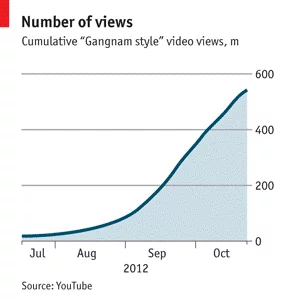
To gather information for the questions asked, I think it is a good idea to pick out a few examples of a music video gone viral. An example probably everyone knows is ‘Gangnam Style’ by PSY. PSY is a South-Korean singer, who mocks the lifestyle of rich South-Koreans. During the video, you see PSY dancing on a rather extraordinary way, the so-called horse dance. The images are moving quickly, never leaving space for a dull moment. The video was released on 15 July 2012. At the end of September 2012 it had over 300 million views and it was listed in the Guinness Book of Records for most liked YouTube video. Today, it almost made it to three billion views on YouTube (YouTube). In Figure 1 you can see how rapidly the views increased after two months.
Two factors contributed to the big hype around Gangnam Style. Firstly, the South-Korean record label YG Entertainment did a lot of research how to drive this song not only to a top hit in South-Korea, but also in the music industry in the UK and the US. Strategic marketing is of course helpful for gaining more success, especially in the beginning of an uploaded video. YG entertainment did already obtain a large engaged audience beforehand, mostly via their YouTube platform and Social Media account, so when this interesting and catchy song came along it was quickly seen by this big audience (Jones, 2012).
Secondly, and what the video ultimately drove to its success, is the sharing of the video after its quick uptake. And this was possible due to how much value we attach to Social Media nowadays and how we are connected to each other via these media. The video became a trending topic on Twitter, a micro-blogging service.
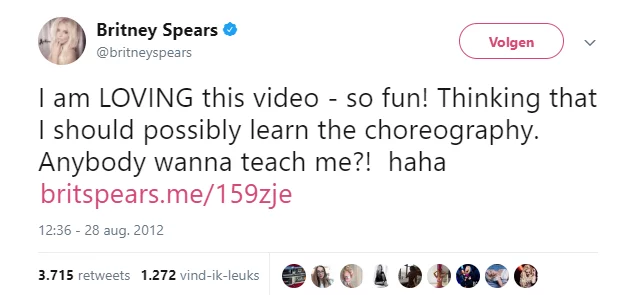
Also a lot of celebrities tweeted about the video, for example Britney Spears (figure 2). With almost 56 million followers she reaches a very big audience from all over the world. But her audience is not the only thoseone who gets to see her tweet about Gangnam Style. Her followers retweeted the tweet almost 4000 times, meaning that also a lot other Twitterers, who do not follow Britney, get to hear about this video (Twitter, 2012). And this sharing continues among these other people and so on, resulting in the video circulating over the Internet on all kind of social platforms all over the world. Nobody wants to miss out on this new phenomena.
After all this sharing, the song was also seen by a lot of Radio Stations. Radio Stations picked up this song as well and started playing it. Funny to mention, the lyrics of the song are almost completely sung in Korean, except for two sentences: 'Gangnam Style' and 'Sexy lady'. This gives the song a bit more of an international touch. But almost no one, except Korean speaking people, understood what PSY was singing about. Still, it remained in the Dutch Top 40 for 23 weeks (from 1 September, 2012) and even on number one for two weeks (Top40, 2012).
within no time For example, isT's culture
“I didn’t expect anything like this. So what can I say? Everything moves way too fast” (PSY on Gangnam Style)
PSY became a very well-known artist and it only took them one song and a few weeks, which resulted in a big fan base for their next songs and a profit of millions of dollars (McIntyre, 2017). I think this shows how much and how quickly the Internet and its social media platforms influence what we listen to. As PSY (2012) said in an interview with the New York Times: “I didn’t expect anything like this. So what can I say? Everything moves way too fast.”
Unfortenately, PSY's second song Gentlemen M/V (2013) was not such a success compared to Gangnam Style. Of course, it is very difficult, if not impossible to create a video as good and creative as Gangnam Style. Gentlemen M/V is in that sense a bit repetitive and that is something that will not catch people's attention. It was not as new anymore as was Gangnam Style in that time, not new enough to go viral.
Back to topSusan Boyle
Another example I would like to elaborate on is the Scottish singer Susan Boyle. While we may not hear much about her nowadays and you probably forgot about her existence, she became world-famous with her audition in Britain’s Got Talent. In 2009, Susan makes her entrance on stage, withno make-up, grey hair, not so fashionable clothing and also her age – 48 years old – where kind of deal breakers for everyone who was watching the show. You can imagine that the judges where not too excited to see her appearing on stage and did not expect too much of her performance. But the moment she opened her mouth, Simon Cowell and the rest of the judges where completely astonished. And so was whole Great-Britain. With an unbelievable voice, she went through to the next round.
But only one audition was enough to make Susan Boyle an overnight sensation. Videos of her audition ended up on YouTube immediately after the show, resulting in more than 100 million views in less than three weeks. So not only the audience of Great-Britain’s national television could enjoy this amazing audition, but the whole world within a few hours, if not minutes, after it was broadcasted. But not only the Internet was full with Susan Boyle now, also several articles about her appeared in newspapers. The older generation is normally not really fond of these websites like YouTube if even ofthe Internet at all. So they will not notice most videos or singers that go viral. But most of the older generation is still loyal to their newspaper. This means that they also came accross articles about Susan Boyle and if curiosity took control of them, the only thing left was to look her up on the Internet. This is in contrast with Gangnam Style which was mainly an Internet sensation and did not appear much outside of it, expect for the radio.
At the end of 2009, Susan Boyle’s audition was the most-watched video on YouTube (The Standard, 2009). But of course, Susan’s audition was also shared via other Social Media platforms. Actress Demi Moore and famous husband Ashton Kutcher used Twitter to discuss her performance (figure 3).
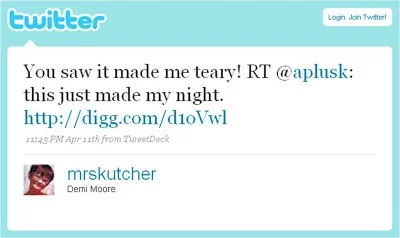
At that time, they had over one million followers. Of course, it spread as a wildfire here as well and Susan Boyle became a trending topic. Here again, we see big influencers on Social Media contributing to the ‘virality’ of a video. It seemed like Social Media platforms already decided who was going to win the contest. Unfortunately, she ended up second place in the finals. But that did not even matter anymore. Susan got all the social attention that was needed to make a celebrity of someone. As Susan’s biggest idol Elaine Paige said in an interview: "She was like a virus that spread across the world in a nanosecond." After the contest, she released an album that broke records in charts and sale in several countries (The Guardian, 2009). Without her partaking in the contest, her beautiful voice was probably still left to uncover now. Back to top
Celebreties and phatic communication
The examples described above show how we are living in a transnational sphere today in which dynamic and unpredictability are keywords (Castells, 2010). A countries’ cultural success does not stay within their borders, but spreads throughout the whole world via Social Media platforms which generates their success. Gangnam Style is not only a South-Korean success and Susan Boyle is not limited to performances in Great-Britain. A national success becomes a global success. Through the Internet people are entertained with all kinds of (music)videos that they come across because someone they know or follow liked and shared it.
People on social media platforms find it important to not miss out on this ‘virality’. They want to be part of this ‘community’ who likes and shares posts by other persons. They want to be connected with others, may it be through so-called ‘pathic communion’: the sharing of ‘empty’ messages containing no relevant content. You can see this when you look at the reactions placed by a video. They are placed so that they are part of it, not because they have anything important to mention (Blommaert & Varis, 2015).
I think it is important to mention though what characterizes society nowadays is the short attention span we have. Everyday videos go viral, we cannot keep up with these continuous and dynamic flows of content. This often results that someone’s fame is of short duration and songs are quickly forgotten. PSY and Susan Boyle have not been in the spotlights for a long time. People moved on to other artists and in a month it will be someone else again who will be in the middle of attention. As a recently famous singer you cannot afford it to take a year off. Their fame will be vanished as quickly as their music video was uploaded on Youtube.
Back to topReferences
Anonymous (2009). Susan Boyle audition tops YouTube most-watched videos chart. Evening Standard. (Last retrieved on November 1, 2017).
Blommaert & Varis (2015). Enoughness, accent and light communities: Essays on contemporary identities. Tilburg University, The Netherlands.
Castells, M. (2010). The Rise of the Network Society. West-Sussex, United Kingdom: Blackwell.
Edwards, L. (2012). How Did Gangnam Style Go Viral? SocialMediaToday. (Last retrieved on November 1, 2017).
Edwards, L. (2012). How Did Gangnam Style Go Viral? SocialMediaToday. (Last retrieved on November 1, 2017).
Hyde, M. (2010). What Elaine Paige really thinks of Susan Boyle. The Guardian. (Last retrieved on November 1, 2017).
Jones, G. (2012). How did gangnam style go viral online? (Last retrieved on November 1, 2017).
K.N.C. (2012). The rise and rise of PSY. The Economist. (Last retrieved on November 1, 2017).
McIntyre, H. (2017). Psy's 'Gangnam Style' Finally Reaches 3 Billion Views On YouTube. (Last retrieved on December 11, 2017)
Michaels, S. (2009). Susan Boyle reaches No 1 with record-breaking debut album. The Guardian. (Last retrieved on November 1, 2017).
Ryzik, M. (2012). His Style Is Gangnam, and Viral Too, The New York Times. (Last retrieved on December 11, 2017).
Top 40 (2012). Week 31. (Last retrieved on November 1, 2017).
Van Dijk, J. (2014). The Culture of Connectivity, A Critical History of Social Media. New York, NY: Oxford University Press.
Back to top