


Paper
The Museum Boijmans van Beuningen Depot
This paper investigates if the new Museum Boijmans van Beuningen Depot is a transparent museum or merely provides the illusion of transparency.

Published date
Courses
Culture policy and economic impact
Copyright
This work is licensed under a Creative Commons Attribution-NonCommercial 4.0 International License.
Read time
12 minutes

On the 17th of March 2017, the mayor of Rotterdam put the first construction pole into the ground to officially start the building process of the new depot for the Museum Boijmans van Beuningen. The depot is located next to the regular Museum Boijmans van Beuningen in the Museumpark in Rotterdam and will be finished in 2020. The depot will house the entire depot collection of the museum in one central building, that will be accessible for the public. According to the museum, this is a world’s first.
Back to topThe Museum Boijmans van Beuningen Depot
The collection of the Museum Boijmans van Beuningen is considered one of the best collections worldwide. The collection consists of over 148,000 artworks. One can image that not all of these works of art are on constant display in the regular museum. Boijmans explains that only 8% of the entire collection is regularly visible in the museum halls. Now, the remaining artworks are spread out over multiple outdated depots in and outside of Rotterdam. The current depot spaces are too small and unsafe.
After five floodings in the museum’s depot, including two big ones in 2013, Museum Boijmans van Beuningen’s director Sjarel Ex snapped and decided that something needed to happen immediately. Luckily enough the museum had already started to think about a new depot in 2005.
In 2005, the museum got in touch with architect Winy Maas of the Rotterdam architect agency MVRDV and asked him to sketch a design for the depot. The idea behind the depot was to first of all save the artworks from being lost, but also to make the entire collection available for the public and make it sustainable for future generations. After multiple ideas, like a colossal table and a Fort Knox, the final futuristic design was chosen.
Back to top
The Building
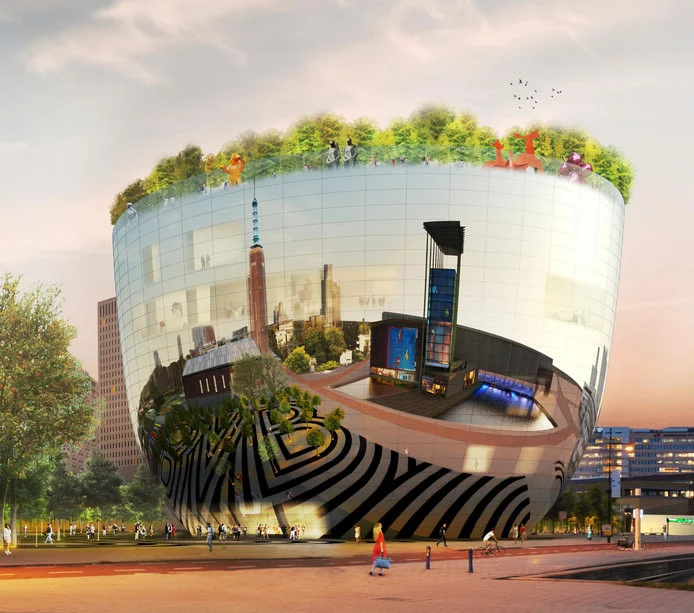
The Boijmans van Beuning Depot will reach 40 meters high, which is just as high as the original museum’s tower. The new building will be 15.000 m2 big, count 6 floors and will have a glass ceiling through which light can shine into the building. During the building process, different modern techniques and materials will be used to make the building progressive in its durability.
The design of the building was chosen to reflect the green park and the architecture in and around the museumpark and to mix with its environment. The mirroring outside will give an illusion of enlarging the museum park instead of reducing it in size. MVRDV tried to keep the museum’s footprint as small as possible by choosing a round shape that widens out at the top, to maintain the Museumpark as much as they could. The museum will plant the trees that have to give way for the construction on its rooftop garden.
The museum displays the artworks, but sells the experience of entering a backstage normally hidden.
The rooftop will be accessible free of charge and houses a restaurant and a rooftop garden. From this rooftop the visitor can admire the skyline of Rotterdam. The visitor is able to explore around 45% of the museum’s surface area after paying for their ticket. The rest of the building is visible through glass windows or on guided tours. Apart from the museum’s own collection, the museum will house collections of individual collectors and companies in seven different compartiments. These collections can also be made public for visitors if the owners wish to do so. The museum estimates that about 100.000 people a year will visit this new transparent icon.
Back to top
A transparent museum
The new museum depot seems transparent in multiple ways. First of all, visitors can experience the building process very closely online. One can download or request a printed version of the Depot Journal that will be published six times during the construction.
Furthermore, interested people can follow every article written on the subject, watch photos of the construction on the special depot website and even visit the construction site on a tour. When the building opens its doors the museum will open up its entire collection to the audience, which makes it a transparent collection. Additionally, the depot is transparent in the entire museum process. The visitor can see restoration, transportation and preservation of the collection through glass windows in the building.
However, how transparent is this museum truly? Would this mean that employees have no privacy at all and that they will preserve important artworks like monkeys in a zoo? Could this imply that an important Leonardo da Vinci is restored while rows of tourists with selfie sticks knock on the windows? Or is the transparent process merely a reconstruction of what will still happen behind doors that are still closed?
Back to topTourist Authenticity?
According to Ning Wang the authenticity of a touristic experience can be divided into three categories (1999). The first category is objective authenticity. This category refers to the authenticity of the originals, for instance the original artwork. There is an absolute and objective way to measure if an object is authentic. With technology it can be confirmed that for instance the Mona Lisa in the Louvre is the true authentic painting that Leonardo da Vinci painted and not a cheap replica. According to Wang, tourists encounter an authentic experience by the recognition of the toured object as authentic.
The second category is constructive authenticity. This authenticity refers to an authenticity that is projected by tourists or tourism producers on an object and involves for instance imagery expectations, beliefs, preferences and powers. If the Mona Lisa were to be replaced by a perfect replica, without anyone knowing about it, visitors would still encounter what they believe is an authentic experience because they trust it is the authentic painting. In constructive authenticity, the authenticity is thus the result of a social construct and has nothing to do with the objective authenticity of an object.
The first two categories derive from the authenticity of the toured object. However, the third category - existential authenticity - determines the authenticity from the point of the touristic experience and is non-object related. Existential authenticity refers to an existential state of being. This state is to be activated by tourist activities. The activities evoke personal or intersubjective feelings that one can not easily express in daily life. The visitor does not have to find the toured objects authentic, however, the engagement in these non-ordinary activities allows the visitor more self-expression and freedom and provide him with an authentic experience.
Within the research project, Wang focuses on touristic experiences in general. Deepak Chhabra (2007) adapts Wang’s theory to target museums specifically and suggests a model for museums to use regarding authenticity in her paper.
The authentic museum experience
Chhabra (2007) constructs a five point continuum containing stances towards the authenticity of touristic experiences within museums. The first, middle and fifth stance will be explained. The second and fourth stance can be seen as transitioning areas.
The first stance is called pure essentialism and mostly resembles Wang’s objective authenticity. In essentialism, authenticity is determined based on the fact if the object or person embodies or reflects a valued essence (Newman, 2016). Furthermore, it has a scientific connotation because it can only be determined by professionals. According to Chhabra, cultural signifiers like museums are endorsed by heritage authorities to use objective authenticity in their discourse.
This is, for instance, visible in the fact that museums display a painting with a small sign containing the details about the painting and the year it was made. The objective authenticity in the Boijmans van Beuningen Depot would be that the artworks are authentic works and not replicas. The essentialism stance, which is object-focused, could be seen as the opposite of the audience driven fifth stance: the constructivist school of thought.
This fifth constructivism stance implies that forms of authenticity are present for market based commodification. According to Chhabra, this stance shows ‘inclination towards audience orientation and the economic rewards’ (p. 442, Chhabra, 2007). This stance can entail deliberately constructed pseudo-backstages. Tourists are given a glimpse of the backstage of an institution like a museum to attract them for financial reasons, however this backstage is not the authentic backstage but merely a reproduction.
In the Museum Boijmans van Beuningen depot this would mean that the windows through which visitors can see restoration and preservation do not show the true restoration process that still happens behind closed doors, but merely a reconstruction of these activities. Visitors are served an illusion of transparency. This stance resembles Wang’s constructivism stance because it provides the visitor with a feeling of authenticity although the viewable object is not authentic but constructed.
The depot provides visitors a touristic experience and an existential state of being that is activated by their entry of the building and their experiences within it.
The third stance is labeled the negotiation stance and defines authenticity as a negotiation process between pure authenticity and commodification. It could be seen as a dialogue between the makers and the consumers and is inclined to embrace the authentic object - or in Museum Boijmans van Beuningen’s case: artwork. According to Laurie Kroshus Medina (2003), this re-creation process can sustain authenticity because ‘it may actually preserve traditions by generating demand or attributing value to them’ (p. 354). In practice, a museum can accomplish this by opening up the museum’s backstages for the audience, creating transparency. Chhabra suggests that museums should open op repositories and offer flexibility of exploration. By doing so, the visitor is not the end goal anymore, instead the museum becomes ‘a laboratory of reflection and explanation’ (p. 443, Chhabra, 2007).
Chhabra mentions in her article that contemporary museums find themselves stretched between an essentialism position, in which they research objects for their own sake, and a constructivist position in which they flourish on market forces. Chhabra concludes her article by suggesting that a negotiation model is the best option for museums to deal with authenticity. The negotiation stance is a mishmash between commodification and artistry. Through a negotiation process a museum can serve the market’s needs and pressures while being able to uphold its own authenticity. The most important aspect for museums then becomes reflexivity. The museum builds a reflexive relation between its audience and the museum itself. The negotiation stance seems to resemble what the Museum Boijmans van Beuningen depot is realizing, however, to what extent can the depot be fit in the negotiation stance and does it not resemble a constructivist stance?
Back to top
True transparency or merely a constructed backstage
Museum Boijmans van Beuningen brands its depot as a completely transparent depot in which the visitor is truly part of the process and is able to see the authentic museum process that normally happens behind closed doors. This seems to be a negotiation between the authenticity of the museum, visible in the chosen form of a depot to better preserve the museum’s art, and the commercial thoughts to make it accessible for an audience and make it profitable by doing so. It looks like a textbook example of Chhabra's negotiation model.
However, this transparency could also be seen as a construction. Perhaps the museum will give the audience the illusion of a glimpse into this authentic process, but still perform important restorations and preservations behind closed doors where employees won’t get distracted and have some privacy. It is impossible to predict if Boijmans van Beuningen will use a negotiation approach or a constructivist approach regarding authenticity in their depot.
Regarding the privacy, precision and importance of the work the employees perform, I would suggest to use a more constructivist approach and construct a backstage. This backstage may already be in place in the current design of the depot, since only 45% of the building is directly accessible to the public. However, the museum does claim that the remaining areas will be accessible with a guide and a guard. What’s perhaps more interesting than predicting what model the depot would use, is overthinking if it would matter if the transparency of the depot is merely an illusion.
The difference between objective authenticity and constructed authenticity, according to Wang, is solely if the object is scientifically authentic. In both cases a visitor would consider the object authentic and have an authentic experience. For the visitor, ignorance is bliss. What the Museum Boijmans van Beuningen depot offers the visitor is more of an experience than a specific object. The museum displays the artworks, but sells the experience of entering a backstage normally hidden.
For that reason, it could stated that the museum will display Wang’s existential authenticity. The depot provides visitors a touristic experience and an existential state of being that is activated by their entry of the building and their experiences within it. The visitor is able to wander through the depot without being guided by an imposed exhibition and engages in non-ordinary activities that allow the visitor an authentic experience. According to Wang, it wouldn’t matter to the visitor if the objects or activities are constructed or authentic, as long as they evoke this authentic feeling.
Apart from the innovative features the depot offers to evoke an authentic experience, I believe this feeling will be enhanced by the futuristic architecture of the building and its interior design. The building is extraordinary in its kind and does not resemble anything from daily life. The way the artworks are displayed is different from how museums regularly exhibit their works of art, and the rooftop garden offers a unique view on the Rotterdam skyline.
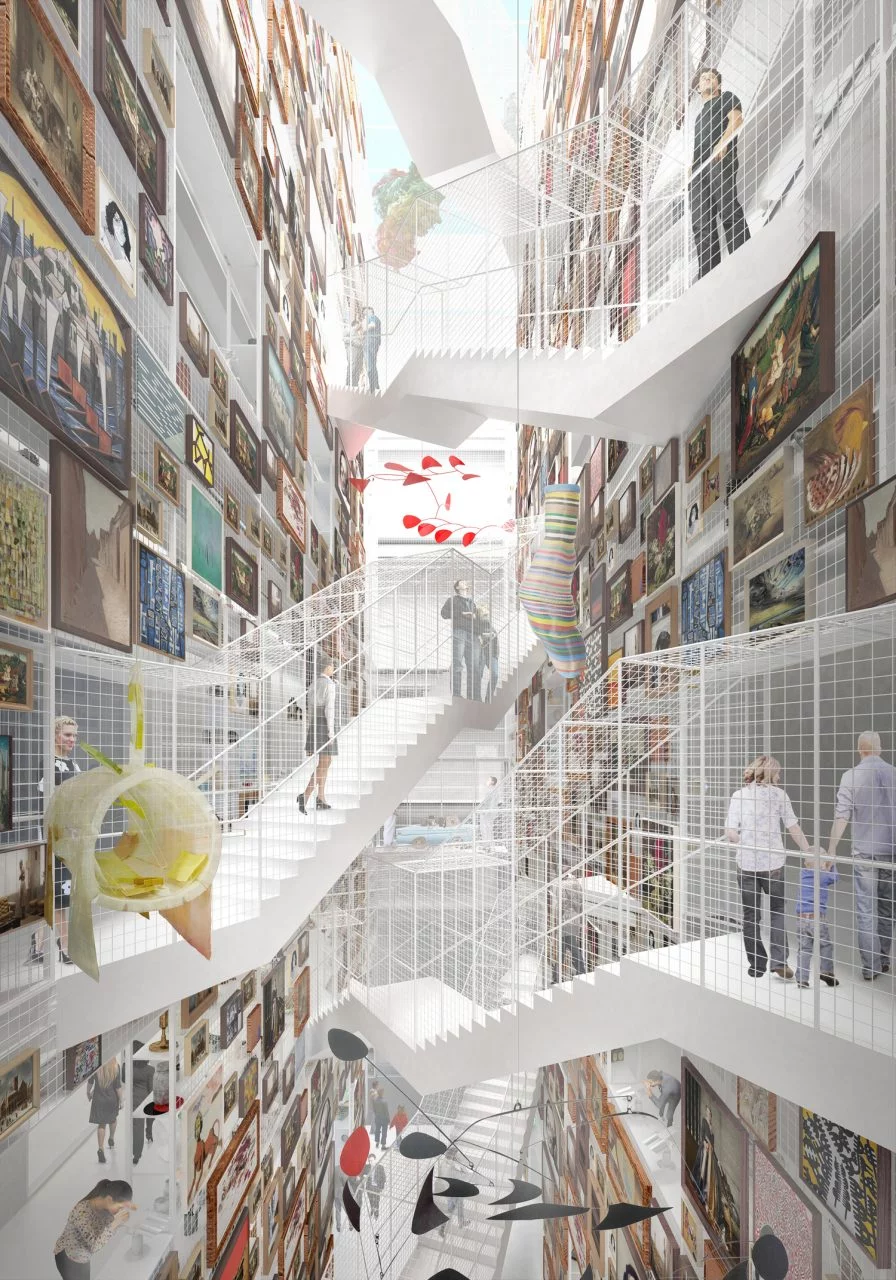
Ideas for an even more transparent inside
It could be concluded that the museum will definitely offer an authentic experience for visitors regardless of whether this experience is based on something constructed or authentic. The Museum Boijmans van Beuningen Depot is an innovative way of dealing with the display of cultural heritage and its authenticity in a museum setting.
However, the museum should overthink how transparent the depot will be. On the one hand, complete transparency would be innovative and a huge refreshment in the museum sector. On the other hand, it could raise issues of privacy and quality. The visitor will probably not notice the difference between a constructed backstage and a true backstage. Morally it would be better to provide complete transparency like the museum claims it will. What’s more, it would be interesting to see what would happen within the entire museum sector if the depot would be completely transparent: would other institutions follow? Would it prompt more and more diverse people to visit a museum?
If the museum wants to embrace this true transparency it would be a great idea to involve the audience in more decisive activities. For instance, the museum could create different workshops on restoration, preservation or collection making. It could give visitors lectures on how concepts for exhibitions are created and how artworks are selected for these exhibitions.
After such a lecture, visitors could then download an app that enables them to virtually create their own exhibitions. Subsequently, they could submit their idea to Boijmans. The museum could then create a monthly small ‘exhibition created by a visitor’ in their regular museum. This would also stimulate visitors of the depot to visit the regular museum and vice versa. Most importantly, it makes visitors active and engaged, and the museum process would become even more transparent. It would prevent the depot from becoming a new but less organised regular museum but truly makes it a lab for visitors to explore and participate actively.
The frame is there, it is visible in the building and in the concept, and it is promising. However, it is up to the Museum Boijmans van Beuningen to make the execution of the concept just as transparent and inclusive. I believe the depot could become a great asset for the city, as well as an important innovation in the worldwide museum industry and I personally hardly wait until it'sá is finished. Museum Boijmans van Beuningen, don’t hesitate to get in touch about my ideas, I’ll be awaiting your email.
Back to topReferences
Chhabra, D., (2008) Positioning museums on an authenticity continuum, In Annals of Tourism Research, 35(2), 427-447, ISSN 0160-7383
Medina, L. K. (2003). Commoditizing culture: Tourism and Maya identity. Annals of Tourism Research, 30(2), 353-368. DOI: 10.1016/S0160-7383(02)00099
Newman, G. E. (2016). An Essentialist Account of Authenticity. Journal of Cognition and Culture, 16(3-4), 294-321. DOI: 10.1163/15685373-12342181
Wang, N. (1999). Rethinking authenticity in tourism experience. Annals of Tourism Research, 26(2), 349-370.
Back to top
