Paper
Metalheads: fighting the stereotypes
Do you really need to have dirty long hair, black clothes, band T-shirts and be covered in tattoos and piercings to classify as a metalhead? This paper portrays the micro-population of metalheads and how it deals with its many stereotypes.

Published date
Courses
Social groups in the digital world
Copyright
This work is licensed under a Creative Commons Attribution-NonCommercial 4.0 International License.
Read time
15 minutes

What exactly is a ‘true metalhead’? This paper provides a description of metalheads and the surrounding stereotypes, misconceptions and truths.
Back to topMetalheads as a micro-population
Music has proven to connect people on a great scale. Enjoying the same type of music seems to create a feeling of social cohesion amongst listeners. People listening to different artists and bands with different sounds and lyrics has created several communities and micro-populations over the years. Infamous examples of this are the punk culture in the midst of the 70s and the grunge culture in the 90s.
This paper discusses another example of a musical genre with an interesting group of fans: metal. Looking at fanbases of famous bands like Metallica or Iron Maiden proves that metal has a huge following. These are two out of hundreds of examples two famous bands that are at the present-day even known outside the metal niche, as they have become what you could call 'mainstream'. Apart from these hundreds of famous metal bands, there is also a huge underground metal scene, consisting of mostly unknown bands that have small groups of fans as well. These fanbases of both the famous bands, the underground bands and those somewhere in-between together form one interesting micro-population of metalheads. Throughout this paper we will see that this micro-population deals with a ton of stereotypes, which will be discussed and put into perspective using data and important concepts.
Back to topThe metalhead
Now what exactly is a metalhead? The word already gives away a good guess of what the definition might be, namely someone who listens to metal. The Internet might be a helpful platform in finding opinions about the definition of the word 'metalhead'. Looking at Urban Dictionary, it becomes clear that there is some controversy amongst people on what the definition could or should be (Metalhead, n.d.). This definition shows some small attacks against the stereotypes created around the micro-population:
"A metalhead is anyone who listens to, and loves metal music."
“A metalhead is anyone who listens to, and loves metal music. Sub-genres are not a factor. Clothing is not a factor. Whether you hate everything is not a factor. Whether you just like the older metal bands, or the newer ones doesn't matter either. To be a fucking metal head, all you have to fucking do is love metal music. That’s fucking it.”
In this definition we already see the writer trying to defend 'the metalhead' from the stereotypes: the clothing, 'hating everything' and the type of metal you listen to. Not all metalheads look the same, behave in the same way or like the same bands. The stereotypes that many critics automatically link to metalheads and metal itself are not always correct. Scrolling further through Urban Dictionary shows that people (including metalheads) do not agree on the definition of what a metalhead is exactly. To some it seems that the stereotypes are necessary to follow to be a metalhead, but most agree that to be a true metalhead, all you have to do is enjoy metal music.
Back to topMetal, as a genre
Even though many people differ in opinion on what a metalhead is, most seem to agree on one thing: to be(come) a metalhead, all you have to do is enjoy listening to metal. We can apply the concept of ‘enoughness’: to be perceived as an authentic member of a certain group or identity category you need to have enough emblematic features of that specific group (Blommaert and Varis, 2013). To be a metalhead it seems to be enough to enjoy metal music, which rises another important question that also goes along with a relevant discussion: when can something be classified as metal?
Musical genres can be very hard to define, especially metal with its many subgenres. Some metal critics only see metal as noise, but the music definitely has some sort of code to it that makes it belong to the category of 'metal' and separates it from other genres like rock or pop (Weinstein, 2000: 10).
The metal genre started in the late 1960s / early 1970s, slowly evolving from rock music (Weinstein, 2000: 14). The true ‘founders’ of metal are often stated to be Led Zeppelin and Black Sabbath (Cogan & Phillips, 2009: 4). This can of course be argued as there were many different metal movements starting back in the late 60s. Metal can be distinguished from (hard)rock music by the heavier and more deeply distorted sounds, frequent use of screaming vocals (or grunting) and often darker or more aggressive lyrics. This is however not necessary, as metal is often based on complex, classical elements that definitely do not sound like 'just a wall of noise'. Over the years the genre grew out to be one of the biggest genres with a huge following, evolving many different subgenres like death metal, trash metal and nu-metal.
Many metalheads see a strong distinction between what is ‘true metal’ or ‘false metal’, often saying that ‘false metal’ is actually pop music, dressed up as metal (Cogan & Phillips, 2009: 5). Hating on pop music is not just a small trend amongst metalheads. It is a popular opinion that both artists and fans share. Pop music and metal can be seen as opposites. Where pop music is simple, soft and commercialized, metal is often more complex, loud and not pleasant for the ears of everyone. This can be linked to authenticity: ‘real’ metalheads do not want to listen to pop music like everyone else, because it is stands for everything that metal is not, namely music created for the mainstream. Therefore, it does not fit in the metalhead culture, which does not make someone a ‘true’ and ‘authentic’ metalhead.
Corey Taylor, the lead singer of famous metal band Slipknot, said in an interview with Loudwire that "pop music makes him ashamed to be a singer and songwriter, because the artists and music are so auto-tuned, beat-produced and lifeless while he puts his entire soul into his music" (Loudwire, 2015). This is an interesting example of a famous band member criticising pop music, especially since the band Slipknot is also criticised by some metalheads for not being ‘true metal’ and for being 'too mainstream'.
This strengthens the ‘true versus false metal’ discussion, but it also shows the strong boundary between insiders and outsiders of the micro-population. You are an 'outsider' if you do not follow or break the rules of the group you are (supposed to be) a member of (Becker, 1963: 1-2). If you like pop music or 'false metal', you can be seen as an outsider in the metalhead micro-population, because you do not follow the norms that some (extremist) metalheads see as necessary to be part of the micro-population: hating pop music and listening to 'true metal' . To some it is not enough to just enjoy metal no matter what subgenre or pop elements it has, it has to be ‘true’ metal and you need to be a 'true' metalhead.
Back to topOpposites within metal: metalcore versus black metal
Examining two bands from completely opposite metal subgenres will help to make this discussion clearer. One of these genres being metalcore, which is a mixture of metal and hardcore punk, often containing more pop elements. An example of a well-known metalcore band is Bring Me The Horizon. Both this band and the genre itself often get a lot of hate and criticism for ‘not being brutal enough’, sounding too commercialised and it is overal a popular genre to make fun of on many different online platforms for these and many other reasons. An example is YouTube video called "THINGS METALHEADS SHOULD NEVER SAY" by Jared Dines, giving examples such as "Bring Me The Horizon is the most brutal band ever" and "metalcore is the best metal genre and you're not a real metalhead unless you listen to it".
The closer the metal subgenre is to pop music, the more people will start to define it as ‘false metal’, because of the strong hatred towards pop music. This is why fans of metalcore (and Bring Me The Horizon) sometimes get seen as outsiders.
An opposite of this genre is black metal, which is a genre with quite a history. It is often defined as one of the most ‘brutal’ and ‘evil’ subgenres of metal, and the source of stereotypes like church burnings and 'Satanic' rituals (Patterson, 2013: 1). It is probably as far away from pop music as possible, and therefore it rarely, if not never, gets called out for being ‘fake metal’. Of course, black metal still has its own critics and also gets made fun of like metalcore, but mainly for reasons like the artists portraying the metal stereotypes. One of the most famous examples of black metal bands is Mayhem, one of the founders of the subgenre (Patterson, 2013: 127). They, like the genre, have an intriguing band history that goes from self-harming on stage to burning local churches. Even though they have an intense past and behaved in ways that society nowadays would definitely not see as approved behaviour, they were not seen as outsiders. In fact, they were often praised for their brutalities, which fit the subgenre perfectly.
Back to topIdentity emblems, stereotypes and misconceptions
To construct a certain type of identity, you need to have enough 'emblematic features' of a certain group in order to be able to be part of that group. When most people think of a metalhead they picture someone who with long black hair, covered in tattoos and piercings, someone who only wears only black clothes, band t-shirts, leather and occasionally denim (Weinstein, 2000: 25).
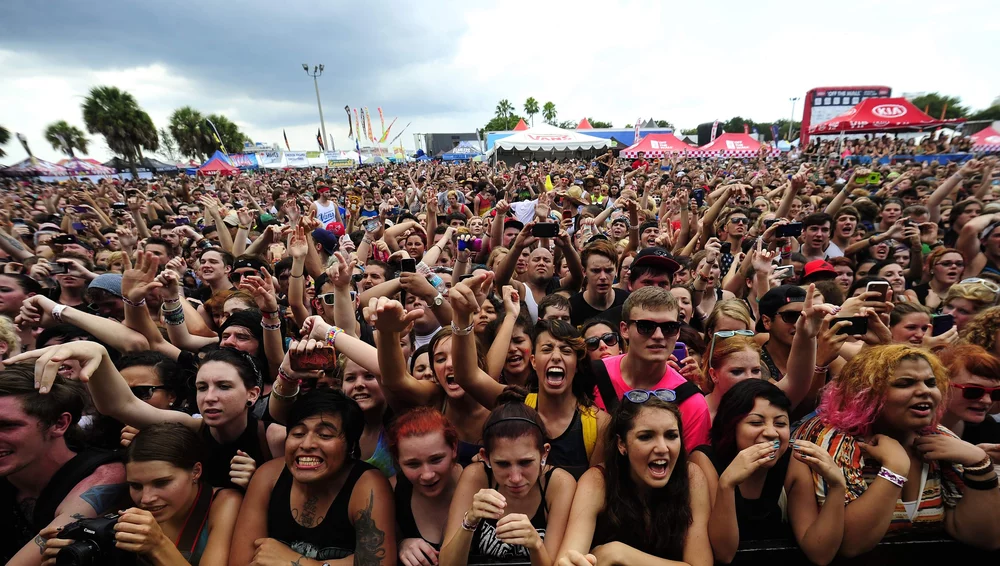
And when you go to a metal concert, festival or other offline metal infrastructures, you will most likely see the majority of the people there looking exactly like that. Especially band T-shirts are frequently seen in the metal scene; they are a way to show what bands you listen to or (if you bought the merchandise at a concert) to show what concert you went to and in this way also construct a certain identity for yourself, as the music you listen to can say a lot about your personality.
Even though this fashion style and way of behaving are often seen as obligatory identity emblems for metalheads, they are definitely not the norm. You are not an outsider if you do not dress like one, this is just a stereotype that many non-metalheads, critics and some extremist metalheads share. To many, this clothing style is their way of signifying their metalhead identity, but it is not a necessary identity emblem. As said before, all you need to reach that sense of enoughness is to enjoy metal music. Social heterogenity is much appreciated by most metalheads and everyone is free to be their own individual and authentic self, no matter in what way they construct their identity.
By showing that not all stereotypes are true (for everyone) it shows that there is no particular identity display that belongs to all the members of this group. This is interesting, because it proves that people do not always have to follow certain fashions or behavioural ways to identify as a metalhead. An example of this is Australian actress Margot Robbie, who claimed in an interview with Jimmy Fallon on The Tonight Show Starring Jimmy Fallon that “she used to be a huge metal fan” (The Tonight Show Starring Jimmy Fallon, 2016). On the show, she said the following about a Slipknot concert she went to when she was younger:
“I went to a Slipknot concert, [which was] actually to this day the best concert I’ve ever gone to. […] I was on a soap at the time in Australia called ‘Neighbours’, and the people that would genuinely watch Neighbours you’d imagine to be like families over dinnertime and like young people, but at the Slipknot concert I got more recognized than anywhere else I’d ever been while I was on Neighbours, it was so weird! And I was like ‘well this is one place, like, no one’s ever going to come up to me here’”.
This is an example of a discourse where metalheads do not act in their expected or stereotypical behaviour. You would not expect to have some badass guy covered in tattoos come up to you to ask about a show that is intended for youngsters or families and yet that person still enjoys listening to metal.
Back to topMetalcore versus black metal: identity display
We can now go back to the comparison between the two subgenres we mentioned above. Comparing black metal to metalcore is an interesting comparison, as it shows both the variety of subgenres in the genre of metal and the variety of different kinds of metalheads within metal, again proving that not all stereotypes are true.
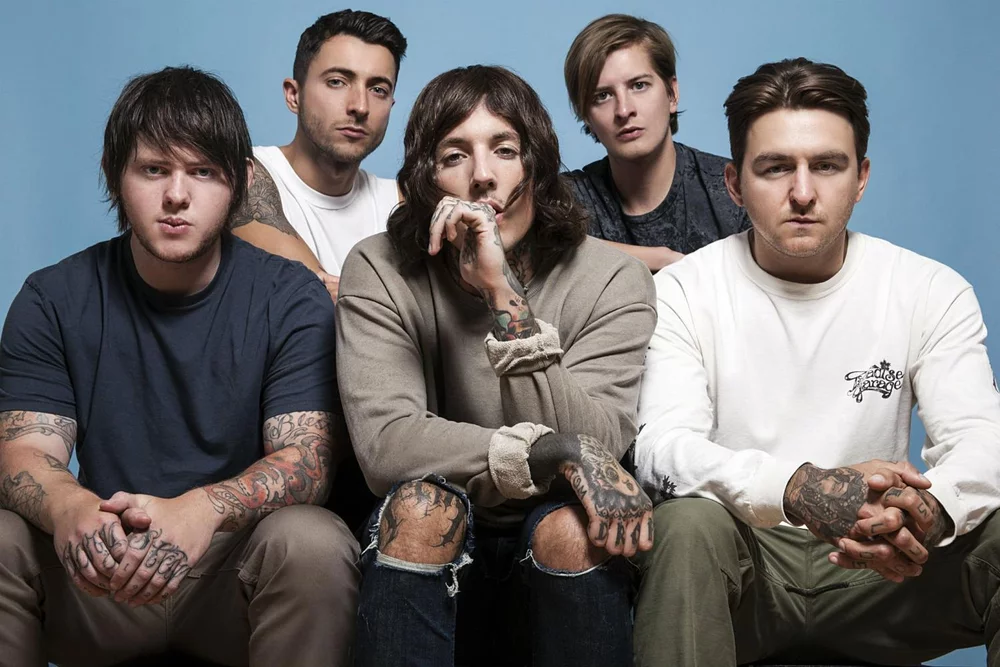
Metalcore band Bring Me The Horizon and its fans do n'ot really look like the typical stereotype metal fans as described before. The band do not have the stereotypical all-black leather outfits or the long hair, and neither do most of their fans. Two point of views come up here: few see this as more reasons for this band to be called ‘fake metal’, but most see this as the band having their own style and approach to metal.
The other end of the metal genre is black metal, with again Mayhem as a main example. When talking about stereotypes, most of the metal stereotypes fit exactly into the black metal subgenre. Whether black metal bands like Mayhem are ‘true metal’ rarely ever gets questioned as they are so ‘brutal’ and because they can be seen as the epitome of the stereotypes. As seen in these pictures, both Mayhem fans and the band itself portray these stereotypical identity emblems: black clothes, black and white make-up (also called corpse-paint by metalheads), long hair and more. This gives metalheads fewer reasons to see this band as 'outsiders'.
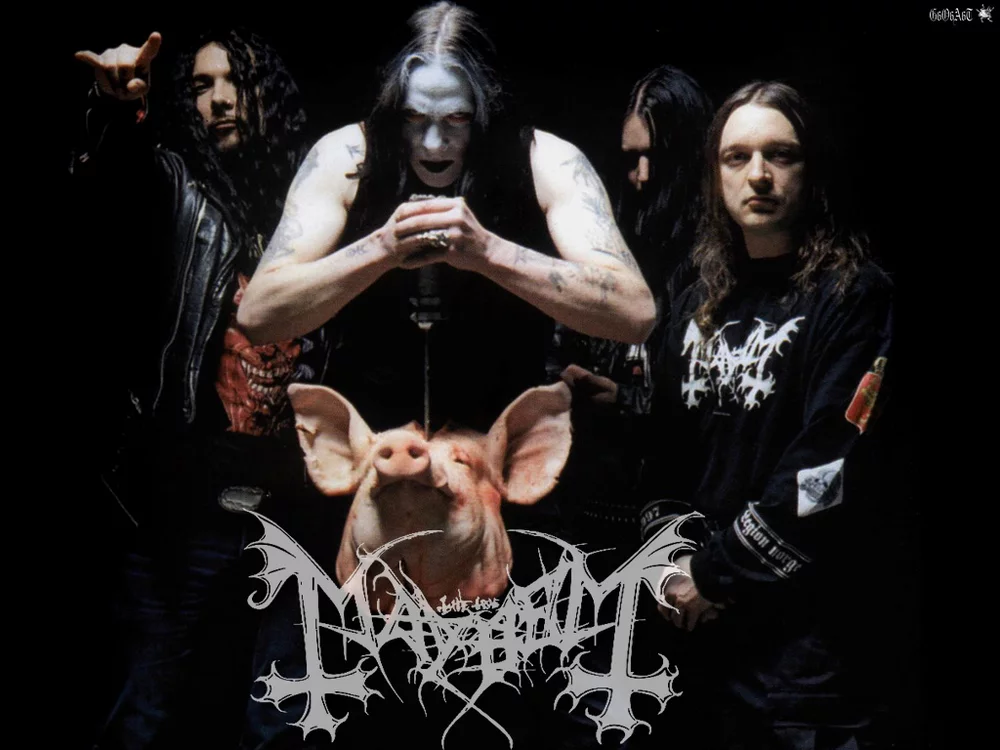
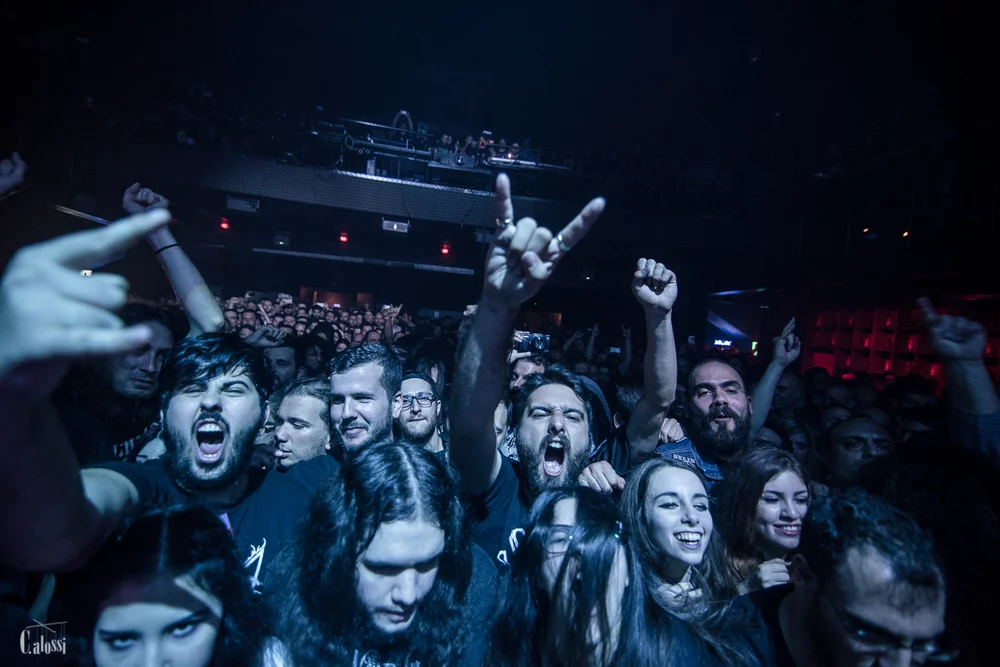
Mayhem fans, and black metalheads in general, often see black metal (and Mayhem specifically) as the only good and ‘true’ music genre. The band themselves however are not only into metal, saying that they have many different musical influences and that only being into black metal is 'a fan thing' (Patterson, 2013: 129). They even stated that they were not even Satanists themselves, despite using Satanism and dark stories in their music (2013: 129). This makes the band seem a lot less 'brutal' than many fans think they are. Bands and fans can sometimes have other views on what ‘true metal’ is, bands apparently having a more open-minded view on the genre of metal where fans get defensive over their favourite genre.
These two subgenres and bands both display a totally different style and identity, even though they both fit underneath the same big genre of metal. Showing two different ‘types of metalheads’ shows that there is a big variety underneath the one genre. It is however still true that those who do not have all the typical identity emblems (or genres that have more pop elements) are more easily 'mistaken' for outsiders or even non-metalheads. This also has to do with expectations: when we see a person walking down the street in a pink dress, we are less likely to think of them as a metalhead than when we see a person covered in tattoos and piercings, with long black hair, wearing all-black clothes.
Back to topMetal: online and offline
Metal is a huge genre, with its fans spread all around the world. This makes it a polycentric micro-population, because it has multiple centers spread around the globe (Blommaert, 2005: 254). We can use the black metal scene as an example here. Black metal started in Norway, but has over the years spread to other countries to the point where there are now bands from all around the world, such as Venom from the U.K., or Behemoth from Poland. This also explains why the metalhead micro-population is a multi-layered social group: the metalhead culture is not only produced on a local level, but on different levels of locality. A band can start out in a city, become big in their country and eventually get known world wide. This also creates metalheads on these different levels of locality, because bands can only grow in popularity if they get more fans.
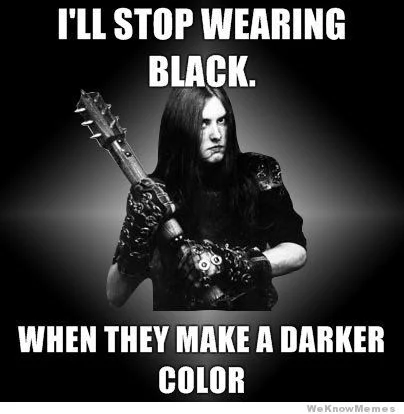
Nowadays we live in a digital age where next to the offline infrastructures, online (digital) infrastructures also play a big part in the shaping of a fanbase. This has also helped to create an even bigger polycentric and layered micro-population. On Instagram, Facebook and Twitter you can find a huge amount of 'metal memes', where metalheads mostly make fun of their own stereotypes. One of these memes can be seen above ("I'll stop wearing black when they make a darker color"). Many bands also have fans who make their own fan accounts, like the one in this picture.
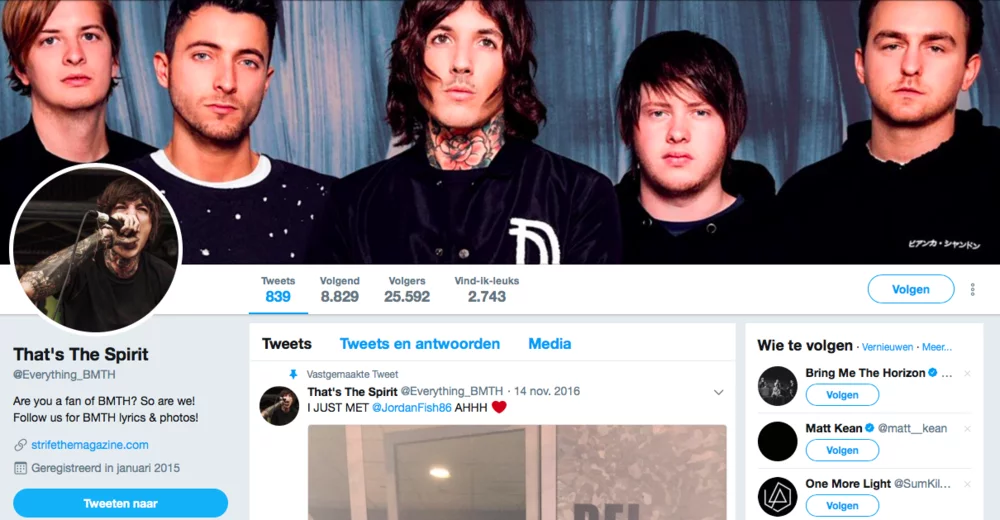
These fan accounts are place for metalheads to express their opinions on the band they support and maybe through this meet other fans. There are metal blogs, where metalhead journalists preach what they think are good and bad albums in both the famous and underground metal scene, an example being Angry Metal Guy (Angry Metal Guy, n.d.). Most metal bands have websites filled with their music, pictures, tour dates and merchandise. They have their own Instagram, Facebook and other social media accounts, used for promotion and updates. The online buying of music of course plays a big role as online infrastructure for metalheads. Their music videos and live videos are shown on YouTube, Spotify and other music platforms, where they can be viewed by the masses. Here, and on other social media, fans and critics express their love or hate for the band.
An interesting sub-group that cannot go unmentioned is the YouTube metalhead group. There are many metalhead musicians on YouTube, that try to make their living creating funny videos about metal or by displaying their music on YouTube. Jared Dines is one of these YouTubers (Jared Dines, n.d.). He uses the platform to both make videos on metal (and sometimes other genres) and to display his music to a large audience. He also makes fun of the stereotypes based around metal and its musicians in his videos, following the popular trends mentioned earlier (like in the "THINGS METALHEADS SHOULD NEVER SAY" video mentioned above).
Concerts and festivals are the place where no one has to think about the stereotypes and controversies and has an amazing time listening to great music together.
Even though there are now many different online infrastructures that the metalheads use, we cannot say that there has been a huge shift from offline infrastructures (such as concert halls, festivals and other metal meetings) to online infrastructures. Metal concerts and festivals are an important part of the micro-population of metalheads. They are the places where you see your favourite artists and bands. A YouTube video of a concert cannot compare to the feeling of going that actual concert. Concerts and festivals are the place where no one has to think about the stereotypes and controversies and has an amazing time listening to great music together.
Back to topTo be a fucking metalhead
Metalheads and their stereotypes are probably slightly more complex than you expected before reading this paper. Comparing just two bands, out of the thousands of bands within this genre, has showed the huge diversity within both the music genre and its fans. Since metal has so many subgenres, it is even more diverse than portrayed here. It is a polycentric and multi-layered micro-population, with its members spread all around the world. The stereotypes and misconceptions that many people mistake for truth have proven to be wrong in most cases.
Of course, there are certain identity emblems and specific discourses that are strongly connected to metalheads, like the black clothing and the band t-shirts. And of course, there are those 'extremist metalheads' that see it as a 'must' to have the exact described identity display. Freedom and open-mindedness are therefore very important, and therefore the only real requirement is: “to be a fucking metalhead, all you have to fucking do is love metal music. That’s fucking it.”
Back to topReferences
Angry Metal Guy. (n.d.). Home. [Blog]. Accessed April 26, 2017, see Angry Metal Guy
Becker, H.S. (1963). Outsiders. New York: The Free Press.
Blommaert, J. (2005). Discourse: A Critical Introduction. Cambridge: Cambridge University Press.
Blommaert, J. and Varis, P. (2013). Enough is enough: The heuristics of authenticity in superdiversity. In: Duarte J and Gogolin I (eds) Linguistic Superdiversity in Urban Areas: Research Approaches. Amsterdam: John Benjamins, pp 143-158.
Cogan, B., & Phillips, W. (2009). Encyclopedia of Heavy Metal Music. Accessed April 20, 2017. See Google Books
Jared Dines. (n.d.). Home. [YouTube Channel]. Accessed April 26, 2017, see YouTube
Loudwire. (2015, August 25). Slipknot's Corey Taylor: Pop Music is Insulting. [YouTube]. Accessed April 20, 2017, see YouTube
Metalhead. (n.d.). In Urban Dictionary. Accessed April 25, 2017. See Urban Dictionary
Patterson, D. (2013). Black Metal: Evolution of the Cult. Port Townsend: Feral House.
The Tonight Show Starring Jimmy Fallon. (2016, September 30). Margot Robbie Was a Huge Metal Fan. [YouTube]. Accessed 7 May, 2017, see YouTube
Weinstein, D. (2000). Heavy Metal: The Music And Its Culture. Accessed April 20, 2017. See Google Books
Back to top