

Paper
The many faces of Hillary Clinton
This analysis focuses on the many faces Hillary Clinton showed the general public during her run for Presidency in the United States of America. It argues that it might have been this "two-faced" reputation that could have cost her the job.

Published date
Courses
Digital media and Politics
Copyright
This work is licensed under a Creative Commons Attribution-NonCommercial 4.0 International License.
Read time
28 minutes

Hillary Clinton seems to be plagued by herf having two faces: the one of the experienced progressive politician supporting the middle class, and the other of the corrupt supporter of big businesses. An analysis of Clinton's different faces in her message, discourse and campaigning and the ones she seems to put up in various media to various audiences.
Back to top
Analyzing Clinton's problem
Clinton seems to have suffered froman image problemnstead of forging one strong and clear image for herself, Clinton seemed to be unwillingly juggling a wide variety of different images. Apparently one was led to believe that Clinton is both progressive, too progressive and not progressive enough, that she is a supporter of normal families, but also of big businesses. Clinton is both trustworthy and corrupt, both experienced and burdened by a negative past. , etc.
Is it any wonder that Clinton has been termed ‘two faced Hillary’? In the end, it seems her reputation as two-faced has won over the image she would have pursued herself. Of all the people who have voted against Clinton in the 2016 elections, more than 75% stated that they thought she was not honest or trustworthy and more than 90% thought she did not have the right temperament to serve as a president (NY Times, 2016). In this paper we retrace the origins of this ‘two-faced’ image that Clinton has cultivated: is it her own actions and inconsistent message creation or it is the media that have created the conflicting faces of Clinton?
What we refer to in this essay as ‘faces’, can be conceptualized as the different images that different audiences attribute to Clinton and the ones Clinton produces. Politicians attempt to craft an image for themselves as an essential part of their message. A ‘message’ in political parlance is the character that a politician presents to a public through their behaviours, backstory, morality and issues (Lempert & Silverstein, 2012). Everything a politician does message and can cause shifts in the image that is being cultivated. Two characteristics of message and image are important to understand how different faces can come to be:
- 'The fallacy of internalism' (Thompson, 2013a) states that meaning is not simply captured in a message, but that the meaning of a message and the image it fits into is constructed by the audience in a particular context. The same message can thus be reframed in different ways or be attached with different meanings by different audiences. We use this theoretical frame to understand how Clinton's message could be reframed and used to paint Clinton as the 'two-faced' politician.
- 'Addressivity' (Bakhtin, 1984; as quoted by Maly, 2014) means that a message is always in some way addressed to a certain audience. Different messages need to be tailored to different audiences. This can be a positive, since different audiences will respond to different messages. However, it can also lead to being seen as ‘pandering’ or ‘flip flopping’ when different audiences that are not being addressed catch onto the differences in messages. We will discuss how Clinton is critized for her 'flip flopping' between different media and audiences.
We conducted a discourse analysis to analyze the ‘two-faced’ image that Clinton seemed to have cultivated over the course of the presidential campaign. We analyzed how discourse by different sources create, support or dispute the different faces that Clinton is said to have. We combined different insights from political analysis and discourse analysis, such as the idea of message, image, issue (Lempert & Silverstein, 2012) ideology (Blommaert, 2005) and image to ground our analysis in a robust theoretical framework.
The data used in this report consist of discourse in different forms found offline and online. Because Clinton has a long history in politics and coverage about this, we decided to focus on the coverage from the moment Clinton announced she would be running for president (April 12th 2015), with a focus on the coverage from the primaries on. We collected data from the Clinton campaign (website, speeches, press releases etc.) and analyzed these to determine the self-presentation present in them to the face that Clinton herself wants to shape. We also collected data from newspapers, blogs and websites to determine which faces of Clinton are presented and supported. Both supportive and critical media were included, but since the analysis discusses criticism on Clinton a focus is placed on the discourse of her opponents.
Back to top
Defining Clinton's faces
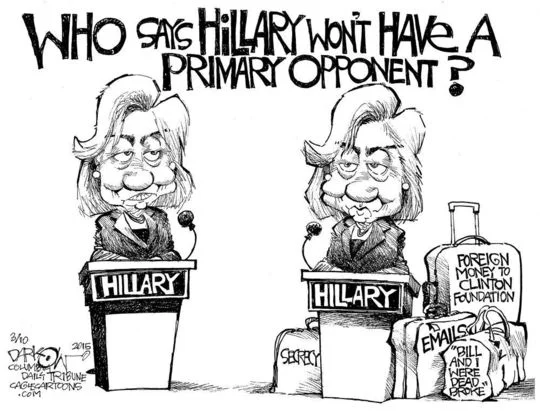
Clinton is often described as ‘two-faced’ in online media. The reasons why vary, but most seem to agree that it is a disjoint between the things Clinton says she is, and a combination of her behaviour and history. Broadly, the two faces amount to one face of the experienced, trustworthy, progressive candidate against the face of the scandal-ridden, corrupt and insincere, unprogressive/socialist candidate. Upon closer inspection, this battle of faces consists of multiple aspects of Clinton's image that are constantly in contention. In order to analyze the faces of Clinton, we analyze three dichotomies in the images presented by and of her, namely:
- A progressive, feminist politician versus an unprogressive supporter of Wall Street (versus a 'socialist' keen on taking away liberties)
- An experienced politician who knows the workings of washington DC versus a ‘typical politician’ with a hazy past fraught with scandals
- A trustworthy, capable politician versus a corrupt and careless politician
For each dichotomy we will highlight what image is being presented on what platform by which means. After this we will discuss which face is complemented by Clinton’s issues and the discursive battle, both offline and online (Maly, 2016). We also touch upon the idea of ‘the medium is the message’: does the message that Clinton sends differ on different media and does this contribute to her overall ‘two faced image’. Finally, we present a case study on Clinton's feminist positioning and what the 'truth' is on the internet.
Unprogressive, progressive and socialist
Clinton has described herself more than once as a ‘progressive who likes to get things done’ (Jerde, 2015). The face that Clinton tries to present is the face of the progressive politician fighting for the middle class. This is evident from the message she tries to send through her communications and behaviour. The first way in which this is evident, is in the story Clinton tells about herself: a fighter who has always put up the good fight and strived for progress. Clinton’s website lists her political history and highlights her continuous fight for social justice. Clinton has spent her career fighting for families and furthering progressive causes, so she can be classified as nothing but a progressive, right? (Clinton, 2016)
The opinions on whether Clinton is a progressive differ, however. Rightwing supporters seem to accept that she is a progressive, and even a socialist, and therefore a danger. Take for instance the headline from the Statesman's Journal (Pittock, 2016): “Clinton a progressive socialist who shouldn’t be elected president” or Tim Cottons ‘insult’ that Clinton was a ‘socialist’ (Engel, 2016). The progressive message is being accepted and reframed by these opponents to make her seem more extreme than she really is, chipping away at her image of being a somewhat moderate progressive and changing her into a leftwing zealot. Note that they are not deying her message, but instead exaggerating it to make her seem less of an option of all but the extreme leftwing part of the USA.
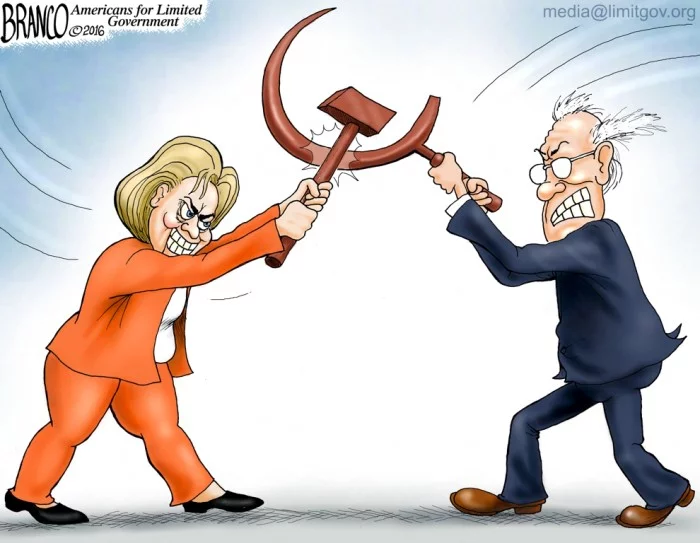
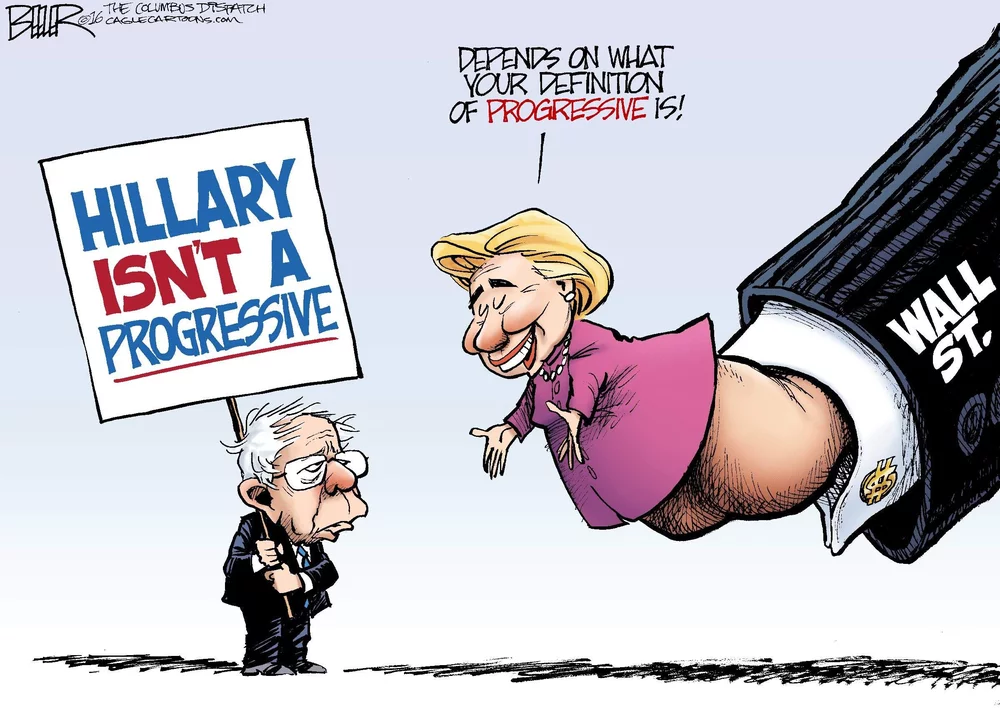
Clinton is apparenty both a socialist and a supporter of Wall Street
A more worrying reframing of Clinton’s message comes from the progressives themselves. Many progressives do not accept Clinton’s progressive face and instead see an unprogressive supporter of Wall Street. Full disclosure: not all progressives have rejected Clinton’s message and many newspapers have stated that Clinton can indeed be seen as a progressive, mostly based on the issues that she supports (e.g. The Boston Globe calling Clinton’s campaign ‘Strikingly progressive’ (Cohen, 2016) and Elizabeth Warren stating that Clinton is ‘running the most progressive agenda in history’ (Lima, 2016)).
Many progressives do not accept Clinton’s progressive face and instead see an unprogressive supporter of Wall Street.
The backlash against Clinton’s progressive claim is, however, significant. Take the headline by the anti-corporate, progressive and socialist magazine In These Times stating: “If Hillary Clinton and Tim Kaine are “progressive,” then the word has lost all meaning” (Geier, 2016). One of the most damning points for many progressives, is Clinton’s ties with Wall Street. To paraphrase president Obama: Clinton’s ties with Wall Street made her seem like an ‘insider’, a supporter of big businesses instead of families (Forster, 2016). This face of a supporter of Wall Street was for many progressives irreconcilable with the face of a progressive.
Clinton's political history is also frequently cited in arguing Clinton is not a progressive, capitalizing upon previous non-progressive policies, votes or behaviours. Williams (2016) for ‘In these Times’ writes: “Making a progressive case for Clinton is impossible given her history.” Bernie Sanders also used Clinton's ties with Wall Street and her history in a series of Tweets arguing why she is not a progressive (Sterne, Weiner, & Oreskes, 2016). Even after Sanders endorsed Clinton, many progressives still did not feel that Clinton truly was their champion. This history, as we see next, was also used to construct even more harmful faces of Clinton.
The experienced politician versus the scandal-ridden one
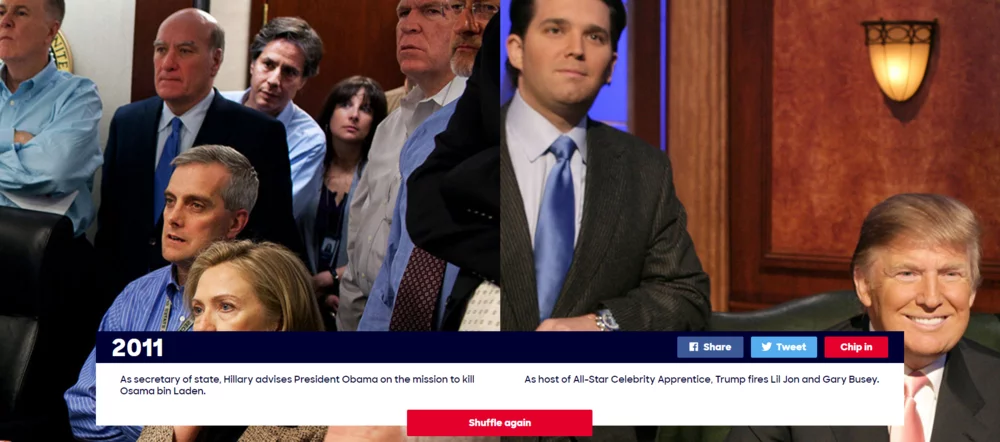
Clinton is happy to present herself as the experienced politician with a long history in politics. A quick look on Clinton’s campaign website shows a summary of Clinton’s history in politics and the actions she undertook. She seemed especially eager to highlight this in contrast to Donald J Trump’s lack of political experience. Take for instance this online tool (shown below) that clearly contrasts ‘way back when’ Clinton was in politics and Trump was hosting celebrity shows (Clinton, 2016).
On the other side of the experienced Clinton is the Clinton that has a history in politics that is ridden with scandals. Thompson (2013b) writes on the political effects of scandals and discusses how politicians in the media (and new media) age have to manage their visbility. Scandals are not new in politics but, unfortunately for Clinton, they have become more and more prevalent in political discourse. One of the causes for this is increasing visibility: everything that a politician does can be somehow recorded and shared, and scandals are no longer localized: anyone can share a scandal with a lot of people. Moreover, things don't even have to be true in order to be seen as a scandal. As John Oliver puts it in an episode of 'Last week Tonight' dedicated to Clinton and Trump's scandals: "If you believe the internet, she [Clinton] 's guilty of everything." (Oliver, 2016). The media is no longer functioning as a gatekeeper and this, in combination with Clinton's already shaky image, gave way to a flood of scandal accusations.
An example of a scandal that is often referred to by her opponents is the Benghazi attacks. The Benghazi attacks are often referred to when discussing Clinton’s past and for many are a reason to see Clinton as unsuitable due to her tattered past (Hicks, 2016). To quote: “If Mrs. Clinton was unable to fulfill her security obligations to the federal employees she was legally obligated to protect as secretary of state, how can we trust her with the security of our entire country? I won’t.” Where previously the scandal might have just been of interest to those generally concerned with politics or the military, the scandal was explicitly used by different anti-Clinton sites to underline that she is not capable.
The qualified, trustworthy, capable politician versus the careless, corrupt one
Finally, like any politician Clinton has tried to be qualified, trustworthy and capable. An important part of the qualified claim is her long experience in politics. The trustworthy claim is one that she naturally tried to uphold, but failed to do during much of her campaign. An important part of this was the email scandal. The scandal made Clinton look untrustworthy and incompetent, “Hillary Clinton: Incompetent, Or Criminal?” asks the American Conservative (Dreher, 2016). Trump even called Clinton incompetent during a speech.
Her trustworthiness also took a hit over the course of the campaign: in a poll by Fox News, only 36% of voters said they considered Clinton be trustworthy (Smith, 2016). While Clinton herself has attempted to be seen as qualified and trustworthy, she struggled throughout the campaign with accusations of being careless, unqualified and, most damningly, corrupt. The email scandal was frequently used by Trump against Clinton: no amount of apologizing of Clinton seemed to be sufficient to stop Trump discussing it. The visibility added to the scandal by Trump made the scandal that much more damning. Trump even suggested that the emails were not just a sign of carelessness, the suggested that it was done on purpose and called it "worse than watergate" (Berenson, 2016). Trump essentially presented his public with a false dichtochomy: Clinton was either horridly incompetent or just plain corrupt. Either choice did not paint a picture of Clinton as a suitable candicate for the presidency.
Back to topWhile Clinton herself has attempted to be seen as qualified and trustworthy, she struggled throughout the campaign with accusations of being careless, unqualified and, most damningly, corrupt.
A multitude of media
Clinton's discourse throughout her campaign was shown to be progressive and tried to portray herself as a woman for the people of America. Her message in different media formats tended to shift from being a formal and well educated politician, who has the experience and was the well-qualified canditate, to a woman who tries to portray her character to be much like any ordinary American citizen.
Media formats allow for a political figure to address their specific discourse and allow a poltician to use that media format in order to spread that discourse to a certain demographic in society. Clinton's campaign mainly focused on the minority individuals, women and the young people's vote in America, which is similar in fashion to her democrat equal, Barack Obama. An example would be Hillary Clinton's stance on criminal justice reform, which was targeted towards the African-American vote, which was promised to bring a change in police programs, a tighter bond on communities and the police and acknowledging implicit bias existence (Clinton, 2016). Her campaign website, YouTube, Twitter and television appearances for the presidential debates were all effective mediums that allowed her to freely spread her message across to millions around the world.
Clinton's Youtube account, which totals at around 134,000 subscribers, has various amounts of campaign advertisments and has average individuals (from working class and middle class) discuss up front about specific issues that her campaign targets. The use of YouTube seems to be a smart tactic which allows her to direct her political discourse towards the younger generation of voters, who are avid users of social media. What's interesting to note is that these videos range from her political knowledge to criminal justice reform and that these videos are short, fast and straight to the point, which allows for her message to be instantly consumed by the individual.
The YouTube videos also display a message of Clinton as someone who knows how to recognise the issues of America and has the interest of every individual in society, ranging from working class citizens, black and hispanic citizens, LGBT+, women etc. Clinton uses her YouTube channel to target different demographics in different video's. Take for instance a video in Spanish or the video honoring a young muslim who died protecting his country (Clinton, 2016). Clinton uses her YouTube channel not only to speak out herself: she uses it to give a voice to the minorites she fights for.
The use of Youtube seems to be a smart tactic in which it allows her to reach her political discourse towards the younger generation of voters, who are avid users of social media
Smile, you are on TV
Another medium that Clinton was prominent on, was television. Clinton's appearance on television allowed her to freely interact with the questions that were given to her by the debate moderator and allowed her to freely disscuss her political discourse and effectively reach out towards the intended audience. We see this especially in the presidential debates that when she discusses her stance on certain issues with abortion, women's rights and immigration. Clinton also uses personal language, the use of words like "us" and "we" and her personal experiences with others she has met over the course of her campaign and Secretary of State role. This allows her to put forward the idea that her discourse is personal and sacred, thus allowing it to reach the intended audience. Her image during these debates was congruent with the image presented on her website and her social media, as she continued to speak up for the marginalized groups in society.
Within the media of TV, we were also shown another Clinton. Witnessing Hillary Clinton on talk shows and late night discussion/comedy shows, we see a Hillary Clinton who is a joker, who takes part in comedy sketches on shows like Saturday Night Live. We see her try to portray herself as a common person amongst the American people. As Lempert and Silverstein (2012 p.9) suggested, many politicians tend to obtain a celebrity like status and becoming or developing a celebrity status as a politician is beneficial.
To Clinton, using the media format television allowed her to further spread her discourse effectively and what better waye thn to partake in popular television shows? For example, her role as 'Val' in the comedy sketch "Hillary Clinton Bar Talk" on SNL, seems to portray her as an average bar worker, giving advice to the actor Kate McKinnon, who is taking the role of Hillary Clinton (Saturday Night Live, 2016). This is an excellent example of how Hillary Clinton portrayed her political discourse through various media formats, in order to gain the public vote, by using these popular media formats on television. Clinton also appeared on 'Between two ferns', where Zach Galifinakis held a mocking interview with her (Funny Or Die, 2016). This was perhaps an attempt to win the popular youth vote, but the appearence ended up being awkard, with Clinton appearing fake and stiff throughout (Wolfgang, 2016).
Hillary Clinton appeared on Saturday Night Live during her campaign
Selling out
Unfortunately for Clinton, the 'fun' side of Hillary Clinton is not displayed in all other settings of media format. When we witnessed her behaviour on the presidential debates over the last couple of months, we saw a very cold and very harsh stance she took against her rival canditate Donald Trump. Not only that, her Wall Street speeches seem to extremely contrast with what she says in the public setting and in the popular media format (Cohan, 2016). Not only this, but the very act of speaking for Wall Street (and getting paid for it) seems to contrast with the progressive stance Clinton promotes in other media.
Therefore, within this media setting, her ideologies and proposals starkly contrast with her discoursein other various media formats such as television. Her intentions seemed to be more towards Wall Street sympathies and her political views shifted towards being pragmatic and had a "middle of the road" attitude (Zurcher 2016b). This reveals a contrast with her discourse on television where she advocated for the American people and had a progressive nature in her political belief. Here, we see the "two-faced" Hillary Clinton, who has conflicting discourses that seem to contrast each other on various media formats: both between the stern, experienced politician and the 'normal citizen' who was pretty cool, and between the progressive and the supporter of Wall Street.
Back to top
Hillary Clinton: discursive illusionist
Not only the Hillary Clinton from the past contradicts the Hillary Clinton from the present. Clinton wages a discursive battle both offline and online, and it is Clinton's own discourse that contributes to her two faced image. Discourse is an important part of shaping a politician's image. According to Maly (2014) a discursive battle can be waged over "the definition of words, the interpretation of facts, the understanding of the ideology or the general image of the party". Language is important in politics, not just in what is being said, but how, why and where it's being said. In order to understand why Clinton is being thought of as two-faced, it is important to highlight that her language might just be two-faced as well.
Analysis of Clinton's offline discursive battle shows why Clinton is being perceived as insincere in her speeches. All across Clinton’s offline discursive battle she tries to appeal to so many demographics at the same time that she could easily be seen as someone with two or more faces. With her sights on progressive Bernie Sanders' supporters, as well as more moderate Democrats and even the Republicans Donald Trump scared off with his harsh rhetoric, Clinton’s discursive battle ended up looking schizophrenic at best. This caused the image of her being 'insincere' to become an integral, unwanted, part of her message. What was being communicated was no longer what was being said textually, but what was being conveyed subtextually in the way that Clinton spoke.
Hillary Clinton's mission in the debates was clear: convince the wide range of demographics that she was the right choice. Faced with this task, Clinton couldn’t go into a battle without being armed. During her campaign for the 2016 elections, her weapon of choice was ambiguity. Clinton probably knew all too well that she would never be able to appeal to all the voters she needed by being very explicit and clear. If she would follow Bernie Sanders in his progressive, left-leaning discourse, she would almost definitely lose the Republicans who don’t support Trump and some of the more moderate Democrats. If she would try to frame herself as a less extreme alternative for Donald Trump by moving to a more right-wing stance, she would lose Sanders' followers and many other Democrats. Clinton struck what seemed to be the golden mean of this dilemma: she created a political narrative where everyone can read whatever they want to read in her words. This use of ambiguity is a common and popular tool for politicians to seem agreeable for a group of voters as large as possible (Blommaert, 2005: pagenr). This effort by Clinton can be described by invoking the term 'addressivity' (Bakhtin, 1984; as quoted in Maly, 2014). Addressivity refers to crafting a message so that it speaks to a certain audience. Clinton attempted to be addressive to a broad demographic at once, but a message that tries to please everyone will not fully please anyone. When addressivity is only implicit, there is no commitment and no real mobilization of supporters.
Clinton struck what seemed to be the golden mean of this dilemma: she created a political narrative where everyone can read whatever they want to read in her words.
Arguably the most important part of Clinton’s strategy would be very carefully controlling her discourse. She does this throughout her campaign by making use of various proven strategies. The first one is heavily related to the concept of intertextuality (Fairclough, 1995), the concept that no one uses their own, unique words. Every word, phrase and sentence carries its own distinct history with it. The “new” discourse does not stand on its own, but rather is a culmination of its entire history. When Hillary Clinton uses the phrase “this is a country of immigrants” in relation to immigration issues, she does not simply accidentally use the same words Bernie Sanders did earlier this election cycle (Sanders, 2016). She actively tries to profit from her association with him: if Clinton talks the same way he does, she probably agrees with him and she is the only alternative to him now that he is kicked out of the race.
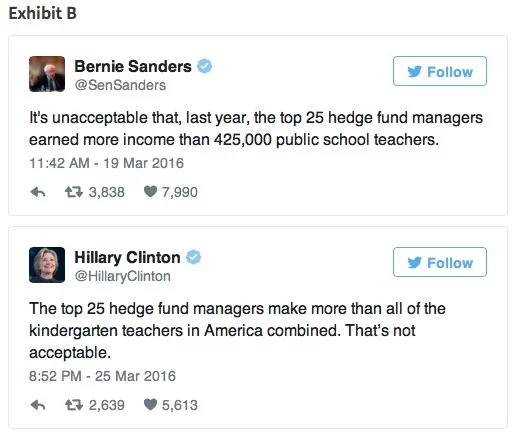
On the one hand, this strategy might be considered clever and contribute to her progressive image, yet there was significant backlash to this strategy. The observer accused her of plagiarizing Bernie Sanders and called her 'Copycat Clinton' (Sainato, 2016). A hashtag '#stealthebern' was even taken into use by opponents to mock Clinton's copying of Bernie Sanders discourse. Another example why this hashtag gained momentum during the campaign can be found in the image below. There are two tweets in the picture: one by Clinton (2016), the other by Sanders (2016). A year apart in posting, both tweets contain frighteningly similar phrasing. Sanders was popular because he was seen as honest and a politican of a different kind, yet by copying him Clinton just gave her opponents more ammunition to shoot with; after all, a politician will say anything to get elected.
Another important aspect of Clinton’s discursive battle and something that characterizes this election campaign as a whole, is how 'telling the truth' became a whole new battleground. The actual content of the discussions got pushed into the back seat, while Clinton and Trump tried to establish their own version of the truth and simultaneously tried to disprove the "truth" the other candidate proposed. Two important strategies that were used to that purpose were dogmatisation, the political version of “you’re reading it wrong”, and reformulation, changing the wording of a certain term to allow multiple interpretations (Blommaert, 2005). It is perhaps because of this that winning the debates did not mean much for Clinton's political success. According to many political commentators and newspapers, like the Los Angeles Times, Clinton won all three debates. Clinton's fact-based, nuanced, experienced and compromising style of debating made that the rational debate was certainly in her favor.

Rationally, Clinton won all three debates, but unfortunately for Clinton she was never up against a particularly rational candidate. As the Washington Post elaborated: Trump supporters don't care about facts (Ignatius, 2016). Trump does not appeal to his supporters on a rational level, but on an emotional level. Clinton was already seen as dishonest by supporters. Any comment that Trump made on that was succesfull for his audience and any claim Clinton made was already deemed untrustworthy by value of who said it. Winning all three presidential debates might have been a deciding factor had Clinton been up against a rational rival with a policy built on facts, but her opponent's campaign was built on emotions, and no amount of fact-checking could take away the profound mistrust and dissatisfaction with the political system.
The flipside of these strategies are that they are pretty easy to see through. In the end, they were used to allow Hillary to appeal to more demographics. This means that at the very least there is one demographic that Hillary is being dishonest to. This perpetuated the idea of Hillary being two-faced: she knows very well that she can’t please every group of people, but she tried to make it seem like that is possible. This way, both her Republican “opponents” and her fellow Democrats had reason to think she was crossing over to the other side. A big number of people within both groups have been given reason to believe that Clinton has another face she is not showing to them, which might have ended up earning her her infamous “two-face” reputation.
Truth and the internet
Clinton's discursive battle did not stop offline: in contemporary politics a politici clear example of Hillary Clinton’s online discursive battle creating a divide in her image
an's rights. Clinton painted herself as the breaker of glass ceilings, proudly proclaiming herself the first of Arkansas and first lady of United States all and, even after her loss, said that the ceiling now had '18 million cracks' in it. Clinton's feminist, pro-woman positioning became even more pronounced as Trump's misogeny grew. Clinton painted herself very much as the 'anti-Trump' on this topic, as is shown in the video below.
Mirrors. A feminist, anti-Trump camapign video by Hillary Clinton.
Throughout her campaign, Clinton attempted to present herself as a progressive and, more specifically, a feminist. Compared to the discursive battle offline, the online battle allowed Hillary and her team to have more preparation time and required less improvisation. It might seem fairly easy for Clinton to present a feminist image: as a woman with a record of breaking glass ceilings and fighting for women's rights, being seen as a feminist should have been fairly easy. Yet a quick Google search on 'Clinton feminist' shows that the discursive battle that is being waged on the topic online is more fierce than one would expect. Take for instance the headline by New Republic "Why feminists shouldn't trust Clinton". (Geier, 2016). Indeed, the online battle for the feminist image seemed to be more complicated than was to be expected.
Throughout her campaign, Clinton deepened her feminist image online, and tried to make it believable. She posted articles on her website, stating her past contributions to counter sexual inequality and her effort on the legislation of parental leave (Clinton, 2016). She also presented election promises on women's issues on her website, including fighting for women’s reproductive right and paid leave, in order to convince the electorates (Clinton, 2016). Interestingly, she named her donation card the “Official Woman Card” and they are distributed to her supporters (Clinton, 2016).
Counternarratives: Feminism for the 1%
Despite efforts by Clinton to be seen as a feminist, not all feminists agree that Clinton should be their candidate. We will analyze why Clinton did not manage to convice all feminists that she was truly 'their' candidate, despite the clear message she tried to send on this topic.
The online discourse against the feminist case for Clinton seems to be focused not on her current actions, but on her past options. Draitser (2016) calls Clinton the "most-anti woman candidate in history". He attacks Clinton for her past support of Bill Clinton's policies. He further attacks Clinton for practicing 'Feminism for the 1%'. Her past hand in past bombings is also brought up, showing Clinton not caring about the deaths of countless women and children. The case against Clinton's feminism is so prevalent that there is a book about it: False Choices: The Faux Feminism of Hillary Rodham Clinton (Featherstone, 2016). This book again addresses Clinton's past actions and accuses her of only caring about middle and high class women, making her not a real feminist. The message that Clinton was trying to convey was being reframed: the feminism she preached only applied to a select few. Her definition of what it means to be a feminist was contested and reframed to show that she was not a true feminist.
The feminist anti-Clinton discourse also turned towards her stance on rape, again focused on her past. Although Hillary seemed to be presenting a consistent feminist image online, there was a woman called Kathy Shelton who stated that she may be the “1 st female victim” of Hillary Clinton (Shelton, 2016). In 1975, a 41 years old man was accused of raping Kathy Shelton when she was 12 years old and Clinton was representing the defendant. Finally, the defendant got off with a lenient sentence because of Clinton’s effort. Although the defendant was dealt with according to law, Shelton took to Twitter to say she took “a lifetime to recover” from how, in her words, Clinton “smeared” her. The victim was suggested by Clinton to be "emotionally unstable" and "seeking out older men and engaging in fantasizing", a hefty claim not backed up with any sources (Kessler, 2016).
in 2014 on the internet did even more so. Clinton could be heard being interviewed about the rape case by an Arkansas reporter in the 1980s (Kessler, 2016). In the tape, both Clinton and the reporter could be heard laughing or giggling loudly during her description of the case. Even though Snopes.com, one of the most prominent fact check websites, has eliminated rumors that Clinton had volunteered to defend the rapist (LaCapria, 2016), she did definitely know the defendant was guilty from the beginning. Clinton showed an inappropriate and indiscrete attitude by frivolously describing the case in the tape.
However, not only the matter whether Clinton is a decent person is at stake. How can her claims of supporting American women and families be reconciled with her victim blaming and subsequent attitude about the case, a case whose victim was a girl? All in all, for someone who uses feminism as such a prominent point in her campaign, and someone who never misses an opportunity to criticize her opponent Donald Trump for sexism, these online accusations and revelations were very harmful. Not only to her credibility as a lawyer, a feminist or supporter of American families, but her credibility as a potential President of the USA.
Back to top
Clinton against the world
Clinton lost the elections, to the surprise of many of her supporters. We posit that it was her failure to construct a coherent and credible image of herself during her campaign that caused the loss. Inconsistencies in her own behaviour and reconstruction by the media of messages, led to the idea that Clinton had many faces, none of which were or could be completely honest. As a result of this, a new overarching image came to be: Clinton is dishonest. This image was particularly harmful, as it effectively negated any of Clinton’s own claims to the image she wanted to present. Every claim to an image that Clinton made was contested by media and contributed to this dishonest image. It is not surprising that the public indeed came to ‘Two-faced Clinton’. Even without Trump repeatedly calling her Crooked Hillary and his supporters picking up the nickname as their go-to Hillary insult (Reynolds, 2016), the sheer amount of contradiction in Clinton's discourse could have easily steered the public opinion in favour of any other candidate. There are a lot of reasons Trump may have become the president-elect, but we can be very certain that Hilary Clinton's untrustworthy image has played a major role.
Back to top
References
Blommaert, J. (2005). Discourse, a critical introduction. Cambridge University Press.
Berenson, T. (2016). Donald Trump: Hillary Clinton Email Scandal 'Worse Than Watergate'. TIME.com.
Clinton, H. (2016). The making of Hillary Clinton and Donald Trump. Hillary Clinton campaign website.
Clinton, H. (2016). The beginning. Hillary Clinton campaign website.
Clinton, H. (2016). Women’s rights and opportunity. Hillary Clinton campaign website.
Clinton, H. (2016). About Hillary Clinton. Hillary Clinton campaign website.
Clinton, H. (2016). Hillary delivers an address on women's rights at the U.N. Conference on Women in Beijing, China. Hillary Clinton’s Facebook page.
Clinton, H. (2016). “This is horrific. We cannot allow this man to become president.” Twitter post.
Clinton, H. (2016). 7 bold stances Hillary Clinton took in the fight for women's equality. Hillary Clinton campaign website.
Clinton, H. (2016). When Hillary Clinton was pregnant in 1980, her office didn’t have maternity leave—so she wrote her own policy. Hillary Clinton campaign website.
Clinton, H. (2016). Criminal justice reform. Hillary Clinton campaign website.
Clinton, H. (2016). Captain Khan | Hillary Clinton. YouTube video on Hillary Clinton’s official channel.
Clinton, H. (2015). "The top 25 hedge fund managers make more than all of the kindergarten teachers in America combined. That’s not acceptable." Tweet.
Cohan, W. (2016). Clinton’s Leaked Wall Street Speeches Reveal, Shockingly, That She Gets Wall Street. Vanity Fair.
Cohen, M.A. (2016). Hillary Clinton’s strikingly progressive campaign.
Draitser, E. (2016). Hillary Clinton: The Anti-Woman ‘Feminist’. Counterpunch.
Dreher, R. (2016). Hillary Clinton: Incompetent, Or Criminal? The American Conservative.
Engel, P. (2016). Tom Cotton rips 'socialist' Hillary Clinton: She's 'running for president so she can pardon herself'. Business Insider.
Fairclough, N. (1992). Intertextuality in critical discourse analysis. Linguistics and education, 4(3-4), 269-293.
Featherstone, L. (2016) False Choices: The Faux Feminism of Hillary Rodham Clinton
Forster, K. (2016). Barack Obama: Hillary Clinton's Wall Street speeches cast her as an 'insider' and helped her lose to Donald Trump. Independent.
Funny or die (2016) Between two ferns with Zach Galifinakis: Hillary Clinton.
Geier, K. (2016). If Hillary Clinton and Tim Kaine are “Progressive,” Then the Word Has Lost All Meaning
Geier, K. (2016). Why Feminists Shouldn’t Trust Hillary Clinton. New Republic.
Greenwald, G (2016). Why Did the Saudi Regime and Other Gulf Tyrannies Donate Millions to the Clinton Foundation? The Intercept.
Hicks, G. N. (2016). What the Benghazi attack taught me about Hillary Clinton. Fox News.
Ignatius, D. (2016). Why facts don’t matter to Trump’s supporters. Washington Post.
Jerde, S. (2015). Clinton: 'I'm A Progressive Who Likes To Get Things Done'. TPM.
Kessler, G. (2016). The facts about Hillary Clinton and the Kathy Shelton rape case. The Washington Post.
LaCapria, K. (2016). Hillary Clinton Freed Child Rapist. Snopes.
latimes.com. (2016). Final debate scorecard: Hillary Clinton won. Again..
Lempert, M. & Silverstein, M. (2012). Creatures of politics (1st ed.). Bloomington, Ind.: Indiana University Press.
Lima, C. (2016) Warren: Clinton running ‘the most progressive agenda in history’.
Kreutz, L. (2014). Hillary Clinton’s Handling of 1975 Rape Case Emerges Again. ABC News.
Maly, I. (2014). New media, new resistance and mass media
Maly, I. (2016). ‘Scientific’ nationalism. Nations And Nationalism, 22(2), 266-286.
NY Times (2016). Election 2016: Exit Polls. Exit polls held during elections.
Pittock, D. (2016). Clinton a progressive socialist who shouldn’t be elected president. Statemen’s Journal.
Red State (2016). Donald Trump: Hillary Clinton Is Incompetent Liar Who Is Mentally Unstable (VIDEO). Online video.
Reynolds, G. H. (2016). 'Crooked Hillary' nickname isn't going away. USA Today.
Sanders, B. (2015). "It's unacceptable that, last year, the top 25 hedge fund managers earned more income than 425,000 public school teachers." Tweet.
Sherman, A. (2016). Hillary Clinton’s changing position on same-sex marriage. Politifact.
Shelton, K. (2016). “I may be Hillary Clinton’s 1st female victim. She ruined my life; defended my rapist & blamed me. I was 12 yrs old. Then she laughed at me.”. Twitter post.
Shelton, K. (2016). “It has taken me a lifetime to recover from what Hillary Clinton did to me, how long will it take America if she’s elected?”. Twitter post.
Sterne, P., Weiner, A., & Oreskes, B. (2016). Sanders rails against Clinton as wannabe progressive. POLITICO.
Singh, K. & Kane, K. (2016). 7 bold stances Hillary Clinton took in the fight for women’s equality. Hillary Clinton campaign website.
Smith, J. S. (2016). Clinton's Trustworthiness Remains a Drag on Her Candidacy. Rollcall.
Thompson, J. B. (2013a). Ideology and modern culture: Critical social theory in the era of mass communication. John Wiley & Sons.
Thompson, J. B (2013b). Political Scandal. 1st ed. Hoboken: Wiley.
Williams, D. (2016). The Progressive Case For Hillary Clinton Isn’t Much of a Case At All. In These Times.
Wolfgang, B. (2016). Hillary Clinton in painfully awkward ‘Between Two Ferns’ interview — ‘I really regret doing this’. The Washington Times.
Zurcher, A. (2016a). Hillary Clinton e-mails – what’s it all about? BBC.
Zurcher, A. (2016b). Hillary Clinton's Wall St speeches published by Wikileaks. BBC.

More from this author