Paper
Make-up lovers in the online world
This paper analyzes the online behaviour of make-up lovers. It is a new, heterogenic, polycentric and multilayered micro-population in which people share a passion for this consumer product. What are the norms and how can one become a master?
Published date
Courses
Social groups in the digital world
Copyright
This work is licensed under a Creative Commons Attribution-NonCommercial 4.0 International License.
Read time
16 minutes

In this paper, the behavior and norms within the micro-population of makeup lovers will be analyzed.
Women have been applying makeup since ancient times and many trends have passed by. Nowadays, interest in makeup has come to a new level; women and men from all over the world share a passion for makeup. The internet, specifically digital media platforms like Instagram and YouTube, has given them an infrastructure on which they share their passion for this consumer product. We can now say that this group of makeup lovers can be seen as a global micro-population.
Micro-population is a concept introduced by Maly and Varis (2015) and they argue that “the world has become more complex due to new kinds of migration patterns and mobilities, the influence of new communication technologies such as the Internet, as well as the neoliberal logic of consumption and commodification. Culture, as a result, is a complex translocal and polycentric affair”. The makeup lover is a perfect example of this: its micro-population is translocal, polycentric and multi-layered.
In this paper, I will focus on concepts like polycentricity, multi-layeredness, ‘how to’ discourse, micro-celebrity, novice, master and norms and apply them to this micro-population. In the end, I will sketch a picture of what it is like being apart of this micro-population: what does one need to know in order to become a master? Which norms are being conveyed? What does it mean to be a makeup lover?
Digital ethnography and theoretical background
Communication among makeup lovers happens on digital infrastructures. In order to understand how this group functions, I have conducted a digital ethnographic research. When doing this type of research, one analyses the behaviour of members of a social group on digital platforms. Digital ethnographic research can be defined differently, but I understand it as follows:
“We might be watching what people do by digitally tracking them, or asking them to invite us into their social media practices. Listening may involve reading, or it might involve sensing and communicating in other ways. Ethnographic writing might be replaced by video, photography or blogging.” (Pink, et al., 2015)
Over the course of multiple weeks, I analysed videos made by makeup Youtubers (or makeup vloggers), comments made on these videos and Instagram accounts of various micro-celebrities within this micro-population. As these micro-celebrities are the masters, their accounts will hopefully reveal certain rules and norms that apply to the whole micro-population.
As theoretical background for this paper, I will make use of Blommaert and Varis’ (2012) analysis of how-to videos, Maly and Varis’ (2015) concept of micro-population, Becker’s (1997) theories on novices, masters and deviance Blommaert and Varis’ (as discussed in Maly, 2017) concept of culture-as-accent.
How to videos
‘How to’ videos are very important within the micro-population of beauty lovers. In these videos, the masters teach you how to apply your make-up in a good way; they teach the norms that apply to doing your makeup.
These videos not just teach how to actually do your makeup, what seems to be more important is that they teach you how to not do it. Demarcation, what is good and what is not good and what is in and what is out, within how-to literature is the first step (Blommaert & Varis, 2012).
YouTube is the main media platform on which these videos are displayed. I picked out one to analyse and see which norms are being taught. This video (figure 1) was made by beauty Youtuber Christen Dominique, who has over two million subscribers on her channel (data collected on 20th of May), from which we can conclude that she is a master within the field of makeup and the micro-population. The video is called “Makeup mistakes to avoid - do’s and don’ts”. The title already gives away the demarcation part of the ‘how to’ discourse; this is good and this is bad. In the video she applies her makeup differently on each side of her face: one side is how you should not do your makeup and the other side shows how you should apply it. For example, on one side she applies her eyeliner really thick and long and on the other side it is thinner and “more flirty and pretty”, as she says herself. And with her lipstick, she applies a light colour on the right side of her lip, which looks “just like putting concealer on your lips” (which is, in other words, not okay), while on the other side of her lip she uses a lip liner underneath the lipstick which “is more flattering”, according to her.
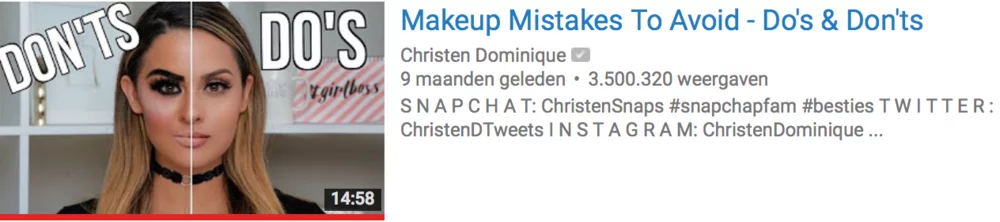
Figure 1: 'How to' video on do's and don'ts when doing makeup
Certain norms about how you should wear make-up are being conveyed. You should not colour in your eyebrows too dark, you should not wear a foundation shade that is too dark and you should not apply your highlight and blush too heavily. However, they only seem to apply on certain occasions. Various users commented (figure 2) on her video that they thought some things on the “wrong” side of her face looked good and that that is how they would wear their makeup on some occasions. So, we see that the video of Christen Dominique only teaches you the norms when going for a more natural and everyday look. However, when you go out or go to a party different norms seem to apply.



Figure 2: comments on Christen Dominique's video
From these comments we can conclude that being a makeup lover is not a uniform thing “and the ‘how to’ discourse illustrates the infinite possibilities provided by stylisation through the consumption and display of different commodities to suit certain occasions” (Blommaert & Varis, 2012). Micro-practices on getting it right thus differ between different occasions. Later on in the paper I will also focus on polycentricity and how culture plays a role in the way makeup is applied.
‘How to’ videos are not just meant for makeup lovers who are already part of the micro-population to share tips and tricks, but are also important, or even more important, for the novices. As a novice, it might be overwhelming to start doing makeup as there are so many brands with a lot of different products and different techniques needed to apply the product in a way that is going to look good. ‘How to’ videos function as a guide in which masters teach the novices what makeup to buy and how to use it.
In these videos, it is not only the technique that is simplified, but different products are used. In videos made by masters that are not specifically meant for beginners, mostly high-end (expensive) products are being featured. In ‘how to’ videos for beginners, mostly cheaper drugstore makeup products are used. So, it is not only the level of technique and the knowledge of certain norms that divides the novice from the master, but also the actual makeup that is being used.
Micro-celebrities as masters
There are many micro-celebrities within the micro-population of beauty lovers. Being a micro-celebrity is “a state of being famous to a niche group of people (Marwick, 2015 as quoted in Abidin, 2016). Within the micro-population of makeup lovers, micro-celebrities are mostly active on Youtube or Instagram or both. Most of them have either worked with a famous brand or have started their own brand. With millions of followers and subscribers they are extremely popular and influential: they know all the trends and/or they set them, they have perfected the techniques and are considered the masters.
As mentioned earlier, the micro-population of makeup lovers is a multi-layered one and micro-celebrities can be found on either a national or a global layer.
Vera Camilla is a very popular beautyblogger and vlogger from the Netherlands; she has over 250,000 subscribers on YouTube and more than 200,000 followers on Instagram (data collected on the 21st of May). Her Youtube channel only functions on a national level.
This is unlike the YouTube account of Nikkietutorials. Nikkie is also Dutch, but she chose to do her Yotube videos in English by which she crossed the language barrier. And she is successful: with her videos being accessible for more people she has been able to reach over 6,5 million makeup lovers on Youtube (data collected on the 21st of May) from all around the world. She is able to work on a global level instead of a national one.
The last microcelebrity that I will discuss is Hudabeauty, who, like Nikkietutorials, functions on a global level. She is originally a Youtuber with over 1,8 million subscribers, but her instagram account is even more popular with more than 20 million followers (data collected on the 21st of May). In her biography on Instagram, it says she is a “MUA (makeup artist) & Blogger Turned Business Woman” and that she is a “Top Beauty Influencer on Instagram”. Huda Kattan started her own successful brand, which she promotes on her account. In her bio it also says she “LOVE(s) to support artists”. And so, besides promoting her own brand, she posts videos of various makeup artists and Youtubers. This might be the reason of her incredible success on Instagram: you not only get to see photos of her makeup looks and new products, but also looks made by many other makeup and beauty lovers. This is interesting for her followers, but also for other, less successful, makeup artists. If she posts a video or photo of yours, you will likely get more famous as over 20 million people see it.
These micro-celebrities are very influential in many ways. For makeup brands these micro-celebrities are extremely important: they can either make or break one of your products. If a Youtuber features your product in a video and dislikes it, all millions of his/her followers will be less inclined to buy the product.
These micro-celebrities are also influential within the micro-population of makeup lovers, since they are the masters and can teach the novices. Online, they create a learning environment where novices can learn the rules to doing your makeup. As they are the ones who starts trends and set norms, they dominate and influence the ‘how to’ discourse. Overall, micro-celebrities are examples for others: they have perfected their techniques, earn money while doing what they love and have big collections of makeup.
A highly polycentric micro-population
In the book Outsiders (1997), Howard Becker described subcultures as homogeneous groups. “Wherever some group of people have a bit of common life with a modicum of isolation from other people, a common corner in society, common problems and perhaps a couple of common enemies, there culture grows” (Becker, 1997: 80), suggesting that these sub-groups have a common, homogeneous culture. Subcultures and micro-populations, however, are much more polycentric: there are different centres of normativity. This also applies to the micro-population of makeup lovers: there is an overarching, common interest, which is makeup, but there are many sub-groups within the bigger micro-population that apply their makeup differently, use different makeup products and have different trends.
As explained before, with ‘how to’ videos, it becomes clear that the occasion influences the way people apply their makeup; different occasions ask for different norms. Your national or regional culture or your integration in another micro-population also influences the way makeup is applied; this is called culture-as-accent (Blommaert & Varis, 2015, as discussed in Maly, 2017).
Western culture is the most dominant in this micro-population; people from America, Canada, Australia and Europe fall under the same centre of normativity in which the same techniques and trends apply. The ‘how to’ video, I discussed previously is a good example of the norms in this centre. Interestingly, you would expect that Muslim/Arabic culture is a centre on its own. However, it seems to be the case that makeup lovers from Arab countries and Western countries have the same norms. There are various videos on YouTube that seem to point out the difference between these two cultures. However, many Arabs commented (figure 3) that that is ‘old school’ and that their makeup is actually similar to Western makeup.
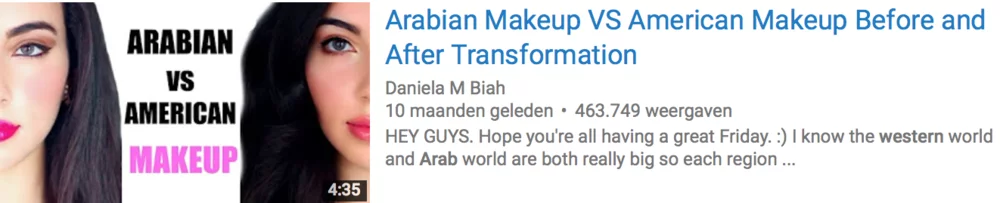


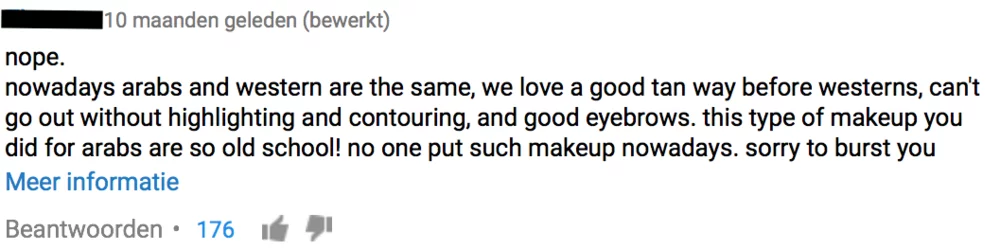
Figure 3: comments made on the video 'Arabian vs American makeup'
So, we see that Western culture is dominant and that Arabian/Muslim makeup is similar and falls under the same centre of normativity.
However, many Asian makeup lovers do have different norms and apply their makeup differently from Western makeup. Again, many videos (figur 4) can be found on YouTube in which a comparison is made between the two.
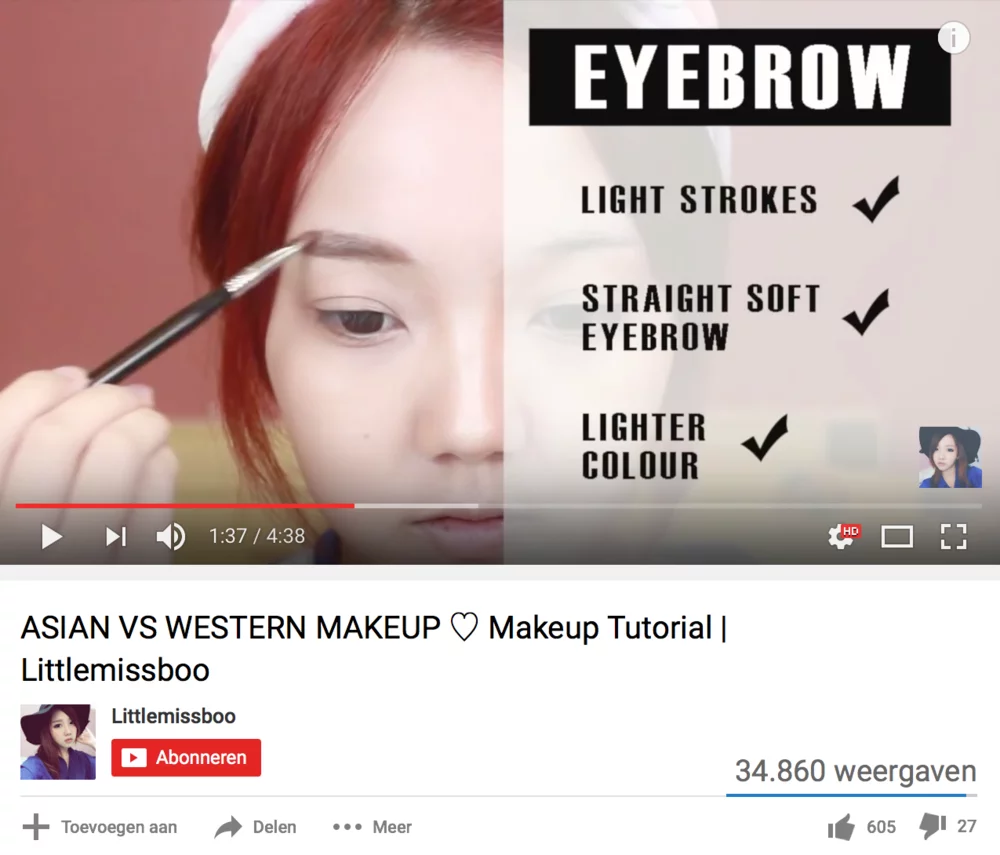
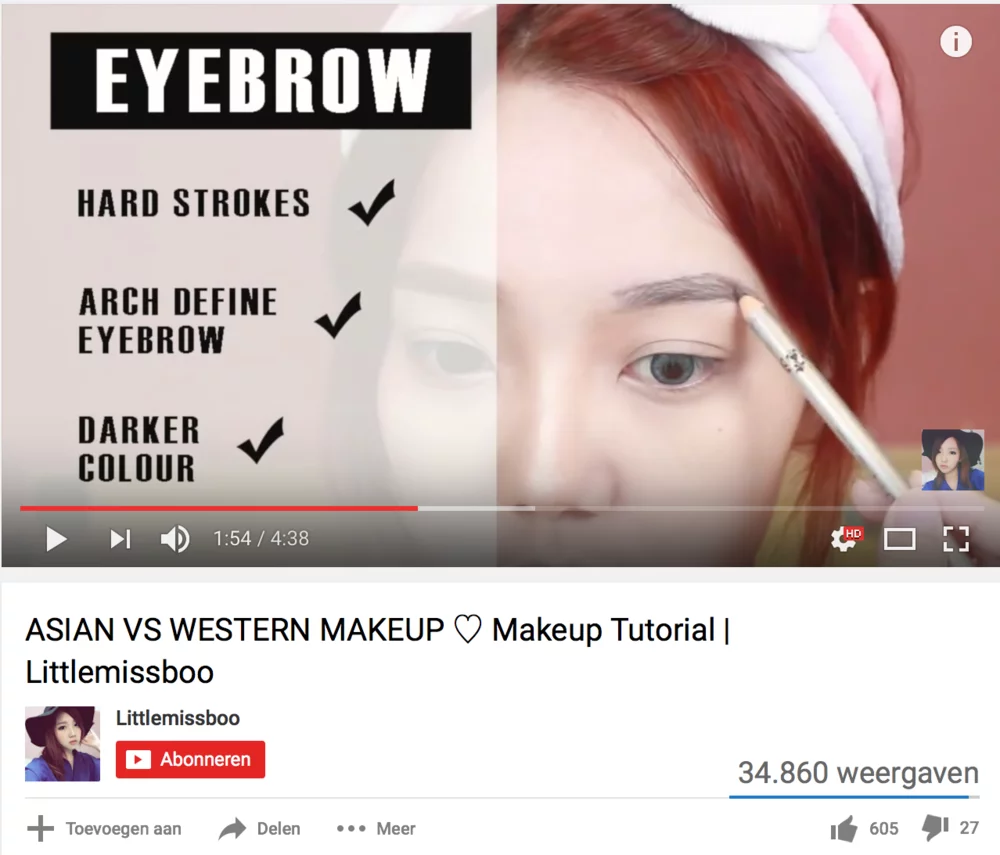
Figure 4: difference between Asian and Western makeup
In this video, we see a big difference between the Western and the Asian makeup. For example, the eyebrows are filled in with a lighter colour and it shaped more straight, while the eyebrow with the Western makeup is made darker and the shape is more arched and defined. Also, Asians prefer a lighter shade of foundation, while it is common in the Western centre that people apply a natural or slightly darker shade. Moreover, Asians create lighter eye shadow look compared to the darker look preferred in the Western centre. The overall difference with Western makeup is that for Asian makeup the norm is that is much lighter and more girly compared to the heavier and more dramatic western makeup.
Another centre, that has completely different norms when it comes to applying makeup, is that of drag queens. Makeup is very important to drag queens as this makes them look more feminine and transforms them into a new persona. A very famous drag queen makeup artist on YouTube is Miss Fame, who has over 400,000 subscribers (data collected on 20th of May). He is a micro-celebrity within this centre of makeup lovers.
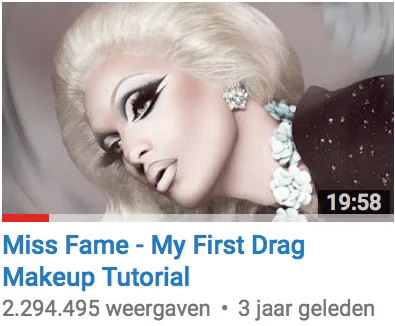
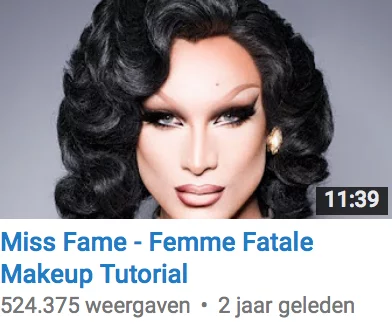
Figure 5: examples of drag makeup looks created by Miss Fame
In his videos you can see a clear difference from the dominant Western makeup. The makeup looks are overall much more over-the-top and dramatic. The eye shadows are darker, the cheekbones are more defined and the look is much less natural. But also, different techniques are used; for example, the natural eyebrow is ‘glued away’ and covered with concealer in order to create a completely new eyebrow that is positioned higher on the face. So we see that, like the Asian centre, norms differ from typical Western makeup. For the drag community, the norm is dramatic and dark makeup looks
Insiders and outsiders
In Outsiders (1997: 79), Becker discusses the deviant group of dance musicians who are “labelled as outsiders by more conventional members of the community.”. Dance musicians experienced a strong feeling of isolation from the rest of society. Although isolation might be too strong of a word, makeup lovers are similar to the dance musicians as described by Becker in the sense that they feel misunderstood by non-makeup lovers.
Memes are an important way of connecting amongst makeup lovers in which the feeling of being misunderstood by others is expressed.
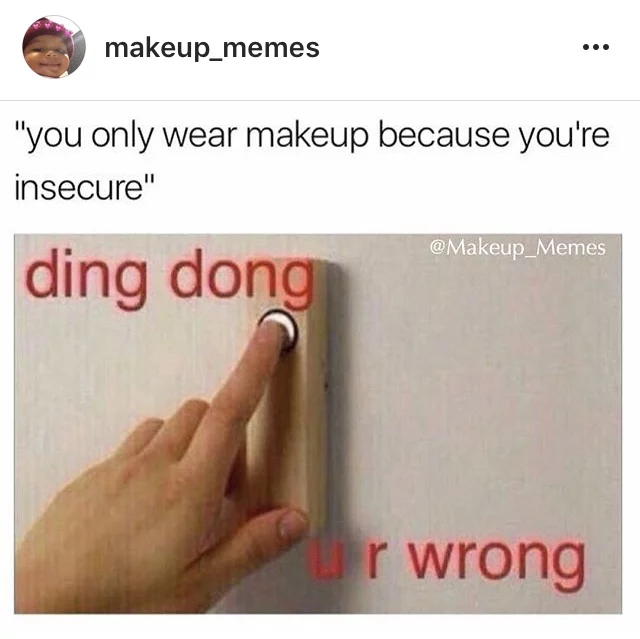
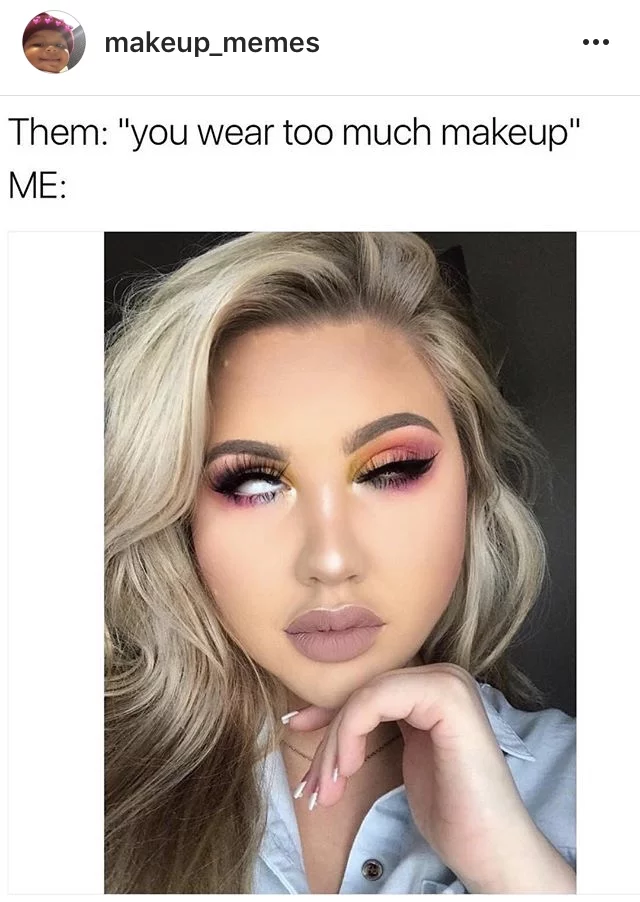
Figure 6: examples of makeup memes
In one of the examples (figure 6), we see that a stigma surrounding people who wear a lot of makeup is addressed. Non-makeup lovers seem to believe that the reason why makeup lovers wear so much is because they are insecure and that they use makeup in order to cover their imperfections. In the other meme, it is addressed that makeup lovers often get to hear that they wear too much make-up. 'Them' refers to the non-makeup lovers and the 'me' in the picture shows enough features (Blommaert & Varis, 2012) - blended eye shadow, foundation and highlighter - to be identified as a makeup lover. Non-makeup lovers seem to be oblivious to the fact that makeup lovers wear it not because they do not like their natural face of to impress someone, but simply because they like to experiment with makeup and create different looks.
Two years ago, the beauty vlogger Nikkietutorials made a video called “the power of makeup” (https://www.youtube.com/watch?v=a4Ov8qvZ2_w) which she applied makeup on one side of her face and nothing on the other half. In the video, Nikkie says: “Nowadays when you say you love makeup you either do it because you want to look good for boys, you do it because you are insecure or you do it because you do not love yourself. It is almost a crime to love doing your makeup”. The video went viral and Youtubers and makeup lovers from all over the world made pictures and videos doing the same as Nikkie did; it became a global trend. The video, like the memes earlier discussed, addresses stigmas and functioned as a message to non-makeup lovers: some people just love doing their makeup and will keep on doing it no matter what other people say. She also sends a message to fellow makeup lovers: “Makeup is fun and there are no rules to makeup. If you want to go for that super sharp contour for the day: do it. And if you want to go for a red lip and crazy bold eyes: do it”. So, despite certain norms and rules, Nikkie suggests that you should just do whatever you want with your makeup. You should experiment and not care about what other people might think of your makeup.
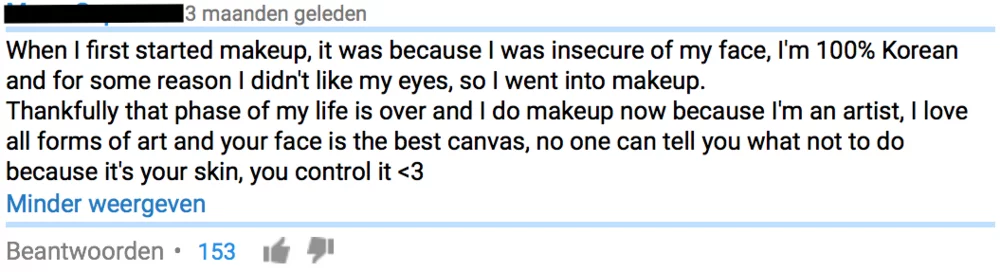


Figure 7: comments made on Nikkietutorials' 'Power of Makeup' video
What Nikkie already said in the video is confirmed by other makeup lovers in the comments section (figure 7). Makeup lovers are not insecure about their face at all, as many non-makeup lovers might think. Some see the face as a canvas on which they can express their creativity. They do not care about what other people think of them, they just simply like to create different looks.
In Outsiders (1997), Becker explains that certain rules and norms always create deviance. This works both ways: makeup lovers are considers outsiders by members of conventional society, but certain rules of this micro-population makes members of conventional society outsiders. Apart from rules and norms, makeup lovers make use of slang by which they take part in a process of self segregation (Becker, 1997). Slang is an identity indexical as it shows you are part of a certain group. By using words non-makeup lovers do not understand or have a different meaning of, the micro-population creates outsiders. Some examples are ‘hit pan’ – which means that you have reached the bottom of your makeup palette, ‘Beat’ – when your face is beat it means that you applied your makeup flawlessly, ‘On fleek’ – if your eyebrows are “on fleek” it means you have drawn them in perfectly and ‘baking’ – a technique of applying your powder in a way that your foundation and concealer lasts longer.
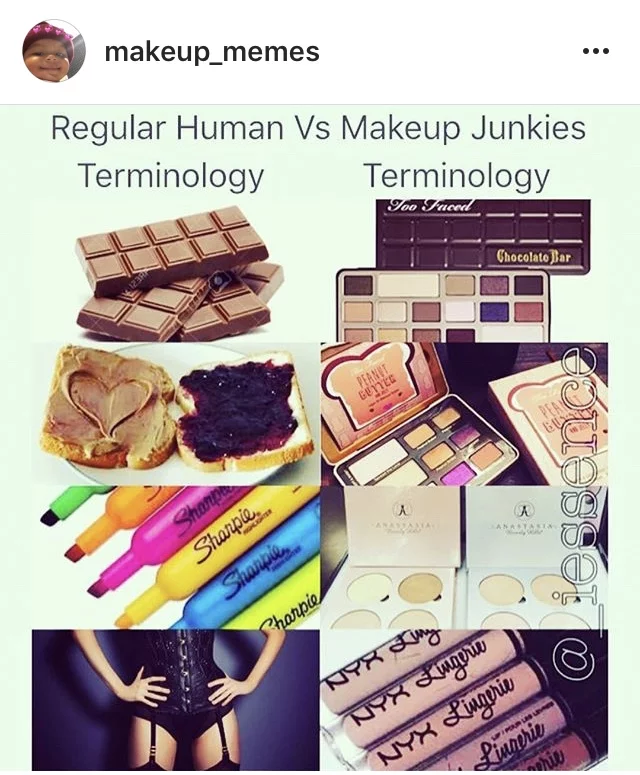
Figure 8: meme that makes a distinction between insiders and outsiders
This meme (figure 8) even makes a distinction between ‘regular human terminology’ and ‘makeup junkies terminology’. When non-makeup lovers hear the word ‘chocolate’, they would never associate it with the popular eyeshadow palette called the ‘chocolate bar’, a makeup lover will. And ‘regular humans’ will never think of the liquid lipstick line called ‘lingerie’ by the brand NYX when they hear the word ‘lingerie’.
So, only true makeup-lovers understand will understand slang and know how to use it properly. It connects them, but also creates outsiders as it divides the ‘regular human’ from the ‘makeup junkie’. Makeup lovers are thus both outsiders and insiders, it just depends on the perspective you take.
Conclusion
We have seen now that the micro-population of makeup lovers is highly polycentric and multi-layered. There are different centres of normativity and different micro-celebrities to be found on different layers. ‘How to’ videos play an important role in conveying these norms to others.
How can one make a career (Becker, 1997) within this micro-population; how can a beginner become a master? First of all, you need to know the norms within a centre. What is good and what is bad? What is in and what is out? Which brands have good products and which ones have bad products? Secondly, you need to have a good technique. Unblended eyeshadow or uneven eyeliner will give away that you are still a newbie. Thirdly, you need to be able to understand and use slang in the correct way. This is an important identity indexical and differentiates the novice from the master. Lastly, and most importantly I believe, you should not care about what others think of your makeup. There are so many norms and ‘how to’ discourses within this micro-population, but if you want to break them you should do it. Wearing a makeup look that makes you feel good in spite of possible judgment by others and having this passion for makeup is what it means to be a makeup lover.
References
Becker, H. S. (1997). Outsiders: studies in the sociology of deviance. New York, NY: Free Press.
Maly, I. (2017). Saabism and Saabists: a digital ethnographic analysis of Saab culture. Journal of Contemporary Ethnography
Pink, S., Horst, H., Postill, J., Hjorth, L., Lewis, L. & Tacchi, J. (2015). Digital Ethnography. Principles and Practice. SAGE publication.