

Article
‘Life’ on the Farm: How Stardew Valley Blurs the Line Between Reality and Fiction
Video games have evolved significantly over the past few years and have become a popular leisure activity taking up a lot of our time. But does this mean the virtual world and the real world are merging?

Published date
Courses
Reading and writing in online culture
Copyright
This work is licensed under a Creative Commons Attribution-NonCommercial 4.0 International License.
Read time
7 minutes

Gaming has become one of the most popular leisure activities among teenagers and young adults. With a variety of consoles and game genres, there is something to be found for everyone to enjoy. Video games in their earliest form used to be very simple. The game "Pong", for example, only featured 3 shapes: a circle and two rectangles, moving back and forth like a tennis match. Nowadays, video games have managed to evolve a lot due to new technology and software, allowing for a more complex and immersive gaming experience. The size of the games can be bigger, graphics are of higher quality and can look quite realistic, and online multiplayer is a crucial aspect of many popular titles. All in all, technological advancements have massively impacted the popularity of gaming as a hobby.
Keeping these evolutions in mind, I wondered how video games blur the line between reality and fiction. To answer this question, I will use the game Stardew Valley as a case study. After a brief description of the game, I will analyse it by looking at theories about escapism, parasocial relationships and the paradox of interactive fiction. Finally, I will summarise my findings and provide a conclusion.
Back to topLife on The Farm
Stardew Valley, a farm life simulation game inspired by the Harvest Moon series (White, 2018) and developed solely by Eric “ConcernedApe” Barone is one of, if not the most popular games of its genre, having sold over 30 million copies as of February 2024 (ConcernedApe, n.d.). When first starting a save file, the player’s character escapes their boring 9-5 job and inherits their grandfather's old farm in the fictional Pelican Town. There, they have an entire plot of land for growing crops, producing artisanal goods, and decorating. There are many non-playable characters (NPCs) in town to interact with and befriend, some of which can even be romanced. As players progress through the in-game years, they will encounter events, stories, and secrets all throughout town, all while creating the farm of their dreams.
Back to topA Break from the Real World
The first way that video games blur the line between reality and fiction is through escapism. When explaining why people engage in media use, escapism is one of the most frequently reported reasons (Knobloch-Westerwick et al., 2009, p. 207), often referred to as “the behavior of avoiding real-life problems by engaging in media such as TV and video games” (Li et al., 2011, p. 536). Stardew Valley facilitates escapist practices in two major ways.
First, the game is very LGBTQ+ friendly. Players can romance any of the 12 bachelors and bachelorettes in town, irrespective of the gender they choose at the beginning of the game. Queer people often use escapism through queer-coded media as a catalyst for resilience (Craig et al., 2015, p. 262), so games that include LGBTQ+ themes can be very helpful in their journey.
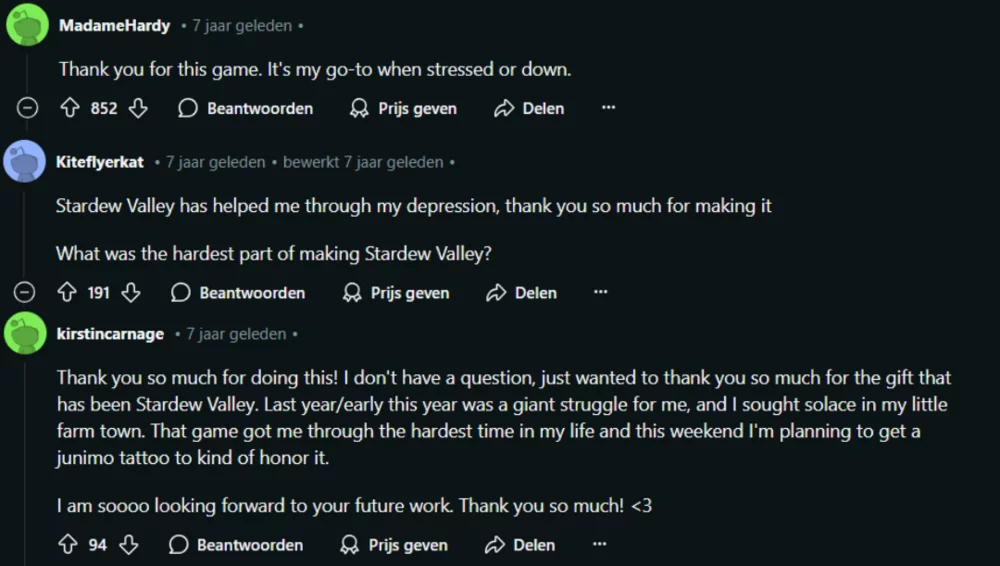
Second, the carefree and relaxing nature of the game is a way for players to de-stress and calm their minds. It presents them with a chill life on a farm without any responsibilities, and they can progress however they want and at any pace they want. In an "ask me anything" Reddit thread with Eric Barone (ConcernedApe, 2017), some fans express their gratitude to him for creating a game they can use to escape (Figure 1). Additionally, the game has no time-limited events or daily login bonuses, so a "fear of missing out" because the player did not play the game on a certain day is not an issue here.
Consequently, instead of addressing their real-life problems, some players use virtual entertainment like video games to temporarily escape from the real world and forget about them. As these Reddit users express, they have a preference for a temporary virtual solution, rather than facing reality:
Real Emotions Towards Virtual Characters
Horton and Wohl (1956) coined the term "parasocial relationship" to describe a seemingly face-to-face relationship with someone that is “one-sided, non-dialectical, controlled by the performer, and not susceptible of mutual development” (p. 215). Although the original definition of parasocial relationships only takes into account real people (or real people playing a fictional character), parasociality can be expanded to video game characters as well. This is because virtual avatars may facilitate an emotional response similar to parasocial interaction (Taylor, 2011, p. 208), and parasocial interactions with computer-generated characters can be just as strong as those with real people (Sheldon et al., 2021 p. 23).
In video games, the real and the virtual thus merge, as players experience real emotions towards characters that do not actually exist. Stardew Valley, with its diverse cast of marriage candidates, further facilitates these emotions by implementing features that resemble real-life relationship practices like gift-giving and moving in together. It is important to note that, unlike the traditional notion of a parasocial relationship, the NPCs do interact with the player and reciprocate their feelings. However, as mentioned by Kavli (2011, p. 86), characters can only follow a preprogrammed dialogue path akin to the one-sided, static communication in a parasocial relationship.
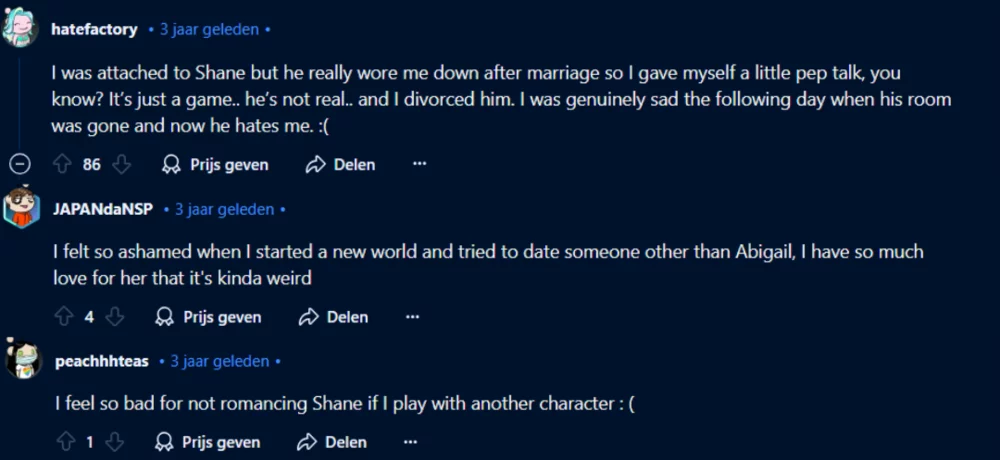
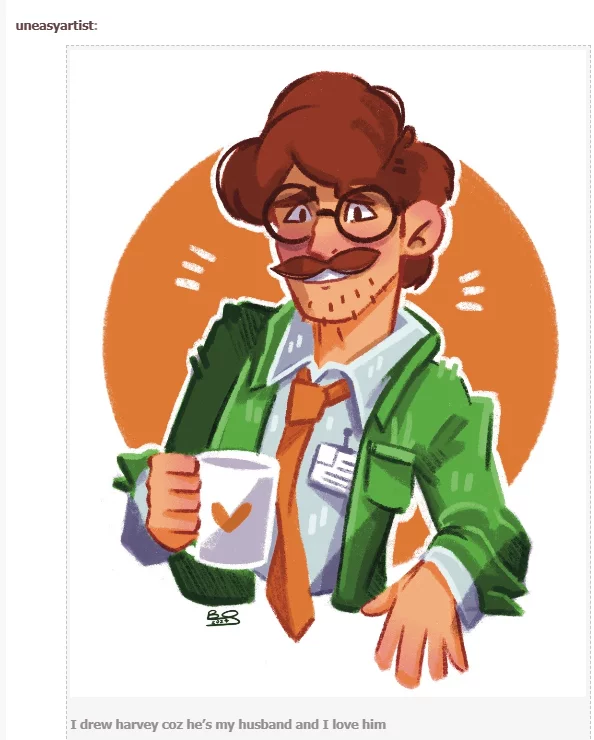
In the case of Stardew Valley, players show possible signs of parasociality through attachment and fan art. A Reddit post by user u/legobdr (2021) on the r/StardewValley subreddit in which they asked about attachment towards certain romanceable NPCs features multiple comments that express feelings of guilt, shame, or sadness because of attachment. (Figure 2). Additionally, artists creating fan art often use vocabulary that would indicate a relationship between the artist and the virtual character, such as in the comment on Figure 3.
Interacting with Fiction
The final way that video games like Stardew Valley blur the line between reality and fiction is the fact that players seem to perform real-life actions on fictional objects. To explain this, it is useful to look at the paradox of interactive fiction as described by Van de Mosselaer (2018). The paradox is made up of three claims, namely 1) “players act on videogame objects”, 2) “videogame objects are fictional”, and 3) “it is impossible to act on fictional objects” (p. 288). While playing Stardew Valley, players act on videogame objects by performing actions like watering crops, decorating their house or slaying a monster, and they know that these objects (crops, furniture, and monsters) do not really exist. What happens here is that the three statements of the paradox can not be true at the same time. The first two premises of the paradox are clearly the case, so the statement that real-world actions can not be performed on fictional objects is thus not true.
To further explain why it is possible to perform actions on fictional objects, Van de Mosselaer (2018, pp. 292-295) argues that gamers play a game of make-believe in which they themselves (in the real world) are involved. Players perform real actions on a controller, creating graphical representations they use to imagine that they are performing actions in the virtual world. For example, players move a joystick in the real world, and through make-believe, they imagine that they are walking through Pelican Town. Or, by pressing a certain button, they ‘water a crop’. The fact that real, tangible objects and actions are associated with virtual objects shows us that fiction and reality might not be as far away from each other as we think.
Back to topConclusion
By using Stardew Valley as a case study, this paper explored how video games blur the line between reality and fiction. The game’s idyllic setting provides players with a way to escape from real-life issues and stress, especially among LGBTQ+ people who find themselves represented by the freedom to marry any gender. Continuing with these NPCs, they show how players form real emotional connections with virtual characters, even though they do not actually exist. Finally, the paradox of interactive fiction shows us how people perform real-life actions on fictional objects through a process of make-believe.
All in all, these examples show how video games in their current state already have the ability to challenge the border between the real and the virtual. With technology still advancing and more realistic virtual reality software and artificial intelligence being created, who knows how long it will take until we can actually live our lives in a video game?
Back to topReferences
Barone, E. [ConcernedApe] (2017, October 9). I'm ConcernedApe, creator of Stardew Valley. Ask me anything! [Online forum post]. Reddit.
ConcernedApe. (n.d.). Media. Retrieved December 14, 2024.
Craig, S. L., McInroy, L., McCready, L. T., & Alaggia, R. (2015). Media: A Catalyst for Resilience in Lesbian, Gay, Bisexual, Transgender, and Queer Youth. Journal of LGBT Youth, 12(3), 254–275.
Horton, D., & Wohl, R. (1956). Mass Communication and Para-Social Interaction. Psychiatry MMC, 19(3), 215–229.
Kavli, K. (2012). The player's parasocial interaction with digital entities. In Proceeding of the 16th International Academic MindTrek Conference. Association for Computing Machinery, New York, NY, USA, 83–89.
Knobloch-Westerwick, S., Hastall, M. R., & Rossmann, M. (2009). Coping or Escaping?: Effects of Life Dissatisfaction on Selective Exposure. Communication Research, 36(2), 207-228.
legobdr. (2021, December 16). Do you get attached to your spouses and NPC’s. [Online forum post]. Reddit.
Li, D., Liau, A., & Khoo, A. (2011). Examining the influence of actual-ideal self-discrepancies, depression, and escapism, on pathological gaming among massively multiplayer online adolescent gamers. Cyberpsychology, Behavior, and Social Networking, 14(9), 535-539.
Sheldon, Z., Romanowski, M., & Shafer, D. M. (2021). Parasocial interactions and digital characters: the changing landscape of cinema and viewer/character relationships. Atlantic journal of communication, 29(1), 15-25.
Taylor, L. D. (2011). Avatars and emotional engagement in asynchronous online communication. Cyberpsychology, Behavior, and Social Networking, 14(4), 207-212.
uneasyartist. (2024, December 1 ). I drew harvey coz he’s my husband and I love him. [Online forum post]. Tumblr.
Van de Mosselaer, N. (2018). How Can We Be Moved to Shoot Zombies? A Paradox of Fictional Emotions and Actions in Interactive Fiction. Journal of Literary Theory, 12(2), 279-299.
White, S. (2018, March 20). Valley Forged: How One Man Made the Indie Video Game Sensation Stardew Valley. GQ.
Back to top
More from this author