


Review
The Joy Luck Club: the joy in finally being understood
The Joy Luck Club is the pioneer of Asian American representation on the big screen. It emphasizes the expectations to be 'Chinese' from your own family and the struggle to be understood by your own family, all due to the cultural gaps.

Published date
Courses
The multicultural individual
Copyright
This work is licensed under a Creative Commons Attribution-NonCommercial 4.0 International License.
Read time
9 minutes

‘To All the Boys I’ve Loved Before’ and ‘Crazy Rich Asians’ stood as the emblems of Asian-American representation on the big screens since their releases in 2018. From blooming teen romance to lavish South-East Asian style wedding parties, the two movies proudly presented Asian-American casts. But before Asian-Americans could relate to ‘Crazy Rich Asians’ and other recent Asian-American film representatives, they related to Amy Tan’s ‘The Joy Luck Club’.
As a movie about Chinese immigrants in America, ‘The Joy Luck Club’ dismissed the stereotypical views of academic-oriented, having accented English and overly frugal individuals that many people assume Chinese-Americans to be. The movie depicted Chinese-Americans as normal individuals with different, distinct personalities and dreams instead of merely representing them as the category of Chinese-Americans. It served its viewers with the message of immigrants struggling to be understood despite being competent in English. But the best part about the movie was the absence of nihaos and stereotypical martial arts experts normally boasted to be 'Asian representation'. What a score for Asians!
Back to topHow the ‘Club’ began
‘The Joy Luck Club’ began life as Amy Tan’s debut novel in 1989. Following the success of the book which sat on the New York Times bestseller list for more than 6 months (Chang, 2021), a movie adaptation was released in 1993. The movie was directed by Wayne Wang, a Hong Kong-American filmmaker known as one of the first Chinese-American filmmakers to break into Hollywood. ‘The Joy Luck Club’ wasn’t Wang’s first movie to represent Asian-Americans. His best works were known to tackle issues surrounding Asian-American life, proving him the perfect fit to direct ‘The Joy Luck Club’.
The best part about the movie was the absence of nihaos and stereotypical martial arts experts normally boasted to be 'Asian representation'
The narrative focuses on 4 mother-daughter pairs in which all 4 mothers were Chinese immigrants in America and all 4 daughters were Chinese-Americans. As a book, the narrative flow was made in a way that resembled a mahjong game, a Chinese tile game. Mahjong consists of 4 rounds, each with 4 players playing. The goal of the game is to get all 14 of your mahjong tiles to be in 4 sets of 3 identically numbered/pictured tiles and 1 pair of identical tiles.
Meanwhile, the book had 4 parts with 4 sections each, where the 4 parts resembled the 4 rounds and the 4 sections mirrored how each of the 4 players takes turns playing. The book thus had 16 chapters, filled with flashback vignettes about each woman's past life stories.
The movie also consisted of flashbacks but in a more smooth-flowing manner. It began at the mahjong table, where June Woo was playing mahjong with Lindo Jong, Ying-Ying St. Clair and An-Mei Hsu in replacement of her mother Suyuan Woo who recently passed away. Each women’s story drifted from one mother-daughter pair to another, making the narrative easier to comprehend when compared to the flashbacks in the book that seemed like large leaps from one another. Quite frankly, the story flow of the book may leave many readers floating around trying to grasp what little understanding they have of the book’s mahjong-like structure.
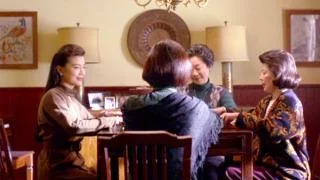
Each mother-daughter pair proposed life stories (in the form of memories) that were more than just struggling to fit into America and American society. The mothers’ stories pictured the lives they had in China: from the pain of losing children to the common unhappy marriages through matchmaking and polygyny. Meanwhile, the stories of their daughters reflected their lows in life and struggles in feeling inadequate toward the expectations of their Chinese parents.
Tan cleverly utilized mahjong, as if an expert player herself, to symbolize various parts of her narrative in metaphors. Where mahjong emphasizes using strategies to win, the mothers taught their daughters multiple strategies to cope with problems. Tan diffused the symbols of winds, dragons, and walls into the narrative, all of which were significant elements of mahjong. It was like she knew the strategies for mahjong all too well. One example was the metaphoric walls that symbolized the communication barriers and clashing cultures between mothers and daughters.
Back to topThere’s no ‘joy’ in ‘bicultural’
It’s fun being bicultural you say? The four daughters of the Joy Luck Club may disagree with you. They also probably thought being bilingual was no use or too much work. Cue the scene of June not being able to understand what the letter her Chinese relatives sent meant. Although at the end of the movie we heard her speak Mandarin, not understanding the letter can be interpreted as a big red flag showing her lack of competence in being Chinese.
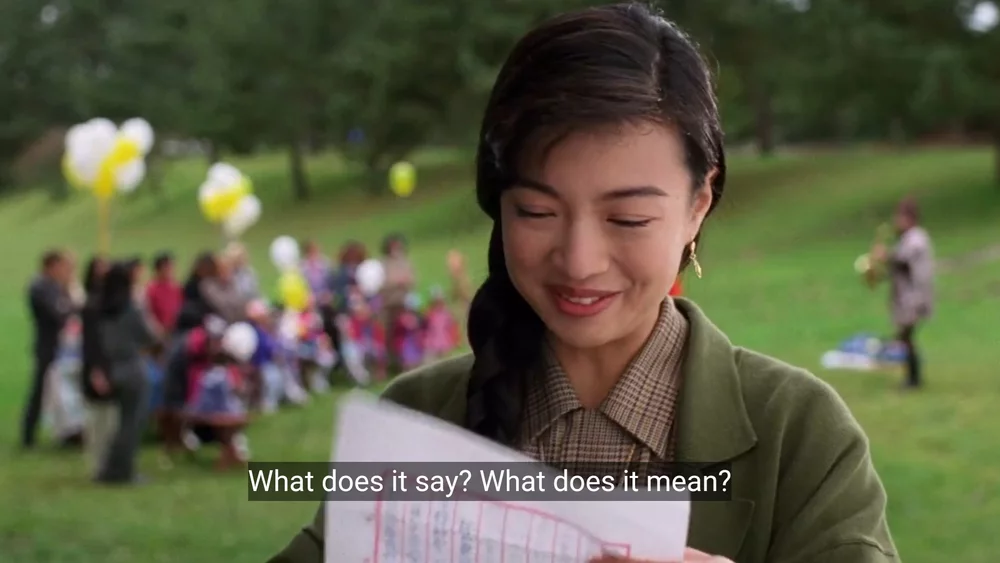
But in all seriousness, being bicultural meant that the four daughters had to constantly negotiate both their levels of ‘Chineseness’ and ‘Americaness’ to be accepted into both communities. They were neither just Chinese nor American: they had to act more Chinese in some places and more American in other places to fit into the cultural norms of both nationalities and be accepted.
Let’s go back to June’s short journey as a pianist. She had been taking piano lessons and had been finding it fun, all because her teacher was an old, nearly deaf man who thought she was pressing the right keys when she wasn’t. A performance disaster led June to stop playing the piano but was forced by her mother to keep practicing. She fought with her mother, and was told that she needed to be "an obedient daughter". Fast forward to the future. June confided to her mother that not living up to her mother’s expectations had hurt her. Her mother told June that there were never expectations, just hope, but it took them both years of misunderstanding one another to express this.
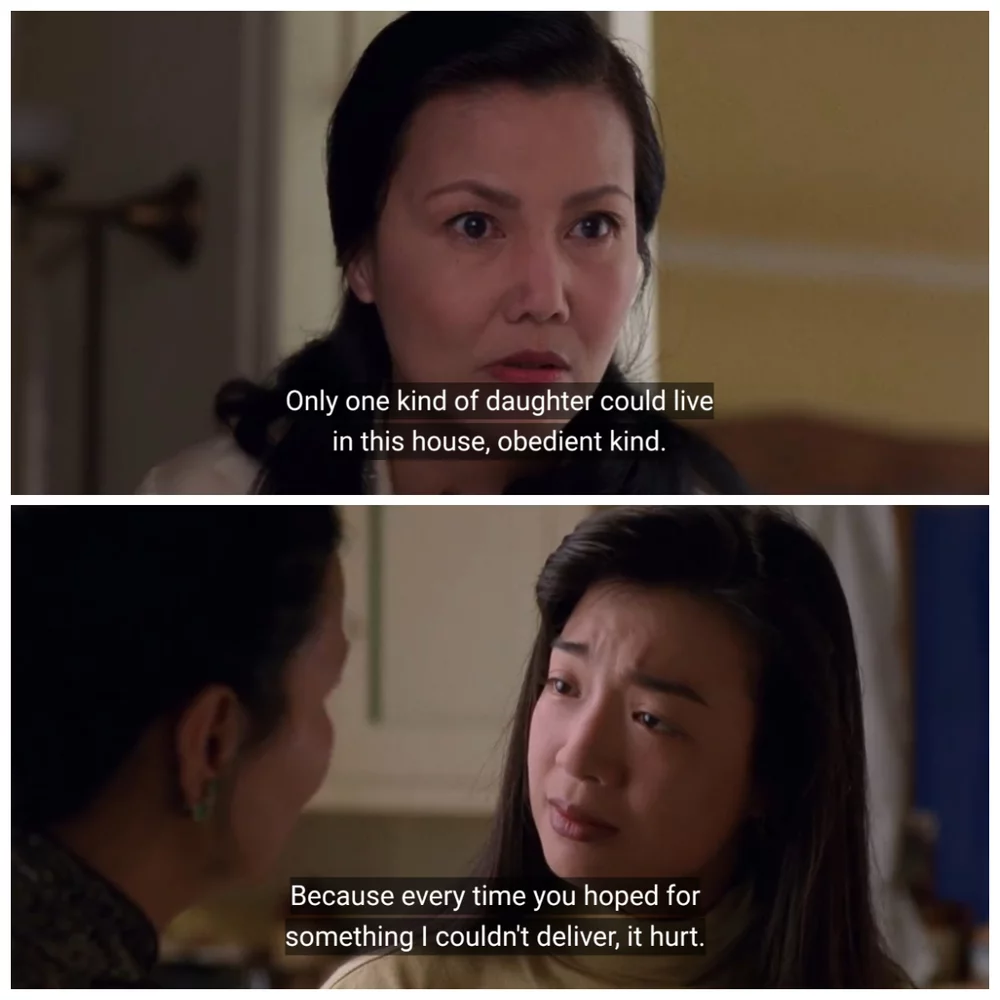
This expectation of being an obedient child was one of the many traditional Chinese values portrayed in the movie. The lack of emotions and the concealment of gratitude expressing were also some of the values prominent throughout the movie, all clashing with the open and free-spirited nature of the American culture. Whether voluntary or not, the daughters had to portray their Chinese identity to their families through various means. They were expected to follow the essential Chinese norms by their families and put pressure on themselves to be considered a Chinese person.
‘The Joy Luck Club’ is an excellent example of the bicultural identity of immigrants. It wasn’t sugar-coating the reality that the daughters were simply 'not Chinese enough' in the eyes of their families. It spoke for other immigrants who struggled with balancing cultures and who were criticized for mixing them together.
Back to topChinese culture 101
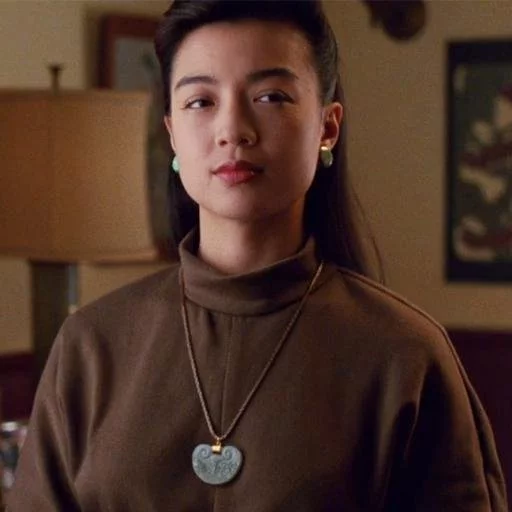
As we progressed into the movie we were treated to more Chinese cultural tropes. Some were obvious to the general public, like the traditional Chinese clothing attire, the Chinese food, or even the typical Chinese jade jewelry worn (Figure 4). But others weren’t so obvious to the naked eye.
When Waverly Jong’s partner Rich met her family for the first time for dinner, he had already been “prepped on the Emily Post of Chinese manners”. Waverly’s family had expected Rich to know the Chinese dining etiquette and when he failed to act accordingly to the unspoken rules, he received disapproving looks and utterances from Waverly’s Chinese family. Clearly Rich did not pass the perfect-guy-for-my-daughter test on the first try.
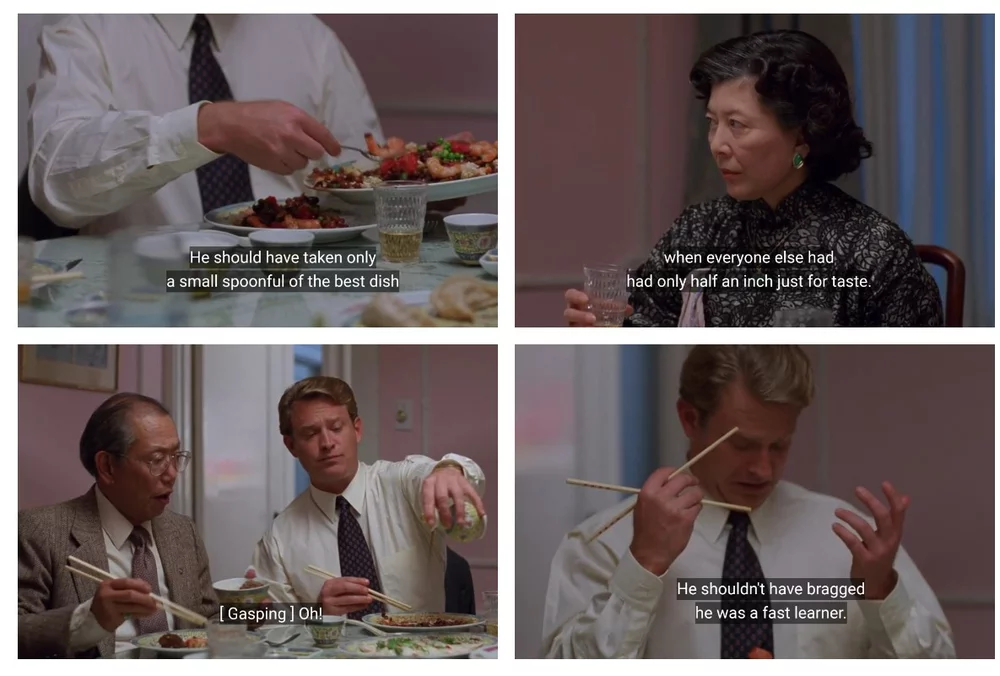
Here we can see ‘The Joy Luck Club’ portraying aspects of the Chinese culture that people are familiar with but also some that people may not be aware of. Being immigrants, there had probably been moments where the mothers and daughters were treated as outsiders, or as someone looking, acting, or sounding “different”. But ‘The Joy Luck Club’ didn’t want to emphasize how Chinese-Americans attempted to fit into these differences. It showed that to Chinese-Americans, Americans were also perceived as “different” and that Chinese-Americans were allowed to have their own opinions and views of Americans.
Of course, Rich was the outsider in this scene and he couldn’t control the way Waverly’s family perceived him. This scene showed that the Chinese culture and traditions were more than what people see on the surface. Even though Chinese immigrants were no longer in China, they still valued the traditions they brought along with them and expect these traditions to be respected. After all, immigrants like the mothers couldn’t bring much of what they had back in China to America. The Chinese culture and traditions were the fragmented, little pieces of China they still had, the pieces of China they could bring along.
Back to topWhat the movie depicted
Sure, the movie depicted what many people would expect a Chinese-American movie to have: the Chinese accent, the strict parents, and the Chinese cuisine. ‘The Joy Luck Club’ did not deny the existence of these stereotypes but it placed importance on these stereotypes. It asserted these stereotypes were essential parts of their identities as Chinese people and thus pioneered the representation of Asian-Americans as 'people' instead of 'different'.
The Chinese culture and traditions were the fragmented, little pieces of China they still had, the pieces of China they could bring along
The movie became the foundation of Asian-American movie representation that opened the way for movies like ‘Crazy Rich Asians’ to be widely accepted. In fact, Lisa Lu, who played An-Mei Hsu in ‘The Joy Luck Club’, was also part of ‘Crazy Rich Asians’. Other movies similar to ‘The Joy Luck Club’ are ‘The Farewell’, which mentioned the differences between Chinese and American values, and ‘Double Happiness’, a movie highlighting the desire to fulfill one’s Chinese parents’ expectations and wanting to live one’s own life.
Thanks to the success of 'The Joy Luck Club', both our big and small screens now have the confidence to boast a predominantly Asian cast. The movie created a shift in the film industry when it gave viewers a new culture to get used to. With its lead characters being Asian women with strong personalities, 'The Joy Luck Club' really celebrated an important milestone for underrated Asian-American talents. Strong family values, identity negotiation, and important female lead characters are all important elements of 'The Joy Luck Club' that we can also see in recent Asian-American productions. What is different about productions like 'Crazy Rich Asians' and 'Fresh Off the Boat' is the international support and attention that is now possible to achieve because of the existence of social media.
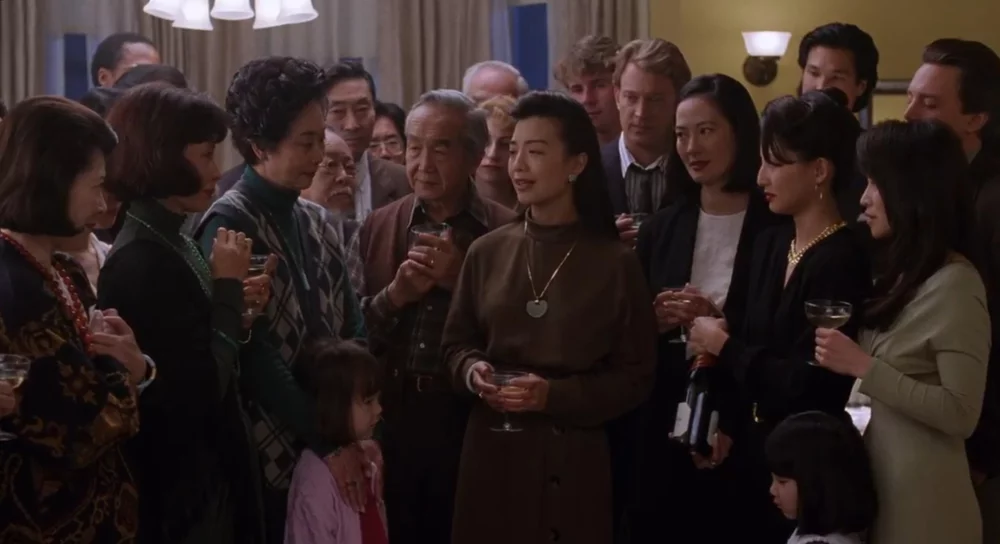
‘The Joy Luck Club’ showed the tragic pasts of the mothers, who fought for better lives in America and the difficulties faced by their daughters to fit into both the Chinese and American cultures. It evoked empathy and compassion from its audience, but was that really its aim?
What the movie really depicted was the mothers’ unfulfilled expectations of wanting their Chinese heritage to be preserved. They wanted their daughters to have better opportunities in America, but they also hoped for their daughters to represent Chinese identities and values. The movie represented language barriers, cultural differences, and generational gaps within immigrant families. The movie showed what it is like longing to be heard by their loved ones. The movie pictured how lucky and full of joy one can be when they’re finally understood.
Back to topReferences
Chang, R. (2021, May 17). How ‘The Joy Luck Club’ made Asian American film history. Biography. https://www.biography.com/news/joy-luck-club-cultural-impact
Back to top
