


Paper
The (in)visible Poetry Museum in Amsterdam
The Poetry Museum raises consciousness on the role of AR, art and the museum in the public sphere. It shows that online media has the ability to influence the public sphere but is inevitably linked to the offline culture to establish changes.

Published date
Copyright
This work is licensed under a Creative Commons Attribution-NonCommercial 4.0 International License.
Read time
17 minutes

On this page
- Introduction
- The ever-changing public domain
- Augmented Reality as a game-changing technology
- The Poetry Museum
- Visiting the Poetry Museum @ Museumplein
- Visiting the Poetry Museum @ Everywhere
- Can the Poetry Museum influence the public space?
- Augmented reality, smartphones and the public sphere
- Notes
- References
In April 2017, the first Augmented Reality Museum was launched on the Museumplein in Amsterdam: The Poetry Museum. But how can this technological phenomenon influence the urban space?
Back to topIntroduction
It is a rather ambiguous experience: standing on the Museumplein, moving my smartphone whilst looking at the several poems which appear on the screen. People who pass by are apologizing to me, assuming that they are walking through the pictures that I am taking of my surroundings.
Instead, I am ‘visiting’ the Poetry Museum, a museum that merely exists through augmented reality. Whilst standing in the midst of ‘real’ museums, for which you do not have to unlock your telephone in order to see them, it feels a bit unsettling to visit this one.
Besides that, I seem to be the only person visiting the museum that day, since I am the only one on the spot moving my smartphone through the air. But without the ability to see for what reasons others are using their phones and without the competence to see other visitors in the museum, I can never be sure.
I am ‘visiting’ the Poetry Museum, a museum that merely exists through augmented reality
This Poetry Museum merges the visible and the invisible, it intertwines the public and the private sphere and encourages smartphone-usage in the urban space. The rise of both new technologies and digitalisation unavoidably affects the urban sphere, whereby a gadget such as the smartphone or tablet can transform the individuals role in the public realm.
This paper therefore aims to analyse whether and how this AR-museum can influence the public space. To do this, the application through which the Poetry Museum is visible, will be analysed. I will place it in the context of augmented reality, its relation to the other museums on the Museumplein and the privatization of the public space due to digitalisation. For this, the theory of Scott McQuire will be used, who wrote about the effect of screens on public space. With that, ideas of Katherine S. Willis will be applied, who addresses digital publics and the privatisation of the public space. With connecting these theories to the analysis of the app of the Poetry Museum, I will aim to answer the question whether and how the AR Poetry Museum can influence the public space.
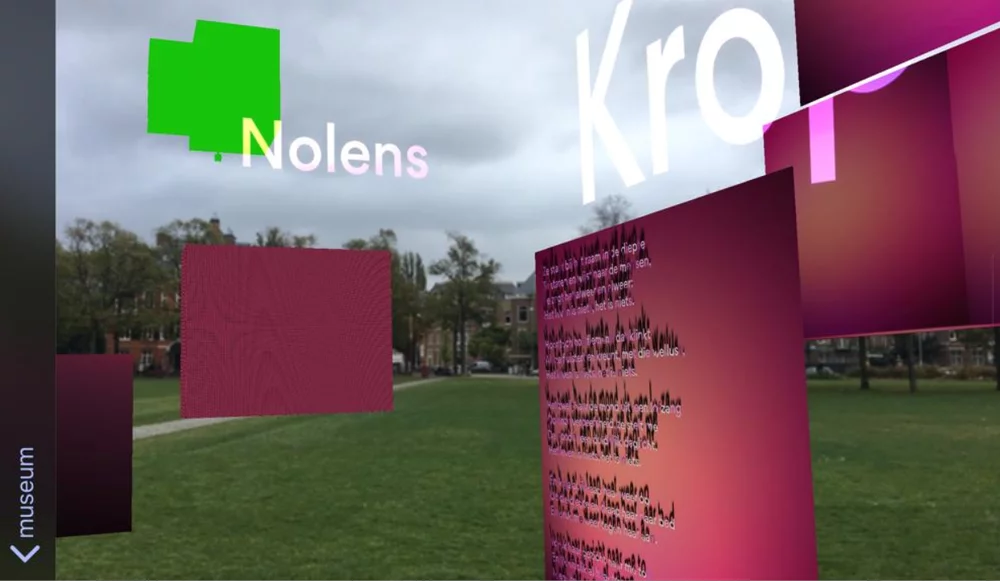
Picture of a part of the Poetry Museum.
Back to topThe ever-changing public domain
Space is a term with no proportions. It consists of different dimensions which are produced by what it contains, while it also reconfigures and rearranges these contained elements (Quayson, 2014). It is nor fixed and unchanging and depends upon what gets bodily performed within them (Urry, 2004). Space is therefore ever-changing and from the 19th century on, urban developments of cities have influenced the public sphere.
Scott McQuire explains in his book The Media City: Media, Architecture and Urban Space (2008) the contemporary interplay between media and public space. This means that the new technologies and digitalisation have an inevitably impact on the public space, which here is seen as a way of understanding how a society might hold the potential for collective (Willis, 2017). He starts his chapter on Performing Public Space with a timeline on how the urban landscape changed during the 19th century. With the emerge of vehicles, which created rapid movement, the streets were adjusted to the dominant value of circulation (Sennet, 1994). With the rise of capitalism and Fordist mass consumption, city space welded into new social and political formations. And after the Second World War, the suburbanization was supported and people turned away from the street whereby they retreated to the private (McQuire, 2008).
These are three examples of how technologies and historical events impact the urban streets. Another important influence was the emerge of the electronic screen. Where the first television screens led to people gathering in public spaces to watch the television, the normalization of the electronic screens then turned people to watch television in their own private sphere. The rise of the screens here had led to a shift from public to private, which therefore inevitably influenced and transformed the contemporary urban space. Herefore, McQuire sees the electronic media as the hinge between public and private life (McQuire, 2008).
This Poetry Museum merges the visible and the invisible, it intertwines the public and the private sphere and encourages smartphone-usage in the urban space
By the 1990s, the devices such as this television and also the telephone, were primarily fixed. They were usually located close to the offices or the home. By then, they already played an important part in the boundaries between the private and the public space (McQuire, 2008). In today’s society these technologies have however become omnipresent, mobile and extensible. They generate new possibilities for social interaction. With that, these mobile media have the potential to alter the dynamic of public interactions amongst crowds of erstwhile strangers. Where this mobile media can serve the individual consumer, whereby the electronic servant can fit his or her rational image of consumption, it can also serve the collective possibilities, by which mobile media enables people to act together in new ways (McQuire, 2008).
McQuire’s chapter on Public Performing Space acknowledges an important insight on the ever-changing urban space, which is that a change in urban space is inevitably linked to (the change of) the division between private and public. With that, it can be both the symptom and producer of social relations (Quayson, 2014). With the upcoming rise of new technologies as the smartphone but also augmented reality, the borders between public, private, the individual and the collective can and will shift. It also means that in order for an event, technology or experience to influence or transform the urban space, it needs to be both interactive and linked to the domain of the private and the public. This will be kept in mind whilst looking at augmented reality in general, as well as the augmented reality museum itself.
Back to topAugmented Reality as a game-changing technology
Where the smartphone was not introduced to the consumer before 2011, augmented reality has its fundaments already in the 1960s, when cinematographer Morton Heilig designed a motorcycle simulation with multi-sensory technology. AR is the taking of digital or computer generated information, by which you can think of images, audio or video, and whereby the creators use these sensations by overlaying them over a real-time environment. T
he key feature of augmented reality is that the user is still able to see the real world around him, whereas virtual reality content simulates a whole different reality. Augmented reality supplements reality rather than replacing it. With that, it gives people the possibility to bring usable information into the visual spectrum without the limitations of time and space (Kipper & Rampolla, 2012).
Augmented reality supplements reality rather than replacing it
A smartphone gives the ability of personal mobility and spatial fluidity, whereby the use of it is no longer fixed in time and space. With the possibility to contact friends, family or colleagues from everywhere and at any time, the social interaction on the streets change. In addition to that, the smartphone and the internet give the user the ability to search for everything online. Interaction in the public sphere therefore seems to become less and less important.
This immediately influences the public space. This idea is explained in Katherine S. Willis’ article ‘Netspaces: Space and Place in a Networked World’ (2017). She explains how the arrival of mobile phones and the internet have led to the privatisation of the public space. With a smartphone in your hand, you no longer have to actively participate in the public realm. Social networking is now possible online, for which face-to-face interaction is no longer necessary. With the ability to create a social life online, this interaction shifted away from the public sphere (Willis, 2017).
Counter-arguments suggests that the public is very much part of how people interact with the mobile phones, but that the public space is no longer merely the public sphere. Instead, it also consists of parochial spaces where people are involved in interpersonal networks that are located within communities (Willis, 2017). Willis sees this as the evidence that media is changing the public space, but that it is still allowing the conditions for participation in the public sphere. With new public spheres opening up due to the internet, which are universally accessible, theorists have argued that these spaces merely contribute to the so-called networked individualism, where people gather around shared interests, but where this equates more closely to the private sphere than the public realm. Here, the focus lies on the individual in the public place.
Back to topThe Poetry Museum
On the first of April 2017, the Poetry Museum was ‘opened’ on the Museumplein in Amsterdam. From that day, visitors could download the app on their smartphone. The application shows the work of ten Dutch poets, such as Annie M.G. Schmidt and René Puthaar. [1] Writer Anna Enquist became curator and she selected these ten poets, who each provided six poems. For all of them, a pavilion was created which together with the poems, shape unfinished architectural sentences.
Interaction in the public sphere seems to become less and less important. This immediately influences the public space
The Poetry Museum is an initiative of the collective called ‘International Silence’, which exists of the two men, Twan Janssen and Johannes Verwoerd. They created the museum with the different pavilions, which can be seen by directing your phone at them at the Museumplein. Their aim was to squat Museumplein and to add a new cultural yet virtual destination. They therefore hope to reach not only a cultural elite but also people who don’t have that much experience with reading poetry. With that, they wish to create a museum for everybody, as they explain in an article for the Dutch daily newspaper 'Trouw'.
The idea of using augmented reality in or for a museum is not completely new. In 2010, the Museum of Modern Art in New York had the exhibition WeARinMoMA, whereby the artists created art through augmented reality. In the museum, 2D and 3D objects were exhibited, but they were only visible through the visitor’s smartphone.
In July 2017, the Art Gallery of Ontario opened an augmented reality exhibition as well, but with another approach: during their exhibition Reblink, historical artworks were transformed and given a modern update by using AR. Both exhibitions show the influence of technologies such as AR on the artwork and the museum. It adds a new dimension to the definition of art and the role of the museum. Here, the smartphone gives the visitor a certain power to decide which artworks they wish to see or transform, and which they do not. Augmented reality is here used to raise questions and consciousness on such questions as well as to lure people in to visit the museum.
Back to topVisiting the Poetry Museum @ Museumplein
Where Enquist tells us that she hopes that the Poetry Museum will attract all types of people, regardless of their knowledge of poetry, she hopes to lure people in with the technique of AR. The application itself is easy to use, with only three options; info, museum and colophon. The museum then has the ten poets placed in a row and you click on the one which pavilion you wished to see. When you have chosen, you are placed ‘inside’ the museum, with the poems and the walls placed around you.
The museum is free to visit for everybody, as long as you speak Dutch and own a smartphone with the application. The museum has some clear differences with the other ‘real’ museums on the Museumplein: the Poetry Museum has no opening hours, no surveillance for touching the objects (which is simply impossible) and no strict rules on running or yelling in the museum. With that, the museum is no longer the traditional white cube: instead, there are some walls which are sometimes partly created with the poetry itself, as can be seen in figure 1.
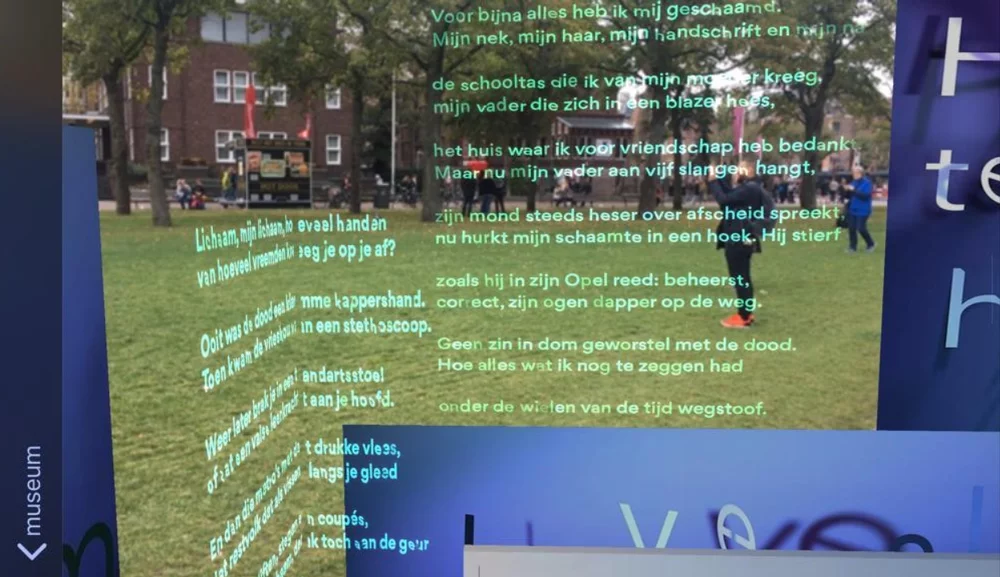
Figure 1. Picture of the Poetry Museum taken at the Museumplein, 19 October 2018.
Where this on the one hand makes it difficult for the visitor to read the poems, since the application does not allow you to watch the poems from a different viewpoint, it on the other hand creates the possibility for the curator and initiators to play with word, sentences and space. In addition to that, some poems have different typography. With the letters being part of the three-dimensional experience, the museum has a kind of theatrical effect. The artwork is here an instrument for the museum, rather than vice versa, which is the case for the ‘real’ museums on the Museumplein. With that, the focus of the experience in this museum lies not on the poetry, but is based on the potentials of AR.
Figure 1 shows a blurring of the distinctions between reality and the virtual. But with the Museumplein still being visible, an immersive experience is lost. With people passing by in real life and the impossibility to see other people visit the Poetry Museum, there is no full virtualization of the museum. Where virtualization is seldom total (Hjarvard, 2008), this border between real life and virtual influences the experience. The awareness of the presence of others influences the reading experience as well as the public realm (Willis, 2017): with the poems shown overlaying reality, you become more aware of the people walking behind the poems since they are a distracting moving background. Herefore, the space does not merely exist of private bubbles as Willis argued.
With the Museumplein still being visible, an immersive experience is lost
The museum negotiates the experience of reality by adding art to the visitor’s perspective. In the Poetry Museum, the augmented reality creates a new context in which the individual reader of the poems can not only observe, but also experience the ‘real’ Museumplein from a new angle since the virtual artworks overlay the tangible world. This can both add to the meaning the reader gives to the poem, as that he or she gives to the surroundings.
In addition to that, it shows opportunities for augmented architecture, where things shown virtually can add another layer to the physical world. In crowded cities, it shows a new way to add to the urban space without physically losing space. It gives possibilities towards new forms of human presence, encounters and activities (Bishop, 2017).
Back to topVisiting the Poetry Museum @ Everywhere
Where the website of the Poetry Museum claims that the museum is only visible whilst standing on the Museumplein, I tried to open the application elsewhere, noticing that exactly the same museum is visible at every other place as well. This means that the museum is not really situated on the Museumplein and that people are no longer determined to physically visit this location. This gives new insights but also opens critique on the project, since thus can be wondered whether this museum can then add anything to the Museumplein.
The possibility to open the application elsewhere on the one hand adds to the initiators’ idea that they want to create a museum for everybody, since this might be the first museum which you can visit everywhere. The individual is then no longer bound in space. With that, the individual still sees the reality intertwine with the virtual, but this might be from his or her home. The public and private sphere therefore intertwine as well, but instead of it being a privatisation of the public space, it might be vice versa since the user can open a public space in his/her the private realm.
It shows opportunities for augmented architecture, where things shown virtually can add another layer to the physical world
It is on the other hand interesting to see whether the museum can still influence the public sphere. Although the museum is not really located on the Museumplein, it might still lure people to that exact location. Visitors might visit the location anyway since the internet only provides information stating that you are determined to visit the Museumplein in Amsterdam in order to see the poetry. When the visitor is standing on the Museumplein, surrounded by the big museums of Amsterdam, the experience might differ from the experience one has when visiting the museum from his or her home. Being surrounded by other museums whilst visiting this one, can add to the idea of the cultural place, which can therefore influence the experience of visiting the Poetry Museum.
Back to topCan the Poetry Museum influence the public space?
The Poetry Museum is visible for the people consciously visiting the museum itself. Bystanders do not see/notice the museum as organized space. The distinction between the visibility and the invisibility of the museum shows complexity of the use and value of space. Where for some people the Poetry Museum adds extra meaning to the location, for others it is merely a space to pass by. There is a barrier between the people who know the museum and who do not, which influences their use and awareness of the public sphere.
In addition to that, there is a barrier between the people who own a smartphone and those who do not. Uneven access can here be seen as a problem for people to participate in this new phenomenon, whereby disconnection means the inability to engage (McQuire, 2008).
The smartphone-usage is an obligatory aspect. Hereby the use of a smartphone in the public sphere is encouraged by which the private and public space intertwine, which, as discussed above, can lead to the privatisation of the public space. The visit to the museum leads to a more individual experience since the use of a smartphone is merely individual.
In addition to that, the possibility to interact is completely left out. Where through the Internet and social media the user of a smartphone can connect with others, the application of the Poetry Museum leaves such interactivity out. The museum is merely based on the possibility to read the poetry. A virtual shared experience therefore is impossible and it is something that the initiators of the Poetry Museum acknowledge themselves:
‘You might see other museum visitors, but they may be visiting a completely different space. It’s like a silent disco for poetry.’ (Verwoerd, 2017)
The idea of the individual experience shines through. You might see other visitors in the real world but the experience of the museum will always be through the singular view of your own smartphone. Where you can have a totally different experience from others, it does not allow a kind of shared viewing or common experience, unless you discuss it afterwards. Since you are not in a private bubble but aware of your surroundings, you might find other visitors whilst looking around you. Where it may not be a shared experience, the Poetry Museum can construct a new public concentrating this space (Willis, 2017). The app can bring people to the same physical place, where they have the opportunity to connect with each other. Here, the power again lies with the audience. They now not only have the power to decide what they wish to see, but can also take advantage of this newly created space. The audience can thus be merely an online spectator or decide to face-to-face interact with fellow visitors in the offline world. The change of the public sphere therefore relies on the participation of the visitors of the Poetry Museum.
Back to topAugmented reality, smartphones and the public sphere
In today’s society, the public and the private are inevitably intertwined. Gadgets as the smartphone allow us to interact with others without the limitations of time and space. This influences the urban space, where face-to-face interaction seems no longer required and where new spaces can be added to the public space. McQuire has shown that in order to change the public space, interaction is mandatory. Here, Willis explains that today’s public realm is altered and that new networked spaces can be added to this, wherein the online space can be just as important as the offline. New technologies such as augmented reality have the ability to change this realm once again, intertwining the reality with the virtual.
The Poetry Museum combines the new possibilities of augmented reality with the possibilities of the smartphone. It firstly allows new ways of presenting art. With that, it enters the on-going discussion on the definition of art and the influence of new technologies. Secondly, it allows the individual to reshape the world through the smartphone. An invention such as this one can alter our perceptions and relationships with the urban space, due to the intertwining physical and virtual space. Further research using f.e. interviews can uncover how this influences the urban imaginary. And where the Poetry Museum can add another dimension to urban space, both the possibility to visit the museum from everywhere and the artwork as an instrument for the museum are interesting topics for further research as well. Here the role of the museum and the artwork can be questioned, whereby the visibility inevitably influences the value of the artwork.
The Poetry Museum shows that offline participation and face-to-face interaction is a crucial aspect of public space
At the same time, the individuality adds to the privatisation of the public realm, since visiting the museum seems to be merely an individual experience. Here the user is excluded from a common experience or shared view. Instead, every visitor occurs the museum differently. So where the public realm can be altered by communication technologies, the Poetry Museum per se seems one step away from that. Instead, it merely creates a new space, together with a new public which appears on the Museumplein. Without the possibility to communicate through the app, the influence on the public space seems rather limited. It is however, not excluded.
The power lays here in the hands of the visitors of the museum. They are part of the public which is lured to the Museumplein, but the visitors are the ones who have to step away from the augmented reality in order to connect with the other visitors around them. For this form of augmented reality to influence the public sphere, it is unavoidably linked to the offline world. This thus shows that offline participation and face-to-face interaction is a crucial aspect of public space. Where smartphone-usage in the public sphere is encouraged by this AR-museum, this paper therefore encourages people to actively participate in the public space by interacting with others, discussing the individual experiences. Here, the number of possibilities of augmented reality can merely be used to alter the public space if people decide to leave their private bubble and participate in offline encounters. Where a whole part of our society is performed online these days, the offline culture stays evenly valuable.
Back to topNotes
[1] The ten Dutch poets are: Alfred Schaffer, Annie M.G. Schmidt, Elly de Waard, Eva Gerlach, Gerrit Kouwenaar, Ida Gerhardt, Leonard Nolens, Menno Wigman, Neeltje Maria Min and René Puthaar.
Back to topReferences
Hjarvard, S. (2008) ‘The Mediatization of Society: A Theory of the Media as Agents of Social and Cultural Change’ in: Nordicom Review, (29)2: 105-134.
Kaganskiy, J. (4 Oct. 2010) ‘Augmented Reality Art Takes Over The MoMA’, The Creators Project. Last retrieved on 28 Oct. 2018.
Kipper, G and Rampolla J. (2012) Augmented Reality: An Emerging Technologies Guide to AR. Amsterdam: Elsevier Science.
McQuire, S. (2008) Performing Public Space. In: The Media City, California: Sage.
Pronk, I. (29 March 2017) ‘Zestig gedichten in het museum zonder zalen’, Trouw. Last retrieved on 28 Oct. 2018.
Sennet, R. (1994) Moving bodies. In: Flesh and Stone, The Body and the City in Western Civilization, New York and London: W.W. Norton and Company.
Toft, T. (2016) What Urban Media Art can do. In: What Urban Media Art can do: Why When Where and How?, Stuttgart: Avedition.
Urry, J. (2004) Death in Venice. In: Sheller, M. and Urry, J. Tourism Mobility, Places to play, Places in Play, New York: Psychology Press.
Verwoerd, J. (2017) ‘Het Poëzie Museum’, Johannes Verwoerd Studio. Last retrieved on 28 Oct. 2018.
Wiercx, B. (12 July 2017) ‘Art Gallery of Ontario brengt klassieke kunst tot leven met augmented reality’, Faro. Last retrieved on 28 Oct. 2018.
Willis, K.S. (2017) Netspaces: Space and Place in a Networked World. In: What Urban Media Art can do: Why When Where and How?, Stuttgart: Avedition.
Quayson, A. (2014) Oxford Street, Accra, City Life and the Itineries of Transnationalism. London: Duke University Press.
Back to top

Content ID
Published date