

Paper
The impact of Black Lives Matter on Hillary Clinton’s message on racial justice
This paper is about the impact of the social movement Black Lives Matter on the message Hillary Clinton wanted to convey on racial justice during the 2016 US presidential elections.

Published date
Courses
Digital media and Politics
Copyright
This work is licensed under a Creative Commons Attribution-NonCommercial 4.0 International License.
Read time
19 minutes

Black Lives Matter is a social movement in the United States of America, that fights for the rights of African Americans. This paper will clarify whether they influenced Hillary Clinton’s message during the last elections, or not.
Back to top
Introduction
The population of the United States of America, consists for 12 percent of Afro-American inhabitants (The USA, n.d.). Since African-American people face more difficulties and disadvantages when it comes to among other things finance (Redden & Kasperkevic, 2016), education (Klein, 2014; Steele, 1992), and discrimination (Quigley, 2010; Pilkington & Luscombe, 2013) in comparison to white American people, black people are encouraged to stand up for their rights. In the past, the Civil Rights Movement played a major role in the improving of civil rights for African-Americans. Nowadays, the social movement Black Lives Matter fulfills that role.
Hillary Clinton focused multiple times on African-American voters during the last elections. Since the African-American population was so important to Hillary Clinton concerning the focus and actions in her campaign, it is interesting to investigate whether Black Lives Matter influenced Hillary Clinton during the last elections. Therefore, the research question of this paper is: ‘How did Black Lives Matter influence the message of Hillary Clinton on racial justice?’ To answer this question, in this paper will be examined what Black Lives Matter is, and what the social movement says about racial justice, how Black Lives Matters exerted pressure on Hillary Clinton during the last elections, how Clinton copies the statements of Black Lives Matters, and how these statements fit into Clinton’s message nowadays, and in the past.
Back to topMethodology & Data
To answer the research question of this paper, first of all, data will be collected. This consists of information about what Black Lives Matter is and information about their stance on racial justice, thus among other things, information from their website and their Twitter page. Data about how Black Lives Matter exerted pressure on Hillary Clinton, will also be collected from Tweets, but besides it will be collected from demonstrations. Data about how Clinton copies the statements of Black Live Matter will be compiled from Hillary Clinton’s speeches, debates during the last elections and newspapers. Finally, data about how the previously mentioned statements fit into Clinton’s message nowadays and in the past, will be gathered from Clinton’s campaign website, Twitter, recent speeches and debates and speeches from the past. Next, the data will be analyzed by critically react to what the impact of Black Lives Matters on Hillary Clinton’s campaign was to give an answer to the research question. Ideological issues, will be analyzed by using Blommaert, J. (2005). This book is about discourse and ideology, from the viewpoint of Blommaert. The book of Lempert & Silverstein (2012), is about media, messages and issues, combined with American politics, and will be used to analyze the message of Black Lives Matter and the message of Hillary Clinton. Furthermore, the article of Thompson (2005) will be used to analyze the mobilization and addressivity power concerning Black Lives Matter. The article of Thompson is about the development of the media nowadays, and with this, the changed relationship between visibility and power (in politics). By focusing on all these kinds of media, the analysis will deal with the relation between online and offline media, as well as old and new media formats: for example newspapers and debates stand for old media formats, and social media like Twitter stands for new media formats.
Black Lives Matter on racial justice
First of all, I will explain what the social movement Black Lives Matter is, and what they say about racial injustice. Black Lives Matter is a social movement concerning the rights and the lives of black American people. The movement was founded in 2013 by Alicia Garza, Opal Tometi and Patrisse Cullors, after 17-year-old Trayvon Martin, a black American, was killed. The movement especially fights for criminal justice, and stopping the systematic criminalization of black people. The movement started with the hashtag #BlackLivesMatter in the summer of 2013, when Alicia Garza on her Facebook page responded to the acquittal of George Zimmerman, the man who shot Trayvon Martin (Stephen, n.d.). Since then, the hashtag became the characteristic of millions of people, who wanted change for black people. The movement instantly made a political agenda, and mobilized people using websites like Facebook and Twitter (Ruffin, n.d). Because of the velocity of social media, they quickly reached thousands of people who thought the same. However, despite the success of social media for Black Lives Matter, they also use the traditional way of mobilizing people.
To understand the success of Black Lives Matter, we need to understand how they manage their visibility. Thompson (2005) said that ‘the field of vision is no longer constrained by the spatial and temporal properties of the here and now but is shaped, instead, by the distinctive properties of communication media, by a range of social and technical considerations (…) and by the new types of interaction that these media make possible.’ (p. 35-36). Thompson writes about political leaders and their communication tools and opportunities. Political leaders can show themselves as not only leaders, but also human beings, according to Thompson: ‘political leaders acquired the capacity to present themselves as ‘one of us’’ (p. 39). When applying this to the founders of Black Lives Matter, this is exactly what made them successful: they were able to use new media, where they could interact with people, and could show themselves as ‘one of them’, as in one of the supporters of the movement. Compared with leaders in the government who stand far more away from the citizens, the founders of Black Lives Matter are approachable, and show their supporters that they are like them. This is what also boosted the mobilization and addressivity power of the movement.
On the website Blacklivesmatter.com, one can read the following:
‘’Black Lives Matter is an ideological and political intervention in a world where Black lives are systematically and intentionally targeted for demise. It is an affirmation of Black folks’ contributions to this society, our humanity, and our resilience in the face of deadly oppression.’’
Thus, as can be read in the quote above, Black Lives Matter calls themselves ideological. This refers to a certain consciousness, a certain believe about how they see politics: a discursive battle of meaning. They want to change what is the standard nowadays, on other words, the common sense. Blommaert (2005) described ideology as the combination of discourse and power: ‘combine the two terms and we think of ideology’. When applying this quote by Blommaert to Black Lives Matter, according to Blommaert, Black Lives Matter is ideological. The movement uses discourse to address political leaders like Clinton, but also people that they want to address. With regards to power, the movement has achieved a few things, by using their power. In an article by The Atlantic, one can read that in December 2015, the Federal Bureau of Investigation notified a new effort to improve its tracking of fatal police shootings (Foran, 2015). Also, student protest in 2015 against discrimination and racial insensitivity at universities, were joined with a change in mentality, according to some Black Lives Matter activist leaders.
Black Lives Matter is ideological
Black Lives Matter is ideological. They do have a specific set of symbolic representation, like their logo, and they also are serving a specific purpose, namely striving for equal and better rights for black people in America. Besides, Black Lives Matter is a phenomenon that characterize the common sense of a particular group of Afro-American citizens. Black Lives Matter thus does not represent the whole black community, but only the people that share their ideas and message with them.
Black Lives Matter also has a clear political message Lempert and Silverstein (2012) a political message: ‘’Message is the politician’s publicly imaginable ‘character’ presented to an electorate, with a biography and a moral profile crafted out of issues rendered of interest in the public sphere’’. Black Lives Matter has a clear publicly imaginable ‘character’. They put a lot of effort to mobiliz people, to be known by politicians, and to be visible in the media. , they social media, . They present their message to an electorate, namely American citizens. The movement has a biography, . They have a clear moral profile about racial justice – the injustice against African American citizens and that profile is established from the public sphere: the founders of the movement knew that there were a lot of people with the same ideas and desires as them.
The pressure of Black Lives Matter on Clinton
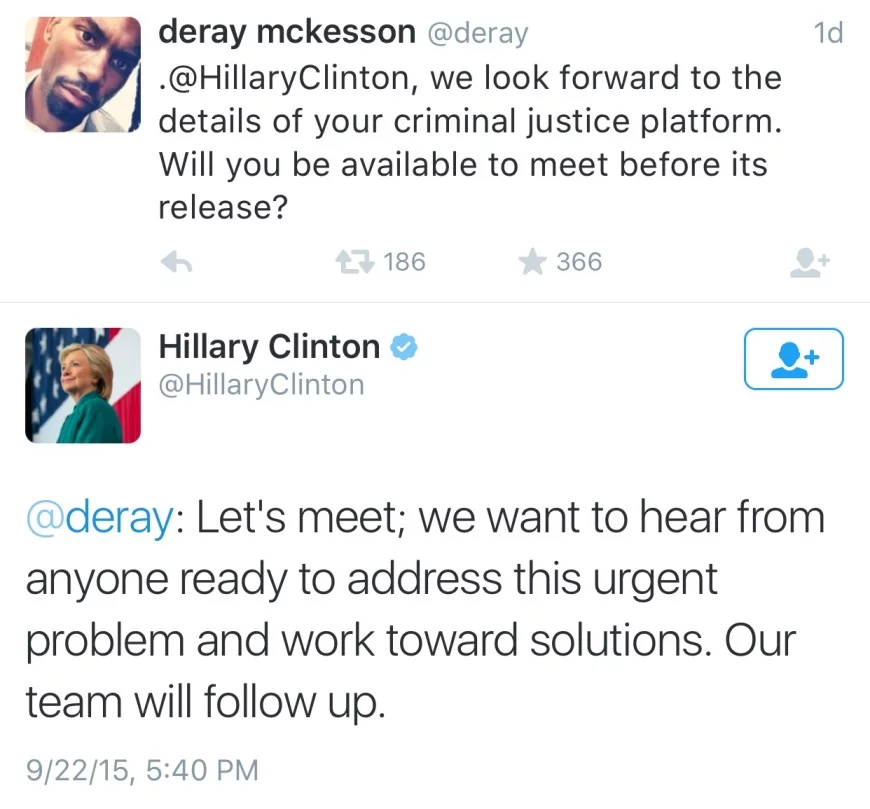
To answer the research question about the impact of Black Lives Matter on the message of Hillary Clinton on racial justice, it is important to examine if, and in what degree the movement exerts pressure on Hillary Clinton's. When it comes to Twitter, the Black Lives Matter movement knew how to use the medium to get things done. For instance, in September 2015, Black Lives Matter activist DeRay Mckesson tweeted Hillary Clinton and asked her to meet him before the revealing of her criminal justice platform (Breaking 911, 2015; McKesson, 2015). Hillary Clinton replied that she wanted to meet him; something that would not have happened when DeRay Mckesson would not have tweeted her. He thus used social media to exert pressure on the presidential candidate to make something happen, and by showing it to the world (by the use of Twitter), he made a public issue of it.
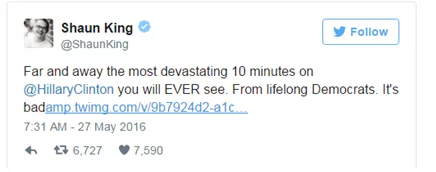
Furthermore, Shaun King, a Black Lives Matter activist, but also a writer for New York Daily News, tweeted on May 27 last year a video about Democrats saying that the campaign of Hillary Clinton's reached a new low, after Wikileaks revealed a lot of emails (Street, 2016). King wrote next to the video, that he thought that the 10 minutes movie, were ‘the most devastating 10 minutes on Hillary Clinton you will EVER see’.
This is what Thompson (2005) has called ‘the double-edged sword’. With this, he refers to the fact that the political field becomes increasingly intertwined with mediated form of communication, like social media. With the double-edged sword, he means that the existence of (new) media has new opportunities for political leaders, but that the existence of the media also brings a new risks with it:
‘’Whether they like it or not, political leaders today are more visible to more people and more closely scrutinized than they ever were in the past; and at the same time, they are more exposed to the risk that their actions and utterances, and the actions and utterances of others, may be disclosed in ways that conflict with the images they wish to project.‘’ (Thompson, 2005, p. 42).
'The political field and new media together, are like a double-edged sword'
This is what happened when focusing on the case above: because of the existence of Twitter (and other kinds of social media), information flows through the Internet, cannot be completely controlled by the campaign team of Hillary Clinton. Clinton faces the risk that her actions (the e-mail scandal), may be disclosed by for instances journalists in ways that is not beneficial.
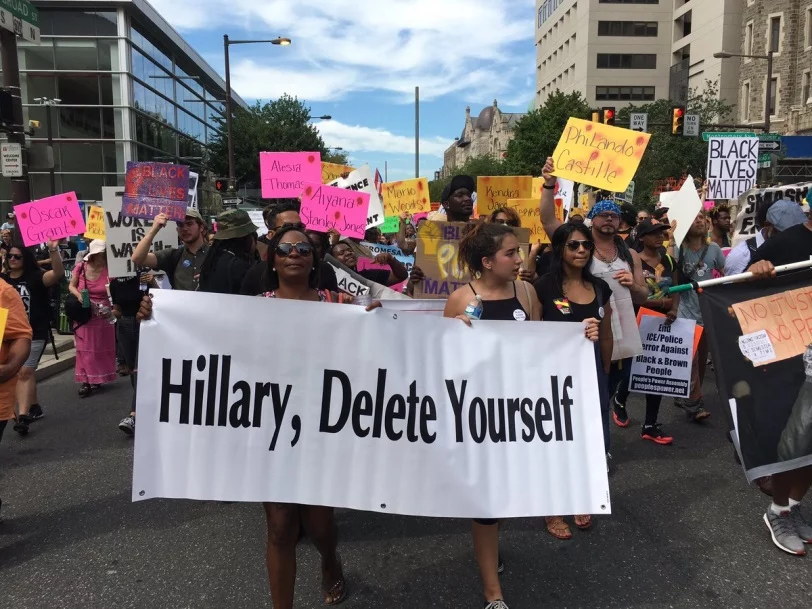
The Black Lives Matter movement, also exerts pressure on Hillary Clinton, by protests and demonstrations. Last July a protest was held by Black Lives Matters members in Philadelphia (Madhani & Johnson, 2016). The protest was held to raise concern about police brutality against black Americans, and the protesters also sent a message to Hillary Clinton: that Clinton had much more work to do, to earn the votes of the Black Lives Matter members.
February before that protest, Ashley Williams, a Black Lives Matter activist, interfered a private fundraising for Hillary Clinton (Tynes, 2016).
Williams held a sign with ‘we have to bring them to heel’ on it, referring to a comment by Hillary Clinton in 1996, when she called Afro-Americans ‘super-predators’. Williams exerted pressure on Hillary Clinton, because Clinton was forced to –again- face the music for her statement, and to apologize. Clinton reacted as follows (Tynes, 2016):
‘’In that speech, I was talking about the impact violent crime and vicious drug cartels were having on communities across the country and the particular danger they posed to children and families. Looking back, I shouldn’t have used those words, and I wouldn’t use them today.‘’
Fooling by Clinton
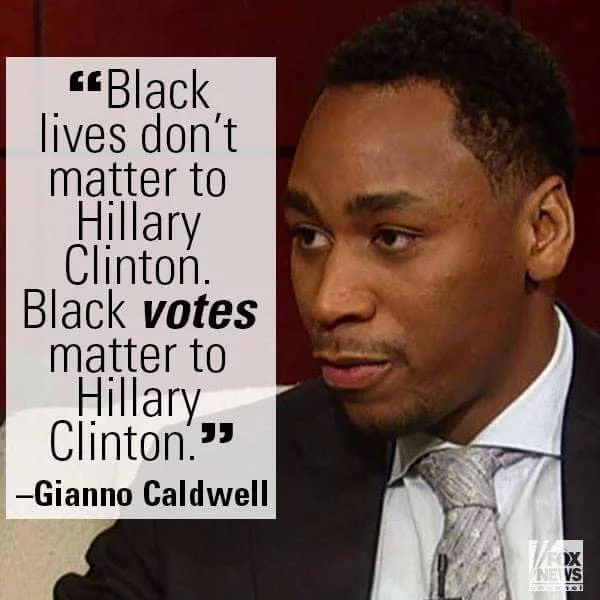
Multiple times, Clinton is put down as ‘crooked Hillary’, Hillary Rotten Clinton, and a liar (Quora, n.d). Last October, Gianno Caldwell, an American political television commentator on multiple big channels in America like Fox News and CNN said the following about Hillary Clinton: ‘’Black Lives don’t matter to Hillary Clinton. Black votes matter to Hillary Clinton’’, referring to the fact that Clinton only wants the empathy of Afro-Americans to win the elections, and not to generally change something about the ongoing fight of them in daily life.
How does Clinton copies the statements and stances of Black Lives Matter to earn their votes, or how does she at least give Black Lives Matter the idea that she copies their stances? On Hillary Clinton’s campaign website, one can read the following:
‘’Gun violence is the leading cause of death for young African American men—more than the next nine leading causes combined. We must do more to crack down on gun stores that flood our communities with illegal guns and deprive our children of their futures.’’
One can also read the following on her campaign website: ‘’Clean air and clean water are basic human rights. But too many children in low-income housing are exposed to lead. African American children are twice as likely to suffer from asthma as white children.’’
quotes above that Hillary Clinton tried to give the black community a voice, and tried to show them, that she really understands that something has to be done, and that she will help them with it. refers to African American children multiple times, and thereby shows that she desires the black community.
During the Democratic National Convention, Clinton invited nine mothers who had lost a child police or street violence (Glanton, 2016). This made a big impact on the mothers ‘’This isn't about political correctness. It's about saving lives. And Clinton is the only candidate willing to so much as call their children's names’’, they said. his action Clinton, shows Black Lives Matter, that she is copying the movement's. When it comes to fighting against systematic racism, Hillary has done more. When Alton Sterling died at the hands of police, she a statement"Something is profoundly wrong when so many Americans have reason to believe that our country doesn't consider them as precious as others because of the color of their skin". Furthermore, Hillary showed support for a wake, held by Black Lives Matter, after another man was shot by police. Last June, Hillary chose Black Lives Matter, over law enforcement support (Picket, 2016).
However, also a lot of people think that Hillary Clinton only gives Black Lives Matter the idea that she copies their statement, and that she wants to do anything about their situation. Clintons campaign website reads that, as a president Hillary Clinton wanted to ‘reform our broken criminal justice system’ (Clinton, n.d.). This is noteworthy, because when Clinton left office in 2001, ‘the United States had the highest rate of incarceration in the w, one can read on the website of The Nation (Alexander, 2016). Human Rights Watch signaled that in multiple states, African Americans formed 80 to 90 percent of all drug offenders that were sent to prison, ‘even though they were no more likely than whites to use or sell illegal drugs’ (Alexander, 2016). Equal Justice Initiative founder Bryan Stevenson noted the following about this: “President Clinton’s tenure was the worst”. The next video also shows multiple racist actions of Hillary Clinton, that would cost Hillary the Black Vote.
Besides, Black Lives Matter founder Alicia Garza, thinks that Clinton uses Afro Americans: “The Clintons use black people for votes, but then don’t do anything for black communities after they’re elected. They use us for photo ops” (Randall, 2016).his is important, because this whether message has been like this, or Black Lives Matter had an impact on message on racial justice. Thus, politicans transfer their image, by talking about the issues. A message i thus not something that is tailored just one issue, but campaign.
With regard to Hillary’s message anno 2016, the stances of Black Lives Matter fit well into Hillary’s message. Clinton especially expresses herself about the issues on her campaign website. She express her stance on racial justice as follows. When Hillary would be a president, she ‘’will fight to break down all the barriers that hold Americans back and build ladders of opportunity for all people—so that every child in America can live up to his or her God-given potential’’ (Clinton, n.d.). Also in the Youtube video below, Hillary expresses her identity by talking about the issue of racial justice. This forms her persona. She shows herself as a woman that want to fight for the racial injustice of (in this video) Afro Americans, and that she also is capable of doing this. She talks in the video –posted by the Washington Examiner- about the innocent Afro Americans who face violence or prison, just because of their race. She talks about Afro Americans in Baltimore that even cannot find a job, just because of their race. Most of the ‘actions’ about what she will do as a president concerning racial justice, are being addressed in the speech in the Youtube video as well as on her campaign website. She thus is very consistent in the image she show the world, at least concerning this issue.
When referring back to the definition of Lempert and Silverstein (2012) of a political message, there can be concluded that Clinton had a clear political message: Lempert and Silverstein describe that message is ‘the politician’s publicly imaginable ‘character’ presented to an electorate’. Clinton indeed has a publicly character that she presents to an electorate. Publicly, because she presents her ideas and her character in the media, and to an electorate, because she presents her ideas to American citizens who could vote for her. Lempert and Silverstein continue with: ‘a biography and a moral profile crafted out of issues rendered of interest in the public sphere’. Clinton shows a biography by explicitly showing that she is a wife, mom, grandma, women and kids advocate.However, Clinton has not always been that favorable Afr American citizens. In 1996, as first lady, Hillary called some young African Americans super-predators, ‘without conscience or empathy that need to be brought to heel’ (Lee, 2016). n 2008, was called racist when she what she believe was an AfricanAmerican accent (Pollak, 2016). The of Black Lives Matter have th not always fit in Hillary Clinton's in the past.
Back to top
Conclusion
Through different viewpoints concerning Black Lives Matter and the message of Hillary Clinton on racial justice, the research question of this paper: ‘How did Black Lives Matter influence the message of Hillary Clinton on racial justice?’ can be answered. First of all is investigated what Black Lives Matter is, and what they say about racial justice. Black Lives Matter is a social movement, who fight for the rights of African American people who are disadvantaged or discriminated. The movement is ideological, they have a clear political message, and their addressivity and mobilization power is present. Black Lives Matter exert pressure on Hillary Clinton by tweets on Twitter and demonstrations. Hillary Clinton also copies the statements of Black Lives Matter, as can be concluded from her social media activities, campaign website, statements and speeches, but nevertheless, a lot of people assumed that Hillary only acted like she copied the stances of Black Lives Matter, to earn votes. Finally is examined how the statements of Black Lives Matter –that Hillary copied- fit into Clinton’s message nowadays and in the past. This data collection and analysis revealed that the stances clearly fit into Hillary’s message, but not into her message in the past. This means, that Black Lives Matter impacted and influenced Hillary Clinton, as regards to her message nowadays. Black Lives Matter determined for a big part Hillary’s opinion for certain issues, and made her focus on the points of interest of Black Lives Matter.
Back to top
References
Alexander, M. (2016, February 10). Why Hillary Clinton doesn’t deserve the black vote. The Nation.
Barnes, B. [binky barnes]. (2016, July 26). ‘’Hillary, delete yourself.’’ [Tweet].
Black Lives Matter. [Black Lives Matter]. (2017, January 4). Sign the petition! (…) Let's free our fam [Tweet].
Blommaert, J. (2005) Discourse, A Critical Introduction, Cambridge: Cambridge University Press
Breaking 911. (2015). Hillary Clinton & #BlackLivesMatter Activist Set Meetup on Twitter.
Chris Fox. (2016, February 24). Black Lives Matter interrupts Hillary at private $500/person event in South Carolina 2/24/16 [Video file].
Clinton, H. (n.d.). Racial Justice.
Foran, C. (2015, December 31). A year of Black Lives Matter. The Atlantic.
Glanton, D. (2016, July 27). Hillary Clinton isn’t afraid to say Black Lives Matter. Chicago Tribune.
Klein, R. (2014, June 30). The Major Disadvantage Facing Black Students, Even In Kindergarten. The Huffington Post.
Lee, R. (2016, April 11). Why Hillary’s super-predator comment matters. The Huffington Post.
Lempert, M., & Silverstein, M. (2012). Creatures of politics: Media, message, and the American presidency. Indiana University Press.
Madhani, A., & Johnson, K. (2016, July 26). Black Lives Matter protesters want to send message to Clinton. USA Today.
McKesson, D. [deray mckesson]. (2015, September 21). @HillaryClinton, we look forward to the details of your criminal justice platform. Will you be available to meet before its release? [Tweet].
Picket, K. (2016, August, 6). Clinton chooses Black Lives Matter over law enforcement support. The Daily Caller.
Pilkington, E., & Luscombe, R. (2013, July 14). Trayvon Martin: how a teenager’s death sparked a national debate. The Guardian.
Pollak, J. B. (2016). Hillary Clinton, racist: her top 5 worst comments (in public).
Quigley, B. (2010, July 26). Fourteen Examples of Racism in Criminal Justice System. The Huffington Post.
Quora. (n.d.). What are some unflattering nicknames for Hillary Clinton?
Randall, A. (2016, August 4). BLM leader says Clintons only use black for photo-ops. The Daily Caller.
Redden, M., & Kasperkevic, J. (2016, September 20). Wage gap between white and black Americans is worse today than in 1979. The Guardian.
Ruffin, H. (n.d.). Black Lives Matter: The Growth of a New Social Justice Movement.
Steele, C.M. (1992, April). Race and the Schooling of Black Americans. The Atlantic.
Stephen, B. (n.d.). Social media helps Black Lives Matter Fight the Power.
Street, J. (2016, May 27). Black Lives Matter activist Shaun King says this video is ‘most devastating 10 minutes’ on Hillary Clinton you will ever see. The Blaze.
The USA. (n.d.) Feiten en cijfers over de Verenigde Staten van Amerika.
The Washington Examiner. (2015, April 29). Hillary Clinton on 'hard truths about race and justice [Video file].
The Young Turks. (2016, February 15). This Video SHOULD Cost Hillary Clinton The Black Vote [Video file].
Thompson, J. B. (2005). The new visibility. Theory, Culture & Society, 22(6), 31-51.
Tynes, T. (2016, February 24). Black Lives Matter Activists Interrupt Hillary Clinton At Private Event In South Carolina. The Huffington Post.
Wong, K. (2016, July 7). Hillary Clinton supports Black Lives Matter in wake of police shootings. News Mic.

More from this author