

Article
Hybrid Media Power: Viktor Orbán’s Digital and Traditional Media Domination in the Digital Age
In the digital era, Viktor Orbán exemplifies the strategic use of hybrid media systems to dominate public discourse and consolidate political power in Hungary. By integrating traditional state-controlled media with digital platforms, Orbán has amplified nationalist narratives and reshaped political perceptions. This study analyzes Orbán's media strategy through the lens of media integration, algorithmic amplification, and persona construction. It highlights how these tactics distort public discourse, amplify populist ideologies, and marginalize dissent, raising concerns about the implications for democratic accountability in an increasingly digital world.

Published date
Courses
Digital media and Politics
Copyright
This work is licensed under a Creative Commons Attribution-NonCommercial 4.0 International License.
Read time
12 minutes

In 2024, smartphones and digital connectivity have become integral to daily life, fundamentally transforming communication and perception worldwide. This technological ubiquity has created unprecedented opportunities for political leaders to influence public discourse. Viktor Orbán has perfected his approach in Hungary, using hybrid media systems to control public perception and maintain political dominance. By seamlessly merging the expansive reach of digital media platforms with the authority of state-controlled traditional media, Orbán has constructed a media ecosystem that amplifies his nationalist-populist narratives while marginalizing dissent. This deliberate integration of media channels enables him to reshape political discourse, manipulate public opinion, and consolidate his power, challenging democratic norms.
This article examines how Orbán manipulates both traditional and digital media to reshape public perception and challenge democratic norms in Hungary. This essay explores Orbán's hybrid media strategy through three lenses: (1) the integration of traditional and digital media to control public discourse, (2) the amplification of nationalist narratives through algorithmic visibility, and (3) the construction of a nationalist persona. Through this approach, this study seeks to develop new insights about Orbáns' practical use of hybrid media systems to structure public discourse, and the role of algorithms and Orbáns' political persona in rendering nationalist narratives more visible.
Orbán was chosen as a case study due to the way media operate in Hungary, where state-affiliated traditional media and digital platforms function in a dynamic relationship. His approach provides a useful example of how media structures and political messaging interact in contemporary landscapes. The broader significance of this study extends beyond Hungary, as similar strategies are increasingly observed in other political contexts worldwide.
Data was collected from Orbán’s social media posts, public speeches, and content shared through media platforms with government alignment. A qualitative content analysis method was used to identify recurring themes, including messaging strategies, digital content visibility, and traditional media integration. The study also incorporates media experts' perspectives and academic literature on hybrid media systems.
This study primarily relies on publicly available data, which presents limitations in fully capturing the inner workings of media operations. Additionally, there are challenges in analyzing the extent to which government-affiliated media sources shape narratives and the impact of algorithmic filtering on opposition content. The presence of algorithmic biases and varying levels of access to information also shape the broader landscape of political communication.
Back to topHybrid Media Systems: Controlling Public Discourse
The concept of the hybrid media system, as outlined by Chadwick (2017), highlights the integration of old and new media logics to create an ecosystem where traditional and digital media are strategically employed to reinforce political power. Viktor Orbán’s hybrid media strategy exemplifies this approach by combining the use of state-controlled media with catering to algorithms to reshape public discourse and consolidate his regime's dominance.
Under Viktor Orbán’s regime, state-controlled media serve as the foundation for establishing and reinforcing pro-government narratives. A key mechanism in this process is media capture, a phenomenon in which governments systematically take control of independent media outlets, either directly or through allied business groups, by exerting financial, regulatory, or political pressure. In Hungary, this process involved the acquisition of major platforms by economic groups affiliated with the ruling Fidesz party, effectively transforming once-independent outlets into instruments of government propaganda.
One of the most notable cases of media capture occurred with Origo.hu, originally an independent news site, which was acquired by government allies and subsequently shifted towards pro-Orbán coverage. Similarly, TV2, a major private television network, was taken over by business figures close to Fidesz, leading to an editorial realignment in favor of the government. This trend culminated in 2018 with the establishment of the Central European Press and Media Foundation (KESMA); a nonprofit entity that consolidated over 500 media outlets, including cable news channels, radio stations, newspapers, and online portals, under a single, government-aligned umbrella. While KESMA is officially a private organization, its structure and leadership are deeply intertwined with government interests, allowing it to function as a central hub for disseminating state-aligned content. The foundation's formation effectively eliminated competition among right-wing media, giving the appearance of media plurality while ensuring strict control over the dominant narrative (Central European Press and Media Foundation 2024).
Algorithms play a crucial role in amplifying government-aligned narratives, extending their reach beyond traditional media. Platforms like X (formerly Twitter) and Instagram do not function as direct extensions of state-controlled media. Rather, they are strategically used to reinforce and disseminate messaging that aligns with narratives promoted in pro-government outlets. This allows for targeted political communication that resonates with segmented audiences. In Hungary, where media ownership has become increasingly centralized under the Kesma Foundation, controlling around 500 outlets and receiving 85% of state advertising revenue (Free Press Unlimited, n.d.), social media serve as a complementary tool to extend and amplify the messaging present in traditional media.
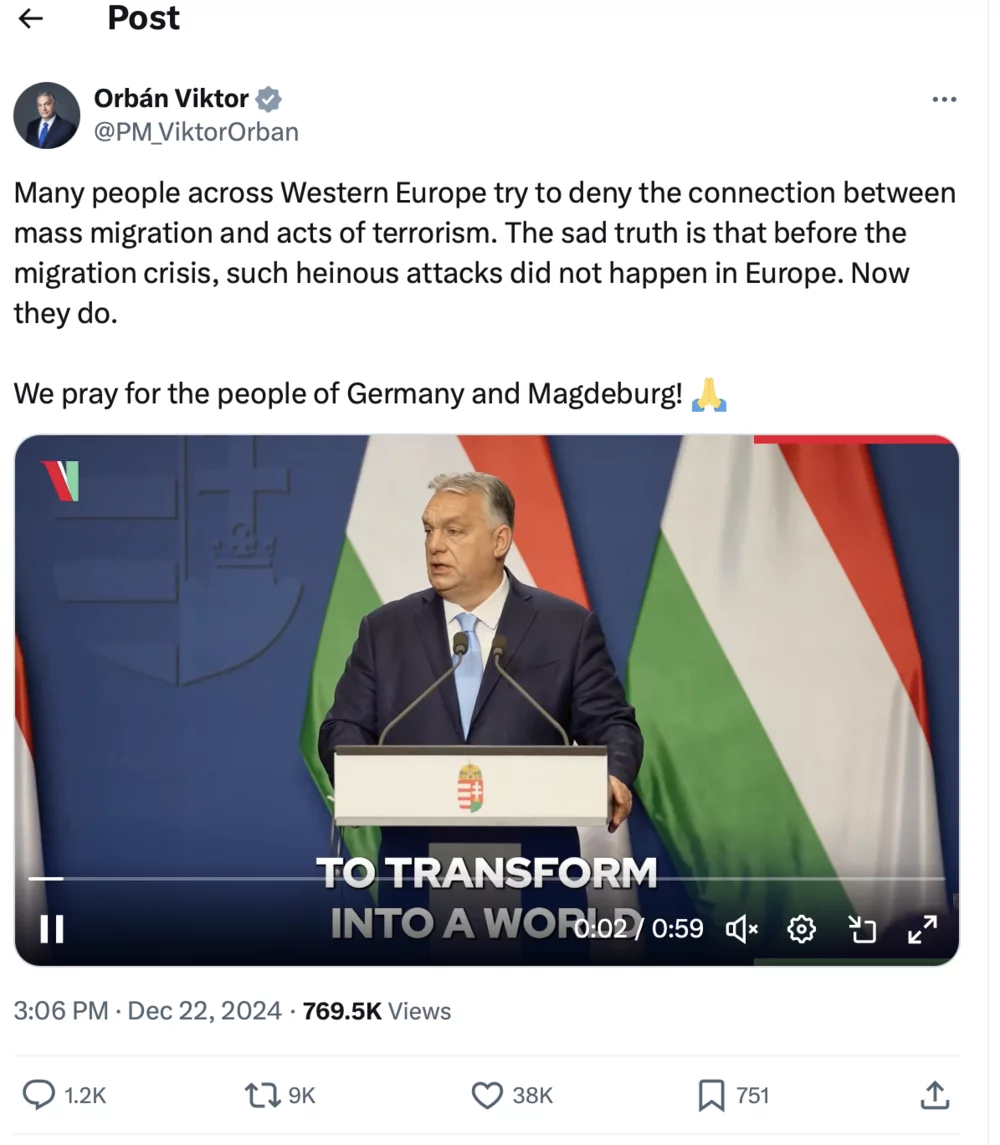
For instance, migration has been a dominant theme in Hungarian media, frequently framed as a security threat (Simon & Rácz, 2017). A post by Orbán linking migration to terrorism (see Figure 1) garnered 38,000 likes and 769,000 views, illustrating how social media facilitates the spread of narratives that align with state-controlled media discourse. Pro-government outlets have consistently portrayed migration as a destabilizing force, and these narratives are reinforced on social platforms, ensuring that both traditional media consumers and digital audiences encounter similar messaging. This interplay between state-controlled media and social media algorithms enhances the government's ability to shape public discourse while bypassing editorial scrutiny in independent journalism.
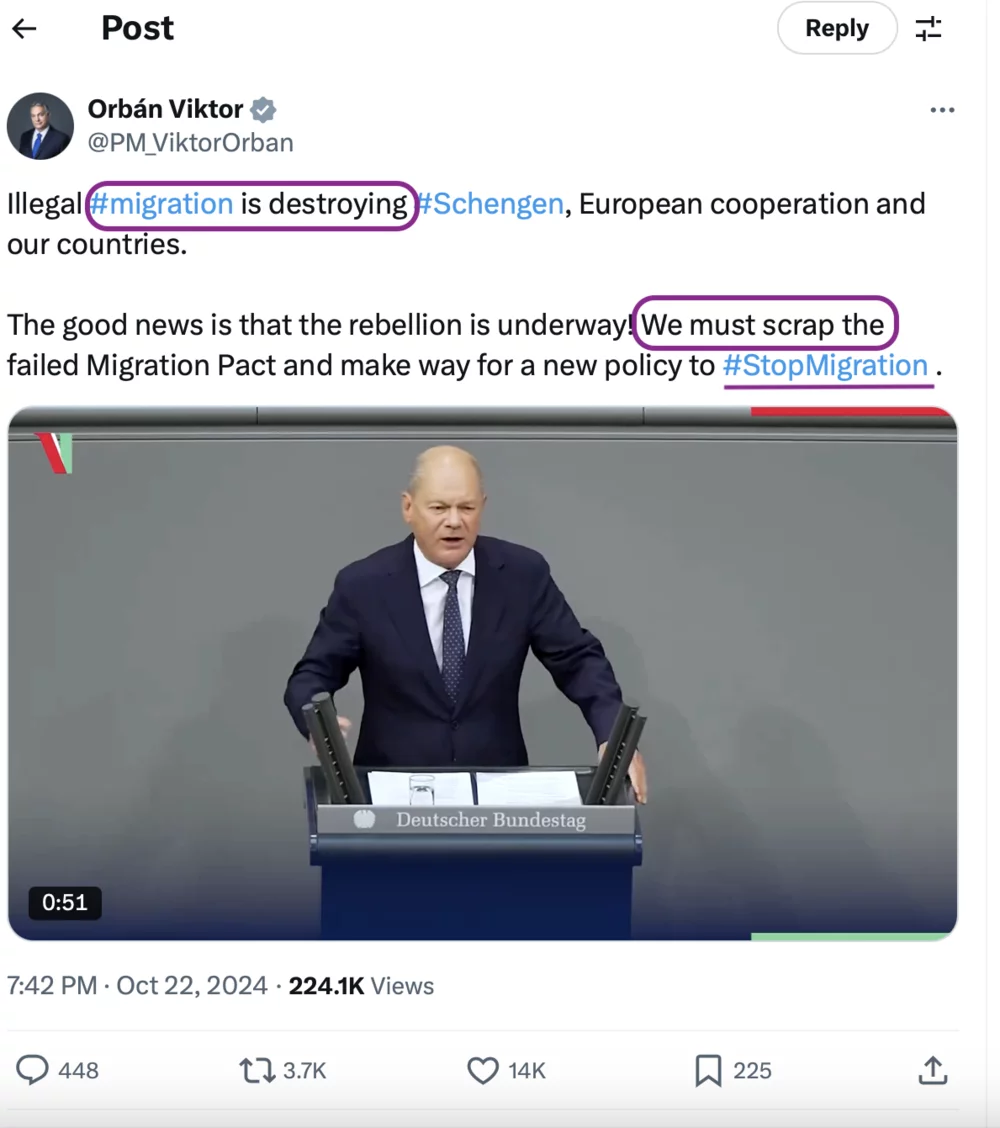
Another post framed migration (see Figure 2) as a destructive force, stating that “illegal migration is destroying Schengen, European cooperation, and our countries,” with hashtags like #StopMigration amplifying his rhetoric. This second post received 224,000 views and 14,000 likes, showcasing how Orbán is managing to strategically amplify divisive narratives through social media to consolidate support.
By linking migration to terrorism and other threats, Orbán employs emotionally charged rhetoric to frame migrants as the primary culprits for societal issues. This narrative not only reinforces societal fears but also strategically uses polarizing content and the affordances of social media (such as hashtags) to exploit social media algorithms, ensuring greater visibility and engagement. In doing so, Orbán advances a nationalist, security-focused agenda that positions his government as the sole protector of Hungary’s sovereignty and stability. By amplifying this narrative, pro-government media and digital platforms work together to reinforce his stance on migration, solidifying public support for stricter immigration policies and further legitimizing government actions. Entities such as Megafon, supported by government-affiliated actors, leverage data analytics and algorithmic tools to disseminate regime-friendly content, ensuring higher visibility and engagement than opposition messages (Benedek, 2024, p. 479). These strategies exploit algorithms’ tendencies to prioritize emotionally charged and polarizing content, further entrenching societal divisions and reinforcing pro-government narratives.
The hybrid nature of Orbán’s media strategy allows crises to be used as opportunities for consolidating power. During the 2015 refugee crisis, both state-controlled media and digital platforms worked in tandem to frame migration as a threat to Hungary’s sovereignty and cultural identity (Krekó and Enyedi, 2018, as cited in Benedek, 2024, p. 480). Orbán’s government actively used Facebook ads and viral posts to spread fear-driven narratives targeting specific audiences, aligning with broader traditional media messaging.
This hybrid media strategy distorts public discourse by integrating traditional media dominance with algorithm-driven outreach. While Orbán does not directly own platforms or their algorithms, his regime’s deliberate exploitation of these mechanisms, such as promoting regime-aligned messages through algorithmic prioritization, limits the diversity of information available to the public, reducing the capacity for informed decision-making. As Benedek (2024) notes, this dual approach entrenches partisan perceptions of reality and creates an environment highly susceptible to elite manipulation (p. 481).
While state-controlled media establish Orbán’s narratives, platforms amplify and personalize them through algorithmic systems. Unlike traditional media, which target broad audiences, social media enable precise audience segmentation, ensuring nationalist messaging reaches and engages specific groups. This shift from centralized media control to algorithm-driven visibility is key to Orbán’s strategy, raising an important question: How do algorithms reinforce his political dominance while limiting opposition voices?
Back to topAlgorithmic Visibility: Amplifying Nationalist Narratives
Algorithmic systems, such as Facebook’s EdgeRank, prioritize emotionally charged and engaging content, ensuring that pro-government narratives gain widespread visibility while dissenting perspectives are marginalized (Bucher, 2012, p. 1166). These algorithms sort, rank, and promote content based on user interactions, creating an ecosystem where nationalist messaging is systematically amplified and tailored to specific audience segments.
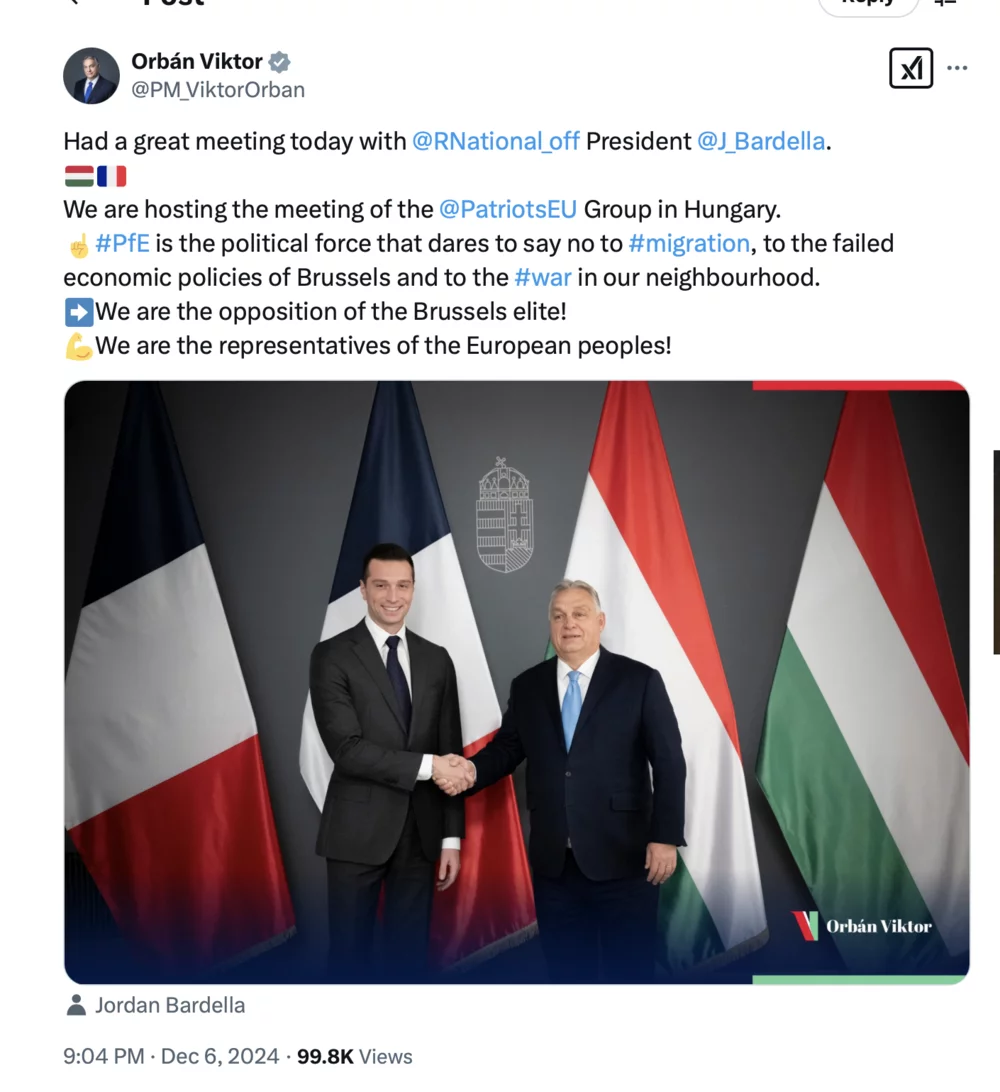
Orbán’s strategic use of computational agency demonstrates his reliance on targeted digital campaigns. Platforms like Facebook and Twitter (X) serve as tools for micro-targeted messaging, where government-aligned entities exploit algorithmic mechanisms to disseminate content reinforcing nationalist ideologies and polarizing public opinion (Maly, 2018, p. 4). A recent example can be seen in Orbán’s December 2024 post on X (figure 3), where he met with Jordan Bardella, the president of France’s National Rally, and framed his party as the 'opposition to the Brussels elite'. The post included hashtags such as #PfE (Patriots for Europe), #migration, and #war, together with him tagging Bardella, is strategically designed to trigger algorithmic prioritization. These hashtags not only boosted visibility among nationalist and Eurosceptic audiences but also ensured that the post appeared in searches and algorithmically recommended content feeds.
This dynamic aligns with Maly’s concept of 'algorithmic populism', which describes how digital platforms do not merely mediate communication but actively reshape political discourse by amplifying populist leaders and their messages (Maly, 2018). Unlike traditional populism, which relies primarily on mass media and direct mobilization, algorithmic populism leverages the affordances of platforms, such as engagement-driven ranking systems and micro-targeted messaging, to claim the voice of the people through the discursive power of platform metrics and amplify ideological narratives while simultaneously suppressing dissenting perspectives.
Furthermore, Orbán’s post featuring Bardella (See Figure 3) coincided with heightened tensions regarding European immigration policies and the ongoing war in Ukraine, both explicitly referenced in the post. By positioning his party as a defender of European people against the so-called 'Brussels elite', Orbán strategically aligned himself with broader far-right discourse across Europe, strengthening transnational populist networks. The post quickly gained traction, accumulating 99.8K views within 24 hours, illustrating the effectiveness of algorithmic amplification in increasing the visibility of nationalist rhetoric.
The impact of these algorithmically amplified narratives extends beyond social media. State-aligned Hungarian media frequently repurpose Orbán’s most viral posts, reinforcing his messaging through traditional news channels. This hybrid media strategy ensures that digitally popular nationalist content transitions into mainstream discourse, further marginalizing dissenting perspectives. This phenomenon aligns with Benedek’s (2024) description of an 'algorithmically sustained propaganda ecosystem,' where state actors produce content and manipulate digital infrastructures to sustain and legitimize their ideological dominance.
The algorithmic amplification of nationalist narratives erodes the pluralistic nature of public discourse. By prioritizing regime-friendly content while relegating critical or dissenting perspectives to obscurity, these systems create an echo chamber effect, making it increasingly difficult for opposition voices to gain traction. As Bucher (2012) notes, the architecture of visibility within algorithmic systems introduces a 'threat of invisibility' for non-aligned actors, severely restricting their ability to challenge dominant narratives (p. 1165). This systematic sidelining of opposition perspectives contributes to a distorted public sphere, where Orbán's nationalist agenda remains largely uncontested in Hungary’s media landscape.
Back to topMessage Politics: Constructing a Nationalist Persona
Viktor Orbán’s political messaging is centered on constructing a nationalist persona that appeals to both domestic and international audiences. This identity is carefully crafted through mediatization, strategic issue framing, and a consistent narrative that ties his leadership to Hungary’s sovereignty and cultural preservation.
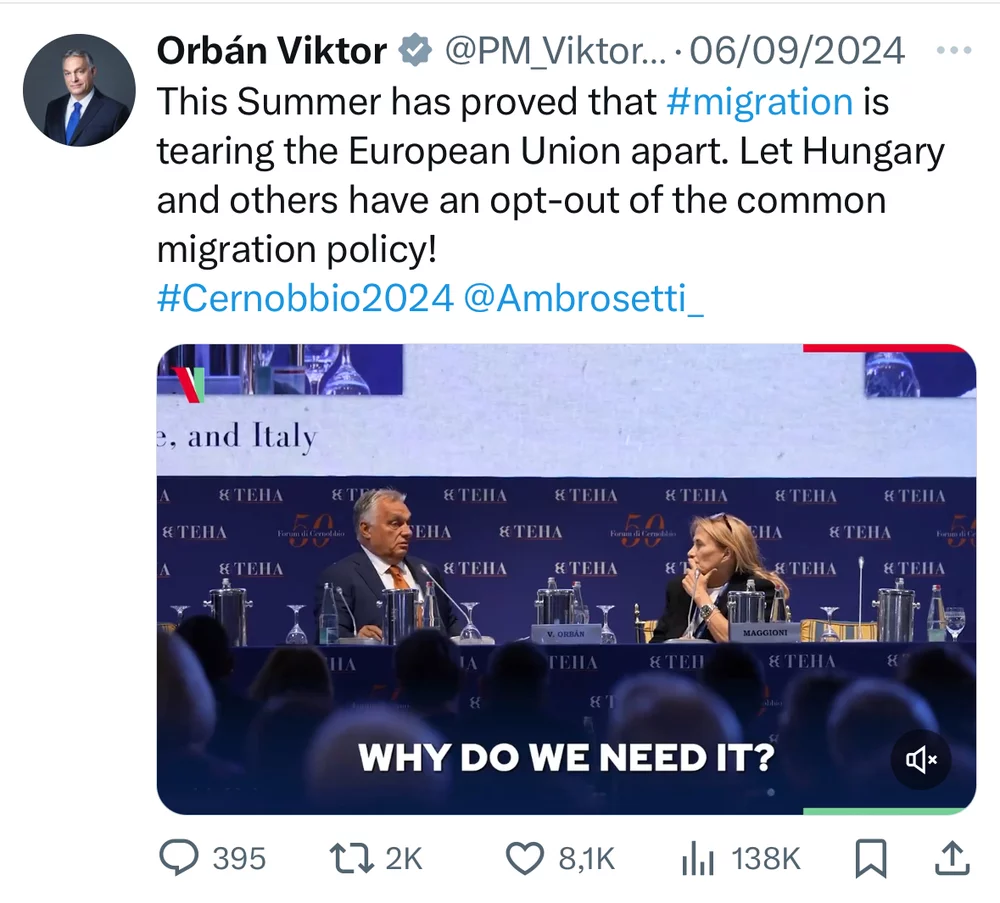
Nationalism is at the core of Orbán’s communication strategy, as illustrated by his September 2024 speech at the Ambrosetti Forum and its subsequent social media amplification. In a widely circulated post, he declared that “migration is tearing the European Union apart,” advocating for Hungary’s withdrawal from EU migration policies. This framing positions Orbán as the protector of Hungarian sovereignty against external threats, particularly the EU and globalist migration policies.
This approach aligns with Maly’s (2018) concept of mediatized communicative relation, where political leaders construct their identity by aligning with the 'voice of the people' while portraying elites as adversaries (p. 4). Only if the people like those posts can the communicator credibly claim the voice of the people. The engagement metrics of this post confirm its effectiveness in mobilizing Orbán’s audience:
- 138K views, demonstrating high algorithmic visibility.
- 8.1K likes and 2K retweets, indicating strong approval among nationalist supporters.
- 395 comments, reflecting both reinforcements from pro-Orbán voices and opposition responses, which further drive engagement.
These figures illustrate how algorithmic visibility amplifies nationalist messaging, reinforcing Orbán’s image as Hungary’s defender. By utilizing both traditional media (the Ambrosetti Forum) and digital platforms (his viral post), he ensures that his nationalist rhetoric remains at the forefront of public discourse.
Orbán’s persona construction relies heavily on issue-framing. In the Ambrosetti post, he depicts migration as an existential threat to Hungary and Europe, reinforcing his image as the sole guardian of national sovereignty. This aligns with his broader rhetoric of protecting 'European Christian civilization,' a theme he frequently invokes.
Unlike outdated references to the 2015 refugee crisis, this recent post offers real-time evidence of how Orbán continues to shape his identity as the savior of the Hungarian people. Additionally, he opposes rival political groups and policies, particularly EU migration policies, and presents Brussels as a distant authority imposing restrictive regulations on independent nations. This strategy, described by Lempert and Silverstein (2012), is crucial in populist persona construction, reinforcing an 'us vs. them' dynamic that fuels his anti-elite narrative (p. 3).
Orbán’s nationalist image is further reinforced through symbolic communication. His speeches frequently incorporate cultural references and evocative imagery, portraying him as the protector of Hungarian heritage. As Blommaert (2018) argues, populist leaders use symbolic gestures and language to align with their audience’s emotions and aspirations (p. 2).
For example, his Ambrosetti speech clip was edited with bold text ("WHY DO WE NEED IT?"), making it visually striking and easily shareable, ensuring maximum impact. This strategic content curation enhances audience engagement and algorithmic visibility, reinforcing Orbán’s political messaging. The direct, provocative phrasing in overlay text strengthens his core message, making it more likely to be widely shared and amplified across platforms.
Orbán’s nationalist persona is strategically crafted through digital and traditional media. His Ambrosetti post serves as concrete proof of how he:
- Frames himself as Hungary’s defender against external threats (e.g., EU migration policies).
- Uses social media algorithms to amplify nationalist messaging (reflected in engagement metrics).
- Transfers digital narratives into mainstream media, ensuring wider reach.
This hybrid communication model aligns with Maly’s (2018) concept of algorithmic populism, where a leader’s public image is shaped through media dynamics and audience interaction. By leveraging online visibility and traditional media, Orbán solidifies his nationalist identity and influence in Hungarian politics.
Back to topConclusion
Viktor Orbán’s strategic use of hybrid media systems demonstrates how integrated communication strategies can reshape public discourse, amplify nationalist narratives, and solidify political power. By seamlessly merging traditional media with digital platforms, he has built a self-sustaining media ecosystem that strengthens his domestic authority while expanding his influence internationally. His deliberate use of algorithmically optimized social media messaging allows him to bypass traditional media gatekeepers, ensuring his narratives reach both Hungarian audiences and global supporters.
The inclination of social media platforms to amplify emotionally charged and polarizing content has enabled Orbán to extend his reach beyond national borders. This highlights the transformative role of digital tools in modern politics, allowing political figures to engage directly with diverse audiences, reinforce ideological alliances, and shape public perception without relying solely on conventional media. However, the effectiveness of this strategy raises important concerns about democratic accountability. While Orbán’s approach exemplifies the power of strategic media control in consolidating political dominance, it also underscores the risks of limiting pluralism and marginalizing dissenting voices through algorithmically driven visibility.
As digital political communication continues to evolve, Orbán’s media strategy demonstrates how leaders can use a combination of traditional and digital media to maintain relevance and shape public opinion. As more politicians adopt hybrid media tactics, it becomes crucial to implement regulations that safeguard democracy. Orbán’s case serves as a reminder to policymakers, media regulators, and the public to scrutinize how digital platforms influence political discourse and to advocate for transparency, fairness, and media diversity in an era where online influence significantly shapes reality.
Back to topReferences
Benedek, I. (2024). Transforming the political public sphere: The media system of the Orbán regime in Hungary. Partecipazione e Conflitto, 17(2), 469–489
Blommaert, J. (2020, February 3). Trump’s tweetopoetics. Tilburg University Research Portal.
Bucher, T. (2012). Want to be on the top? algorithmic power and the threat of invisibility on Facebook. New Media & Society, 14(7), 1164–1180
Krekó, P., & Enyedi, Z. (2018). Orbán’s laboratory of illiberalism. Journal of Democracy, 29(3), 39–51.
Lempert, M., & Silverstein, M. (2012). Creatures of politics: Media, message, and the American presidency. Indiana University Press.
Maly, I. (2021, March 22). Populism as a mediatized communicative relation: The birth of algorithmic populism. Tilburg University Research Portal
Wikimedia Foundation. (2024, November 4). Central European Press and Media Foundation. Wikipedia.
Note about AI: ChatGPT was used solely to clarify complex political concepts and assist with translation.
Back to top
More from this author