

Article
How Ron DeSantis reshapes his message and algorithmic relevance after losing 2024 elections
Ron DeSantis is a Republican who ran for the 2024 presidential elections in the United States of America. He withdrew his election after realizing he was going to lose from Trump. This article analyses how DeSantis restores his reputation and alters his message by using algorithmic knowledge.

Published date
Courses
Digital media and Politics
Copyright
This work is licensed under a Creative Commons Attribution-NonCommercial 4.0 International License.
Read time
17 minutes

Introducing Ron DeSantis
Ron DeSantis is mostly known as the current governor in Florida. As an American politician he is a member of the Republican party (Navarro et al., 2024). In 2024, Ron DeSantis was running for president of the USA against Donald Trump and Nikki Haley, but he withdrew his candidacy in January of 2024. DeSantis acknowledged that he failed to position himself as a better alternative to Trump, but also the high costs of his campaign contributed to thedecision to withdraw (Navarro et al., 2024).
As governor in Florida he is known for his policies during the COVID-19 pandemic: he has expressed being against vaccines and against wearing masks. However, he initially did instate a lockdown in Florida and adopted other measures against the coronavirus. Over time, he shifted his views and began to focus on prioritizing personal and economic freedom, opening the State of Florida sooner than other States (Bollyky et al., 2023).
DeSantis’ political views align with those of many other right-wing conservative politicians. First of all, he is strongly pro-life and has enacted an abortion ban in Florida that makes abortions after six weeks of pregnancy illegal. Furthermore, he has expressed being “anti-woke” and promotes parental rights in education (Cabral, 2023).
During his presidential campaign, DeSantis had to distinguish and brand himself from his opponent Trump to present himself as a clear alternative despite having similar political views (Wu et al., 2024). This distinction was made through style and message, for example by using jargon and using his wife in his campaigning to support his image as a family man (Wu et al., 2024). Most importantly, he tried to present himself as a more sane, reliable version of Trump. This messaging worked at the start of his campaign, but soon he just became a one issue candidate that was, on top of that, also considered boring. After his withdrawal he quickly announced his support for Trump instead of Nikki Haley, who was also running for president at that time (Debusmann & Epstein, 2024).
The present article aims to analyze DeSantis’ messaging through digital media and to compare his use of algorithmic politics during and after his presidential campaign. "Message" is defined by Lempert & Silverstein (2012) as ‘the imaginable character presented to an electorate, with a biography and moral profile crafted out of issues rendered of interests in the public sphere’ (p. 1). In this definition, a message is not only communicated through text, but also through issues, images and style. This analysis will illustrate how messaging and the use of algorithmic politics can change depending on context. The focus will be on how DeSantis reshapes his image after his withdrawal in the 2024 U.S. presidential elections.
Back to topDiscourse analysis of DeSantis on social media
Language is connected to power (Fairclough, 2001) and this becomes obvious in the fact that the meaning of words isn't fixed, but temporarly fixed as the result of discursive political battles (Maly, 2022). These discursive battles for meaning are held to realize the temporary fixations of meaning (Maly, 2016). By using discursive resources, political actors are trying to normalize certain ideas. When certain ideas become common sense, they can contribute and sustain unequal power relations (Fairclough, 2001). Successful politicians succeed in using discourse to create a positive message about themselves and a negative message of others.
If we want to analyse how DeSantis establishes meaning by shaping a narrative about himself and certain political issues, then discourse analysis is an appropriate method. By using discourse analysis, we can draw conclusions on how Ron DeSantis positions himself in the political landscape in the United States. This also allows us to see possible changes in his message. Political discourse in our digital era involves a wide range of actors who function as producers and receivers of political messages (Blommaert, 2019). For this reason, this analysis does not only focus on the messages of the politician, but also takes into account uptake and algorithmic logic.
To collect empirical data for this article, I focussed on DeSantis’ account on social media platform X (formerly known as Twitter). Firstly, it’s important to note that Ron DeSantis has two verified accounts on X. One account (@GovRonDeSantis) is used in his role as governor of Florida where he mainly focuses on regional issues in Florida. The second one (@RonDeSantis) is a more general account where he comments on national politics. The latter was also the account that was mostly used for campaigning during this candidacy race. The focus of this analysis will be on DeSantis' X accounts, because after his withdrawal from the presidential race, he has been relatively inactive on other social media platforms compared to the time he was still campaigning for presidency. Furthermore, he is most visible on X compared to other platforms with 2.5 million followers on @RonDeSantis and 5.4 million followers on @GovRonDeSantis compared to 1.1 million followers on Instagram. While both accounts on X have been analyzed, my focus will be on his general account (@RonDeSantis) as this account is most relevant in relation to his candidacy for president. On May 24 2023, Ron DeSantis announced he was running for president. Data from this period until November 2024 has been analysed to formulate an answer to the research question.
Back to topRon DeSantis' Message
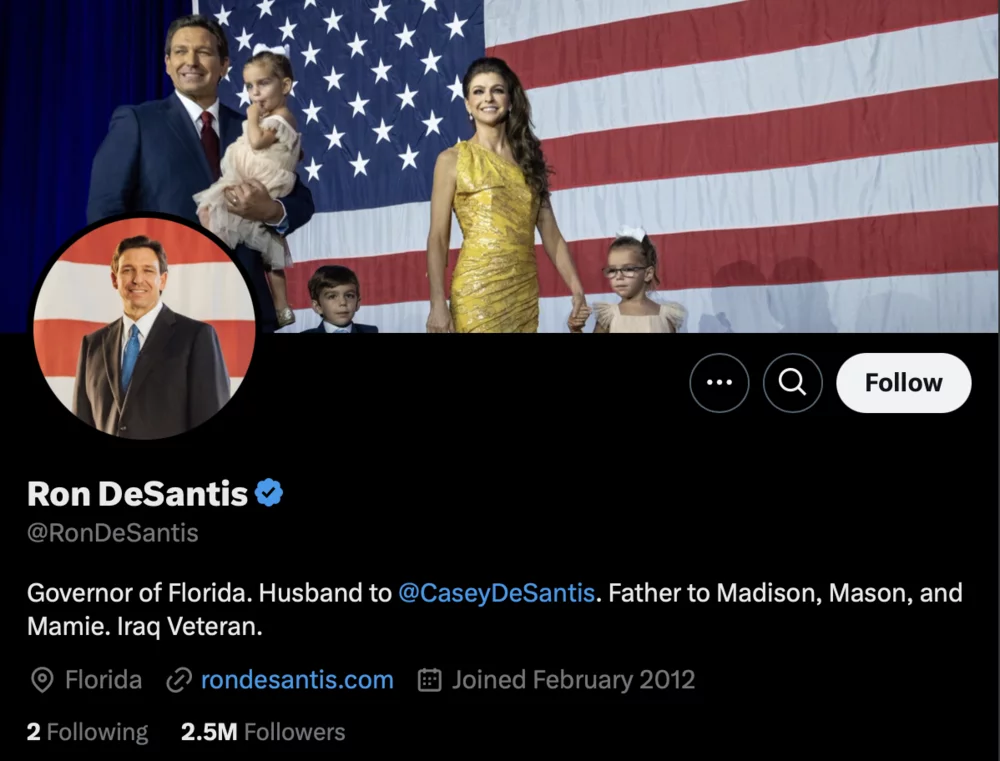
Firstly we will look at DeSantis’ general image presented on social media. Ron DeSantis’ banner on X (fig. 1) is exemplary for this, especially because this is the first thing that users will see from him. He portrays himself as a family man in his biography where he mentions being a husband and a father. Furthermore he brings up that he is a veteran. This is supported by an image of him and his family with an American flag in the background. Not only in this banner and his profile picture is he wearing a suit, but also in other pictures on his account he is always wearing formal clothing. While it's common for politicians to wear a suit, this formal wear is also worn by DeSantis during more informal events where others around him are dressed more casually. Based on his photos on X, he sometimes also might wear jeans instead of formal pants, but he always wears at least a neat blouse on top of it. When comparing his clothing to other governors in U.S.A., it's noticeable that others like Jared Polis (Governor of Colorado) and Gavin Newsom (Governor of California) regularly do not wear a tie or a suit at all in their photos on X. DeSantis' preference for formal clothes shows off authority and discipline which reflect his traditional values.
According to Lempert and Silverstein (2012) message is multimodal, which means it’s not just communicated through words, but also through gestures, materials and speech. Politicians try to create a coherent story about themselves through these different modalities (Lempert & Silverstein, 2012). Their clothing is thus not a coincidence, but the result of active messaging. In this case we can see that Ron DeSantis is using multiple modalities like clothing, images of his family and descriptions of who he is as a person in order to reinforce his message. Central in that message is traditional values, American nationalism and conservativism. The clothing is emblematic for his discourse on those topics. His anti-woke campaign, his clothing style, his family pictures, all contributed to his message. De Santis, before he ran for president, was known as a Trump-man, and a lot of the Trump-supporters loved him as governor in California. That changed with his candidacy for the president. Message is dialogical which means it is created in relation to other actors (Lempert & Silverstein, 2012). In this case, Trump supporters, but of course also Trump himself, have impacted DeSantis' message through framing. After DeSantis' had announced he was running for president, Trump quickly gave him the nickname 'DeSanctimonious'. This nickname was used to call DeSantis disloyal, because Trump endorsed DeSantis as governor during the gubernatorial elections in 2018 and now DeSantis was challenging Trump during the presidential elections (Slisco, 2023). The American press also played a role in this narrative as they have often focused on how Trump would win in popularity, underscoring Trump's power (McGraw, 2023).
Back to topRon DeSantis’ campaign during the presidential race
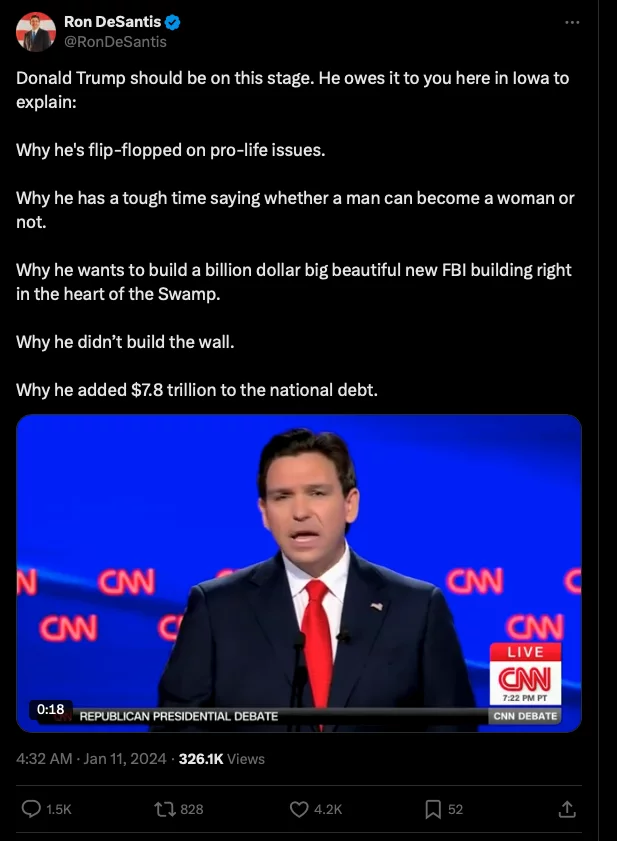
When looking at tweets during Ron DeSantis’ presidency campaign, we see a consistent message where he points out the flaws of the other candidates and uses this to contrast his opponents to himself. Ron DeSantis often argues that Donald Trump hasn’t kept his election promises during his time in the White House (fig. 2). Note that, DeSantis doesn’t attack Trump on an ideological level. Several traditional media have mentioned that all three candidates for the Republican party have similar ideas, but differ in their presentation (Wu et al., 2024; Gift, 2023). This might explain DeSantis’ focus on Trump's inadequacy during his previous time as president instead of focussing on ideology.
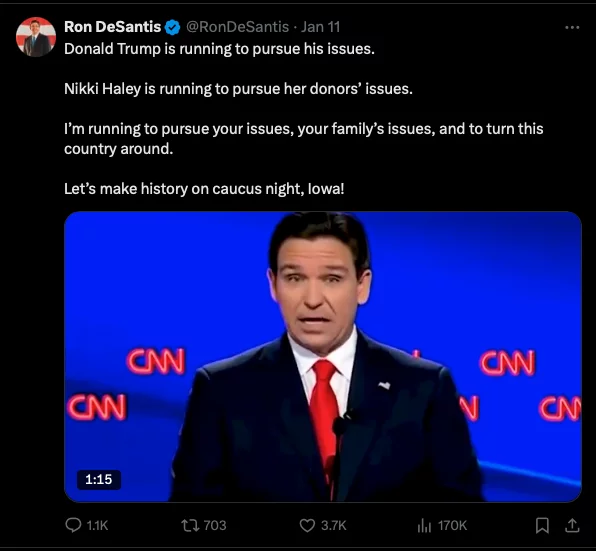
An analysis of other tweets from during DeSantis’ presidential campaign reveals him using this strategy to distinguish himself from his opponents Donald Trump and Nikki Haley. In the tweet above (fig. 3), Ron DeSantis separates himself from his opponents by using the same populist frame that also Trump uses, namely by presenting himself as a man of the people in comparison to his opponents. The exact text of this tweet has repeatedly been used in other tweets. This use of repetition is a stylistic and rhetoric method that is used to convey political message and ideology (Chiad & Sallomi, 2019). Furthermore, the negativity towards DeSantis' opponents is part of his message. According to Lempert and Silverstein (2012) negative messaging can be used to brand your opponent and attribute negative traits to their image. In DeSantis' case, he tries to frame himself as a stable option compared to Trump and Haley, who according to him are not to be trusted with their election promises.
Creating visibility is necessary for politicians nowadays as visibility is connected to power (Bucher, 2012). Algorithmic logic determines what becomes visible and politicians try to adapt their content accordingly (Bucher, 2012). In the tweets shown above, DeSantis is using affective language which is preferred by social media systems (KhosraviNik, 2018). This affective language is reinforced through directly speaking to his audience by using words such as ‘our nation’, ‘we the people’ and framing himself as a man of the people (fig. 4), while framing the other candidates as untrustworthy. Furthermore, most of his posts contain photos or videos as illustrated by these examples, which are preferred by algorithms on social media (Bucher, 2012). Interestingly, he does not make use of hashtags to boost his engagement while hashtags can contribute positively to uptake (Gkikas et al., 2022).
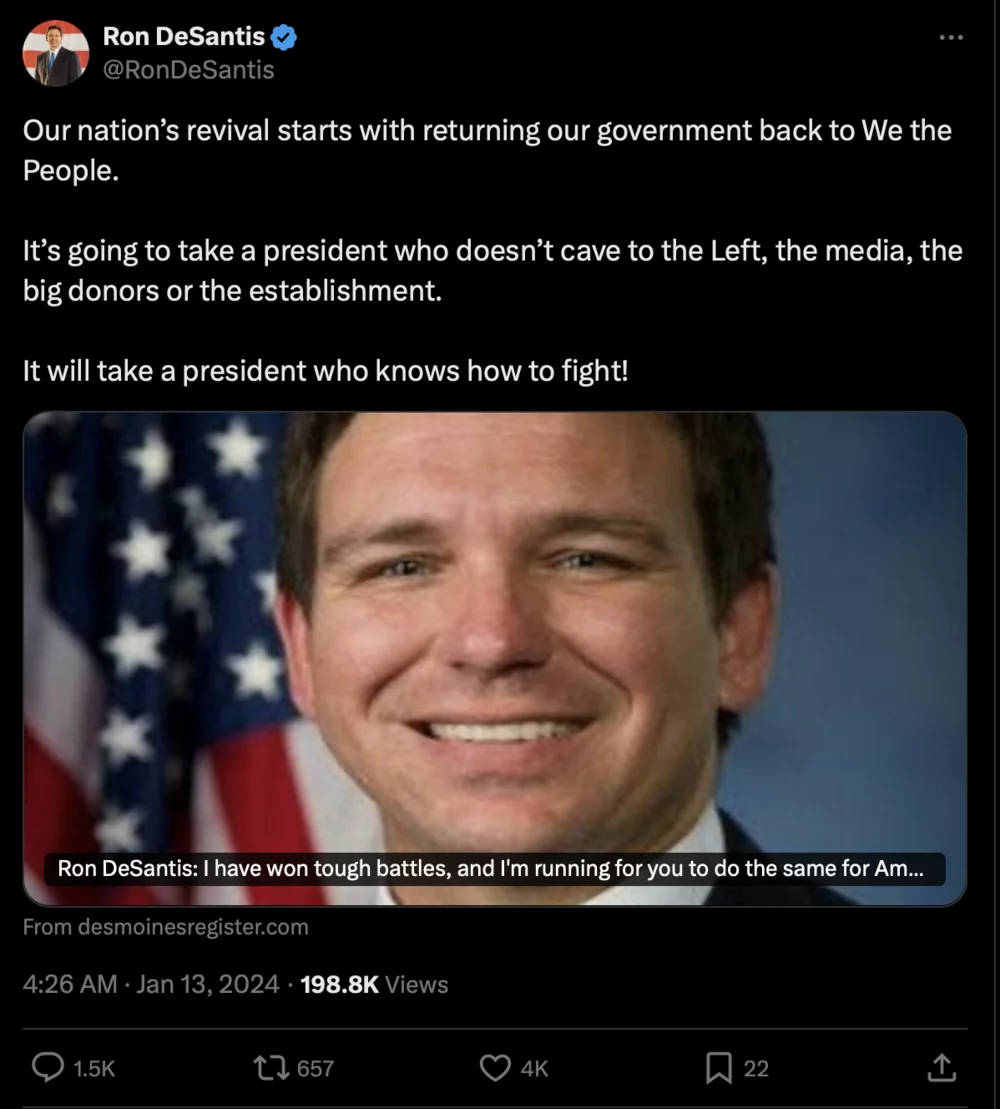
At the same time, DeSantis is using a populist narrative. Populists shape ‘the voice of the people’ rather than directly reflecting the voice of ‘the people’ (Maly, 2022, p.47). In this post (fig. 4) we see the use of an populist frame where ‘the people’ are contrasted to ‘the elite’ (Maly, 2022, p.36). In this constructed narrative, ‘We the people’ is very explicitly mentioned in relation to the nation. It also seems to have an intertextual connection with the preamble of the Constitution of the United States which starts with the same words.
On the other hand, ‘the elite’ is presented as the left and the media. DeSantis also mentions big donors as a part of this, implicitly referring to Nikki Haley as he has often criticized her for supposedly letting her donors influence her political agenda (Kinnard et al., 2024). By doing this, his Republican opponents are also framed as part of ‘the elite’, because he implies they are collaborating with ‘the Left, the media, the big donors or the establishment’. Therefore, DeSantis is using this populist narrative to resonate with ‘the people’ and to separate himself from his political opponents.
In this paper populism is understood as ‘a mediatized chronotopic communicative and discursive relation’ (Maly, 2022, p.34). De Santis can only successfully mobilize the populist frame, if he gets public support. By understanding populism as such we thus need to focus on the distribution and uptake of the populist frame in specific contexts (Maly, 2022). Users of social media are not just consumers of discourse, but are also ‘prosumers’ which means they partake in the (re)production of discourse (Maly, 2022). Politicians rely on these prosumers for uptake and therefore visibility (Maly, 2022). This makes analyzing uptake crucial which is why this analysis includes likes, comments and shares.

Interestingly, most of the comments under DeSantis’ posts during his campaign are negative and criticize DeSantis’ participation in the elections. They stress their disappointment and reproduce Trump's messaging of De Santis. These commenters become messengers of message (Lempert & Silverstein, 2012). These negative comments therefore contribute to a negative message of Ron DeSantis as a politician who should in their eyes solely stay focused on his role as governor. People appear to side with Trump or say he should focus his attention on his role as governor in Florida instead of investing in national politics (for example, fig. 5).
Back to topCounter-audiences, message and populism
Political actors depend on uptake as algorithms significantly impact the spreading of ideas (Maly, 2022). However, the public sphere consists of a wide range of audiences, which means messages can reach unintended audiences and create negative messages (Blommaert, 2019). When looking at the negative comments, it’s clear that DeSantis' message did not solely reach his supporters. Interestingly, these comments seem to echo Trump's narrative about DeSantis, indicating that Trump's framing has fueled the commenters. This narrative frames DeSantis as someone who should focus on regional politics instead of campaigning against Trump.
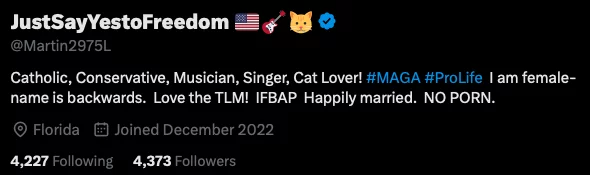
When looking at the types of accounts that comment under DeSantis' post, such as the one in the example above (fig. 6), we can notice a type of digital activism taking place. After clicking on this specific account, you can see they are a Trump supporter based on the biography, which explains why their posts resemble Trump's narrative of DeSantis. Moreover, this account seems to post regularly about American politics and has a relatively large following with over 4000 followers. This account is emblemetic of the activist movements that are taking place on social media. According to Maly (2022), algorithmic activists like this account use their algorithmic knowledge to (re)produce political discourses. By posting about politics, and in this case commenting under DeSantis' posts, these activists are participating in the discursive battles for meaning that shape DeSantis' message. This is done through challenging the message of DeSantis in the comment section.
While negative comments also generate uptake, Ron DeSantis’ attempt to create a positive message seems to have failed. Furthermore, a populist needs to resonate with the people. Uptake is being used as legitimacy for what politicians are saying (Maly, 2022). As a result of this negativity, Ron DeSantis might have suffered reputational damage contributing to a negative narrative about him on social media.
Back to topChanging strategies
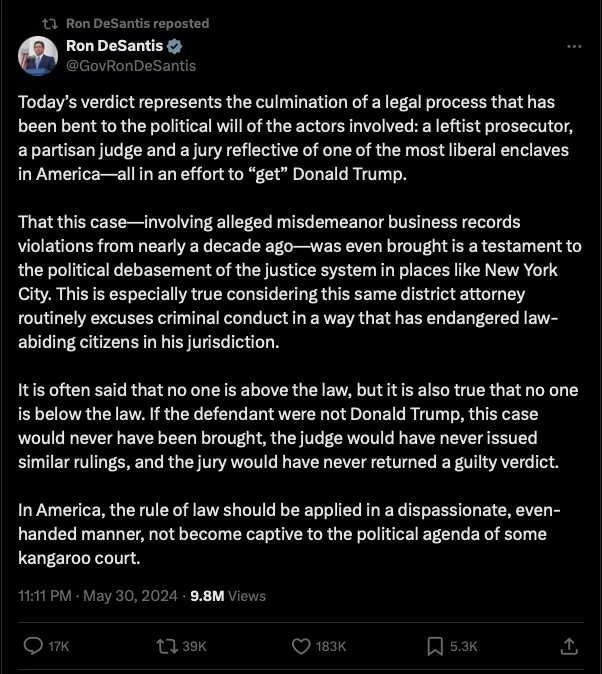
However, after DeSantis withdrew his candidacy, we can immediately see a change in strategy. First of all, after Ron DeSantis’ withdrawal, no posts have emerged where he openly criticizes Donald Trump. This seems in line with his endorsement of Trump (Debusmann & Epstein, 2024), but is still surprising considering the harsh critiques DeSantis has given to Trump and undermines further his credibility. This attention seems to have shifted to Joe Biden, but after he also withdrew his candidacy, DeSantis turned to Kamala Harris based on the content of his tweets. In another post DeSantis criticizes the court ruling where Trump was found guilty for falsification of business records that proved he gave hush money to a porn star (NOS, 2024). DeSantis argues that the verdict is unjustified. This shows us that not only has DeSantis stopped criticizing Donald Trump, he actively expresses his support and defends him in certain issues as shown in the tweet above (fig. 7).
Now DeSantis has no need to distinguish himself from other Republican politicians. This implies that DeSantis is shifting his attacks to maintain support from right-wing voters and to maintain relevance, but also to fall into the grace of Donald Trump again. This way DeSantis can sustain his visibility on X.
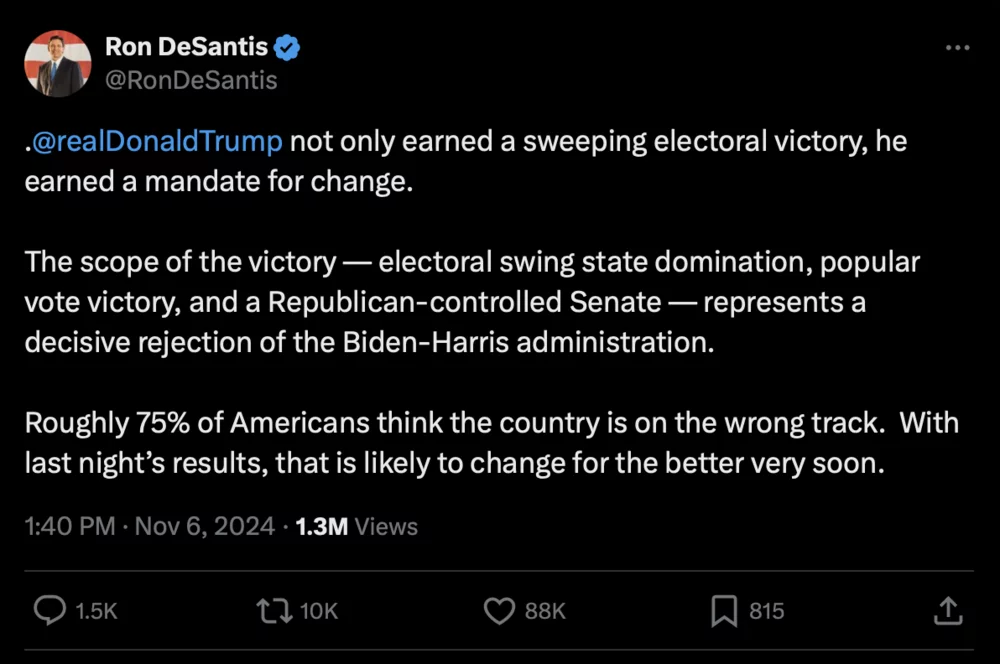
This change in strategy is also illustrated by a different use of the populist narrative. The tweet above (fig. 8) was posted after Trump won the presidential elections in 2024 (Smith & Pengelly, 2024). Once again, DeSantis is framing ‘the elite’ as the left, specifically Joe Biden and Kamala Harris. He is contrasting this ‘elite’ with ‘the people’ by saying Americans are ‘rejecting’ this left elite and think they are on the wrong track. Moreover, he frames himself as part of ‘the people’ by saying Trump’s victory will be ‘for the better’. By mentioning how Trump ‘earned’ this victory, he not only implies that Trump is representing the voice of the people, but also that he agrees Trump will provide positive change. He therefore frames himself as agreeing with ‘the people’ which positions him as part of ‘the people’.
This same frame of differentiating ‘the people’ and ‘the left’ is also used in earlier social media posts during his presidential campaign as illustrated previously. However, we see a contrast in this framing compared to posts during his candidacy. While prior posts have framed other Republican candidates as part of ‘the elite’, now Trump appears to represent the voice of the people according to DeSantis. This presents a narrative of a unified Republican party who will provide a positive transformation of America. According to Fairclough (2001), ideologies are embedded in discourse and sustain certain power relations through normalizing certain ideas. Trump has a growing widespread impact on the political landscape in America. By changing his ideology to Trumpism, DeSantis is connecting himself to this power, while avoiding marginalization. Therefore, this strategic shift of DeSantis seems to be an opportunistic move.
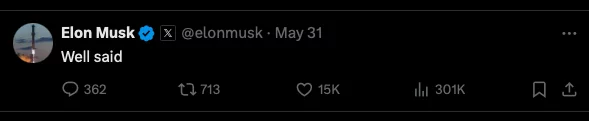
These findings are supported by the uptake, especially when looking at the comments under his posts. Interestingly, the uptake in these newer posts is better than the posts during his presidency campaign. In the examples used in this article, we see the first tweets during DeSantis' campaign have a few thousand likes. In comparison, the newer posts have tens of thousands likes. Moreover, the comment section is a lot more positive. Furthermore, a greater amount of verified users are contributing to this uptake. Even a prominent figure like Elon Musk is interacting with his posts (fig. 9). It's worth mentioning that Musk has expressed support for Trump in the past (NOS, 2024). Musk's positive comment under DeSantis' post reaffirms DeSantis' supportiveness towards Trump. As mentioned before, politicians depend on uptake for their visibility (Maly, 2022). By changing his message on social media, Ron DeSantis is able to resonate and reconnect with his right-wing audience who mostly seem to support Trump nowadays. By framing himself as a Trump supporter, DeSantis is able to adapt to this new power of Trump as a prominent figure in the political landscape, which might explain the change in uptake of his posts. As a result, this increased uptake makes his message more visible on social media.
Interestingly, almost no users seem to comment on DeSantis' shift from criticism towards Trump to support. Rather than criticizing DeSantis for not being consistent in his message about Trump, commenters seem to applaud him for it. Furthermore, he can use this increased uptake to restore his negative message of loss.
Back to topFrom Trump critic to supporter
This article investigated how DeSantis’ message and use of algorithmic politics changed after his withdrawal from the presidency race in 2024. His discourse on X mainly focuses on the attacks of other politicians while trying to maintain his image as a conservative American who stands for traditional values. However, there is a clear difference between his message before and after his withdrawal in the presidential race. While he centres his attention on criticizing his opponents from the Republican party during his candidacy, he shifts the focus of his attacks to democratic politicians after his withdrawal.
More specifically, DeSantis' criticism towards Donald Trump changes to support. Furthermore, we see how DeSantis applies a populist narrative and how this populist frame is adjusted over time to benefit his message. This article analyzed how DeSantis changed his message after his withdrawal and regained relevance and visibility by adapting to algorithmic logic. His case illustrates how political visibility is highly dependent on algorithms in our digital era and how strategic adaptation can redefine message and influence. Lastly, this analysis shows how DeSantis is adjusting his message based on changing power relations by showing he is in favor of Trump. The increased uptake and support from digital activists suggest that he is succeeding in this.
Back to topReferences
Bollyky, T. J., Nies, A., Turilli, I. (2023, September 7). Did Florida get it right against COVID-19?. Think Global Health.
Bucher, T. (2012). Want to be on the top? Algorithmic power and the threat of invisibility on Facebook. New Media & Society, 14(7), 1164–1180. https://doi.org/10.1177/1461444812440159
Blommaert, J. (2019). Political discourse in post-digital societies. Tilburg Papers in Culture Studies, n. 236.
Cabral, B. S. (2023, May 26). Where Ron DeSantis stands on key issues. BBC News.
Chiad, M. O. & Sallomi, A. H. (2019). A Stylistic Study of Repetition and Ideology in Political Discourse: Donald Trump as a Case Study. Journal Of Education College Wasit University, 2(2). https://doi.org/10.31185/eduj.vol2.iss2.899
Debusmann, B. & Epstein, K. (2024, January 22). Ron DeSantis drops out of presidential race and backs Trump. BBC News.
Fairclough, N. (2001). Language and Power. London, United Kingdom: Routledge. https://doi.org/10.4324/9781315838250
Gift, T. (2023). Trump v DeSantis: how the two Republican presidential heavy-hitters compare. The Conversation.
Gkikas, D. C., Tzafilkou, K., Theodoridis, P. K., Garmpis, A., & Gkikas, M. C. (2022). How do text characteristics impact user engagement in social media posts: Modeling content readability, length, and hashtags number in Facebook. International Journal Of Information Management Data Insights, 2(1), 100067. https://doi.org/10.1016/j.jjimei.2022.100067
KhosraviNik, M. (2018). Social Media Techno-Discursive Design, Affective Communication and Contemporary Politics. Fudan Journal Of The Humanities And Social Sciences, 11(4), 427–442. https://doi.org/10.1007/s40647-018-0226-y
Kinnard, M., Peoples, S., & Price, M. L. (2024, January 11). Haley, DeSantis tear into each other’s records in Republican debate. AP News.
Lempert, M. & Silverstein, M. (2012). "Message" is the medium. In Lempert & Silverstein (Eds.), Creatures of Politics: Media, Message and the American Presidency. Bloomington, IN: Indiana University Press.
Maly, I. (2016). ‘Scientific’ nationalism: N-VA and the discursive battle for the Flemish nation. Nations And Nationalism, 22(2), 266–286. https://doi.org/10.1111/nana.12144
Maly, I. (2022). Populism as a Mediatized Communicative Relation: The Birth of Algorithmic Populism. In C.W. Chun (Ed.). Applied Linguistics and Politics (pp. 33–58). London: Bloomsbury Academic. http://dx.doi.org/10.5040/9781350098268.ch-002
Maly, I. (2022b). Guillaume Faye’s legacy: the alt-right and Generation Identity. Journal Of Political Ideologies, 28(1), 35–61. https://doi.org/10.1080/13569317.2022.2045460
McGraw, M. (2023). Trump prepares an extensive opposition file on ‘Ron DeSanctimonious’. Politico.
Navarro, A., Garrett, M., & Costa, R. (2024, January 22). Ron DeSantis drops out of 2024 Republican presidential race, endorses Trump ahead of New Hampshire primary. CBS News.
NOS. (2024, May 30). Donald Trump als eerste oud-president VS schuldig bevonden in strafzaak. NOS.
NOS. (2024b, November 24). “Musk hoopt via Trump zijn heldenrol waar te maken”. NOS.
Slisco, A. (2023, June 21). Trump Explains “Ron DeSanctimonious” Nickname for Ron DeSantis. Newsweek.
Smith, D., & Pengelly, M. (2024, 7 november). Donald Trump elected US president in stunning political resurrection. The Guardian. https://www.theguardian.com/us-news/2024/nov/06/donald-trump-wins-us-presidential-election
Wu, A., Huang, J., & Gold, M. (2024, January 19). How Trump, Haley, and DeSantis Are Campaigning for the 2024 Election. The New York Times. https://www.nytimes.com/interactive/2024/01/11/us/trump-haley-desantis-campaign-2024.html
Back to top
More from this author