

Article
How Eva Vlaardingerbroek uses Algorithmic Populism on Instagram to Construct and Spread her Ideological Message
Eva Vlaardingerbroek is an increasingly influential and important political activist who frequently posts on social media platforms to construct and share right-wing ideologies about politics in Europe and the USA. Since she influences and mobilises a large audience, she plays a big part in Western political discourse, using algorithmic populism as a frame to construct and spread her ideological message.

Published date
Courses
Digital media and Politics
Copyright
This work is licensed under a Creative Commons Attribution-NonCommercial 4.0 International License.
Read time
16 minutes

Who is Eva Vlaardingerbroek?
This article discusses how Eva Vlaardingerbroek uses algorithmic populism to influence and mobilise users of Instagram, and reveals how she plays a crucial role in the landscape of digital media and politics, both in Europe and the USA.
Eva Vlaardingerbroek is a Dutch right-wing political activist and opinion maker who uses various social media platforms to address her audience. Her posts often discuss themes like national conservatism, anti-globalism, ethno-differentialism, and freedom of speech, taking her own position in far-right discourse.
Eva Vlaardingerbroek is a Dutch political activist and a metapolitical influencer (Maly, 2024). She actively shapes public discourse and normalizes far-right ideologies through online strategies. According to Maly (2024), metapolitics refers to the far-right cultural and ideological struggle that emphasizes the shifting of public opinion and ideas through cultural means, rather than directly engaging in political action. Eva Vlaardingerbroek uses the hybrid media system (Chadwick, 2017) - combining both old and new media - to maximise visibility and influence in the post-digital public sphere; she utilises social media platforms such as X and Instagram, and regularly appears on television, such as on Fox News. She especially gained international attention during the Dutch farmer protests, where her outspoken advocacy for the farmers’ cause made her globally famous. Her personal brand is strengthened through her consistent style, often wearing feminine clothing and using her polished appearance to attract attention, gain uptake, and strategically frame herself as both relatable and authoritative.
On Instagram, she has almost 400k followers. Despite being Dutch, she doesn’t only discuss politics from the Netherlands.In her social media posts, Vlaardingerbroek mainly discusses current politics of Europe and the United States of America, sharing her visions and insights with her audience. She spreads her message in English in an attempt to sustain her global flame and international uptake.
To realise this goal, Vlaardingerbroek uses a populist frame and an in-depth knowledge of the digital ecology. Maly (2022) defines such digital populism as 'algorithmic populism'. With this concept he draws attention to the use of algorithms and affordances of platforms that are used by the populist to (1) construct ‘the people’ as a unified group that is opposed by ‘the elite’, which is portrayed as corrupt and oppressive and (2) to claim to be able to speak in their voice. Populism functions as a frame to normalize ideologies by presenting them as 'the voice of the people'. In a post-digital context, this political and cultural message is presented so that it maximises uptake and engagement. Since Vlaardingerbroek seems to be increasingly successful in generating uptake on her social media platforms, it is important to ask: How does Eva Vlaardingerbroek use a populist frame and algorithmic knowledge on Instagram to construct and spread her ideological message?
Back to topDigital Discourse Analysis
To answer this question, a digital discourse analysis will be conducted, which involves the analysis of various forms of digital communication, such as text, images, and multimedia, to uncover patterns and meanings in online discourse. The analysis focuses on how the utilisation of specific digital media platforms shapes the kinds of messages that their users make. In this case, the focus is on how Eva Vlaardingerbroek utilises Instagram to construct a certain Message.
Lempert and Silverstein (2011) define ‘Message’ as a carefully constructed ‘character’ that presents itself in the public and faces the audience. This refers to the contents of the communication and includes the style and imagery to create a convincing public identity. This Message extends beyond speech or text, incorporating many semiotic resources to present a coherent and appealing persona (Lempert & Silverstein, 2011). It operates as both a dialogical and diachronic phenomenon: dialogical because it anticipates interaction with audiences and opponents and, therefore, exists in a relationship with its audience, and diachronic because it draws on past messages and thus contributes to a larger character (Lempert & Silverstein, 2011). Furthermore, Message is inherently multimodal, as it combines various materials - such as dress, staging, and speech - to create a unified narrative that invites audiences to connect emotionally and ideologically with the political figure (Lempert & Silverstein, 2011).
For Eva Vlaardingerbroek, her Instagram posts offer the opportunity to construct a digital version of this ‘Message’. Instagram allows her to not only spread her ideological content, but also combine it with a carefully constructed persona, strategic engagement, and audience interaction. Here, her Message also involves how the persona resonates with its audience; uptake is a crucial aspect in the hybrid media system (Chadwick, 2017), since Instagram’s algorithm pushes content that engages users. In the context of Vlaardingerbroek, uptake refers to how her audience interacts and engages with her content.
To conduct a digital discourse analysis, I selected three recent Instagram posts by Eva Vlaardingerbroek that I consider emblematic of her Message, the use of algorithmic knowledge, and the populist frame. This will create a complete image of her Message and how she constructs it. Instagram was chosen as the platform for this study because of its unique affordances, which make it an effective platform for constructing a successful public persona; Instagram emphasises reels: short videos that allow for visual storytelling and direct interaction with the audience through comments and likes, which connects to Bucher’s (2012) concept of algorithmic visibility, stating that platforms prioritise content that drives engagement, positioning these videos within Instagram’s economy of visibility. The decision to focus on these three recent posts is because these posts provide the most relevant image of her current messaging.
The posts under analysis consist of two longer videos and a shorter one. All three of these posts highlight aspects of Vlaardingerbroek’s persona, Message, themes, and presentation styles that create one complete image of her ideological Message. Nevertheless, all three of these posts have a consistency in that they all touch upon the politics of the USA and share a coherent Message in their core. Moreover, in all three of these posts, Eva Vlaardingerbroek strategically encourages uptake by positioning herself as ‘the voice of the people’; she uses algorithmic populism as a frame (Maly, 2022).
Back to topVlaardingerbroek as a ‘character’

Eva Vlaardingerbroek posted her first post on November 4, 2024 (Vlaardingerbroek, 2024a). We see her standing in - what seems to be - her living room, talking directly into the camera, creating a strategic form of intimacy between her and the viewer. She opens by saying “Dear white men,” directly addressing a certain audience that immediately indexes her specific political position. She follows with ordering the ‘white men’ to go and vote for Trump “right now.” It is already clear that she directly engages with the politics of the USA, despite being European herself. She goes on to say that if they don’t vote for Trump, they will be “stuck with another administration that hates your guts.” By stating this, she puts ‘white men’ against the Harris administration, framing Harris and the Democrats as 'anti-white men'. She adds to this polarisation by stating that the white men demographic is the “most undervalued, underappreciated and even despised demographic in modern history.” She physically emphasises these three statements by pointing up a finger for each of the three arguments.
Here already, the frame of algorithmic populism becomes clear; Maly (2022) highlights that algorithmic populism is not an ideology but is, first and foremost, based on a frame used to articulate “the voice of the people” against perceived elites. Vlaardingerbroek’s video creates a polarising and emotionally charged narrative that pits ‘white men’ as the undervalued people against the political elite - ‘the Biden-Harris administration’ - as their oppressors. Vlaardingerbroek not only claims to speak in the name of those people, but she also goes on to state that the white men she directly addresses are the key agents of change; she uses the populist frame to create a sense of empowerment and urgency.
This video has received a lot of interaction on Instagram; it has 375k views, 26k likes, and more than 1k comments and shares. This uptake legitimizes her populist claims by giving her an audience to frame as a 'we'. The result of this interaction between the people and her posts is that such affordances amplify her Message; algorithms are socio-technical assemblages since they only function in relation to human interaction, and are thus (invisible) participants in the digital discourse.
The affordances of Instagram amplify this Message by giving the videos with the most uptake a higher algorithmic visibility. The direct and emotionally charged language of the video - such as “hates your guts” and “this is your moment” - aligns with Bucher’s (2012) economy of visibility, where the platform’s algorithms give priority to engagement-driving content. In addition, the emotional response is amplified by the use of inspirational and emotional background music, making her sound like a messenger of true wisdom, and physical language: she uses her hands to emphasise certain statements, and her active way of talking mobilises viewers also to take action.
Additionally, Vlaardingerbroek (2024a) uses a clip in her video to portray that her Message is part of a broader political discourse. She explains that white males "hold the key" for the future of the USA, and elaborates on this point by using a clip of a podcast where a man explains that the white turnout for Trump is crucial for him to win. This use of intertextuality adds to her credibility and connects Vlaardingerbroek’s Message to other influential voices, again amplifying its uptake. They index her integration in the global new right network (Maly, 2024), which contributes to the uptake and reproduction of her voice on a global scale.

To understand this video of Vlaardingerbroek (2024a), Lempert and Silverstein’s (2012) concept of Message is crucial, since Vlaardingerbroek crafts a clear persona: a knowledgeable European outsider invested in the future of the USA. While she is a political influencer from the Netherlands, the topics she discusses are frequently about the politics of the USA, aiming to influence and mobilise American citizens. This ‘character’ is carefully designed to resonate with both American and international right-wing audiences, combining anti-globalism - an ideology that opposes a neoliberal globalisation based on open borders and thus migration and homogenization in a global culture - and national conservatism - an ideology that prioritises the preservation of national culture and identity.
"The character of Vlaardingerbroek is carefully designed to resonate with both American and international right-wing audiences, combining anti-globalism and national conservatism"
In a short time, she has become an important node in the global new right (Maly, 2024). Her appeal to Donald Trump and his image as a savior figure, and her interest in the USA, connects her personal Message to a larger political new right discourse. This integration in the global new right is not just an effect of their discourse, it is also the result of her clever use of the algorithms to enhance her visibility and position her content in the broader far-right discourse. This is a clear example of using the affordances of Instagram to construct a “Message machine” (Lempert & Silverstein, 2012) that builds a consistency across her political and digital presence, which creates a seemingly real and consistent persona.
The video, with more than 26k likes, is one of her more popular videos on Instagram, with more than a thousand comments and shares. It is instantly clear that the audience has extensively interacted with this video, resulting in Instagram's algorithmic boosting of it. When looking at the comments, the opinions are divided; some people support her, while others oppose (and sometimes even insult) her. Nevertheless, the most recurring and biggest point of critique is about the fact that she is addressing white men in particular, and not just all men; many people in the comments interpret the addressing of only white men to go vote as racist. While these commentsoppose her statements, such interactions with the video nevertheless allow it to get picked up by Instagram's algorithm, potentially resulting in the video reaching - and, therefore, influencing - an even larger audience.
Back to topVlaardingerbroek’s love for the USA
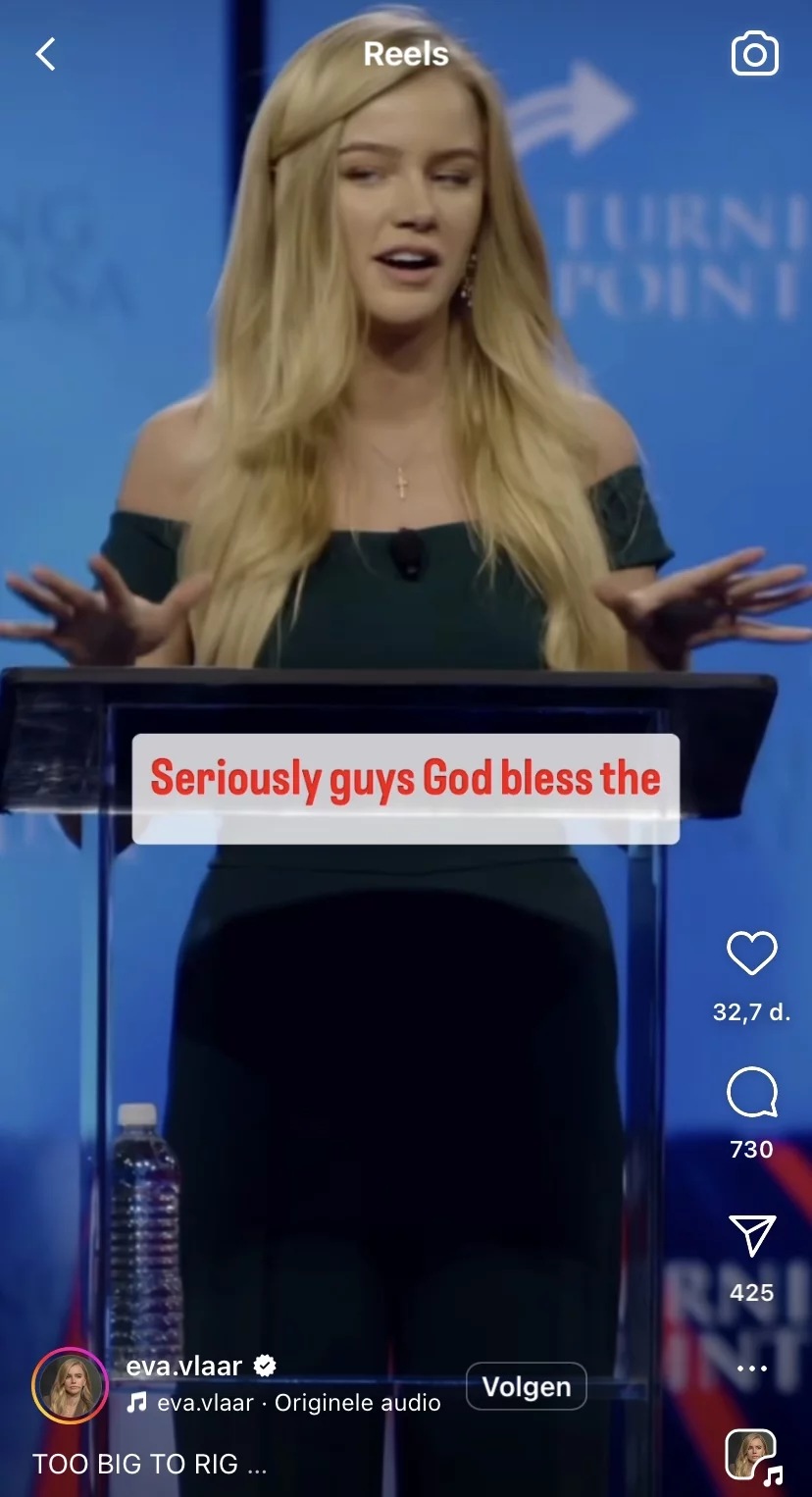
The consistency of her character becomes clear when analysing a different Instagram post of Vlaardingerbroek from two days later. In this post from November 6, Vlaardingerbroek (2024b) shows her love for the USA in a short Instagram video: we see Eva Vlaardingerbroek at a conference, where she says “Seriously guys, God bless the United States of America!”, followed by the audience reacting with cheers. Despite being short, it is an important piece of data to analyse; it shows Vlaardingerbroek actively participating in politics at a conference, her consistent love for the USA, and how the audience reacts to her. With this short video, the algorithmic populism (Maly, 2022) is nevertheless apparent: the cheers from the audience serve as a form of validation, emphasising Vlaardingerbroek’s Message as popular and positive, which allows for a big uptake, both offline and online. This double layer enhances the impact of her Message, while being very simplistic.
Especially the simplicity of such a statement makes it effective: KhosraviNik (2018) emphasises the importance of affective relatability in algorithmic populism over argumentative deliberation. In other words, a simple personal and relatable Message has more uptake than a well-constructed rational argumentation. In this case, Vlaardingerbroek’s quote, “God bless the United States of America,” is more than just a statement; it is an emotional performance designed to evoke a certain response. The phrase has a cultural and religious significance and appeals to the audience's values, which creates a sense of shared identity; she wants her audience to know that she identifies herself as a proud Christian who shares the Christian values. This connects to Christian nationalism as an ideology, which sees Christianity as a guiding force in shaping political beliefs and democracy as rooted in Christian ideas and ideals, and aims to achieve dominance in political and social life. That the intended response of Vlaardingerbroek was successful is confirmed by the audience's reaction; the cheers demonstrate the effectiveness of a simple statement, and by sharing this moment on Instagram, Vlaardingerbroek extends the power of this statement to her online audience.
Additionally, a short video like this generates more views - in this case 488k views -, since Instagram videos start over when they are finished; more views means more uptake in the algorithm of Instagram; the use of affordances in a hybrid media system (Chadwick, 2017) generates more uptake to spread Vlaardingerbroek’s Message (Bucher, 2012).
When comparing the uptake of the video to the other two pieces of data, it is clear that it has less comments and shares, but more likes: almost 33k likes, while the other two have 26k and 23k likes. There has thus been less extensive interaction with this video than with the other two. This can be explained by the fact that this shorter video doesn't give many statements that can be discussed in the comments, but a simpler comment about the USA. In addition to the offline success of this Message, the intended response was also successful in the online dimension; the comments on this video mainly show a lot of support for the USA, Vlaardingerbroek herself, and the quote in the video.
Back to topThe ‘corruption’ of the Netherlands

The third and final piece of data is another longer video of Vlaardingerbroek (2024c), in which she discusses the current situation of freedom of speech in Europe and how Europe does not have the First Amendment rights that the USA does. This video also shows how Vlaardingerbroek’s algorithmic populism functions as a frame to amplify her ideological Message (Maly, 2022) while crafting a persona to portray a certain Message (Lempert & Silverstein, 2012). Vlaardingerbroek (2024c) presents herself as a defender of free speech by saying that “we [Europeans] are not allowed to say what we want, especially about the government” and she positions “the government”, “the establishment”, and the “Neo-Marxist elites” as the oppressors. She creates a polarised Message where figures like her friend Reize Blumenstein and right-wing politicians are victims of an unjust system, which she describes as “deeply corrupt and politically motivated”.
This polarisation connects her audience by drawing upon shared feelings about freedom of speech. She directly addresses American viewers to value “how lucky they are” to have a First Amendment, which broadens her reach by connecting European issues to a global Message about freedom of speech. Vlaardingerbroek adds to the frame of algorithmic populism by stating that, “they’re not exactly coming after left wing politicians, are they? This only goes for us far right thought criminals.” Here, she portrays ‘us’ as the far right and ‘them’ as ‘left wing politicians’ and ‘the establishment’, generalising them as oppressors who see the far right as ‘thought criminals’. Here, Vlaardingerbroek uses air quotes with her fingers when saying ‘far right’, emphasising that ‘far right’ is indeed how they are being perceived, while at the same time distancing themselves from that label.

In this video, there are more instances of the use of physical language: when talking about Wilders - the leader and member of the Dutch Parliament and the right-wing populist Party for Freedom (PVV).She says that Wilders “was also convicted of a crime a few years ago.” After this sentence, she repeats the word "crime" with air quotes and a laugh, following with “obviously not”. Here, she shows that she can laugh about the way the establishment treats right-wing politicians like Wilders because she finds it so wrong and absurd. She follows up by saying: “even the idea that you could offend a group is insane to me, and as if offending someone would be a criminal offense. But in the Netherlands it really, really is.” With these sentences she portrays The Netherlands as a country of ‘corrupt elites’ that treats people who offend others too harshly; she wants to emphasise that offending others is not a crime and should not be punished this way because according to her, that is a threat to the freedom of speech.
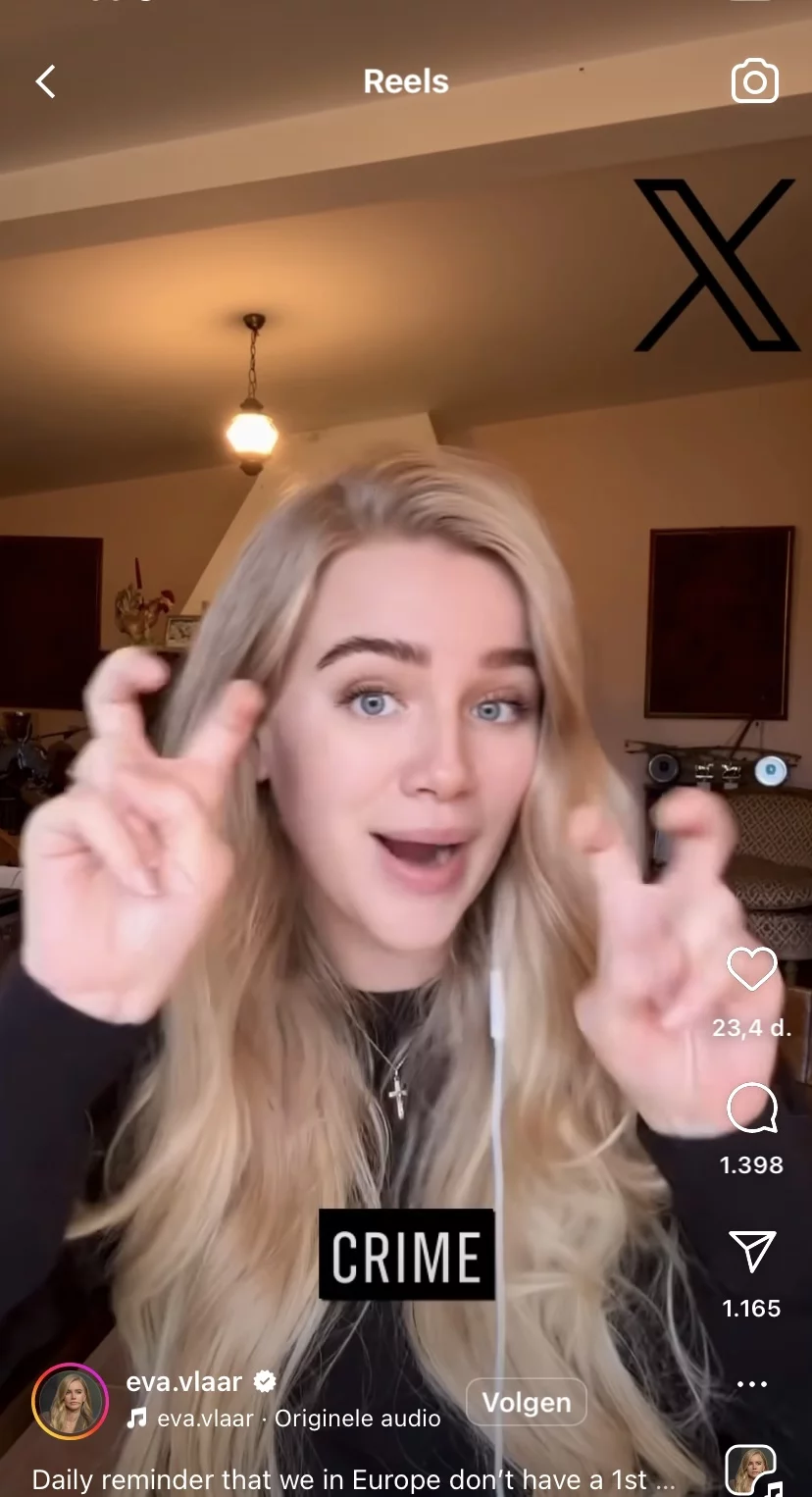
She ends the video by comparing Europe to the USA and, once again, reminds the American audience how “lucky they are with a First Amendment." She also states that she "just wanted to record this video” to update her audience on the situation in Europe. This statement makes the video seem like a quick recording in one take that wasn’t prepared beforehand, making it feel like Eva Vlaardingerbroek is an authentic and insightful messenger with important information for the audience. This staged authenticity (Gaden & Dumitrica, 2014) is emphasized by the strategic intimacy of the video; Eva is sitting in her hotel room, making direct eye contact with ‘us’ - the viewer - and calmly shares her thoughts with us. She’s sitting at a desk wearing the same style of clothing and the cross around her neck, referring to her Christian nationalism, adding to the consistency of her persona and her brand (Lempert & Silverstein, 2012).This directly addresses the audience. In addition, she shares that she can’t go to the trial of her friend Reize Blumenstein in the Netherlands because she got negative advice from her gynaecologist, saying that she can’t fly. Sharing a personal story about her medical condition enhances the intimacy and authenticity of her persona and Message.
Finally, she directly asks her audience to “pray” for her friend, also adding to her Christian nationalism, and “show support in the comments”, which engages her followers to interact with her, helping her gain gain algorithmic visibility (Bucher, 2012). The people in the comments do not only show support to Blumenstein, but also to Vlaardingerbroek herself. Many share their gratitude for Vlaardingerbroek speaking up about a topic such as these. They connect the video's content to their own situations and explain that they agree with Vlaardingerbroek's views. A striking pattern in these comments is that most people show their support by using the word 'we': "we support you"; "we don't want you to face the same problems"; "we are having the same kind of issues"; etc. This directly connects to the populist frame of 'us' versus 'them', showing that Vlaardingerbroek successfully framed this audience as a unified group.
Back to topAlgorithmic Populism through Instagram
Through this analysis, it becomes clear that Eva Vlaardingerbroek mainly shares the ideologies of national conservatism and anti-globalism on Instagram, with a love for the USA, by portraying herself as a ‘character’ who actively believes in and actively uses these ideologies - both online and offline - to play her own part in political discourse, attempting to reach, influence, and mobilise her target audience: white Europeans and Americans. To reach this goal, she uses algorithmic politics by not only constructing ‘the people’ opposing ‘the elite’, but also presenting herself as the ‘voice of the people’; she portrays herself as a ‘character’ who took it upon herself to bring the Message that ‘the people’ need to bring down ‘the elite’. This influential Message, which generates a lot of uptake, is carefully constructed through the utilisation of affordances and algorithms of Instagram. This raises significant questions about the role of digital media in politics. To what extent do political influencers impact voting behaviour? Does freedom of speech include the spreading of hateful/racist discourse, and where should the line be drawn? Should users of social media platforms be made more aware of the power of algorithms, and in what way? Who should be in control of these algorithms and platforms? By finding answers to these questions, we can obtain deeper understandings and insights not only into the world of digital media and politics but also in society.
Back to topReferences
Bucher, T. (2012). Want to be on the top? Algorithmic power and the threat of invisibility on Facebook. New Media & Society, 14(7), pp. 1164 - 1180
Chadwick, A. (2017). The Hybrid Media System: Politics and Power (2nd ed.). Oxford University Press.
Gaden, G., & Dumitrica, D. (2014). The ‘real deal’: Strategic authenticity, politics and social media. First Monday, 20(1).
KhosraviNik, M. (2018). Social Media Techno-Discursive Design, Affective Communication and Contemporary Politics. Journal of the Humanities and Social Sciences, 11(1), pp. 1-16.
Lempert, M. & Silverstein, M. (2012). Introduction. Creatures of Politics, pp. 1-57.
Maly, I. (2022). Populism as a Mediatized Communicative Relation: The Birth of Algorithmic Populism. Applied Linguistics and Politics, pp. 33 - 58.
Maly, I. (2024). The birth of metapolitics 2.0. Metapolitics, Algorithms and Violence: New Right Activism and Terrorism in the Attention Economy, pp. 65 - 106.
Vlaardingerbroek, E. [@EvaVlaar]. (2024a, November 4). Dear white men, go vote for @realdonaldtrump now! 🇺🇸. Do not get stuck for 4 more years with an administration that [Video]. Instagram.
Vlaardingerbroek, E. [@EvaVlaar]. (2024b, November 6). TOO BIG TO RIG. God bless @realdonaldtrump. God bless his team of heroes Elon Musk, @robertfkennedyjr, @tuckercarlson , @tulsigabbard and many [Video]. Instagram.
Vlaardingerbroek, E. [@EvaVlaar]. (2024c, November 20). Daily reminder that we in Europe don’t have a 1st Amendment: My best friend @raisablommestijn, who’s a Dutch right-wing TV [Video]. Instagram.
Back to top
More from this author