


Review
GLOW: Critiquing the Stereotypes of American Identities on TV
Glow critiques how stereotypes in the media do not do justice to the complex lived realities of multicultural individuals in America through the juxtaposition of stereotypical performances with the lived realities of individuals.

Published date
Courses
The multicultural individual
Copyright
This work is licensed under a Creative Commons Attribution-NonCommercial 4.0 International License.
Read time
8 minutes

GLOW is a comedy-drama series on Netflix that presents a fictionalization of the characters and gimmicks of the women's professional wrestling circuit ‘Gorgeous Ladies of Wrestling’ founded by David McLane in the 1980s. The series shows a great fondness for the 80’s time period in its fictional wrestling segments with its homages to the iconic spandex costumes, larger-than-life hairdos, and campiness of many 80’s shows. However, it also provides an intriguing critique of how stereotypes presented in the media do not do justice to the complex, lived realities of multicultural individuals. The way in which GLOW juxtaposes the stereotypical performances of the actresses with their lived experiences outside of the show, as well as the way in which it critiques the achievability of the hegemonic American ‘nuclear family’ ideal, makes it a must-watch.
Back to topGLOW: Gorgeous Ladies of Wrestling
The series follows Ruth Wilder, a highly idealistic, struggling actress who auditions for a seemingly sketchy professional wrestling promotion called the Gorgeous Ladies of Wrestling (GLOW). Ruth is offered a job but clashes heavily with the cynical director Sam Sylvia, who has also employed Ruth’s former friend Debbie Eagan. Debbie, a former soap opera actress, has a complicated relationship with Ruth since Ruth had an affair with her husband in the past, whom Debbie is now divorced from.
In their process of funding and producing the show, they are joined by a large cast of colourful characters who each have their own personal struggles to confront, such as the flamboyant main funder of the project Sebastian ‘Bash’ Howard, the closeted lesbian Arthie ‘Beirut the Mad Bomber’ Premkumar, the illegal immigrant Rhonda ‘Britannica’ Richardson, the older, black woman Tammé ‘Welfare Queen’ Dawson and many others.
GLOW does a masterful job at providing an intersectional portrayal of the issues faced by ethnic minorities in America
The cast of supporting wrestling actresses is very diverse in terms of their ethnic and cultural background, and their varying ethnicities and cultures create unique problems in their everyday lives, especially in combination with other identity aspects such as gender, sexuality, socio-economic background, etc. GLOW does a masterful job at providing an intersectional portrayal of the issues faced by ethnic minorities in America, but it also takes culture into consideration when approaching the issues faced by the phenotypically white characters, showing us that everyone is multicultural.
The next sections will cover some striking moments from the series to explain how GLOW juxtaposes the portrayal of ethnic minorities in the media and the normative ‘white, nuclear family’ ideal with the lived experiences of American individuals.
Back to topThe Duality of Lived Experiences and Representation in the Media
Many of the over-the-top personas of the actresses in the fictional wrestling program are based on specific minority-related fears in the American consciousness. ‘Zoya the Destroya’ (played by Ruth), for example, portrays the fear of the communist ideology, whereas ‘Beirut the Mad Bomber" (played by Arthie) represents the fear of Arab terrorism.
Although these overexaggerated stereotypes add to the campy, offensive appeal of the GLOW wrestling segments, they leave a sour taste when contrasted with the real lives of the actresses. Through this contrast, the audience is confronted with the realisation that the way in which the actresses have to portray themselves is often degrading and feels like a betrayal of their ethnic or cultural identity. In some instances, their stage personas can be empowering, but they also cause emotional damage to many of the actresses.
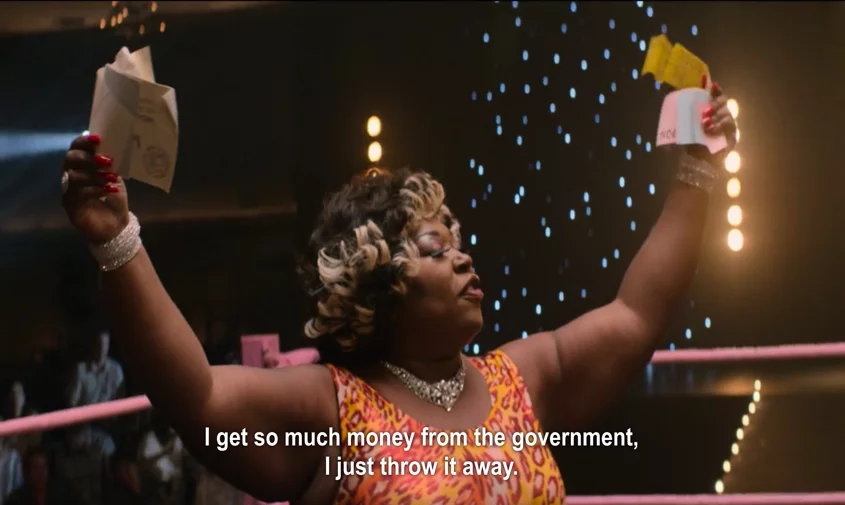
An example of this is Tammé Dawson whose stage persona is ‘The Welfare Queen’: a character that represents the American fear of (black) free riders of the welfare system (see Figure 1). In the ring, Tammé portrays herself as a lazy, scheming, job-less antagonist who banks on tax-payer dollars. Although she loves acting like the villain, she also feels a certain guilt towards her son who received a tax-dollar funded university scholarship from a program for black applicants because Tammé could not afford to fund his degree. In contrast to her stage persona, Tammé also refuses to stop working and fall back onto welfare programmes when she experiences a lot of pain later on in the series because of back issues.
The cast of supporting wrestling actresses is very diverse in terms of their ethnic and cultural background, and their varying ethnicities and cultures create unique problems in their everyday lives
Another actress who is in a deep emotional struggle with her stage persona is Jenny Chey, who plays the extremely stereotypically portrayed Asian character ‘Fortune Cookie’. Jenny comes to a breaking point after Melrose - another female wrestler who is Jenny's best friend - puts an even more offensive spin on the character in the episode “Freaky Tuesday” in which all the actresses switch roles for one performance. When the ladies go camping in the desert in the following episode, she shares the horrific story of the reason she came to America in the first place.
In a very emotional scene, Jenny explains that she had to flee from her home country Cambodia when the Khmer Rouge (the communist party of Kampuchea) took over the area. She was lucky enough to escape before the ensuing genocide, but most of her friends and family could not flee in time. She tearfully says: “I get to be one of the lucky ones. Like, really, really lucky. And now I jump out of a fortune cookie every night pretending everything is fine.” What is worse is that she is often portrayed in the wrestling show as the villainous companion of the communist ‘Zoya the Destroya’ and having to portray a character so closely related to the ideology that justified the murder of her family causes a great deal of emotional distress.
Back to topAbandoning the American Ideal
Not only does GLOW subversive the stereotypical personas of the actresses in the ring by contrasting their performances with their lives outside of the ring, but it also juxtaposes the lived experiences of its (white) characters with the American heteronormative, hegemonical ideals about marriage and family. Throughout the series we see multiple characters attempt to achieve these ideals and most characters end up abandoning them completely by the end.
A good example of this is Debbie and her wrestling persona ‘Liberty Belle’ who is portrayed as the typical patriotic American housewife willing to do anything to protect her family and defend her nation. This norm-spouting American wrestling persona contrasts heavily with Debbie’s life outside of the ring where, after finding out that her husband cheated on her with Ruth, she abandons the role of the diligent housewife to pursue her own ambitions. After a long fight for recognition as a capable woman and after spiraling into a depression, she eventually manages to get the job of producer on the show.
Another example of how the norms associated with marriage and family clash with lived realities is the unusual relationship between Rhonda (who plays ‘Britannica’) and Bash (who acts as the commentator for the show). After the British Rhonda admits to the other girls that she is an illegal immigrant, Carmen proposes that she should marry her biggest fan during an upcoming episode to secure a green card. However, Bash, who is head-over-heels for Rhonda, and who knows she would not be happy being married to her biggest fan, disrupts the ceremony and marries her instead (see Figure 2).
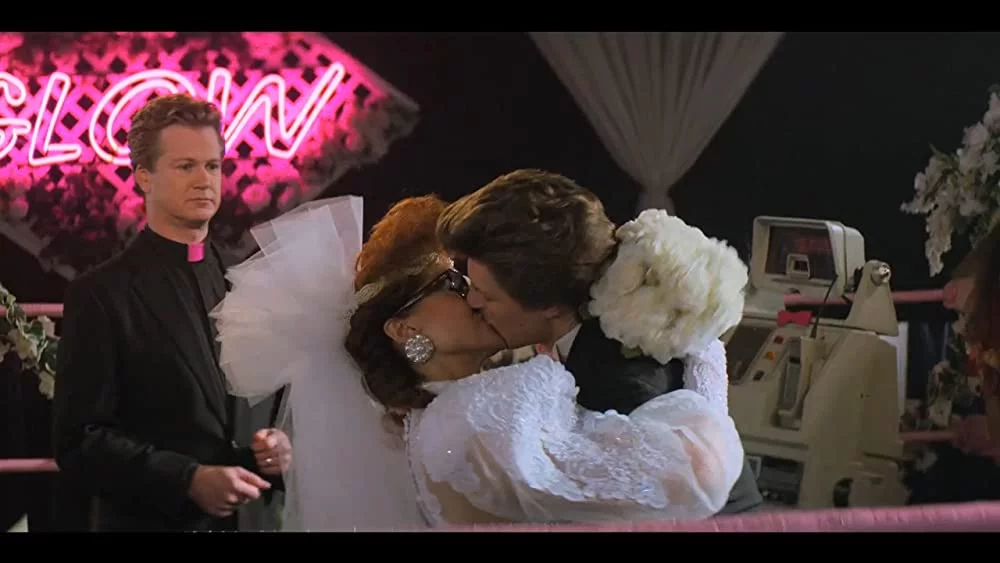
On the surface, their wedding seems to match the heteronormativity still associated with marriage in many societies. It also seemingly reinforces the American norm of marrying for love, which radiates from Bash’s spontaneous objection to Rhonda’s loveless marriage. We soon get to see, however, that this outward image as a typical white, heterosexual American couple does not reflect the complexities of their individual motivations and identities.
Rhonda deeply cares about Bash, but later admits to Birdie, who manages Bash’s finances, that she would not have married him if she had not badly needed a green card, which undermines the previously mentioned American ideal of marrying for love. Bash, on the other hand, undercuts the heterosexual norm by admitting to Rhonda that he is bisexual. Because Bash was raised in an environment where heterosexuality was the norm, he is deeply terrified that his bisexuality will ruin his relationship with Rhonda. Not only does the heteronormativity of the society in which he lives have a strong hold on Bash’s worldview and actions, but the legal and economic power of this heterosexual normativity is later affirmed when Bash can finally access 40 million dollars of his grandfather’s inheritance because of his marriage to Rhonda.
Rhonda and Bash’s marriage, as well as the contrast of Debbie’s life with her American ideal-inspired ‘Liberty Belle’ persona, show that the American stereotypes surrounding marriage and family do not do justice to the complexity of the identity of many American individuals.
Back to topA Multicultural Mosaic of American Identities
GLOW may not always be very subtle in its critique of how generalized stereotypes in the media can have a harmful effect on the people that portray them and the audiences that view them, but it does create a wonderful mosaic of (marginal and major) American identities connected through similar experiences and social categories such as ethnicity, gender, sexuality, and socioeconomic status.
It is a shame that GLOW’s social critique can only be optimally enjoyed by an American audience who is familiar with the stereotypes presented in the fictional wrestling segments. Although foreign audiences may recognize elements of Liberty Belle’s patriotism, not many will pick up on Welfare Queen’s creative insults that refer to the daily reality of Americans who make use of the welfare system. An example of this is when she exclaims “body brought to you by government cheese” in her match against Liberty Belle, which refers to the massive amounts of government-sponsored cheese given to those who rely on food stamps.
Despite the fact that a lack of knowledge of American stereotypes and cultural norms will prevent you from experiencing the show to the fullest, this series is still a recommended watch for those living outside of America as some of the messages that the series is trying to convey are universal. One of these universal messages, that was explored in-depth in this review, is that the stereotypical portrayal of minorities -and even majorities- in the media does not do justice to the complex identities and lived experiences of individuals.
Back to top
