Paper
Geert Wilders' Anti-Islam and Anti-Immigration Ideology on the Platform X
Geert Wilders utilizes his X platform to spread anti-Islam and anti-immigration political discourse. The paper explores how these two ideologies are presented in a selection of posts collected from Wilders X profile between August and November 2024. These two ideologies are mainly presented in his X posts through racist and nationalistic themes. Wilders' display of political Message, understanding of algorithmic politics, and presenting as a populist all allow Wilders to effectively create political discourse in his tweets.

Published date
Courses
Digital media and Politics
Copyright
This work is licensed under a Creative Commons Attribution 4.0 International License.
Read time
17 minutes

On this page
- Geert Wilders: Nationalistic and Racist
- Understanding Politics and Platforms
- Wilders' Ideology: "Interested in the [...] Islamic Threat?"
- Wilders as a Populist: The Man of the People and a Cat Dad
- Wilders' Brand: Anti-Asylum and Anti-Immigration Policies
- "I will NOT accept that. NEVER"
- Wilders' Remarkable Message and Ideologies
- References
Geert Wilders utilizes his account on the online platform X mostly to share anti-Islamic and anti-immigration discourse, which have become a defining feature of his message. This article explores Wilders' message within a collection of X posts.
Back to topGeert Wilders: Nationalistic and Racist
Geert Wilders is not new to the Dutch political scene. In fact, he has been in it for quite a while. Geert Wilders is the leader of the Dutch political party Partij voor de Vrijheid (PVV - Party for the Freedom) since 2006. Wilders has been a member of the House of Representatives since 1998 and used to belong to the Liberal party VVD till 2004 (PDC Foundation, n.d.). In 2023, the far-right politician's political party won the November general elections. Though the winning party is usually allowed to nominate its political leader to become prime minister, Wilders abandoned his bid for the position, since he was not receiving enough support from other political parties during negotiations about a potential political alliance (Schaart, 2024). Wilders is known for his controversial ideas. Some of them include ending asylum for refugees, revoking asylum permits for Syrians, criminals to be deported, and opting out from EU regulations on asylum and immigration (Schaart, 2023). His political discourse, mostly consisting of anti-Islamic and anti-immigration discourses, is often shared across Wilders’ social media platforms.
Wilders has always been a popular figure in Dutch politics, but has grown in popularity just before and after the 2023 November elections, leading to his ideology being visible more now than ever. Wilders utilizes his large X audience of 1.5 million followers (as of November 2024) to share his (political) ideas, and utilizes X's affordances, such as hashtags and trending topics or keywords, to insert his ideas and manipulate political discourses taking place on the platform.
Hence, this article tries to answer the question of how his anti-Islamic and anti-immigration discourses are presented by Geert Wilders on the platform X.
Back to topUnderstanding Politics and Platforms
In order to understand political communication, Message must be explored first. Lempert & Silverstein (2012) argue that Message in American politics is not the topic or proposition of a political discourse but rather communication of the politician as a full person, with certain convictions, but also a specific character and style. Message is performed for the viewing public (Lempert & Silverstein, 2012). Message is understood as multimodal: "Message strategists […] are fashioning […] an electorally viable political persona through all manner of signs that creatively gesture toward this persona without explicitly describing it" (Lempert & Silverstein, 2012, p. 2). Message incorporates various materials of clothing, gestures, staging, and speech which within itself values pronunciation, grammar, register, and more (Lempert & Silverstein, 2012). Message can be positive, i.e. how the government (or politician) wants to be viewed, or negative, i.e. how the government wants the opponent to be branded by a candidate (Lempert & Silverstein, 2012). Recently, brand marketing strategies have been employed in political campaigns, where, in some cases, Message is not only shaped as brand, but Message itself is brand (Lempert & Silverstein, 2012).
Political communication is almost exclusively the communication between a politician and a public (Lempert & Silverstein, 2012). With the digitalization of political discourse, the threat of invisibility due to algorithmic power rises. This means that algorithmic knowledge and understanding platform culture now becomes an inherent part of the politician's message production. Media serve to illuminate, and inform publics about something previously unknown, and visibility of such is affected by the medium itself (Bucher, 2012). Interactions, such as likes or comments on a piece of content, influence the algorithm into highlighting or downgrading certain contents (Bucher, 2012). The threat of invisibility is both literal and symbolic as a user faces the threat of constantly disappearing from the media (Bucher, 2012).
Algorithmic politics “refers to the idea that realities are never given but brought into being and actualized in and through algorithmic systems” (Bucher, 2018, p. 3). For political success online (and increasingly also offline), the politician must have an understanding of the platform, its culture and its algorithmic logic. Algorithmic politics is about how not only politicians, but also movements and citizens use digital media to have a voice in the public domain, and most importantly, to engage in message politics (Maly, personal communication 2024).
Message is important to build electoral capital, but in the end politicians like Wilders are in politics to normalize their ideology. Fairclough (2001) defines powerful ideologies as ‘common-sense’ assumptions, which are closely linked to power and language. Ideological assumptions, taken as ‘common sense’, contribute to power relations, and ideology is defined as ‘most effective’ when it’s least visible. Fairclough says that “if one becomes aware that a particular aspect of common sense is sustaining power inequalities at one’s own expense, it ceases to be common sense and […] to function ideologically” (p.85). Ideology as common sense can be set(s) of symbolic representations, discourses, arguments, etc. that help structure reality and is (re)produced in discourse (Maly, personal communication, 2024). All ideologies can be connected with different ideologies (racism, sexism, nationalism, etc.).
One way to normalize an ideology, is to use a populist frame, and thus to communicate your ideologies as if they are 'the voice of the people'. Populists are politicians who “claim to voice concerns of the people against the establishment” (Maly, 2022, p. 34). Populists, also referred to as “antiestablishment” (Müller, 2017, p. 24), claim that “they, and they alone, represent the people” (Müller, 2017, p. 26). To study populism, Maly (2022) proposes to analyse it as constructed in mediatized communicative relations between academics, journalists, and politicians, as well as citizens, activists, and computational agency. Uptake is thus crucial in establishing that populist frame. Uptake refers the (re)production of discourse through user consumerism on digital platforms and the role of algorithms in the dissemination and reproduction of ideas (Maly, 2023). Uptake is influenced by the use of hashtags, the timing of posts, and communication interactions. It is visible by platform affordances such as the like button, the amount of views being shown, and the (amount of) comments. In general, uptake is the recognition and legitimation received (Maly, personal communications, 2024).
To answer our research question, a collection of posts were gathered from Wilders’ X account, @geertwilderspvv, between August 6th to November 8th, 2024. X was the chosen platform for data collection due to Wilders’ large audience (1.5 million followers) on it and the fact that he uses it as his primary message communication instrument. A total of five emblematic posts by Wilders were chosen by a selection process focusing on posts containing anti-immigration, anti-Islam, and nationalist topics. This selection of posts was chosen due to the clarity of Wilders’ ideas being expressed in the post and the fact that they are emblematic for his discourse on those topics. The language barrier also played a role in the selection of the posts: four of the five posts are in English and the other is in Dutch (an English translation is provided for this post). This also portrays Wilders’ intended audience as a mostly global audience. The analysis of Wilders’ message through the posts will help develop an understanding of who Wilders is as a politician.
Back to topWilders' Ideology: "Interested in the [...] Islamic Threat?"
Geert Wilders’ brand is a global one. Throughout his career as a Dutch politician, he has become known to be hard on immigration and the Islamic religion. However, especially in the last years Wilders’ has succeeded in becoming more ‘acceptable’. Mainstream media talked about 'Geert Milders', where 'mild' refers to more moderate than before. This more moderate image is actively constructed by Wilders, and taken over by mass media. One example of how he produces this moderate image is his cat-account on X: @Wilderspoezen. This beloved account, dedicated to Wilders’ cats, presents Wilders as a normal man, not a politician, who likes to post pictures of his adorable cats. He creates an influencer-like profile for himself and for his audience, and simply portrays himself as a cat dad. This plays into his Message a as a simple man who aligns with other Dutch citizens. This example clearly shows Lempert & Silverstein (2012)'s definition of Message as brand, and in this particular case, Wilders’ seemingly normality brand and portrayal as a cat dad develops Wilders’ image as a common man.
Despite this new 'image' of a moderate Wilders, Wilders didn't drop his radical ideas Post 1 (fig. 1) depicts ‘the Old Wilders’, the one with extremist ideas against Islam.
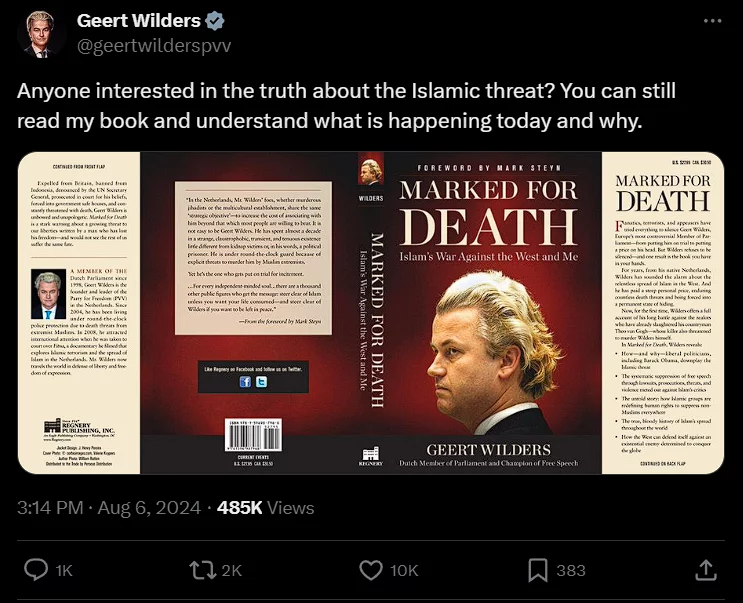
Firstly, the text “anyone interested in the truth about the Islamic threat?” showcases Wilders’ anti-Islamic discourses and poses the religion as negative by associating it with danger. Wilders’ uses this post as a way to promote his book. Heframes his book as ‘common sense’ and as something the viewer needs to read in order to ‘understand what is happening today’. Wilders’ book not only introduces content, it also creates a brand for him, and depicts Wilders as a certain person with certain ideas.
Wilders’ Message also portrays him as a proud man: he has no shame in promoting his own book that has his face on the cover. All of these factors combined, the post portrays the following: 1) Wilders is knowledgeable about “the Islamic threat”, so much so that he wrote a book about it, 2) Wilders paints Islam in a negative light, 3) it is ‘common sense’ that the Islamic religion is a “threat”. Like Lempert and Silverstein (2012) claim, Message also incorporates how the opponent in branded, which Wilders uses to brand Islam as a threat.
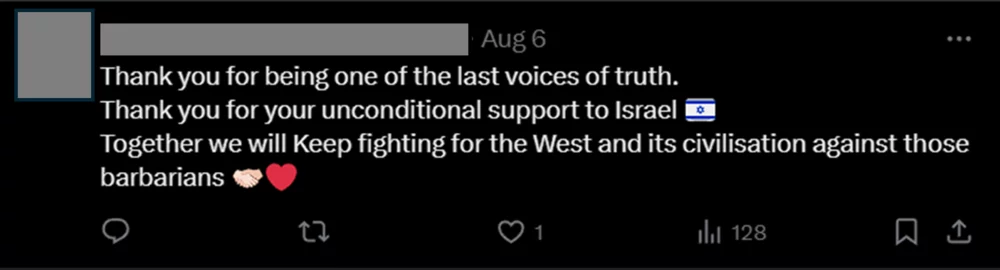
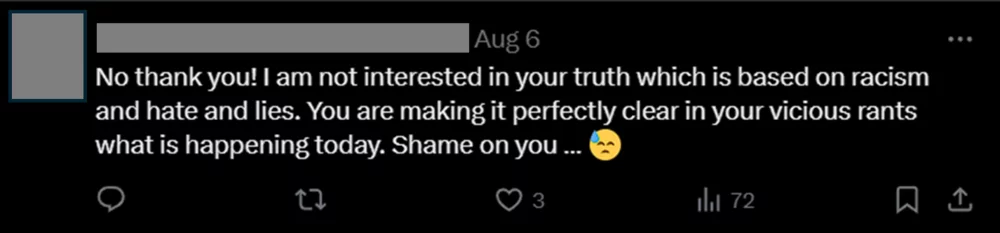
The uptake on this post isn’t massive yet it has a large reach, with 10 thousand likes, 485 thousand views, and 1 thousand comments, allowing for a decent reproduction of discourse (Maly, 2023). The comments are mixed responses with some users praising Wilders (fig. 2), and others criticizing Wilders’ racism (fig. 3).
Back to top
Wilders as a Populist: The Man of the People and a Cat Dad
As Wilders’ message appears to have become less intense throughout the years according to mass media, who refer to him as ‘Geert Milder’, Wilders’ still presents the same radical ideas still containing anti-Islamic and anti-immigration themes that are seen as ‘acceptable’, and Wilders establishes the idea of the ‘common sense’ by using other countries as examples. Through this, Wilders can demonstrate to his audience that his anti-immigration ideas align with many others throughout Europe, andis thus framed ‘common sense’. So, despite Wilders maintaining the same radical ideas, fellow European countries pushing for the same ideas as Wilders presents a group identity which mutes Wilders’ controversial discourse and changes it into common sense.
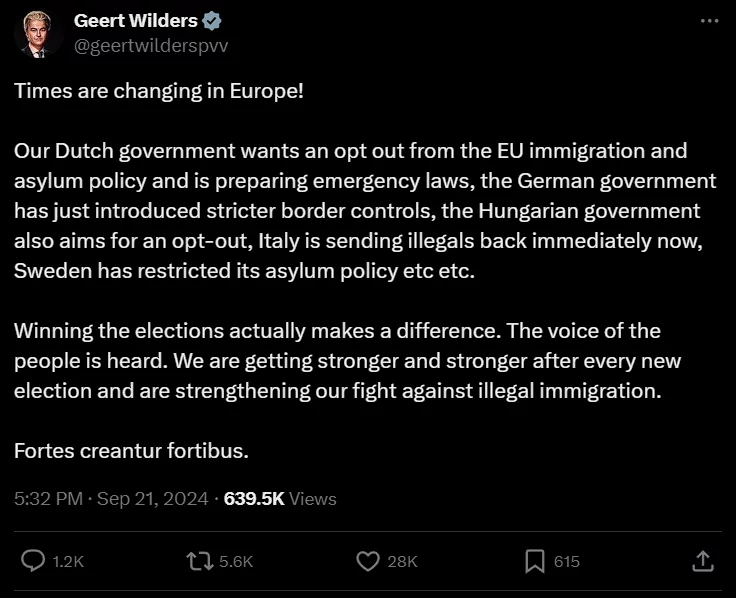
A nationalistic ideology is implicit in this post as it targets Dutch citizens. The message of the post implies that immigrants are a threat to national security, in both the Netherlands and across Europe. At the same time, his position is normalized by referring to other countries doing the same thing. What isn't mentioned here is that those countries are also ruled by rightwing or even far-right dominated governments.
Wilders also displays himself as a populist in this post. He says “The voice of the people is heard” which positions Wilders as the voice of the people. His use of inclusive language, words such as “we”, aligns Wilders with the common citizen. Defined in the theoretical framework by Maly (2022) and Müller (2017), Wilders fits well into the populist category as he ‘voices the concerns’ of the common citizen and constructs a form of communication between himself and the citizens. The use of “the voice of the people”, “we”, and “our fight”, portrays Wilders as a man of the people, and positions him as a ‘savior’ of the Dutch people. This is supported through the final Latin sentence “Fortes creantur fortibus”, which translates into something along the lines of “the strong are created by the strong”. This presents Wilders as a hero of the people and as a strong leader, which contributes to his political Message and how he brands himself.
This post contributes to Wilders’ Message, creating a powerful post that resonates with the people, and is supported by the comments below. It has a very positive uptake by the viewers: 639.6 thousand views, 27 thousand likes, and 1.2 thousand comments. The timing of the post influences uptake (Maly, 2024). In the Fall of 2024, there was a rise in the number of right-wing politicians and especially a rise in anti-immigration ideologies in Europe, such as in Hungary and Germany. An overwhelming majority of the comments come from users supporting Wilders and praising him (figg. 5 and 6).
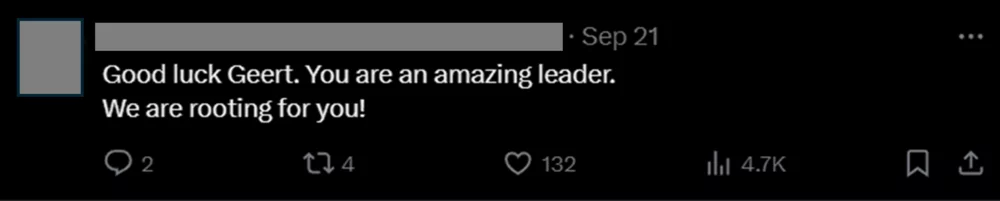
The populist framework is also supported in the comments, seen in fig. 6, where Wilders, as member of a government party, is praised for “listening to their citizens”. Furthermore, the comments display the concept of racist and anti-immigration ideology becoming normalized and being seen as ‘acceptable’.

The third post by Wilders (fig. 7) applies a very similar framework as the second post. The post also establishes an anti-immigration ideology presented as ‘common sense’ ideas through the support of mentioning other countries. This presents the idea to his audience that the ideology is universal and normal. This also creates an identity of unity throughout Europe, as a populist framework is also applied to a larger community. In post 2, it targeted Dutch citizens and contained a more nationalistic approach, whilst with post 3, it targets EU citizens. The post portrays the list of countries as finally listening to the voice of their people: “[…] what tens of millions of Europeans long for!”.
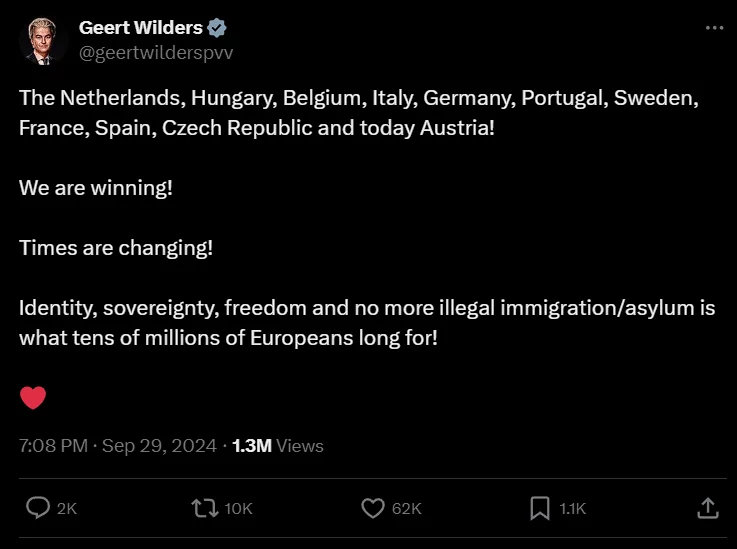
Despite posts 2 (fig. 4) and 3 (fig. 7) contain very similar Message and ideology, post 3 has a much larger uptake with 1.3 million views and 62 thousand likes. The timing of the post, the evening of Austria’s elections, may have an influence in this larger uptake as another audience besides Wilders’ is present. The comments are overwhelmingly positive, and in support of Wilders’ (and other countries with right-wing politicians) anti-immigration approaches.
Back to topWilders' Brand: Anti-Asylum and Anti-Immigration Policies
Wilders is popular through his anti-Islam and anti-migration discourses. In post 4 (fig. 8) Wilders announces the creation of “the strictest asylum policy ever”. The whole speech by Wilders in the video centers around anti-immigration and anti-asylum policies in the Netherlands, enforcing Wilders’ ideology as he presents a set of discourses that structures the future of immigrants and asylum seekers in the Netherlands.
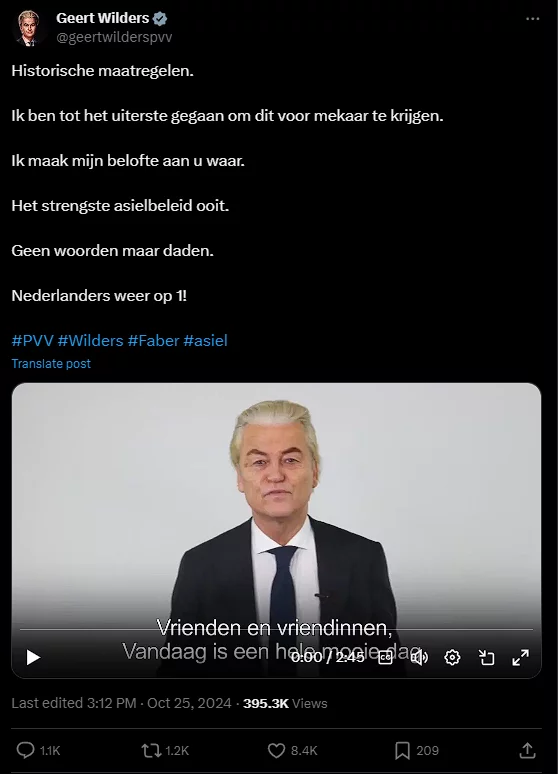
Wilders’ Message is well presented in the video. He’s dressed in a suit with a tie, making him look professional and clean against a white simple background, and he speaks clearly and with passion on the topic. Together, this makes Wilders seem confident in his policy, which he even states himself: “I am confident that it will all work out”. He presents himself as a trustworthy politician, speaking in terms of ‘I’ to display that he himself has done this, not the government nor his party. He utilizes influencer tactics starting the speech by addressing the audience as “friends” and finishes with “And the Dutch again at number one”, which indexes Donald Trump’s slogan. This use of Trump’s well known “America first” slogan reinforces Wilders’ nationalistic ideology and him as a populist as he establishes a close relationship with his Dutch audience. Wilders displays the multimodal aspect of Message described by Lempert and Silverstein (2012) as he incorporates clothing, staging, and speech in the video. In this post, Wilders also shows his understanding of algorithms as he uses hashtags in his post to engage in message politics.
The post has 397.1 thousand views and 8.4 thousand likes and 1.1 thousand comments. Compared to the other posts, the uptake isn’t significantly large and there are mixed reactions to the post. Those who appear to be big fans of Wilders praise and announce their respect for him in their comments (fig. 9), while others mock Wilders and his ideas (fig. 10).
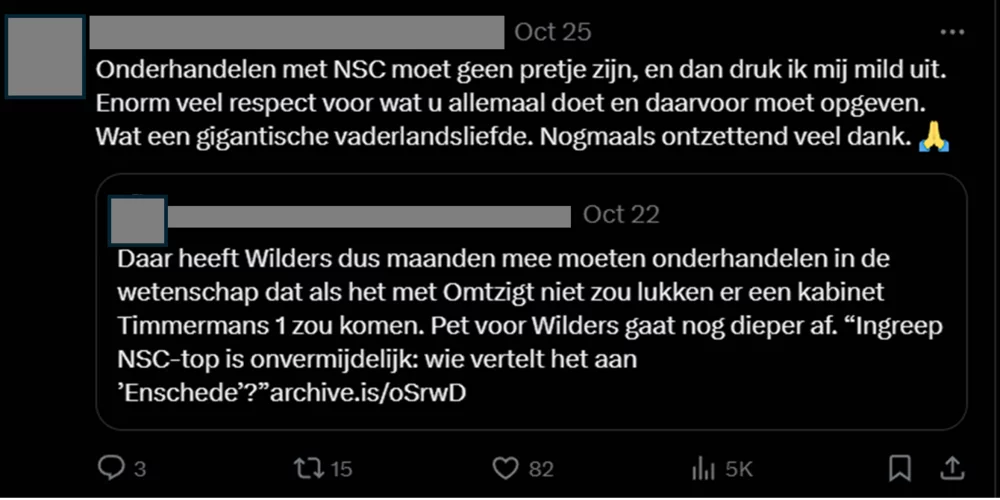
English translation: "Negotiating with NSC must not be fun, and I am putting it mildly. Enormous respect for all that you do and have to give up for it. What a gigantic patriotism. Once again, incredibly huge thanks."
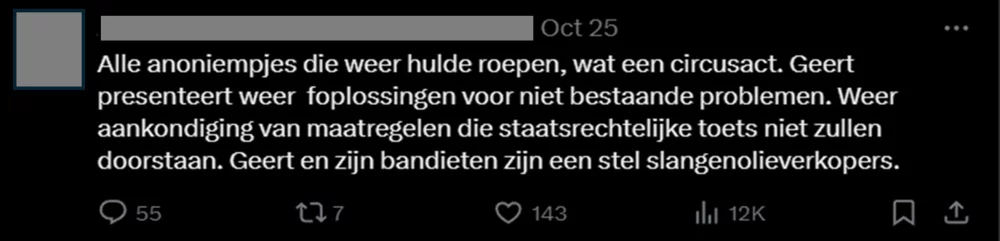
English translation: "All the anonymous small people who are shouting tribute again, what a circus act. Geert is again presenting solutions for non-existent problems. Again announcing measures that will not pass constitutional scrutiny. Geert and his bandits are a bunch of snake oil salesmen."
Fig. 9 demonstrates how certain members of the public view Wilders. They see him as someone to look up to, as he displays ‘patience’ and is ‘willing to compromise’, which paints Wilders as the “good man” in a ‘difficult’ political setting. This also depicts Wilders as less extremist compared to his message from a couple of years ago, seen in post 1, as he is willing to compromise. On the other hand, fig. 10 demonstrates that people see Wilders as a clown in a ‘circus act’ who simply likes causing problems.
Back to top"I will NOT accept that. NEVER"
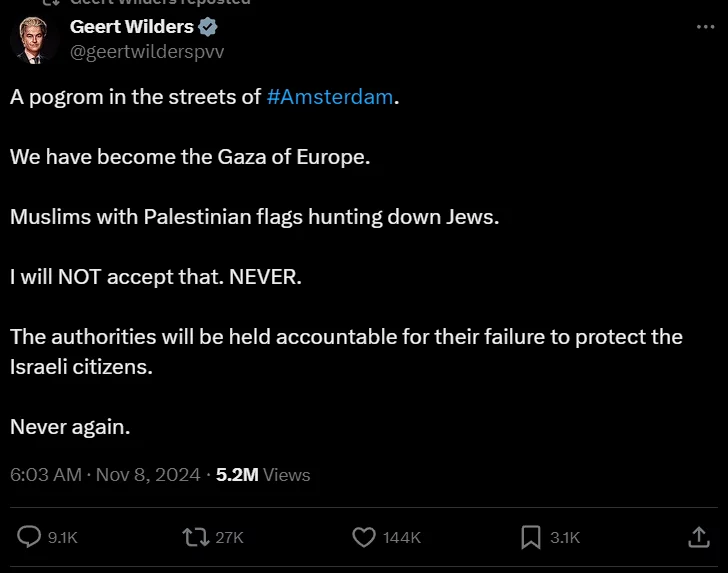
Wilders’ message as anti-Islamic is well depicts in the post above as Wilders compares Amsterdam to Gaza (fig. 11). The context of this post is in relation to the violence that occurred after the Ajax-Maccabi football match in Amsterdam on November 7th. The comparison between Amsterdam and Gaza allows Wilders to target and place blame on a certain group of people whilst also referencing historical events relating to Jewish communities. Aside from his anti-Muslim ideology, nationalism is also present as Wilders creates an “us versus them” narrative and creates a division between the Muslim community and other communities in the Netherlands as Wilders aims to unify citizens against Muslims.
A populist framework can also be applied as Wilders critiques the Dutch political system and blames the authorities. Wilders saying “I will NOT accept that. NEVER.” enforces the idea of Wilders as a protector of the country, which was also presented in Post 2, and as "antiestablishment"(Müller, 2017). The use of capitalization in ‘NOT’ and ‘NEVER’ also play a role in Wilders’ Message. Once again using Lempert and Silverstein (2012)’s layered concept of Message, the sense of speech and its textual register influence how Wilders is perceived. This performance frames him as a strong lead and someone who will not stand down in times of violence.
Furthermore, Wilders has previously and consistently critiqued the Dutch political system and acted as a populist speaking for the people, such as when he tweeted in the name of freedom of speech “On behalf of millions of Dutch people, I demand of Prime Minister Rutte: deny the Turkish minister access to the Netherlands! Don't let him land here!” in response to the Turkish government sending their Minister of Foreign Affairs to Schiphol (Blommaert, 2017).
The timing of the post in fig. 11 played a major role in the uptake of the post. Having posted soon after the event, Wilders allowed himself to be visible on the platform, especially with the use of a hashtag which would be searched more after the news of the violence was publicized. The uptake of this post is enormous with 5.2 million views, 144 thousand likes and 9.1 thousand comments. The comments have mixed reactions, some users commenting and reproducing anti-Muslimism and anti-immigration ideology, while other comments criticize Wilders and his support for Israel.
Overall, Wilders shows an excellent understanding of algorithmic politics, the platform X and its affordances, as well as the timing of posts in order to engage in Message politics. Wilders’ Message portrays him as a hero of the people with a positive brand image for himself whilst painting migrants, Muslims, and the current political system as bad. He succeeds in doing so as he has continued to gather a larger audience, ultimately leading to winning the elections after having been a figure in Dutch politics for decades. Wilders also establishes suitable political communication on the platform, and his knowledge about the platform and post timing allows him to avoid algorithmic invisibility. He utilizes local and international news to gain visibility when certain topics, such as elections in other countries, are trending on the platform.
Wilders’ anti-Islam and anti-immigration discourse contain obvious racist and nationalistic tones. He paints these ideas as common sense through his language, and his ideology, fuelled by his far-right nationalist ideology and his Zionism, plays an important role in his message, especially Message as brand: Wilders is known for these types of Islamophobic and anti-migrant comments. Because he is known for this, he plays into it and utilizes it to spread his ideas. Furthermore, Wilders is a populist, and he creates not only an “us vs. them” narrative with Dutch citizens and Muslims and migrants, but also against the current political system.
Despite his popularity on the platform, Wilders treats it as an ‘old’ media in the sense that he creates a one-way broadcast, “which allows for a […] controlled frame of the message” (Muis et al, 2019, p. 14). There is interaction between Wilders and his audience through the repost affordance on X, as Wilders audience engages more through retweets and likes to display their support and “profess a more extreme form of political speech” (Gonawela et al., 2018, p. 317)
Back to topWilders' Remarkable Message and Ideologies
The right wing politician has constructed a remarkable, and most importantly a memorable, message for himself. He has fairly strong uptake on X and has kept a stable presentation on his ideologies and his goals as a politician. He displays his manipulation of digital communication through leveraging his understanding of algorithms and platform affordances to push his message forward. The five posts analyzed allow for an understanding of who Wilders is as a politician and his development in Message over time whilst maintaining consistency in his ideologies. He promotes anti-Islamic and anti-immigration ideology in his X posts through various ways such as nationalistic values, claiming to be the voice of the people, and creating an identify of unity whilst also creating an “us vs. them” narrative with Muslims and immigrants. Together, this has allowed him to repetitively spread his political discourse containing anti-Islamic and anti-immigration ideology to his audience.
Back to top
References
Blommaert, J. (2017). Wilders, Rutte of Erdogan: wie heeft recht van spreken?, Diggit Magazine.
Bucher, T. (2012, April 8). Want to be on the top? Algorithmic power and the threat of invisibility on Facebook. New Media & Society, 14(7), pp. 1164-1180. doi:10.1177/1461444812440159
Bucher, T. (2018). If...Then: Algorithmic Power and Politics. Oxford University Press.
Fairclough, N. (1989). Language and Power. Longman Group UK Limited.
Gonawela, A., Pal, J., Thawani, U., van der Vlugt, E., Out, W., & Chandra, P. (2018). Speaking their Mind: Populist Style and Antagonistic Messaging in the Tweets of Donald Trunp, Narendra Modi, Nigel Farage and Geert Wilders. Computer Supported Cooperative Work (CSCW), 27, pp. 293-326. doi:DOI 10.1007/s10606-018-9316-2
Lempert, M., & Silverstein, M. (2012). Creatures of Politics: Media, Message, and the American Presidency. Indiana University Press.
Maly, I. (2024). Personal communication. Digital Media and Politics course Tilburg University
Maly, I. (2022). Populism as a Mediatized Communicative Relation: The Birth of Algorithmic Populism. Applied Linguistics and Politics, pp. 33-58. doi: 10.5040/9781350098268.ch-002
Maly, I. (2023). Guillaume Faye’s legacy: the alt-right and Generation Identity. Journal of Political Ideologies, 28(1), pp. 35-61. doi: 10.1080/13569317.2022.2045460
Muis, I., van Schie, G., Wieringa, M., & de Winkel, T. (2019, January 3). ‘Liberation Begins with Stating the Facts': Framing Statistics and Information Bricolage in Geert Wilders' Twitter Practice. Open Library of Humanities, 5(1), pp. 1-31. doi: https://doi.org/10.16995/olh.320
Müller, J.-W. (2017). What Is Populism? Penguin UK.
PDC Foundation. (n.d.). G. (Geert) Wilders.
Schaart, E. (2023, November 23). The Dutch Trump: Who is Geert Wilders and what does he want? Politico.
Schaart, E. (2024, March 14). After Geert Wilders gives up, what’s next for the Netherlands? Politico.
Wilders, G. [@geertwilderspvv]. (2024a, Nov 8). A pogrom in the streets of #Amsterdam. We have become the Gaza of Europe. Muslims with Palestinian flags hunting down [Post]. X.
Wilders, G. [@geertwilderspvv]. (2024b, Aug 6). Anyone interested in the truth about the Islamic threat? You can still read my book and understand what is happening [Post]. X.
Wilders, G. [@geertwilderspvv]. (2024c, Oct 25). Historische maatregelen. Ik ben tot het uiterste gegaan om dit voor mekaar te krijgen. Ik maak mijn belofte aan u [Post]. X.
Wilders, G. [@geertwilderspvv]. (2024d, Sep 29). The Netherlands, Hungary, Belgium, Italy, Germany, Portugal, Sweden, France, Spain, Czech Republic and today Austria! We are winning! Times are [Post]. X.
Wilders, G. [@geertwilderspvv]. (2024e, Sep 21). Times are changing in Europe! Our Dutch government wants an opt out from the EU immigration and asylum policy and [Post]. X.
Back to top