


Review
Review: Everything Everywhere All at Once: The Ultimate Multiversal Guide to Identity, Understanding, and Purpose
With their movie Everything Everywhere All at Once, the Daniels did not only think outside the box but outside of this universe as well. This fun, frenzied, all-over-the-place absurdist movie is one that deserves all the praise it's been getting.

Published date
Courses
The multicultural individual
Copyright
This work is licensed under a Creative Commons Attribution-NonCommercial 4.0 International License.
Read time
8 minutes

Just moments before Everything Everywhere All at Once is about to become the most outrageous, confounding, and visually dazzling movie you’ve seen, Michelle Yeoh’s Evelyn reads a crucial piece of advice: “P.S. Don’t forget to breathe.” It’s more of a heads-up to an oblivious audience, preparing them for an expertly orchestrated cinematic assault on the senses. Everything Everywhere gives us raccoon chefs, muscular pinky fingers, rocks with googly eyes, and dildo fights. But don’t be fooled; that’s just the beginning.
Anyone who saw the Daniels’ (that’s American directing duo Daniel Kwan and Daniel Scheinert) first full-length movie, Swiss Army Man, – a 2016 movie starring yet another Daniel (Radcliffe), – could have expected the slightly bizarre, non-stop action-packed thrill ride that is Everything Everywhere All at Once. The duo’s feature debut, – infamously known as the ‘farting corpse’ movie – introduced many to the magic that makes a Daniels movie. While the thought of a speaking corpse growing magnetic erections might freak you out, its absurdity is the gateway to open, honest, and loving conversations about life and death. The viewer is knocked off their centere of gravity, their senses confounded, and their soul enriched. This is a Daniels movie, and Everything Everywhere All at Once is no exception.
The Daniels, who werew ere once ‘just’ enthusiastic summer camp counsellorscounselors wanting to “make really weird movies with the kids,” are now renowned Oscar winners, scoring 11 nominations with their 2022 sci-fi, action-comedy blockbuster Everything Everywhere and winning 'Best Director', 'Best Original Screenplay', and 'Best Picture'. In total, the movie has managed to win six above-the-line Oscars, and for good reason.
Everything Everywhere All at Once opens on a chaotic day in the life of the uninspired Chinese-American immigrant Evelyn Wang (Michelle Yeoh), who runs a failing laundromat with her sweet, cheerful husband Waymond (Ke Huy Quan). While Evelyn attempts to simultaneously organize a dazzling Chinese New Year party and prepare for an all-decisive meeting with her grumpy IRS tax auditor, Deirdre (Jamie Lee Curtis), tensions are running high. Evelyn’s demanding father (James Hong) has just arrived from China and takes every opportunity to comment on her ‘stupid’ decision to marry Waymond and move to the land of the so-called ‘free’. Her daughter, Joy (Stephanie Hsu), wants to introduce her girlfriend Becky (Tallie Medel) to her grandfather but is shoved back into the closet by her dismissive mother, who fears grandpa is ‘too traditional’ to understand. Oh, and Evelyn’s husband has been trying to serve her divorce papers all day. Evelyn is so caught up in life’s meaninglessness that she doesn’t even notice. The Wang family is on the verge of completely falling apart, crushed by the reality of the American Dream. But what if things were different?
As if on cue, a suave Alpha Waymond from another universe appears and charmingly talks Evelyn into entering the nearest janitor’s closet. When Alpha Waymond reveals— – and I know it sounds bizarre— – that the multiverse is in danger and that she’s the only one who can save it, Evelyn tethers even further towards an existential crisis. How can she, the most ordinary woman on the planet with no talents and no passions, possibly be the multiverse’s only hope?
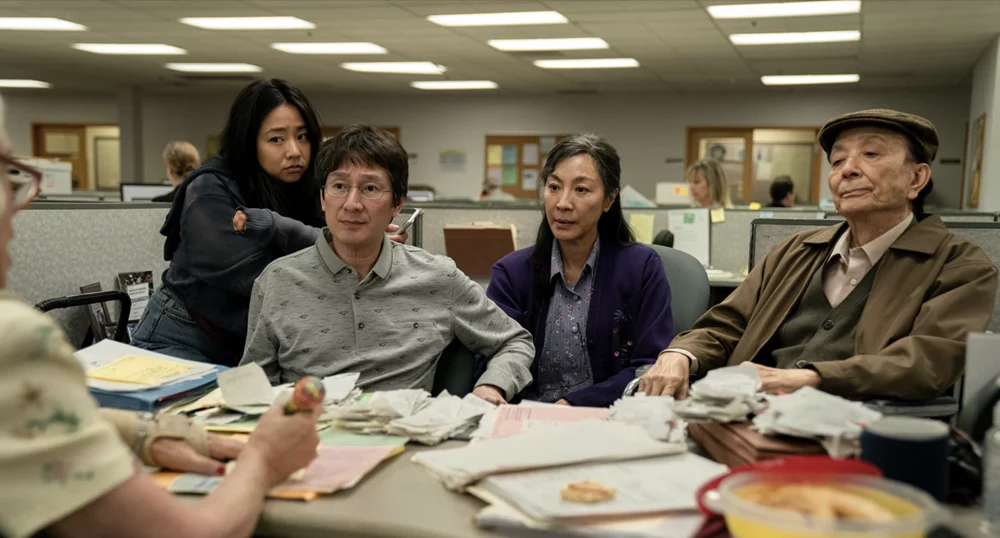
Overwhelmed and consumed by everything, everywhere, all at once, Evelyn accepts her fate and learns to jump across different universes to tap into skills from other, more successful versions of herself. From there, we meet quite a lot of Evelyns: an opera singer, a martial arts star, a loving woman with hot dogs for her fingers, a fine-dining chef, and even a googly-eyed rock. Some of these versions epitomize all Evelyn ever wanted to be, causing her to fall into a nihilistic abyss of could-have-beens. Unsurprisingly, she meets her disregarded daughter in that same abyss, so far gone already that she renamed herself ‘Jobu Tupaki’ and became the greatest evil power the multiverse had ever known. Jobu, overwhelmed by the sensory overload and countless possible realities, demolishes universes and murders versions of Evelyn— – not because she really wants to, but because she is looking to find the one version of her mother that can understand and accept her— – “sSomeone who could see what I see, feel what I feel,” in Jobu’s words.
While Evelyn forcefully fights Jobu and murders her way through saving the multiverse, her universe’s version of Waymond reminds her to choose kindness over hate. When Evelyn finally realizes we’re all just broken people searching to find our purpose —– even those that have hot dogs for fingers in alternate universes— – she stops fighting and understands what’s truly important: her family. Evelyn only just manages to keep her almost-estranged daughter from leaving her for good, but that doesn’t make the moment any less heart-warming. Evelyn is finally able to see the good in everything, even in the tiniest of moments, and is brave enough to let her daughter know: “Of all the places I could be, I just want to be here with you.” It’s a well-deserved emotional pull that can’t leave you untouched, revealing beautifully how embracing the absurd can make life more enjoyable.
The heart-breaking disconnect between daughters and their parents in immigrant families is, for the most part, unexplored in the film. Everything Everywhere takes a stab at it, though, and does so phenomenally. Tapping into the unspoken Asian-American experience, the movie shows how empathy, connectivity, and understanding are key to resolving intercultural trauma and generational tensions. Joy, having grown up in America and trying her hardest to reconcile two opposing cultural identities, doesn’t fit the mouldmold of a traditional Chinese daughter. It is only when Evelyn travels through increasingly bizarre universes and meets parallel versions of herself that she begins to understand her daughter.
At last, Evelyn canis able to put their differences aside and strives to see and feel in the way that her daughter does. This is when we come to realize that beneath the multiverse of madness, Everything Everywhere All at Once is a family story, one that vouches for intense love and understanding.
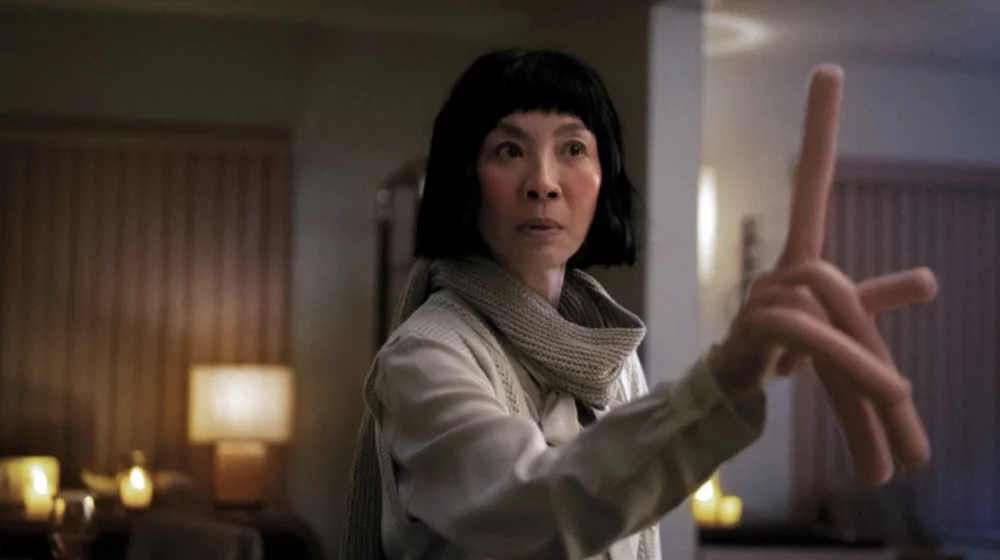
But let’s not forget how the portrayal of Evelyn’s different ‘multiversal identities’ tells a story in itself. Family is messy and complicated, but so is the concept of identity, – especially multicultural or immigrant identity. In Evelyn’s own universe, the identities claimed by her —– a chef, teacher, novelist, and singing coach (as the purchase of a groovy karaoke machine shows)— – are explicitly dismissed by the family’s assigned tax auditor, Deirdre, who declares that in this world, you can only have one identity. The existence of the multiverse, however, tells us a completely different story. Here, Evelyn can be a kung fu master, an opera singer, a chef, and even a gifted mind-traveller who saves everything, everywhere, all at once.
By travellingtraveling through increasingly strange universes, Evelyn canis able to free herself from the one identity that was always pushed on her – that of the cold Asian-American mother running a failing business. With their revolutionary way of filmmaking, the Daniels have made it clear that stereotypes in film won’t do anymore. Instead, we must imagine otherwise: Asian AmericansAsian-Americans can be anything they want to be, just like Evelyn, whose multiversal identities have no boundaries. The chosen framework of the fast-paced, chaotic multiverse, including its comedic timing and absurdity (remember the hot dog fingers? ), doesn’t take away from the movie’s deeply emotional and universal message; it strengthens it. Deep down, all we want is to be accepted and loved for what we have discovered about ourselves, even if those identities don’t make sense to others.
For Michelle Yeoh and Ke Huy Quan, Everything Everywhere All at Once was an opportunity they had both been waiting for. Despite the success of Crazy Rich Asians (2018), in which Yeoh stars as an influential matriarch, her opportunities in Hollywood were always limited due to her Asian descent and the industry’s unwillingness to change. When Yeoh read Everything Everywhere’s script for the first time, she burst into tears, knowing that she’d finally be able to show the world what she wasshe’s capable of. By masterfully drawing from every role she’s played, Michelle Yeoh canis able to passionately convey not only emptiness and regret but also curiosity and bliss – even as a googly-eyed rock (a scene that will make you cry, by the way). To say Yeoh deserved to win ‘Best Actress’ at the 95th Academy Awards is nothing but an understatement, but the same can be said for Quan, who won ‘Best Supporting Actor’. For years, he had been relegated to the edges of the industry as a Chinese immigrant actor (what’s new, Hollywood!?). Quan poured his heart and soul into this role, delivering a performance that should mark the first of many more to come. If his soft-spoken, emotional speech on the importance of kindness – “especially in moments when you don’t know what’s going on” – doesn’t make your heart explode, I don’t know what will.
To create such a fun, frenzied, all-over-the-place absurdist movie, the Daniels did not only think outside the box but outside of this universe as well. Something that’s not done often in film, but definitely makes sense in the contextcontexts of battling nihilism, existential crises, and identity stereotypes. Its absurdism is the gateway to open and loving conversations, startling the senses while enriching the soul. I hope Everything Everywhere All at Once exists in every universe. If you haven’t watched this outrageous but unexpectedly emotional movie yet, please do. Don’t be surprised by its ability to dazzle— – or its hot dog fingers and raccoon chefs – and most importantly, don’t forget to breathe.

