Environmental Justice through Art
What happens when art meets environmental justice? Explore this question through a cultural studies analysis of Irish artist's Michele Horrigan's ongoing arts-based research project Stigma Damages. In collaboration with the artist, Tilburg University hosted an exhibition of Stigma Damages in the spring of 2025. This exhibit uses art to explore the environmental impacts of a material that we all use every day: aluminium. It's in bicycles, Internet cabling, and electronics. We even cook with it. Yet where does it come from? And how does the process of making aluminium products affect the environment? How can art and culture offer new perspectives on these seemingly simple questions? Watch the video to learn more!

This work is licensed under a Creative Commons Attribution-NonCommercial-NoDerivatives 4.0 International License.

What happens when art meets environmental justice?
In the spring of 2025, scholars and students explored this question together with Irish artist Michele Horrigan, whose work grapples with the ongoing environmental injustices in the region where she lives and works. Horrigan’s arts-based research represents and analyzes complex issues emerging from the production of one of our most everyday materials: aluminum. Learning from Horrigan's expertise, we collaborated with her to up an art exhibition, host a video installation workshop for students, and offer a public lecture together with Studium Generale.
In this video, cultural studies scholars offer an analysis of the Stigma Damages exhibit, which was open to the public in the Cobbenhagen building from March 18th through June 16th, 2025. This video expands our collaborations with Horrigan to open up conversations about how art can provide new ways of thinking about the environment, justice, and the future of our planet.
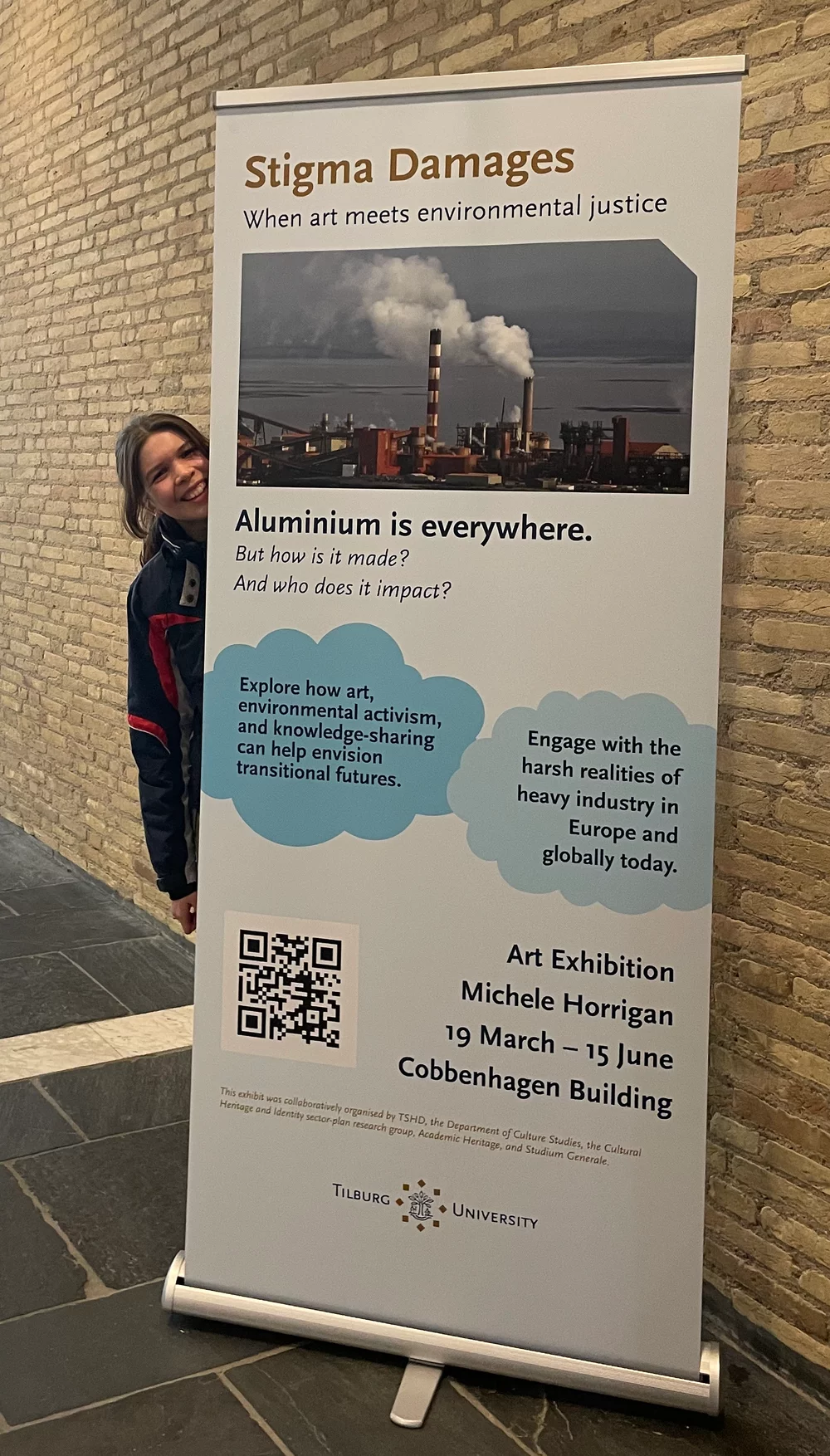
Student assistant Clara Daniels standing with the exhibit advertisement banner she designed, photo courtesy of Kate Huber
Back to topEurope’s Sacrifice Zone
Aluminum is everywhere: It's in smartphones, food packaging, and the trains and planes that move us. But few pause to consider the environmental and social costs of this ubiquitous material. Transforming red bauxite rocks into the alumina powder necessary for aluminum products generates vast pollution, including caustic air emissions and millions of tonnes of hazardous chemical waste that scar landscapes and the bodies of humans and more-than-humans worldwide.
One striking example is Aughinish Alumina, Europe’s largest bauxite refinery, located on the edge of Ireland’s Shannon Estuary, a region rich in biodiversity. Since its opening in 1983, the refinery has transformed local ecosystems, leaving behind toxic mud and hazardous materials atop porous limestone, mere meters from Ireland’s primary river estuary. Today, the refinery is owned by Rusal, a Russian company with documented ties to Vladimir Putin’s war machine—yet it remains unsanctioned by the Irish state and the European Union.
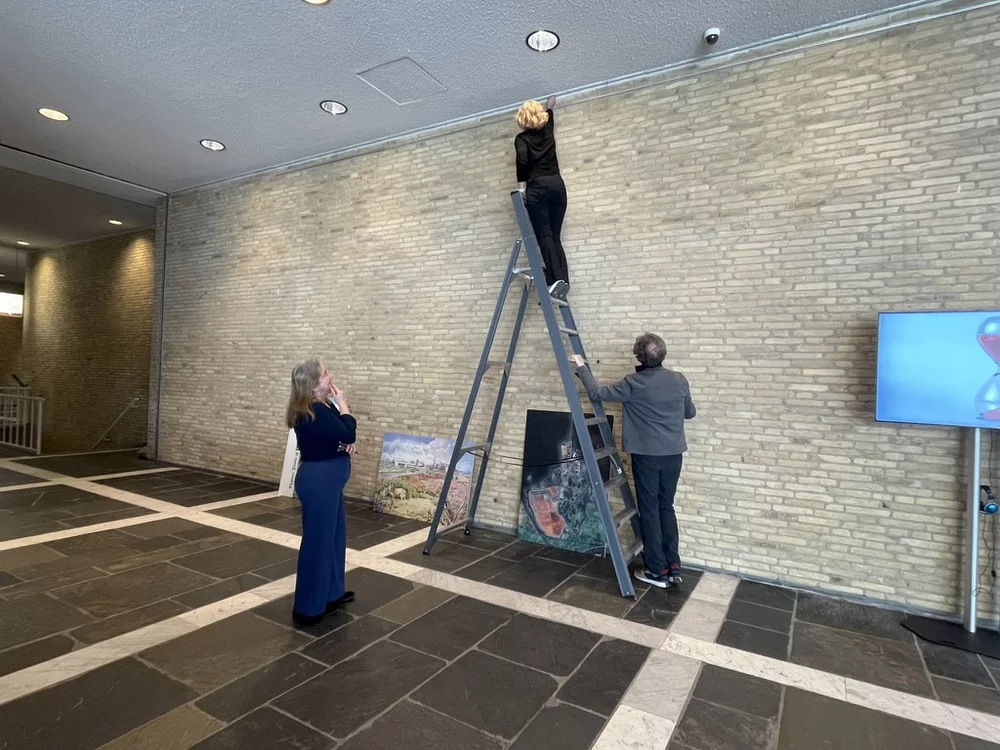
Building the Stigma Damages exhibit in the Cobbenhagen building with Tilburg University's Academic Heritage Department, photo courtesy of Kate Huber
Back to topAbout the artist
Living and working near the refinery, Horrigan has spent over a decade investigating the environmental injustices Aughinish Alumina has caused. In Stigma Damages, she presents videos made in Ireland and Australia alongside a series of photographic artworks. The display examines the harsh realities of heavy industry in Europe and globally today, and the role environmental activism and knowledge-sharing can take in envisioning transitional futures.
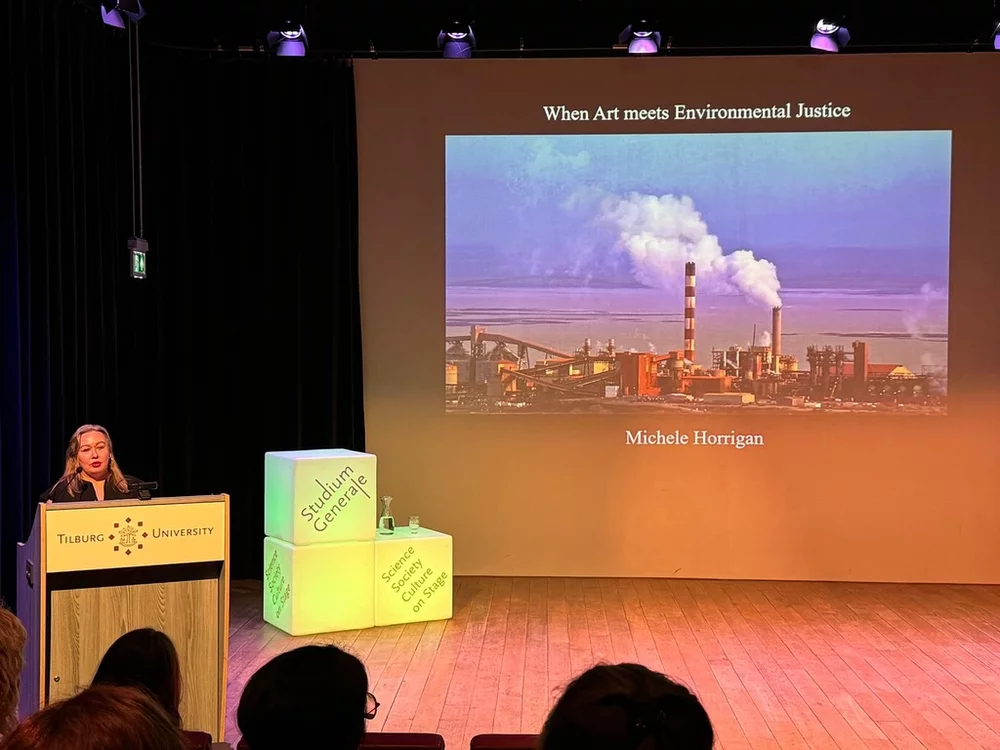
Michele Horrigan giving a lecture for Studium Generale, photo courtesy of Sean Smith
Horrigan's visit to Tilburg University and the Stigma Damages exhibit was collaboratively organized by TSHD, the Department of Culture Studies, the Cultural Heritage and Identity sector-plan research group, Academic Heritage, and Studium Generale.
Back to top