

Essay
Dead Babies and Sleeping Beauties: The Met Gala's Dystopian Atmosphere
We live in an era of post-truth, where fiction is everywhere. Because of this, people have a tendency to link real life events to fiction. This article delves into the 2024 Met Gala and how social media users pointed out the similarities with the Hunger Games novels.
Published date
Courses
Reading and writing in online culture
Copyright
This work is licensed under a Creative Commons Attribution-NonCommercial 4.0 International License.
Read time
8 minutes

In May of 2024 the highly revered annual Met Gala took place, with the theme being “Sleeping Beauties: Reawakening Fashion”. Hundreds of celebrities from all over the world attended the night of glamour, fashion, and extravagant activities. At the same exact time, Israeli forces invaded and bombed Rafah, the last ‘safe’ place in Gaza. On one end of the world, the elite was partying and enjoying their luxuries and wealth, while thousands of innocent Palestinians were taken hostage and brutally killed. This simultaneous occurrence of the Gala and the deaths in Gaza caused huge digital discourse with the hashtag #AllEyesOnRafah trending on multiple platforms. People on social media, such as TikTok, pointed out how the scene was reminiscent of the dystopian fictional trilogy The Hunger Games. It became, once again, apparent that the fine line between truth and fiction is often much thinner than suspected. This article explores why people tend to relate sociopolitical events to fiction, focusing specifically on the Met Gala and the Hunger Games.
Back to topUsing fiction to escape
According to literary studies, people often read stories to temporarily escape their own lives. Escapist fiction, as author Karen Li wrote, is simply a different kind of truth about another aspect of reality (2021). It allows us to escape, as the name suggests, our own reality and delve into another. Dystopian fiction goes beyond escapism, as it hands us ways to manage our fears (Solheim, 2024). As we explore stories of disorder, we observe how these fictional characters tackle their difficulties which can serve as a mental preparation for our real-life challenges.
Our era is one of ‘post-truth’, in which fiction is everywhere. Fiction is described as a representation, both in form and morality (Wood, 2008). It shows us situations that could have been and allows us to reflect on them as to how we would respond to these imaginary events from a moral perspective, one of the earlier examples being fairytales and myths which teach us valuable lessons. Reading fiction, both escapist and dystopian, helps us to understand our own world better. Because fiction is everywhere, it often becomes intertwined with reality. As an effect of our "post-truth" era, as well as due to mediatisation, the lines between fact and fiction become more and more blurred, for example in how we consume stories about celebrities as if they exist as some kind of fictional story.
Back to topMedia coverage of real-life events
One of the most important aspects of contemporary politics is visibility. For a political event or issue to have impact and be recognized on a larger scale, it needs to receive coverage and attention. Media participate in configuring what is seen and what is not seen (Bucher, 2012, 1165). In light of this, it is important to observe that the dire situation in Palestine was not a matter of public attention or discussion at the Met Gala. The celebrities that attended the gala kept quiet about the ongoing conflict, and the Met Gala itself attracted a lot of attention, attention that was previously focused on Palestine (Elle literacy, 2024). Because of the switch of attention towards the gala, Palestine became less visible. Even the protests that took place near the gala were not “TikTokised” as New York Times critic Vanessa Friedman wrote (2024). The lack of attention caused many people to express their discontent with the situations and how celebrities handled it.
As media and communications scholar Henry Jenkins points out, fandom is also a participatory practice (2006). When people are a fan of things or people, they do not only observe them, they comment on, annotate, appropriate, and recirculate these subjects. People expect the people they are a fan of to be vocal on the matters they find important. When celebrities do not speak out, fans are disappointed. This dynamic is a result of a parasocial relationship, a term first coined by Horton and Wohl (1956). For celebrities to keep being relevant, they have to create a simulacrum of intimacy; they have to reveal themselves and their identity. By keeping quiet on certain matters, they show that this is not part of their identity and what they stand for. This silence can be critiqued by their followers, as it might clash with what they find important. These audiences often want to call them out on such matters and need ways to do so.
Back to topPeople’s discontent with the hypocrisy surrounding the Met Gala’s silence
The Hunger Games novels were written to call out the hypocrisy in the current world (Babcock, 2020, 662). Suzanne Collins wrote the novels inspired by the Iraq war that was going on at that moment. The sentiments in the book therefore are not entirely fictional. For people to use the contents of the books to call out the hypocrisy in the current world therefore makes sense, as we as humans tend to relate things to our personal experiences and what we see happen in our lives to make sense of them (Li, 2021).
Seeing celebrities at the Met Gala display their wealth while millions of people in Palestine have been cut off from food and water is almost a dystopian image (elle literacy, 2024). One YouTuber that goes by the name Elle literacy argues in her video on the topic that it shows how disconnected the celebrities are from reality. She is addressing the fact that people are calling these celebrities out on their hypocrisy. As she explains, people see their feed constantly cycle through images of dead babies and beautiful gowns and wealth, and our brains are not built to stay sane when we face such stark and shocking dissimilarities.
Back to topLinking real life events to fiction
People try to make sense of the situation and do so through literature. They use literature both as an escape, to defuse their strong feelings and to make sense of them, as well as to make reality seem more distant. They reflect on things they have read about or seen in fiction because they want to refer it to something in order to make sense of it. In a video covering the aftermath of the bombing in Rafah, Bisan said “Have you ever seen destruction like this? Even in the ‘end of the world’ movies?” (AJ+, 2024). She is comparing her surroundings to what she has seen in fiction because the situation around her is even more dire and gruesome than what has been imagined in fiction and movies. The situation around the Met Gala has been compared to fiction a lot online, specifically to the Hunger Games franchise.
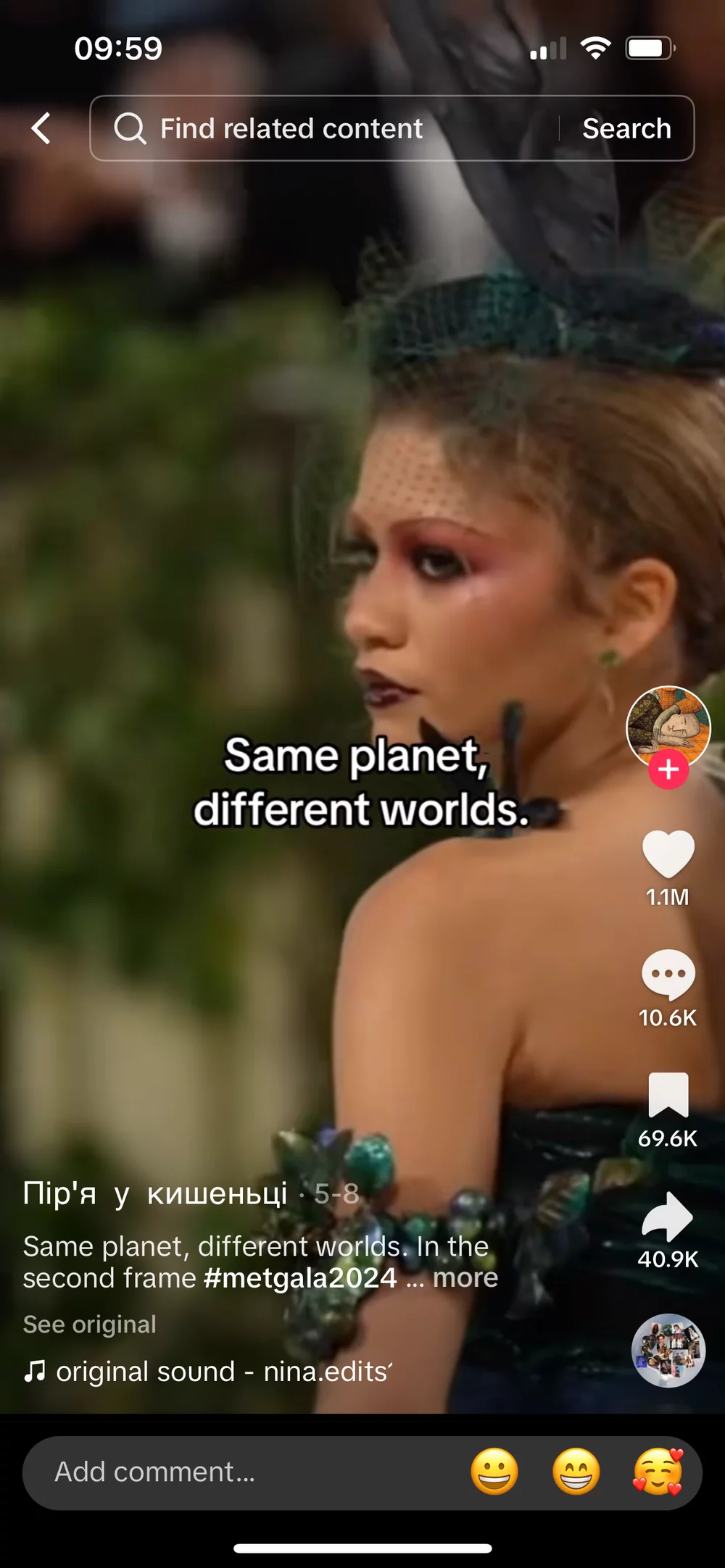
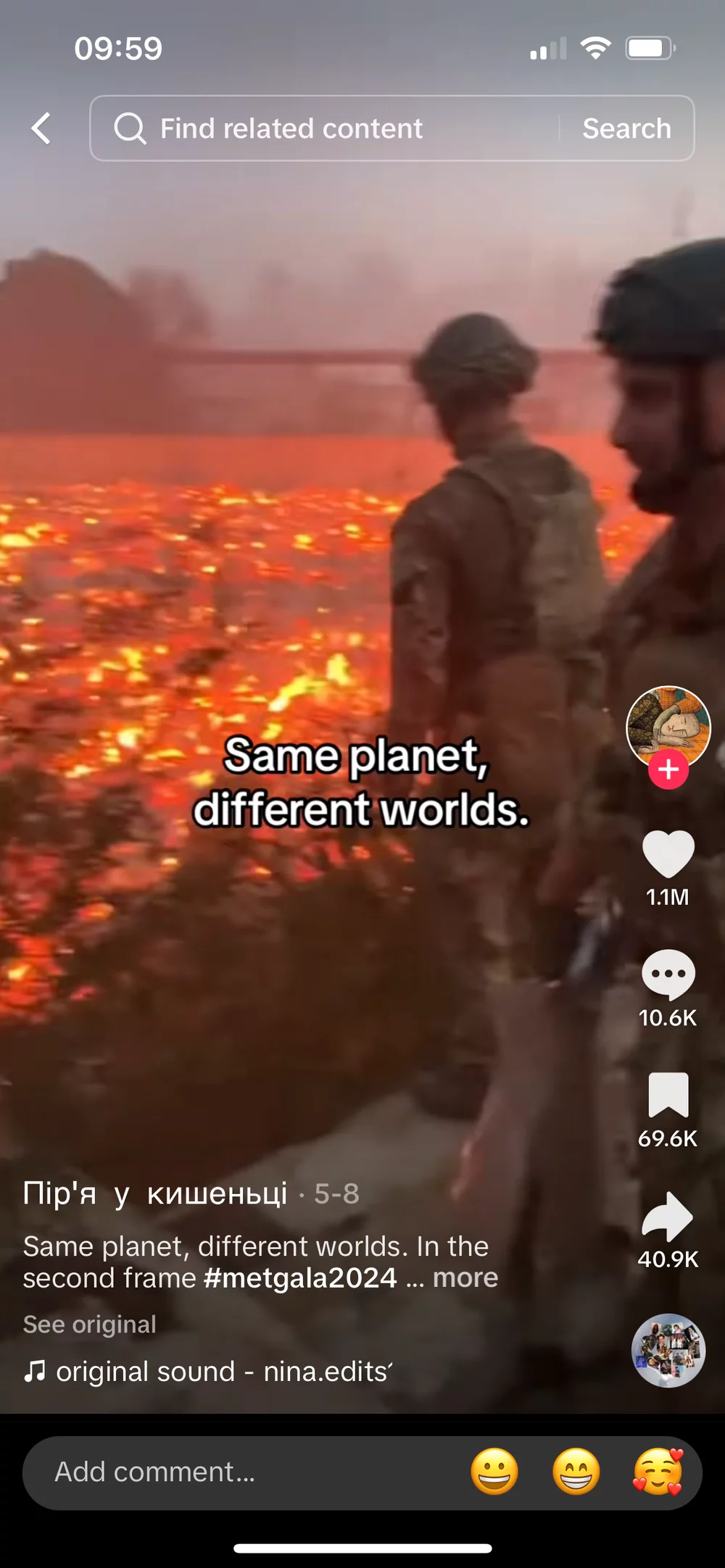
A video that alternates short clips of the Met Gala and its luxuries and the shocking images from Rafah with the title “same planet, different worlds” gained over 1 million likes on TikTok (@bruntius, 2024). It used a song from the Hunger Games, The Hanging Tree, which in the books is a song of rebellion. The user meant to show off the dissimilarities between the gala and the situations civilians in a war are in. Another user stitched the video, saying “We’re literally in the Hunger Games. The rich people are enjoying themselves in the capitol, meanwhile we got people in district 12 dying. […] How can we watch those movies and understand the levels of inequality and when the same things happen in the news we just don’t care?” (@camcorderx, 2024). Here, she points out how absurd the situation is by comparing it to what she has seen in fiction and calling out how people do not rise to action in the same situation.
Back to topConclusion
What we can see from all of this is that fiction is being used and referred to for multiple reasons. On one hand, it is used to make sense of what is happening. The images of what is happening in Gaza bring up many feelings of confusion, and fiction helps to diffuse those strong feelings and give them a place. They compare these images to the themes in the Hunger Games because it makes the events seem more as fiction, as if it is not really happening. In a sense, people are using fiction to let those events ‘escape’ their sense of reality.
On the other hand, people are using their fictional references to point out how absurd the situation’s gotten and to call out the hypocrisy of celebrities that are attending the gala and ignoring the events in Gaza. Due to their sense of justice and parasocial relationships, people find that celebrities should speak up on the matters in Gaza and find it distasteful how they are flaunting their wealth while poor people in war zones don’t even have access to water. To comment on it, they compare the Met Gala to the Hunger Games movies, due to similar aesthetics and the disparities it highlights. It is a way of activism, of reclaiming the visibility Gaza had. A lot of the attention that had gone to Gaza previously, was now focused on the Met Gala. People used the Hunger Games to focus that attention back to Palestine and the unspeakable things that are happening there.
By attracting attention towards these matters and calling for activism, people express how appalled they are by the violence and destruction in Palestine. Along with that, they express how outraged they are by the ultra rich turning a blind eye to the events. They draw parallels with fiction to show their discontent with the "sleeping beauties" and collectively protest against this, while simultaneously hoping their feeds will never have to feature dead babies again.
Back to topReferences
[@buntius] (8 May 2024). Same planet, different worlds. In the second frame #metgala2024 #hungergames #metgalaoutfits #metgalastyle [video]. TikTok. https://www.tiktok.com/@buntius/video/7366682446332448032
[@camcorder] (8 May 2024). #stitch with @ freedom. #hungergames #metgala #metgala2024 #metgalastyle #metgalaoutfits [video]. TikTok. https://www.tiktok.com/@camcorderx/video/7366699166061432096
AJ+. (21 May 2024). ‘It’s Bisan From Gaza, Look At What U.S. Weapons Have Done’ [Video]. YouTube. https://www.youtube.com/watch?v=zpI8sezLqX0
Bucher, T. (8 April 2012). Want To Be on Top? Algorithmic Power and the Threat of Invisibility on Facebook. New Media & Society, 14(7), 1165. https://doi.org/10.1177/1461444812440159
elle literacy. (25 May 2024). How has Israel/Palestine changed how we view the Met Gala, Eurovision, & celebrities? [Video]. YouTube. https://www.youtube.com/watch?v=PXaEZBIoTao
Friedman, V. (7 May 2024). Is the Met Gala Protest-Proof? The New York Times. https://www.nytimes.com/2024/05/07/fashion/met-gala-protests.html
Horton, D. & Wohl, R. (1956). Mass Communication and Para-Social Interaction, Psychiatry, 19(3), 215. http://dx.doi.org/10.1080/00332747.1956.11023049
Jenkins, H. (19 October 2006). Confronting the Challenges of Participatory Culture: Media Education for the 21stCentury. Pop Junctions. http://henryjenkins.org/blog/2006/10/confronting_the_challenges_of.html
Li, K. (10 December 2021). Escaping Into Reality: The Importance of Fictional Truth. Berkeley Fiction Review. https://berkeleyfictionreview.org/2021/12/10/escaping-into-reality-the-importance-of-fictional-truth/
Solheim, Ø. (10 October 2024). Is Dystopian Fiction the Escape We All Need Right Now. Medium. https://medium.com/blogbytes/is-dystopian-fiction-the-escape-we-all-need-right-now-cc1ec434fe9f
Wood, J. (2008). How Fiction Works. Vintage Books Publishing Company.
Back to top
More from this author