Article
Conlang: Fictional Languages and Online Communities
Conlangs are getting more popular, especially because of the popularity of series like Game of Thrones. In shows, constructed languages are an important factor to create a storyworld. But fans speak conlangs also in reallife communities.

Published date
Courses
Digital literacy
Copyright
This work is licensed under a Creative Commons Attribution-NonCommercial 4.0 International License.
Read time
12 minutes

Valar Morghulis." You might have heard of this sentence if you have watched Game of Thrones, but do you also know what it means? How do you pronounce it? (How do you map these graphemes onto the right phonemes?) And who made it? "Valar Morghulis" is part of High Valyrian which is a constructed language. Constructed languages are getting more and more widespread these days due to popular series such as Game of Thrones. Can they be defined as languages? What do we actually know about them? And how did they get an online life?
Now-a-days you can learn hundreds of languages on apps like Duolingo, but did you know that you caneven learn constructed languages on that app as well? Another commonly used word for it is a fictional language. It is a made-up language used for a fantasy world or for another purpose. Mainly they are constructed for a fictional setting, such as the High Valyrian and Dothraki languages in Game of Thrones or Klingon in Star Trek or Quenya in the books of Tolkien.
Game of Thrones is one of the most popular series of the last decade. Can you say that there is a link between this big fan base of Game of Thrones and the uprising of constructed languages? Before Game of Thrones there already were some existing constructed languages used in books and tv shows. But after the hype of Game of Thrones lots of people became familiar with sentences such as; "Valar Morghulis." You can also say that Game of Thrones is taking advantage of the era in which light communities are very common. People from all over the world are communicating about constructed languages which enhances the use of them in the real-life world.
Back to topWhat is a constructed languag?
A constructed language (or conlang) means that it is a language created by humans, but not in a natural way like the common languages like English or Russian. Those languages evolved naturally and can be traced back to one Proto-Indo-European language (Adelman, 2014). Conlangs are created for particular reasons. We can also call them artificial languages, but fans and speakers use mostly the term conlang. There are some different kinds of conlangs, we can distinguish ‘a priori’ languages, which are not based on an existing language, but are completely made up from scratch. And an ‘a posteriori’ language, which uses grammar or words from already existing languages. A big difference between the two sorts of languages is that an ‘a posteriori’ language is more based on cultural ways of using a language, whereas an ‘a priori’ language has a basic way of using grammar, there are no (or fewer) exceptions (Adelman, 2014).
Tedtalk explaining conlangs:
Then we can distinguish conlangs in another category; International Auxiliary Languages (IAL) or in short: auxlang. An auxlang is most likely created to simplify the communication between speakers of different languages (Adelman, 2014). From 1880 until the Second World War a lot of such languages were made, a famous one is Esperanto. The creator, Dr. Ludwig Lazarus Zamenhof created this Latin-like language hoping it would unify people all over the world. During the Second World War organizations as the Red Cross used the language, but it never became an internationally approved language. But,now-a-days there are already two generations of native speakers of Esperanto, meaning that those people learned the language immediately after they were born. We can’t say that of Dothraki (yet).
Esperanto is a bit different from other conlangs, because it was created for using it in the real world. In that way its purpose is different from Tolkien's Quenya, which was purely created for his books or Dothraki which was purely created for the series. Esperanto can also be seen as a more ‘natural’ language, because of three reasons:
- When learning Esperanto you depend on the existing community, as there are not many books or dictionaries about it. It’s the same with a natural language:, you cannot learn English solely from textbooks;
- Although Esperanto is made as an easy to learn language, with easy to learn grammar and rules, during its existence it already has underwent some changes;
- As already said before, Esperanto already has some native speakers (Lindstedt, 2006).
“Language is an important factor in being connected to a story world”.
Dothraki, High Valyrian and Klingon are other kinds of constructed languages though. They are not made to unify speakers of different languages; they are made for a fictional world. Just as Tolkien did with the languages in his books about Middle Earth. Tolkien's most famous language is Quenya, also known as Elvish. He was a philologist and spoke a lot of languages besides his native language English. He created Quenya (and more conlangs) as a kind of a hobby. But he believed that in order for a language to really exist or work, it has to have a mythology. A lot of people think that is why he started writing the Lord of the Rings. These conlangs are also called artlangs. They’re created primary for entertainment or for novels/films.
Language is an important factor in being connected to a story world. Tolkien’s Quenya has a long (made-up) history. By creating old and new versions of Quenya, he already created a story (Overbeeke, 2014). Not only that, by already using a fictional language in a novel or film, the audience will immediately know that the diegetic world is a fictional one.
Tolkien speaking Quenya:
Back to top
Examples of constructed languages
As discussed before there are multiple types of conlangs with different purposes. Let’s take a closer look into the artlangs that were mentioned before. The first example is the Quenya language.his language was invented by the author and scholar J.R.R. Tolkien. Quenya is a fantasy language that’s been used by the Elves in the books of Lord of the Rings. This language was strongly influenced by the grammar and vocabulary of the Finnish language with some similarities to Greek and Latin. Firstly Quenya was developed as a written text and afterwards the language had to be adapted into the Lord of the Rings movies. David Salo translated all dialogue into the many languages featured in the films. In some cases, Salo had to develop an entire grammar and sound system (Destruel, 2016).
Another constructed artlanguage that will be discussed is Klingon. Klingon is developed by Marc Okrand for the TV shows and films of Star Trek. Unlike Quenya, Klingon was created in oral form first. Because it initially only appeared briefly, the actors were simply told to make incoherent grunts and sounds when “speaking Klingon”. When the production of the third movie started the Klingon language was to be featured more prominently. Okrand created a dictionary and grammar based on a few official words that had been created throughout the years and has said that he deliberately designed it to sound “alien”, using rare phonemes as well as typologically uncommon features. (Okrand, 1992). In figure 1 you can see the typography of the Klingon language.

The third example of constructed languages are Valyrian and Dothraki. These languages are created in George R.R. Martin’s novel series A Song of Ice and Fire and the television adaptation Game of Thrones. Valyrian is basically a family of languages, stemming from High Valyrian, a language spoken in the ancient Valyrian Freehold. The Dothraki language is spoken by the nomadic people in the fictional world. To create the spoken version of the two languages, HBO selected creator David. J. Peterson. He developed over 4000 Dothraki words and about 2000 Valyrian. Peterson drew inspiration from George R.R. Martin’s description of the language and from other languages such as Estonian, Inuktitut, Turkish, Swahili and Russian (Dothraki, 2010). In addition the languages were developed under two conditions. Firstly, the Dothraki and Valyrian language had to match with the uses who were already put down in the books. And secondly, the languages should be easy to learn by the actors of the series.
A video explaining different kind of conlangs:
Back to top
What’s the current online development of conlangs?
The phenomenon ‘the online’ brought another extent to conlangs. We are all aware of the fact that via worldwide connections, everything nowadays is sent around the world in an eye wink. Meeting new people online, chatting on forums, searching through different sources, all tools that make spreading conlangs easy nowadays. Therefore it made such an uprising as spoken before. Fans of conlangs are sharing information through forums, for example ‘The CBB’ (CCBForum, n.d.) and ‘Linguaholic’ (Linguistanerd, 2018). On these kinds of forums, fans of conlangs are sharing new languages that they discover, discuss existing conlangs, and of course are free to share everything about their passion for these fictional languages. These forums, and other online tools, make it easy for people from all over the world to connect, and share their passion for conlangs.
“The popularity of Game of Thrones helpedlanguages as Klingon to become more famous.”
Back in the days, when there was no internet, people couldn’t connect with each other as fast as today, or as far as today. Klingon, famous from the Star Trek movies, first appeared in the episode “Errand of Mercy” ((The Organians Prophecy The Klingons and The Federation Will Become Friends, 2019), which was broadcasted in 1967 (Fandom, n.d.). Imagine, you are watching StarTrek, and you see the actors speak a language that you have never heard before; conlang. If you are watching with someone, you can turn to him or her and be amazed together. But there it stops. Imagine this situation but then today, in 2020. Firstly, probably the one who ‘discovers’ a new conlang while watching a tv show, is already glued to his phone, ready to use and start or join a conversation about this language.
The popularity of Game of Thrones helped languages as Klingon to become more famous. The popularity came with a whole new group of fans of conlangs.Ready to search through the history and find out more about existing conlangs. Conlangs have been developed to such an extent that even some invented languages can be found on DuoLingo, another online development of conlangs. Next to learning regular languages as English, you now can learn for example Elvish (from Lord of the Rings).
Among which online communities are conlangs used?
These constructed languages, such as Quenya, Valyrian/Dothraki and Klingon are initially used for the novels and the films, but nowadays with the rise of the internet people can actually learn a constructed language of their favourite novel or movie. Therefore conlangs have grown in popularity, people can easily find each other and platforms to expand their vocabulary (Prisco, 2019).
A popular example is Duolingo, which is a free language app where people can learn constructed languages. For instance the language of Game of Thrones (High Valyrian), which has currently 1.2 million active learners, or those who have used the app in the last 12 months (Higgins-Dunn, 2019). At the moment there are 824 words of High Valyrian that users can learn from the Duolingo app, and the amount of words continuously grows.
So these conlangs are not only used in novels, films or language apps, but also on internet forums, blogs and social media. For instance on the social media platform Facebook. There are several Facebook groups with members who are interested in a certain constructed language. Within these groups the majority of the conversations and messages consist of asking questions about the language or how to translate a certain sentence into a fictional language and vice-versa.
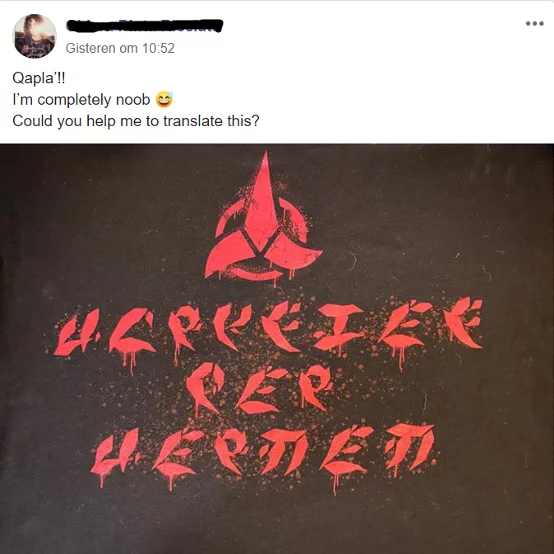
An example is the Facebook group Learn Klingon, which is a public group with 2.176 members. As you can see on the screenshot above (figure 2) someone is asking advice from fellow members to translate the fictional sentence. The same applies to online forums, where everyone can learn more about the specific language and people can ask each other questions according to the constructed language. An example is the online forum (lwhere people can learn more about the Valyrian and Dothraki language.
Another online platform which provides multiple videos regarding constructed languages is YouTube. Some videos explain how the language was invented. And other videos function as tutorial lessons to teach people how to write and speak a constructed language. Overall learning a fictional language may have little practical value, but it offers a way for people to connect with their passions and interact with like-minded people (Prisco, 2019).
Back to topTOOL
So, it looks like conlangs are becoming more and more popular these days. The internet has played a big role in forming conlang communities and even brought Klingon back into our (digital) lives. This is also the primary reason that Esperanto is still spoken today. On social media people create fan pages or fan accounts and that’s where they can practice conlangs every day. Also, with the popularity of shows such as Game of Thrones, and films as The Hobbit, conlangs became more mainstream among the public. It’s also important to keep in mind that conlangs can be created for different reasons, but they mainly exist to make a story world feel more ‘real’.
So, can we state that conlangs can be defined as languages? If you read through the lines, it is made clear that everyone who is involved or a fan of conlangs treat them as real languages. And thereby, it has already developed this far that they fully live their own lives on- and offline due to great popularity. There is so much to be found nowadays about conlangs that it must be seriously considered as a real language. Due to a massive fanbase, the development of online tools to spread the languages around the world, and the popularity of fictional movies and series, conlangs will only become bigger. There will probably be new conlangs in the future, but for now, let’s just say v"alar morghulis (do you already know what it means?
Back to topReferences
Adelman, M. (2014). Constructed languages and copyright: a brief history and proposal for divorce. Harvard Journal of Law & Technology 27/2.
CCBForum. (n.d.). Retrieved March 21, 2020, from CCBForum.
Destruel, M. (2016). Reality in Fantasy: linguistic analysis of fictional languages. Boston College University Libraries. Retrieved from eScholarship@BC.
Dothraki. (2010, April 12). Official HBO Press Release. Retrieved from Dothraki Conlang.
Fandom. (n.d.). Errand of Mercy. Retrieved March 21, 2020, from Memory-alpha.
Higgins-Dunn, N. (2019, April 14). If you are a ‘Game of Thrones’ fan, this app will teach you how to speak in High Valyrian. Retrieved from CNBC.
Lindstedt, J. (2006). Native Esperanto as a Test Case for Natural Language, Sky Journal of Linguistics
Linguistanerd. (2018, June 10). Retrieved March 21, 2020, from Linguaholic.
Okrand, M. (1992). The Klingon Dictionary. New York: Pocket Books, Simon & Schuster, Inc. 1992
Overbeeke, A. (2014, December, 24). Fictional Languages in Film and Television. University of Amsterdam
Prisco, J. (2019, May 20). The 'Game of Thrones' language that 1.2M people are learning. Retrieved from CNN.
The Organians Prophecy The Klingons and The Federation Will Become Friends. (2019, November 19). Retrieved March 21, 2020, from YouTube.
Back to top