

Article
From concert to community: How TikTok shapes fan identity and connection around Harry Styles’ ‘Love On Tour'
This analysis explores how TikTok discourses surrounding Harry Styles’ Love On Tour contribute to fan identity formation and community building. Drawing on concepts such as recontextualization, intertextuality, and performative identity, the study examines how fans use TikTok’s features - hashtags, sounds, and multimedia tools - to create and share personal narratives that resonate within a broader collective discourse. These practices foster emotional connections, shared rituals, and a sense of belonging, illustrating the platform’s role in amplifying values central to the tour, such as love, inclusivity, and freedom. Additionally, the analysis reflects on the unique interplay between digital affordances and fan creativity, while critically addressing the limitations of fan culture within social media ecosystems. Ultimately, this case study highlights TikTok’s capacity to transform concert experiences into dynamic, collaborative fan communities.

Published date
Courses
Doing Research: Discourse Analysis.
Copyright
This work is licensed under a Creative Commons Attribution-NonCommercial 4.0 International License.
Read time
13 minutes

From the stage to the screen
This article focuses on the fan interactions during Harry Styles’ ‘Love On Tour’ – the famous artist’s second world tour – and the central themes of inclusivity, love, and freedom that emerge during the shows and in the online reactions through the platform TikTok. As a passionate fan who attended this tour five times, I've seen how it formed strong connections between fans, creating a real feeling of community and shared experience. By analyzing the digital discourse surrounding ‘Love On Tour’ fan-generated content, I aim to gain insights into how TikTok shapes social interactions and identities. This topic is particularly relevant as it highlights the power of music to connect people andthe power of music to connect people, but also the impact of Harry Styles on his fans’ lives and identities beyond his songs. It highlights how fandoms can deeply impact people’s lives, fostering emotional connections and meaningful relationships. By exploring this, I can gain insight into how digital spaces transform music into a powerful force for identity and community-building.
The research question guiding this paper is: How do TikTok discourses surrounding Harry Styles' Love On Tour contribute to the formation of fan identities and community building?
Back to topBuilding connections in digital spaces
I will use Digital Discourse Analysis to look at how fans engage with Styles’ concerts on TikTok. I will explore how TikTok features (like hashtags, templates and sounds) help shape the way fans express their experiences. By analyzing fan videos and discussions, I will examine how fans interpret the values Styles promotes during his shows – love, inclusivity and freedom – and how they reflect these ideas in their content.
To research fan reactions to Harry Styles’ ‘Love On Tour’ through Digital Discourse Analysis, it is essential to first look at the definitions of fandom identity and community building, and after that discuss the most important concepts of the theory relevant to this study.
Fandom identity
Fandom identity is the way individuals define themselves as part of a larger group (community) based on their shared admiration for an idol or subject, shaped by the level of personal commitment and emotional involvement they invest as fans (Wang, 2019). Identity within fandoms is not only about admiring the artist, but also about producing and creating forms of creative media (Grinnell College, n.d.). These practices include commenting on performances, sharing personal stories related to the artist's music, or participating in fan-driven content creation. In this context, identity becomes performative, as it is expressed and constructed through actions, behaviours, and participation, such as creating content or engaging with others in the fandom.
Community building in fandoms
Community building is all about bringing fans together to connect, share experiences and create a sense of belonging (Chatelier, 2023). Platforms like TikTok allow fans to engage with one another in ways that go beyond physical distance, bringing people together in online communities that are united by their shared love for Harry Styles. The emotional experience of ‘Love On Tour’, with its themes of love, freedom, and inclusivity, strengthens this sense of connection, as fans resonate with the concert’s atmosphere and bring those feelings into their online interactions.
Online communities built around fandoms are often highly interactive. Nowadays fans interact daily, if not hourly, online (Jenkins, n.d.). They respond to one another’s posts, comment on each other’s TikToks, and collaborate to create stories driven by fans. These interactions strengthen community bonds and help shape a collective identity, as fans see themselves in relation to the shared experiences and emotions of others (Mentes Abiertas Psicología S.L., 2023). However, this constant interaction can also blur boundaries between personal and communal identities, potentially fostering pressures to conform or maintain an idealized version of fandom participation.
Texture
Texture is a property of connectedness that is created through cohesion, that is, the way different parts of the text are held together using the syntactic and semantic resources of whatever semiotic system is being used, and coherence, the way different parts of the text are ordered sequentially so that it can be recognized by readers as logical and meaningful (Halliday & Hasan 1976; Schegloff & Sacks 1973; Jones et al., 2015). Texture is a relevant concept for this study, because it highlights how TikTok discourses create connections between fans through the cohesive integration of text, sounds, and visuals, allowing for meaningful narratives.
Intertextuality
Intertextuality refers to the inherent quality of all texts to be connected to other texts, as they are to some extent dialogic, in that they respond to previous texts and create the conditions for subsequent texts (Bakhtin, 1981). Moreover, it is a social process through which people not only create linkages between texts, but also create relationships between themselves and other users of texts (Jones et al., 2015). Intertextuality is a relevant concept for this study as it underscores how TikTok discourses related to ‘Love On Tour’ are interconnected with fan expressions, enabling users to engage in a dialogic process that fosters community and shared identity.
Embedding is a technological affordance of intertextuality (Jones et al., 2015). It is a numerical representation of text that captures semantic meaning (Discourse Meta, 2023). It involves integrating multimedia elements (such as videos, images, or audio) directly into a digital text, allowing users to access and interact with these elements without leaving the original context.
Recontextualization
Recontextualization is the process by which texts and their meanings change as they move across different contexts, both virtual and physical (Jones et al., 2015). This involves the adaptation of texts to new situations that their producers may not have anticipated. The overlapping and interconnected networks of contexts created by digital technologies complicate the maintenance of what is known as contextual integrity (Nissenbaum, 2009), making it challenging for analysts to trace how texts evolve as they are appropriated into various settings. Recontextualization is a relevant concept for this study, because it illustrates how fans adapt and transform their experiences and meanings related to ‘Love On Tour’ as they share content across different digital and social contexts.
Interrelationship
The concepts of texture, intertextuality, embedding, and recontextualization are closely linked and support each other in this case. Texture refers to how TikTok posts combine text, sound, and visuals to create meaningful stories and emotional connections among fans. This leads to intertextuality, where fans engage with existing texts and respond to each other, strengthening their collective identity. Embedding allows users to add multimedia elements, making the interaction more engaging. Finally, recontextualization shows how fans adapt their shared experiences across different contexts, illustrating how meanings evolve within the community. Together, these concepts explain how TikTok serves as a platform for fans to connect, express their identities, and build a sense of belonging through shared experiences.
Back to topA case study on TikTok videos
Data
I chose TikTok videos as my data, because the platform makes public conversations more inclusive and engaging (Silvestri, 2024). TikTok is an essential space where fans engage in discourse, shaping their identities and community dynamics. Discourse is not only produced by humans, but also by algorithms (Maly, 2022). The platform exerts control through algorithms that decide what content users see (Silvestri, 2024). Moreover – unlike in traditional media platforms – TikTok users have cultivated a unique connection with their followers, creating content that feels genuine, personal, and relatable (Haysler, 2024). TikTok allows users to engage, using video content, sounds, and hashtags to communicate.
I selected three TikTok videos by searching on the hashtag #loveontour and focusing on popular videos related to the key concepts and themes like inclusivity, love and freedom. These videos not only illustrate fan engagement with the tour, but also provide insights into how fans express their identities and participate in community building within the fandom.
Back to top
Analysis
In video 1 the creator used a template that includes the text, "Nothing will ever beat the 'Love On Tour' level of happiness." The fan was able to insert her own videos from ‘Love On Tour’ into the frames, creating a compilation that summarizes the tour experience. The video showcases clips of Harry Styles, his band, the audience, and fireworks. The sound used in this template is a live version of the song "Iris" by the Goo Goo Dolls, which is a pre-selected sound that accompanies the template.
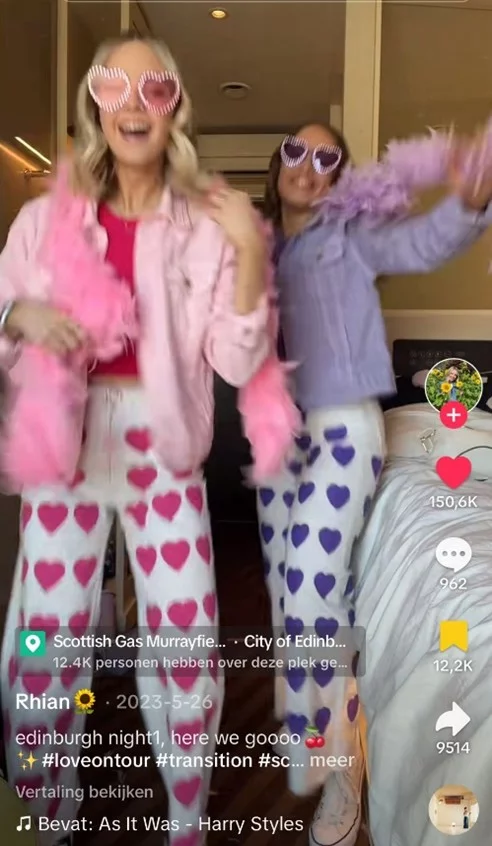
In video 2, you see a transition where two fans are first shown in Harry's merchandise and then, after the transition, in their tour outfits. The sound playing underneath is "give me all your numbers so I can phone ya" (from "Work It" by Missy Elliott), followed by "come on Harry, we wanna say good night to you" (from "As It Was" by Harry Styles) during the transition.
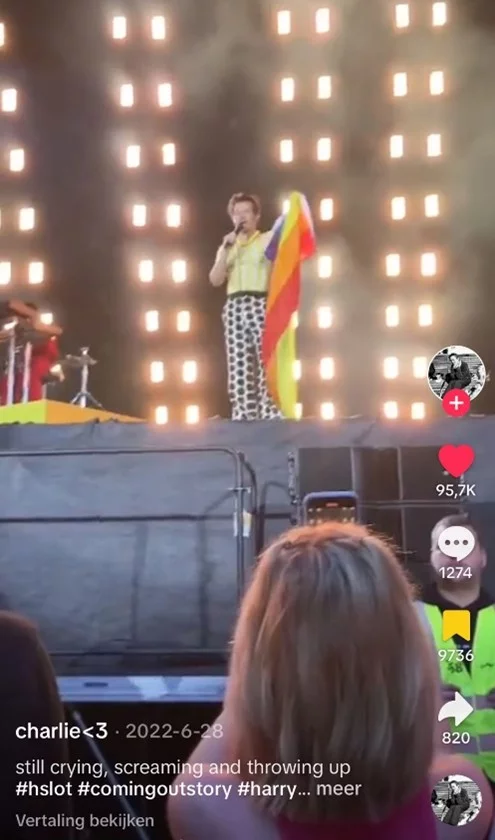
In video 3, you see a video that a fan (Lisa) made during Harry's show in Hamburg. Harry interacts with Lisa, who is holding a sign that says "help me come out." Harry pulls out an LGBTQ+ flag and says, "when this flag goes above my head, you're out." He builds up the suspense with drumrolls and waving the flag. When he holds the flag above his head, the audience screams and Harry chants "freedom for Lisa!".
Each video contains a texture characterized by cohesion. In video 1, the creator uses a pre-designed template that integrates multiple semiotic elements (text, visuals, and sounds) to produce a cohesive narrative about the ‘Love On Tour’ experience. This texture not only combines individual clips into a meaningful compilation, but also fosters a sense of connectedness among fans (Halliday & Hasan 1976; Schegloff & Sacks 1973). In video 2, the transition between outfits captures the excitement of the concert experience, while the combined sounds enhance the coherence of the narrative by linking the visuals to recognizable music. The popular combination of sounds, which have only been used for similar transitions, creates an experience that deepens the emotional connection and expresses fan identity. Video 3 creates texture through the interaction between Harry and Lisa, where the build-up of suspense and the audience's reaction deepens the meaning and emotional connection of the fan experience. The use of hashtags like #hslot and #loveontour enables dialogic interaction by connecting individual videos to a larger discourse around Harry Styles and his tour. This interaction is dynamic, allowing fans to engage through likes, comments, and shares. This fosters a conversation among fans and between users and algorithms .
The videos are an example of intertextuality as they reference and respond to broader cultural texts. In video 1, the use of the phrase "nothing will ever beat the 'Love On Tour' level of happiness" reflects a dialogue (Bakhtin, 1981) with other fan experiences and the collective memory of the tour. Video 2 contains popular songs and uses existing lyrics that resonate with the audience and serve as a familiar background for fans' transformations. The used hashtag (#LoveOnTourOutfit) had over 11.0k posts on TikTok, with many fans roaming social media trying to find an outfit bold enough to wear (Waghorn, 2024). Therefore, fans not only consume this content, but also actively contribute to it. This behavior is performative, as users often replicate the same types of videos or similar concepts using specific sounds or hashtags repeatedly (Zulli & Zulli, 2020, p. 10). Consequently, this demonstrates the role of intertextuality in digital media, as fans engage in the curation (selection) of content by drawing on existing trends. In video 3, the interaction between Harry and Lisa engages with LGBTQ+ discourse, demonstrating how fan expressions can overlap with social issues, creating a richer context for understanding the significance of the moment (Jones et al., 2015).
The embedding of multimedia elements plays a crucial role in each video's discourse. In video 1, the compilation of fan footage of ‘Love On Tour’ integrates various aspects of the tour experience. By embedding these elements, the creator allows users to relive the live concert atmosphere, while interacting with the highlights of the experience, such as the crowd's excitement and the visual spectacle of the show. The template of the video allows users to engage with multiple layers of content without losing the context (Jones et al., 2015) of the original event. Video 2 contains sounds from popular music to embed familiar cultural references, enhancing the relatability of the fans' outfits and transitions. The embedded sounds, combined with the visual transitions, create a recognizable template that resonates with the audience, inviting them to engage and replicate the content themselves. In video 3, the embedding of the rainbow flag and the sign held by Lisa creates a powerful social statement, transforming the concert moment into a statement of inclusivity and personal identity. This embedding creates an emotional and symbolic connection with fans who share similar experiences or support LGBTQ+ causes. It highlights how embedding enables fans to contribute personal meaning to the collective discourse, reinforcing their sense of belonging within the fandom and the community.
Recontextualization is evident in the videos as fans transform their experiences across different contexts. In video 1, the creator recontextualizes the ‘Love On Tour’ experience by using a popular TikTok template, but personalizing it with her own footage from the concert. The template serves as a framework that fans use to showcase their individual experiences, reflected within the larger fan community (Jones et al., 2015). Video 2 recontextualizes the excitement of getting dressed for the concert, inviting other fans to participate in a shared ritual of preparation. This preparation, which is a private, individual act, is transformed into a public fan ritual when posted on TikTok. The act of getting ready becomes a social performance, inviting other fans to participate in the same ritual and thus connecting personal preparation with a collective experience. In video 3, the act of Lisa holding the "help me come out" sign is recontextualized by Harry’s supportive response, showcasing how concert settings can become spaces for important personal and social expressions. Additionally, the context of each video exists within both online and offline spaces, allowing fans to relive concert experiences while contributing to a collective memory. The comments section of each video reflects how emotions dominate the discourse, illustrating fans' deep connections to the tour while emphasizing the power of collective memory.
Back to top
Conclusion
In conclusion, the TikTok discourses surrounding Harry Styles' ‘Love On Tour’ contribute significantly to the formation of fan identities and community building. Through the platform's features – such as hashtags, sounds, and templates – fans engage in practices that foster both individual expression and collective belonging. TikTok allows fans to recontextualize their concert experiences, embedding their personal narratives into a broader fan discourse, creating shared rituals and emotional connections. The interaction between personal identity and collective memory is visible as fans use multimedia elements and participate in dynamic conversations that strengthen their sense of belonging within the fandom. What makes this case study unique is the ability of TikTok to turn momentary concert experiences into ongoing, interactive narratives, allowing fans to continuously shape and share their collective memory in ways that go beyond traditional fan practices. Finally, TikTok serves as a digital space where fans can interpret and amplify the values of love, inclusivity, and freedom central to ‘Love On Tour’, enabling them to build meaningful relationships and affirm their identities within a supportive community.
Back to top
References
Baker, T. (2023, February 27th). Lights up on the Harrie fandom: an analysis. https://thatfangirllife.com/2023/02/lights-up-on-the-harrie-fandom-an-analysis/
Bakhtin, M. M. (1981) The Dialogic Imagination: four essays; trans. C. Emerson and M. Holquist, M. Holquist (ed.) Austin, TX: University of Texas Press.
Chatelier, B. (2023, May 30th). Community Building: Definition and Principles. https://www.meltingspot.io/the-guide-to-community-building/community-building-definition-and-principles
Discourse Meta. (2023, April 24th). Discourse AI - embeddings. https://meta.discourse.org/t/discourse-ai-embeddings/259603
Goffman, E. (1981) Forms of Talk, Oxford: Blackwell.
Grinnell College. (n.d.). Fandom and Participatory Culture. Subcultures And Sociology. Accessed on October 10th 2024, from https://haenfler.sites.grinnell.edu/subcultural-theory-and-theorists/fandom-and-participatory-culture/
Halliday, M. A. K. and Hasan, R. (1976) Cohesion in English, London: Longman.
Handbook of Research on the Impact of Fandom in Society and Consumerism. (2019). In C. L. Wang (Red.), Advances in marketing, customer relationship management, and e-services book series (English edition). IGI Global. https://doi.org/10.4018/978-1-7998-1048-3
Jones, R. H., Chik, A., & Hafner, C. A. (2015). Introduction. Discourse and digital practices. https://doi.org/10.4324/9781315726465
Kerremans, S. (2023, December 26th). Love on tour forever 🥺🩷🪩🕺🏾🥝🍉 [Video]. TikTok. https://www.tiktok.com/@sofiekerremans/video/7316860328418102561?_r=1&_t=8qSLzhI3x2p
LaFollete, A. (2024, March 2nd). Love on Tour: A Concert Experience Like No Other. Trillmag. https://www.trillmag.com/entertainment/music/love-on-tour-a-concert-experience-like-no-other/
Maly, I. (2022, December 7th). From methodology to method and back. Some notes on digital discourse analysis. Diggit Magazine. https://www.diggitmagazine.com/working-papers/methodology-%20method-digital-discourse-analysis
Maly, I. (2023). Metapolitics, Algorithms and Violence: new right activism and terrorism in the attention economy. Routledge. https://doi.org/10.4324/9781003283379
Mentes Abiertas Psicología S.L. (2023, February, 27th). Collective Identity: Concept and Examples. Mentes Abiertas Psicología. https://www.mentesabiertaspsicologia.com/blog-psicologia/collective-identity-concept-and-examples
Nissenbaum, H. (2009) Privacy in Context: technology, policy, and the integrity of social life, Palo Alto, CA: Stanford University Press.
Rhian. (2023, May 26th). edinburgh night1, here we goooo🍒✨ [Video]. TikTok. https://www.tiktok.com/@rhian_bw/video/7237474354056023322?_r=1&_t=8qSNAtkjcqx
Sandtner, L. (2022, June, 28th). still crying, screaming and throwing up [Video]. TikTok. https://www.tiktok.com/@lisa.sandtner/video/7114404159675321605?_r=1&_t=8qSOmo0DLYR
Schegloff, A. E. and Sacks, H. (1973) ‘Opening up closings’, Semiotica, 8(4): 289–327.
Silvestri, C. (2024, June 6th). Do we want AI algorithms to shape public discourse?
Rijksuniversiteit Groningen. https://www.rug.nl/feb/organization/departments/ims/blog/do-we-want-ai-algorithms-to-shape-public-discourse
Waghorn, R. (2024, April 17th). How Harry Styles: Love on Tour is allowing fans to express themselves with their outfits and confidence, even after his tour ended. Hybrid Magazine. https://www.hybridmag.co.uk/p/how-harry-styles-love-on-tour-is
Zulli, D. and Zulli, D. J. (2020). Extending the internet meme: Conceptualizing technological mimesis and imitation publics on the TikTok platform. New Media & Society. https://doi.org/10.1177/1461444820983603.
Back to top

More from this author