

Paper
Captured Between the East and the West
This essay explores how and what an artist like Ai Weiwei can contribute to the discussion on the refugee crisis in Europe and if "political" artworks and artistic expressions can have a certain impact on society.
Published date
Courses
Online writing and publishing
Copyright
This work is licensed under a Creative Commons Attribution-NonCommercial 4.0 International License.
Read time
19 minutes

The refugee crisis is one of the most discussed issues in Europe on political and social levels. This essay explores in what ways artistic activism and more specifically, an artist like Ai Weiwei, can contribute to the discussion on the 'refugee crisis' in Europe. Furthermore, it explores if artworks and artistic expressions can have a certain impact on the political debate, the public debate and not to forget on the refugees.
Back to top
Introduction
A very difficult situation is going on at the borders of Europe. The European Union Agency, Frontex detected more than 1,800,000 arrivals at the European borders in 2015 – mainly fuelled by the war in Syria (BBC News, 2016). Because of the open internal borders it is very hard for the different EU-members to manage a national immigration policy, so it becomes a problem on a European level. Nevertheless different countries try to handle this issue on their own, by closing the borders and sometimes even with hostile and discriminating policies. The one sure thing is that the refugee crisis is a very complex issue, which deserves a more cohesive policy framework.
The refugee crisis is a very complex issue, which deserves a more cohesive policy framework.
But not only on political level the refugees are treated in an inhuman way, also in the European society there is a visible division in opinions regarding this influx of people with another culture. Besides the fact that a lot of European citizens are helping and defending these people, there is as much negativity shown towards the refugees through social media. Butven worse are the demonstrations at the asylum centres in different European countries we see and hear about in the news.
The refugee crisis is also dominating newspapers and other media for a long time now. Until September 2015, hardly one of them made a lot of impression. On September 2the poignant image of a three-year-old drowned boy named Aylan Kurdi went viral and suddenly there was a transformation in the public debate regarding the crisis in Europe (Fahey, 2015). Two studies revealed the extent of this phenomenon and show how this story engaged global audience and even changed the way social media users talked about the issue of immigration positively. They have done this by analysing nearly three million tweets and millions of Google searches around the death of Aylan (News Republic, December 2015).
But also charities and NGOs saw a 15-fold rise in donations within 24 hours and even UK’s prime minister Cameron bowed to the pressure to let in more Syrian Refugees (Fahey, 2015). Such an image reminds us that this war is happening to real people and that behind every number and statistic is a name and a face. Although it raised a lot of awareness regarding the issue, it also comes with a lot of controversy because not everyone agrees with the fact that the image has been published. So isn’t there another way to affect people than using an image of a death three-year-old boy?
Not only the media, but also different artists are responding to this issue like the renowned Chinese artist and political activist Ai Weiwei (1957). According to Chenal (2009) the role of the artist becomes more and more important in all kinds of social contexts and especially where politicians and social workers have failed. “They are expected to unveil new realities, bring people together in communities, contribute to inclusive policies, and so on. Whether they want it or not, a role as actors and beacons of change is thrust upon them.” (Chenal, 2009).
To examine in what ways Ai Weiwei contributes to the discussion on the refugee crisis in Europe, I will first give a global outline of the events and policies regarding the refugee crisis. Secondly I will give insight in the value of art in relation to humanitarian and political issues. Then I will look at the role of the artist Ai Weiwei and analyse his artistic expressions and an artwork he made regarding the refugee crisis. Finally I will conclude how and to what extent an artist like Ai Weiwei can contribute to the discussion and what kind of impact his art can have on the different levels in the European society.
Back to top
“Europe's” refugee crisis
According to Andersson (2016) the refugee crisis is a recent and man-made phenomenon. Irregular land and sea migration hardly existed in Europe before the 1990s – the time when a border security model was starting to be put in place (p. 2). Andersson (2016) states that the Schengen agreement on free movement, which (largely for political and symbolic reasons) came to entail the reinforcement of the external borders of the EU, is the reason for this shift towards border security (p. 3). Northern European states started to put pressure on southern counterparts to shore up their migration regimes and as they did so, for instance by introducing visa requirements for North Africans early in the 1990s, migrant boats started appearing along their shores; legal pathways were being replaced with irregular ones (Andersson, 2016, p. 3). The vast majority of the migrants are taking huge risks when fleeing to Europe through these irregular land and sea routes. The International Organisation for Migration (IOM) reported 162,902 arrivals by sea at March 23, 2016 but also 531 migrants where reported dead or missing in the Mediterranean. In 2015 1,011,712 people arrived by sea but also 3,770 migrants where reported dead or missing (2016).
The vast majority of the migrants are taking huge risks when fleeing to Europe through these irregular land and sea routes.
It’s clear that the European countries are struggling to cope with the influx. But these migrants are not only taking huge risks when fleeing their country, they are also arriving in Europe under desperate and inhuman circumstances. According to Andersson (2016) this is due to the failure of the European attempts to ‘secure’ or ‘protect’ the borders, despite the mass investments Europee did in advanced border controls (p. 1). People remain stuck at different borders in Europe where the conditions are poor and there is a lack of essential supplies such as food, clothes and a normal bed to sleep on.
And as I have earlier mentioned, different countries try to handle this problem on a national level with hostile policies. In some of the European countries they “successfully” criminalized illegal immigration. For example in Italy illegal migrants can face fines, jail time or even deportation under the controversial ‘Bossi-Fini immigration law’, which makes illegal immigration – and aiding illicit migrants – punishable. Also in Greece they confront migratory pressures by emphasizing interdiction, detention, and removal of illegal migrants and Hungary adopted a new series of emergency laws in September 2015 that allow its police to operate detention centres, in addition to making illegal border crossings and aiding migrants punishable by prison time. The Hungarian government also deployed armed troops to its border (Park, 2015).
There are also countries, which are reluctant in accepting migrants from the Middle East and North Africa, especially after the Paris and Copenhagen terrorist shootings in 2015. And some countries even expressed their preference to only receive non-Muslim migrants, which is according to Council on Foreign Relations (CFR) in clear violation of the EU’s non-discrimination laws (Park, 2015). But not only on political level this cruelty towards refugees takes place, also in the European society there is an obvious division regarding the refugee crisis between supporters and opponents. It looks like most of these people who are against the influx of migrants, are scared because of the unknown; the cultural differences that come along with the influx of people from Eastern countries. It could be seen as a drain on “their” European culture and resources. In this way the refugees are finding themselves captured between the East and the West, not only at the borders, but also on cultural level.
Back to top
The value of art
The use of art and literature to appeal for humanitarian or political actions is not new. A particularly poignant example regarding the current refugee crisis is the last surviving play script handwritten by William Shakespeare (1564 – 1616), in which he imagines Sir Thomas More making an impassioned plea for the humane treatment of refugees (Brown, 2016). According to Brown the powerful scene, in which More is calling on the crowds to empathise with the immigrants, was written at a time when there were heightened tensions over the number of French Protestants (Huguenots) seeking asylum in the capital (2016).
Another interesting example is the work of the famous and political writer George Orwell (1903 – 1950). After he wrote his second book, a novel that offers a dark look at British colonialism in Burma, Orwell’s interest in political matters grew rapidly (biography.com, n.d.). In his essay (1946) ‘Why I write’ he states the following: “the opinion that art should have nothing to do with politics is itself a political attitude.” ‘Political purpose’ is according to Orwell one of the fourth great motives for writing, at any rate for writing prose – besides ‘sheer egoism’, ‘aesthetic enthusiasm’ and ‘historical impulse’. By this he means political in the widest possible sense. “It is the desire to push the world in a certain direction, to alter other peoples’ idea of the kind of society that they should strive after” (1946). About his writing process he says: “I write it because there is some lie that I want to expose, some fact to which I want to draw attention, and my initial concern is to get a hearing. But I could not do the work of writing a book, or even a long magazine article, if it were not also an aesthetic experience.” (1946).
“The opinion that art should have nothing to do with politics is itself a political attitude.” (George Orwell)
But also different scholars have their theories about the ‘aesthetic dimension’ of culture in public and political life. In his research article on the boundaries between fiction and ethnography Fassin (2014) is mentioning literature or, more generally, art as a ‘domain to capture life and to represent the reality and truth of life’. The other domain ‘anthropology’ looks into the real, but has not the capacity to unveil the truths beneath the surface of reality (Fassin, 2014). To make this more clear Fassin quotes philosopher Martha Nussbaum: “Literature is an extension of life not only horizontally, bringing the reader into contact with events, locations, problems or persons, but also, vertically, so to speak, giving the reader experience that is deeper, sharper, more precise than much of what takes place in life” (2014). So, while the scholar feels bounded by reality, the novelist can take the freedom to connect actions to more general issues. In this way the novelist can speak more to the imagination and even send a better message.
Also Eyerman (2006) mentions the notions of truth in art, which he compares with the representational notion Pierre Bourdieu (1930 – 2002) propounded in his book The Rules of Art. Bourdieu (1996) argues that ‘the best novels are not simply fictions that emerge from nowhere into the heads of geniuses; rather, they are representations of those invisible forces we like to call structures, which help shape human thoughts and actions.’ According to Eyerman, Bourdieu believes that some aspects of social structures are better grasped through novels than the more direct methods of scientific research: “Literature and art can reveal things that otherwise might go unsaid or unnoticed. The novel in other words, can give voice to worlds, as well as processes, that we would rather not see or speak about. Through the mask of fiction, one can say and uncover the truth.” (2006).
In one of his other essays ‘The Role of the Arts in Political Protest’ Eyerman (2013), who is focussing here on the broadest sense of artistic expression – including music, street theatre as well as all forms of visual representation – states that art has an undisputed place in contemporary social activism. “There is a long, perhaps even ancient history of wall writing and what we would today call street art and graffiti used as means to express discontent and catch public attention.” (Eyerman, 2013). In his essay Eyerman mentions a few functions of art and artistic expression in political protest. The first one is producing knowledge and solidarity within the group of protesters and others as a means of communication to those outside what the protest is all about. But they are also important in creating and communicating a collective narrative, articulating who we are, where we come from, what we stand for and what we are against (2013).
To these functions of art and artistic expression I would also like to add a few more presented by Efva Lilja (2013). In her article she appoints the importance of artistic research, which can have the same impact on society. But also interesting is the function of art to provoke: “Art must be made as an indispensible stimulus or curiosity, wellbeing, cultural and societal development. Art is an integral part of society’s survival strategy.” (2013).
Back to top
About Ai Weiwei
The famous Chinese artist Ai Weiwei (1957, Beijing) is best known for his installations, often tending towards the conceptual and sparking dialogue between the contemporary world and traditional Chinese modes of thought and production (Artsy, n.d.). But he is also admired for his criticisms of the Chinese government’s human right abuses and because of that the term ‘activist’ is also increasingly used in discussing Ai Weiei. This activism is influenced in no small part by his father’s legacy: his father, the celebrated poet Ai Qing (1910 – 1996), had made critical remarks on Mao’s regime during the Cultural Revolution in China in the 1950s. Shortly after Ai Weiwei was born, his father was labelled an “enemy of the people” and he and his family where exiled and he endured daily political humiliations, manual labor, and re-education, and due to his particular fame and influence was assigned the most humiliating tasks (Ambrozy & Ai, 2011).
After the death of Mao in 1976 the family returns to Beijing. In 1978 Ai Weiwei got accepted at the Beijing Film Academy. After his study he joined ‘Stars’ (1979 – 1983), an avant-garde art collective existing of twelve artists. They staged an illegal art show on park railings outside the China Art Gallery after being denied an official exhibition space. But when they were forced to remove these works, the group organised a protest march in the name of human rights and as a result granted permission to exhibit their works in the Gallery itself (Ambrozy & Ai, 2011). Nonetheless, when facing political pressure and criticism, several of the artists left China and around that time Ai Weiwei decided to move to New York.
About ten years later Ai Weiwei returns to Beijing to take care of his ill father and also starts making controversial work that openly criticises the Chinese government (Ambrozy & Ai, 2011). And in 2005, when the biggest Internet platform in China, Sina Weibo, invited Ai to start blogging, the Internet became of huge importance to Ai. At first he started posting photos of himself, his studio and his artworks. But when he explored how far digital information would reach, he started to use the blog for more political writing and as a call for social responsibility, government accountability and transparency. Because of the top to bottom information in other Chinese media, the information spread on blogs enjoyed a uniquely high credibility. Therefore Ai Weiwei also became one of the most sought-after social commentators in China. And his fame enabled him to take an increasingly outspoken and critical stance (Ambrozy & Ai, 2011).
Through the Internet Ai was giving a voice to those individuals who dared to shout out against the corruption and cruelties of the ruling authorities. But in 2009 the authorities shut down his blog and millions of posts, photos and comments were deleted. After that happened social media like Twitter became of a huge importance to him. Unfortunately, his struggle to bring the basic right of free speech to a greater population, ended in a severe beating from Chinese police in 2009 and an imprisonment of eighty-one days in 2011 because of different false allegations of tax evasion. The Chinese authorities even confiscated his passport for four years; so he had to stay in this corrupt country while his family moved to Germany. And so he also found himself captured between the East and the West. But it didn’t kept him quiet “I’m more convinced then ever of the need to stand up to China’s monstrous machine” Ai Weiwei said in an article for the Guardian (2012).
Back to top
The role of the artist and his artworks
After Ai Weiwei got his passport back in July 2015, he moved immediately to Berlin, which has now became a haven for some of the more then 4.7 million people who have fled the war in Syria (Bonessi, 2016). So, not long after being reunited, Ai was already involved in another human rights issue; the European refugee crisis. Ai Weiwei left several times to the Greek Island Lesbos and to Idomeni near the Greek-Macedonian border where around 13,000 people remain stuck in horrible conditions as a result of the Syrian war. He helps and assists the refugees after their arrival and documents the situation mainly through his Instagram account.
In an interview with Al Jazeera's Hoda Abdel-Hamid Ai said he is there to ‘study and document the situation and give the world a full picture of whatever there is to see, because that is what his art is about’ (2016). “My definition of art has always been the same. It is about freedom of expression, a new way of communication. It is never about exhibiting in museums or about hanging it on the wall. Art should live in the heart of the people. Ordinary people should have the same ability to understand art as anybody else. I don’t think art is elite or mysterious. I don’t think anybody can separate art from politics. The intention to separate art from politics is itself a very political intention.” (Ai, 2013). Which is very comparable to Orwell’s desire to “push the world in a certain direction” as earlier mentioned.
Ai Weiwei is responding to the refugee crisis in many different ways. For example, together with the British-Indian sculptor Anish Kapoor he led a protest march through central London on September 17, 2015 to press for “human rather than political” responses to the refugee crisis. Both Ai and Kapoor are viewing this walk, attended by a swarm of journalist and other protesters, as a creative act akin to art making. “It is important that artists are not outside the equation, we don’t stand on the sidelines. Artists are part of the story of a response, we cannot stand aside and let others make the response.” (Munro, 2015). But not everyone agrees with that and some people find it even disrespectful, because at the end of the day, the refugee crisis has nothing to do with these artists they say (Alonso, 2015). In my opinion precisely because the crisis has nothing to do with them, they can give a voice to the refugees and intervene in the public debate. And although it might not change something on a higher level, it raises awareness amongst the citizens of London.
Another action of Ai Weiwei, that maybe can have an impact on higher level, is the fact that he closed two of his Denmark exhibitions as a protest against the controversial approved laws by the Danish parliament to (Al Jazeera, 2016). The director of the Faurschou Foundation in Copenhagen where he exhibited 'Ruptures' supports his decision, but the director of the Aros Museum where Ai’s installation Yu Yi (2015) was part of an exhibition. Erlend G. Høyersten, the director of the Aros Museum said the following about Ai’s decision: “While I profoundly respect his reaction to Danish refugee policy, I think it is unreasonable that an entire country and its people should be punished as a result of government policies.” (2016). At this point Ai Weiwei used his status as a renowned artist to make a very important statement. And because his decision affects an entire country and maybe even Denmarks cultural position and reputation, it can also eventually have an effect on political level.
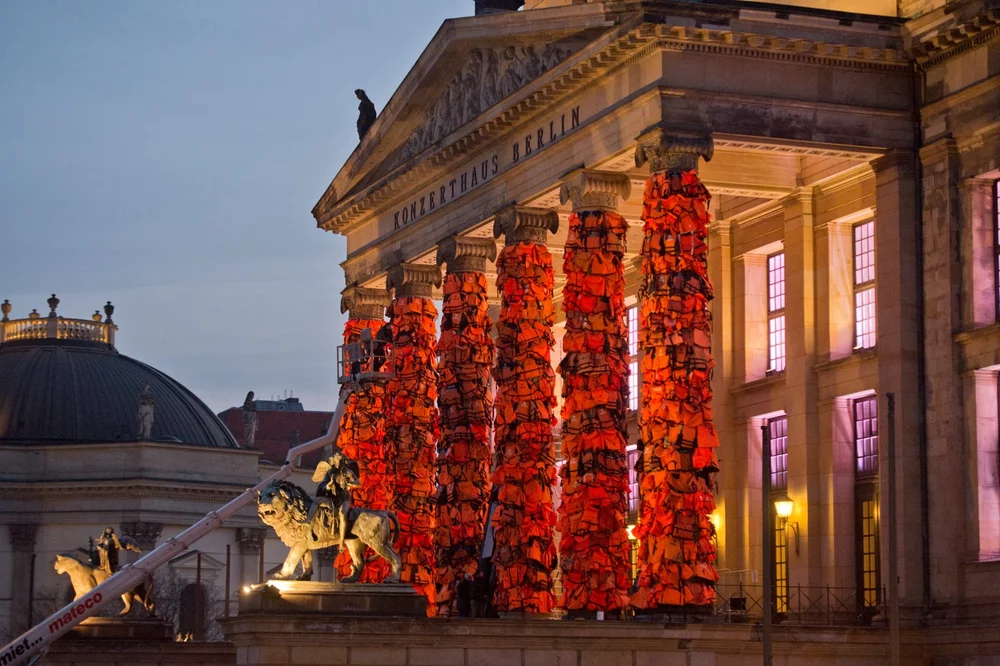
What can be considered more as an artwork then as an artistic expression, is the Konzerthaus in Berlin of which the columns Ai wrapped with 14,000 salvaged refugee life vests – which he got from the authorities on Lesbos where the vests had been abandoned at the beaches after being used by refugees crossing from Turkey– on the 13th of February this year. This conceptual installation was created for the Cinema for Peace Gala, where Ai served as honorary president this year (Bonessi, 2016).
Looking at the photograph of the installation, my first thought is ‘beautiful’, but it immediately also evokes a feeling of bewilderment and compassion. I think that besides the enormous and overwhelming building, the light and the way it brightens the reflective material of the orange life vests is the beautiful aspect of this work. I think that it was Ai’s intent to create an aesthetic experience: when looking at other photographs of the construction of the installation, you can see that there were also blue and red life vests. But Ai decided to not use them for this installation. With this artwork Ai Weiwei relocates the real happening from Lesbos to Berlin. The fact that too many people are facing huge risk by crossing the sea, is in my opinion something that everyone has to face in order to understand what this crisis is all about and in order to have an substantiated opinion.
Back to topBack to top
Conclusion
In this essay I have tried to explore how and what an artist like Ai Weiwei can contribute to the discussion on the refugee crisis in Europe. This essay also explores if artworks and artistic expressions can have a certain impact on the political debate, the public debate and not to forget on the refugees. As earlier mentioned, the role of the artist becomes more and more important in all kinds of social contexts, but it’s nothing new. When we go back to Shakespeare’s manuscript, you can see that back in the 16th century writers already where influenced by humanity and politics. Also Orwell was confident about the political aspect in art in combination with an aesthetic experience. Other studies confirmed that literature – and more generally art – is very important to depict social and political life because artists do have the freedom to unveil certain truths, to give a voice and to provoke. But in my opinion not every artist can reach a wide audience and has the power to influence.
The role of the artist becomes more and more important in all kinds of social contexts
There is a need for artists who have the power to give a voice and to intervene in the public- and sometimes even the political debate, and whose opinions are influential. I think that Ai Weiwei fulfils this role. Back in China, where he had the power and courage to show the whole world about China’s inhuman cruelties and corrupted rules, he was (and still is) one of the most influential artists. And I think the fact that he really stood up there for the minorities, makes his actions very credible. In my opinion artists like Ai Weiwei, who have a lot of supporters all around the world, are needed to raise awareness on the refugee crisis, by not only showing what is happening but by really giving a voice to these people.
An important aspect that comes with it, is that everything he does is picked up by national and international media. In my opinion he has already achieved the most import goal and that is helping the refugees, making them visible and giving them a voice. And by doing that, I think that he also reaches the hearts of many European citizens and is making them aware of what is really going on at the borders. In this way Ai Weiwei is able to influence the public debate with his art and artistic expressions. It is hard to say if this also applies to the political debate. But if he is able to affect a whole country on a cultural level by shutting down an exhibition, a thing that is certainly noticed by the politics, he will also be able to affect politicians.
Back to top
References
Ai, W. (2013). Weiwei-isms. Princeton University Press, Oxford
Al Jazeera Staff (January 27, 2016) Ai Weiwei closes Denmark exhibition over refugee laws.
Ambrozy, L & Ai, W. (2011) Ai Weiwei’s Blog.
Andersson, R. (2016). Europe’s failed ‘fight’ against irregular migration: ethnographic notes on a counterproductive industry.
BCC News. (March, 2016). Migrant crisis: Migration to Europe explained in seven charts.
Biography.com (n.d.) George Orwell Biography.
Brown (March, 2016) William Shakespeare’s handwritten plea for refugees to go online.
Bonessi, D. (February 19, 2016) 5 times Ai Weiwei’s art has called attention to the refugee crisis.
Chenal, O. (2009). Conference about re-tooling residencies.
Lilja, E. (2013). The politics of Art or What do the Arts do in Relation to the Creation of a New Narrative for Europe?
Eyerman, R. McCormick, L. (2006). Myth, Meaning and Performance: Toward a New Cultural Sociology of the Arts. From The Yale Cultural Sociology Series.
Eyerman, R (2013). The Role of the Arts in Political Protest.
Fahey, J. (September, 2015). The Guardian’s decision to publish shocking photos of Aylan Kurdi.
Fassin, D. (2014). True life, real lives: Revisiting the boundaries between etnography and fiction.
IOM (2016). Migration Flows Europe: Arrivals and Fatalities.
News Republic (December, 2015). Tragic boy Aylan's image saw 'refugee' word outstrip 'migrant' in Tweets– study.
Orwell, G. (1946) Why I write.
Park, J. (2015). Europe’s Migration Crisis.
Back to top
More from this author