Review
California scheming: Miranda July's Kajillionaire
In Miranda July's 2020 film Kajillionaire, Old Dolio's life is turned upside down when her criminal parents invite an outsider to join them in their scamming practices. She feels the need to detach from her hustling parents.

Published date
Courses
The multicultural individual
Copyright
This work is licensed under a Creative Commons Attribution-NonCommercial 4.0 International License.
Read time
7 minutes

On this page
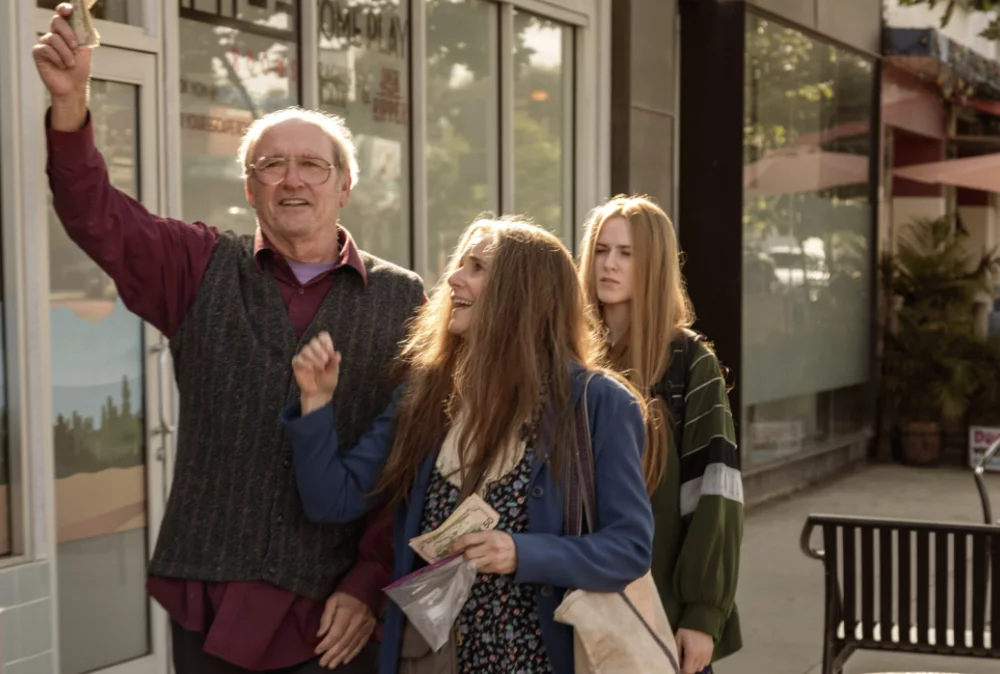
Ever wondered what being poor looks like in California's biggest city? Miranda July tells the story of a poor and dysfunctional family that scams their way through Los Angeles in Kajillionaire. The American crime-comedy-drama, written and directed by Miranda July, is filled with beautiful shots of Los Angeles. The main character, Old Dolio (Evan Rachel Wood), is a 26-year-old girl with a low, gravelly voice, way too long hair, and shapeless tracksuits, who has grown up under her neglectful and manipulative parents. Old Dolio has never been a real daughter to her parents Theresa (Debra Winger) and Robert (Richard Jenkins), but rather a scam partner. Most of the interaction between the family members is purely business-related scam talk.
‘’We split everything three ways, we have since I was little.’’
Back to top
Family scamming
After a few failed schemes, the family ends up three months on rent. They need to come up with a plan to collect $1500 in a week's time. Old Dolio devises a scam using airplane tickets they won in a contest: Old Dolio’s luggage will be stolen — by her parents — as she pretends to be a businesswoman, allowing her to claim that the airline has lost it. This leads to an insurance claim that will provide them with enough money to cover the rent. During the flight, her parents meet Melanie (Gina Rodriguez), an attractive but bored young woman who impulsively decides to join the family’s low-level scams. Robert and Theresa immediately embrace Melanie in a way that Old Dolio can only envy. Melanie has a strained relationship with her mother too - her apartment is full of useless presents given to her by her mom as a shallow sign of affection.
Back to top“Isn’t that amazing? Old Dolio learned to forge before she learned to write. Actually, that’s how she did learn to write.”
At first, Melanie is not intending to scam other people. She visits the home of one of her optician clients with the idea that they will give her free stuff or presents in return for Melanie’s visit with ‘her family’. Her plan is to then sell the items at a flea market. However, Old Dolio's parents immediately look for paychecks and other stuff to steal, so Melanie’s plan doesn’t hold up. Luckily for them, Melanie is interested in some adventure and a taste of the criminal life. She sets up another visit at a client’s home, who happens to be an old dying man. One of the man’s last wishes is to be surrounded by the sounds of an ordinary, normal, loving family. The four of them act upon the man's wish, and this is the first time Old Dolio experiences what a normal loving family feels like, making her more aware of her family's shortcomings.
After the parents realize that they have made use of all of Melanie’s scamming opportunities, they initiate a threesome with her. Melanie backs down from this while suddenly realizing how disturbing the entire situation is. Not much later, Old Dolio comes into the room hearing her mother calling Melanie ‘hon’. She feels hurt because her mother never called her anything like that. Old Dolio even offers her mother all of the insurance money to call her ‘hon’ too. Her mother simply cannot do it and instead Melanie accepts the offer. She takes Old Dolio to her apartment and decides, for that amount of money, to provide Old Dolio with a full-affection service instead of only calling her ‘hon’.

Back to top
Foam as motif
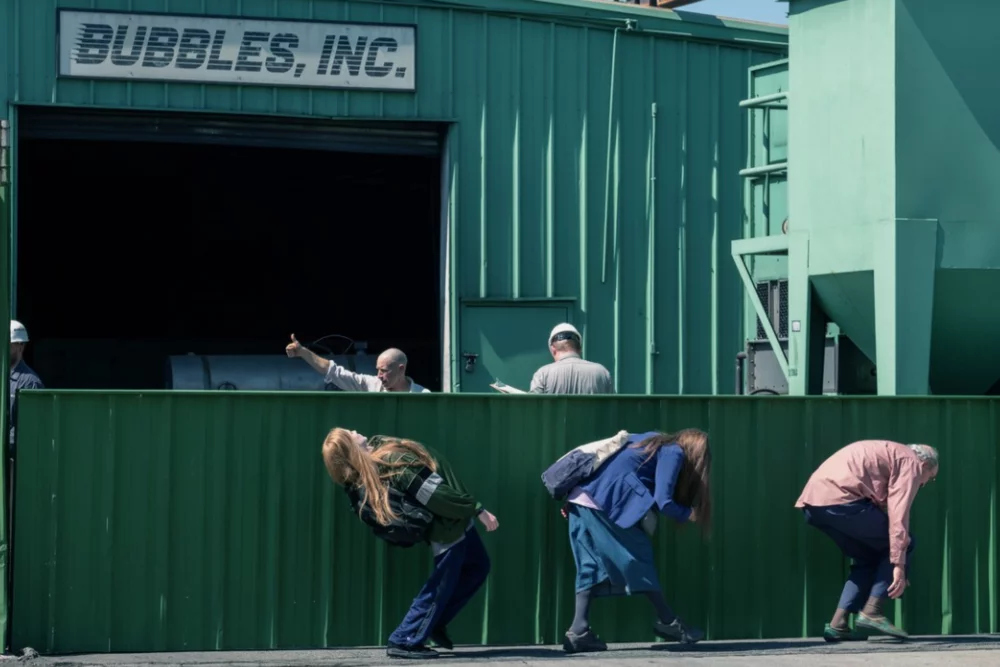
An important feature of the film is that the family lives in an old office space next to a soap factory. They rent the space for a relatively low price, but foamy bubbles drip off the wall everyday. In order to clean this up the family has to be home around the same time every day. One interpretation is that the foam is a metaphor for amniotic fluid, with the little earthquakes that occur during the film representing contractions. This metaphor is further motived by Old Dolio attending weekly planned parenting classes as one of her scams. In return for 20 dollars, she shows up under someone else’s name so that this person is marked present. In these classes, among other things, they practice the breast crawl with babies. Old Dolio comes to understand that her mom never did this with her, emphasizing her slow realization of her parents' neglectfulness.
Later in the film, as part of the full-affection-service treatment, Melanie brings Old Dolio to what she calls the darkest place in California for her to exercise the breast crawl. After this sort of rebirth, Old Dolio thinks she is in the afterlife. After realizing she is not, Old Dolio embraces life more than ever before. She searches for all the affection there is to find. Thus, a second interpretation of the foam is that it represents Old Dolio’s humanity, it literally sprays from the joints. The family is continuously trying to clean up and put back the soap, which is a metaphor for them trying to prevent Old Dolio’s humanity from coming forward. However the foam along the wall — and thus Old Dolio's humanity — is unstoppable. In support of this interpretation is that during this particular moment Old Dolio is not home to clean things up with her parents.
Kajillionaire displays a unique perspective on what it's like to grow up in your parent's bubble and break out of it little by little. It is everything but an average family drama. Kajillionaire follows the route of a not-so-ordinary young adult who struggles to fly away and leave behind everything that has been familiar to her. As 'leaving the nest' is a universally human event that all of us have gone through — or are going through — this film is recognizable yet absurd.
Back to top
Leaving the nest
Old Dolio stays with Melanie for a few days until her parents show up. They bring 17 birthday presents, telling her they love and miss her and promising an 18th present during dinner the following night. The 18th present turns out to be a necklace and promises to change. That same night they tuck Old Dolio into bed in Melanie’s apartment. Melanie hides the money from the luggage insurance scam in an obvious place and states that if Dolio's parents steal the money, the whole evening was a lie. Old Dolio counters that if her parents leave her a third of the money, as they do with all their scams, it shows that this is the only way they are capable of loving her.
To their surprise, the cash is not stolen that night. However, the next morning Old Dolio and Melanie wake up to a completely empty apartment. The parents have stolen all of Melanie’s things, including the insurance money. The only thing left is Old Dolio’s 17 presents. Melanie and Old Dolio return the presents for a total refund of $485.05. When they realize Old Dolio is still wearing the necklace, the 18th present, the total amount ends up being $525 - exactly one third of the insurance money.
Old Dolio has never been anything more than a tool in her parents' heists. One of the main themes in the film is character development and (a)social dynamics. The central question Miranda July poses is whether we are destined to follow our parent's footsteps or if we can create our own identities.
At first, Old Dolio knows nothing about life outside her parents' manipulative bubble. As Old Dolio gets to know Melanie, she realizes her opportunities beyond her bubble and begins experiencing life beyond everything she has ever known.
Back to topThe fear of 'the big one' reflects a similar fear towards Old Dolio's outbreak of humanity
The family often talks about ‘the big one’, a hypothetical giant earthquake they are afraid of. This fear of ‘the big one’ can serve as metaphor for her parents' fear of Old Dolio breaking away from them. Eventually, this is exactly what happens. Melanie introduces Old Dolio to forms of affection she has never experienced before. These new sensations open up a new world to her - she goes from a caterpillar to a butterfly. She develops from a devasted and haggard young woman into an individual, loveable human being. Kajillionaire shows the struggles of leaving the nest and flying on your own.
Back to topWho wants to be a kajillionaire?
Old Dolio's father often says that everyone wants to be a kajillionaire, i.e., so rich you no longer have any problems. The family rebels against this ideal - all they want to do is skim a bit off the top. However, their whole life is based on materialism and money. Paradoxically, they are doing exactly what they fight against. Despite this, the family prides itself on being skimmers and living on the bare minimum, in contrast to other people who worship money and try to be kajillionaires every single day.
''Most people want to be Kajillionaire's, that's the dream, that's how they get you hooked, hooked on sugar, hooked on caffeine, ha ha ha, cry cry cry. Me, I prefer to just skim.''
Old Dolio gives us a unique perspective on a coming-of-age story. The harmful effects of neglecting and manipulating your children are very visible. Towards the end of the film, Old Dolio’s identity finally starts to develop. However, this growing up should not start at the late age of 26. The end comes together beautifully when Old Dolio answers Melanie’s attempt at romantic love.
Miranda July takes her viewers seriously and trusts her audience's intellect. There is a lot of subtle storytelling with many underlying layers. All of this and more make Kajillionaire a real treasure among arthouse films.
Back to top