

Column
Black Pete: When commodifying “blackness” is tradition
Black Pete is a tradition for the Dutch population. Traditions are, however, ever-changing entities, especially ones rooted in colonial commodification of blackness.

Published date
Copyright
This work is licensed under a Creative Commons Attribution-NonCommercial 4.0 International License.
Read time
10 minutes

Every year, when the trees shed their leaves, I like to show my opposition to the Dutch folklore of Black Pete. The annual celebration of Saint Nicholas and his black faced servant brings me great shame of my home country which I make known in any way I can. As a consequence, I’m often met with disagreement and heated discussions. I however got especially impassioned when my own grandmother, after seeing my anti-Black Pete propaganda, protested me on the basis of Black Pete being a “tradition”. It moreover being one, which she looks back upon with lots of nostalgia. Thus, he should remain… right?
Admittedly, sympathizers usually make this argument. They seem to perceive a huge threat: their tradition is being taken from them, the Netherlands is changing for the worse! In this article I briefly discuss the unavoidable ever-changing nature of our traditions as well as e how ours is ingrained in a deeper structure of white dominance.
Back to topBlack Pete, a typical Dutch tradition
Hobsbawm refers to “invented tradition” as to mean “a set of practices, normally governed by overtly or tacitly accepted rules and of a ritual or symbolic nature, which seek to inculcate certain values and norms of behavior by repetition which automatically implies continuity with the past” (Post 1996, 93). Post highlights Hobsbawm's interest in the process of nation-form and urges his readers to keep this context in mind when dealing with the concept of invention of tradition(1996, 87). If one looks at the Dutch St. Nicholas, and with him Black Pete, it can be concluded thatthe festivity is absolutely such an invented tradition.
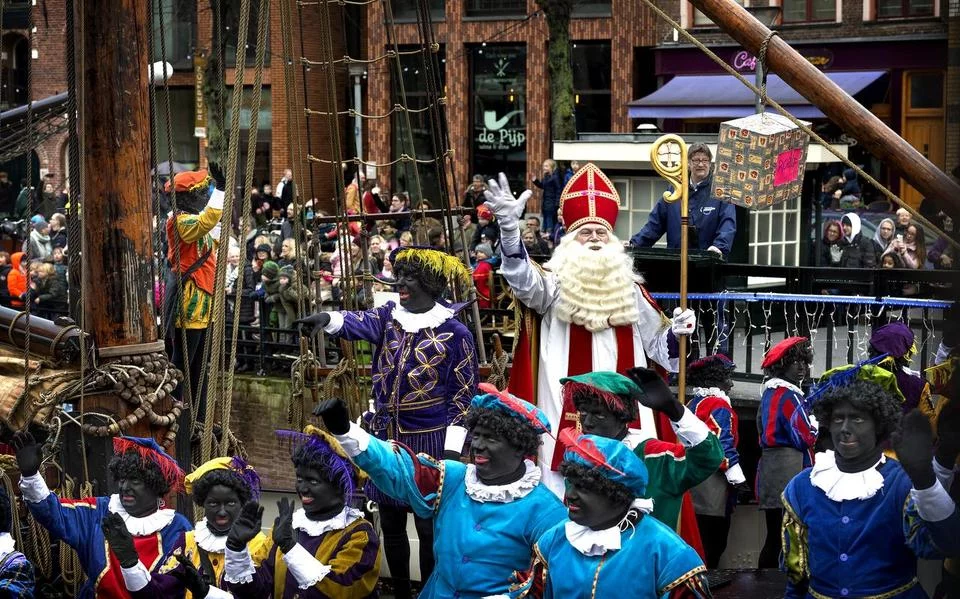
We, for instance, have certain acknowledged “rules” pertaining to how Black Pete and his boss should look, we have annual rituals like the arrival of the steamboat, the scattering of a particular kind of candy and the handing out of gifts. These guidelines and rituals didn’t just happen organically, they were constructed and repeated. In this way the Dutch now have an unspoken “common sense” understanding of their national holiday and, in the Black Pete debate, it is generally argued as something quintessentially Dutch. Our prime-minister, Mark Rutte, even said that Black Pete is black because that’s just the way it has always been (Van der Pijl & Goulordava 2014). Is this in fact the case?
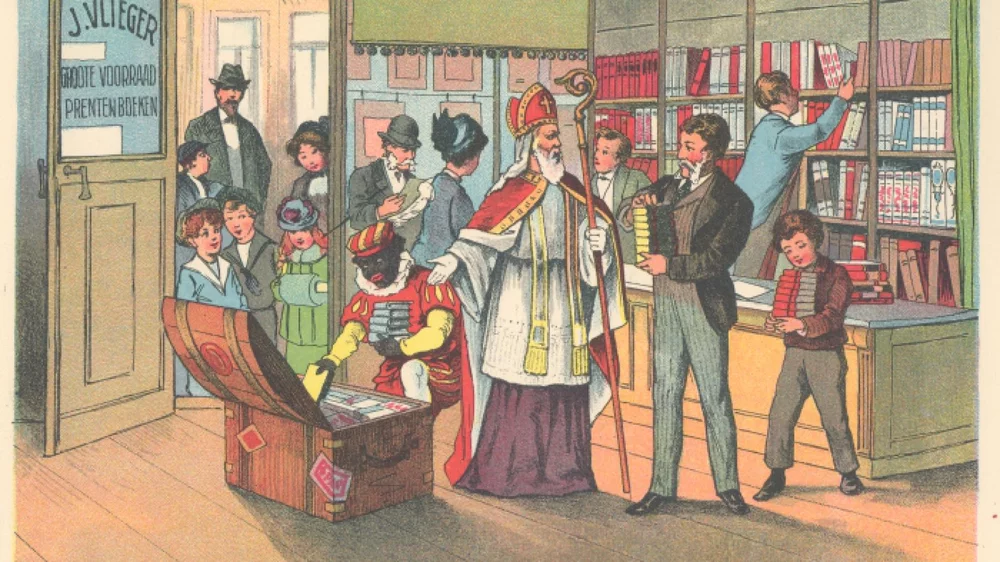
The helper of St. Nicholas being a black man, was especially popularized by the 1850 booklets of an educator named Jan Schenkman (KB, n.d.). Before this, St. Nicholas and Black Pete were merged into one blackened bogeyman who resembled a devil, wore chains, a mask and a broom and rounded up naughty children. Only later on were they split up into a bishop-like figure and a helper (who was at first, white!) (Wikipedia, n.d.). Black Pete and St. Nicholas like we know them now, are thus based on this folklore and subsequently, the books by Schenkman. All of this is very much in line with, as Hobsbawm calls it, the innovation of material from the past, which leads to the invention of tradition (which was done massively in the 19th century) by ritualization and repetition (Post 1996, 91).
Back to top
Transitions of traditions
Whereas Hobsbawm's his interpretation of tradition is quite fixed, Post deems it very much subject to change. Change is constantly in conflict with the continuity of tradition (and thus with stability), yet relentlessly prevails and eventually pushes the tradition into adaption and compromise. furthermore argues that this adaption process is also "invented tradition” (Post 1996). my grandmother might not be all that aware, “my” Black Pete is already very much different hers, and the generations before her. Not so much in appearance but in his role.
He used to be a fear-inducing servant that would spank you and put you in his burlap sack to Spain if you were naughty. In pedagogical circles this was rightly deemed traumatic for children so Black Pete slowly changed to a loveable friend and helper instead. This however wasn’t until well at the end of the 20th century (NOS, n.d.). Furthermore, while his skin color and duty as a helper w determined in 1850, Black Pete's his demeanor changed until around 1950 (Schuiten 2020). These are just a few of many examples tradition adjusts.
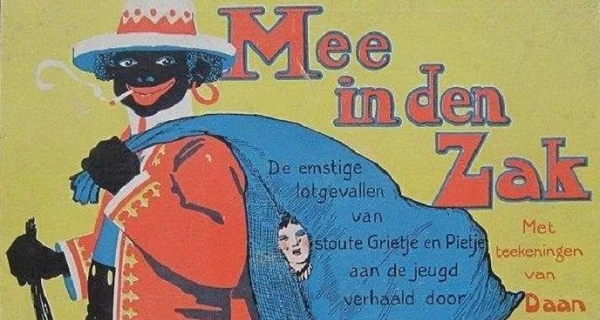
Precisely these adjustments are vital to understand. Why, Post wonders, does a tradition change? I argue an important aspect to be the support of a social agenda For example, the aforementioned pedagogic one, or how I don’t it to be much of a coincidence that Schenkman published his booklets depicting a sudden black helper in 1850. Social agendas and cultural utterances such as Schenkman's work should ultimately be put in their historical contexts. And indeed, the 1850 genesis of Black Pete is smack in the middle of the process of the abolishment of slavery by the Dutch, seeing as they signed a treaty condeming it in 1814 while beginning to officialy abolish it starting in 1863 (Canon van Nederland, n.d.).
In the booklets, the black man was not only depicted as a servant of the white man, he was also shown as simple or evil and frightening. Such themes surely arose in European circles around these times. One can thus argue the possiblity of the booklets and its respective characters to reflect this distinct stage in the history of slavery. In any case, it should be highlighted that the central function of tradition is the creation of social, religious and political identities (Post 1996, 99). The Netherlands has changed, we are multi-diverse and home to way more black people, largely due to our colonial past. Hence, our identity as a nation is different now. The current celebration of St. Nicholas doesn’t fit this.
Back to topBlack as a commodity
When speaking on both slavery and the formation of identity, I however can’t help but think of Hills-Collins (1990) skillfully phrasing their comparability. She mentions how, akin to the way bodies can be bought and sold on the open market of our commodity consumer culture, identity can likewise be purchased. White people moreover seem to have the desire to rebuild their identity by consuming the “exotic other”, or as Hooks (1992) describes, ethnicity becomes a spice used to “liven up” the white, bland mainstream culture (Watts a Orbe 2002).
Blackness is a source of both enjoyment and oppression, pleasure and anxiety
Black people indeed are and have been seen as the “exotic other”, resulting in a sort of “Blackophilia/Blackophobia” dynamic as Yousman (2003) adequately calls it. In other words, we can observe white societal fascination with blackness, yet simultaneously disgust. Blackness is a source of both enjoyment and oppression, pleasure and anxiety.
This polarity is specifically well represented in the times of colonialism, and thus also the historical backdrop of Black Pete’s genesis. Black people were enslaved and perceived “inferior savages” while also essentialized from black person to a black body. This was for instance noticeable in their bodies of course being traded but also in the usage of black female bodies for readily available sexual pleasure, often by white males, and the unfathomable exhibition of Sara Baartman and many other black enslaved people (Van der Pijl & Goulordava 2014; Magubane 2001). Or should we say bodies?
The objectification of the (submissive) black body in the name of amusement is not new and one that is mirrored every year in the Netherlands (Van der Pijl & Goulordava 2014)
Yousman indeed mentions how there is a habit of commodifying cultural differences as a source of titillation and pleasure for white consumers (2003, 378). This is exactly the case. Black bodies are an object of spectacle, essentialized to a source of entertainment and pleasure. Black people are thus also commodified, or like Njee (2016, 115) explains “turned into a marketable good that can be bought and sold”. The objectification of the (submissive) black body in the name of amusement is not new and one that is mirrored every year in the Netherlands (Van der Pijl & Goulordava 2014).
“Our” Black Pete is in fact a fine example of black commodification: a black person is reduced to a black body and furthermore simplified to “parts” (like the skin color, afro hair, the big red lips, the earrings, athleticisms, fun loving, etc.) an annual spectacle to enjoy for the non-black Dutch population. He is at the same time a caricature of blackness fiercely used to sell other goods every November and December:numerous products display him, and Black Pete can be purchased and consumed. In summary, the usage of the black body by whites for consumption, enjoyment and commerce dates back to slavery (Van der Pijl & Goulordava 2014). And just like in the trade of black people, Njee rightfully argues how blackness as commodification “can be possessed, owned, controlled and shaped by the consumer” (2016, 126). We can therefore say that this commodification in the hands of whites, our tradition, builds upon another Dutch “tradition”: the exploitation of black bodies for consumption by a white supremacist society.
Russell Brand refers to the Dutch tradition as "a colonial hangover" ("Zwart als Roet"/"Black as Soot")
Towards change?
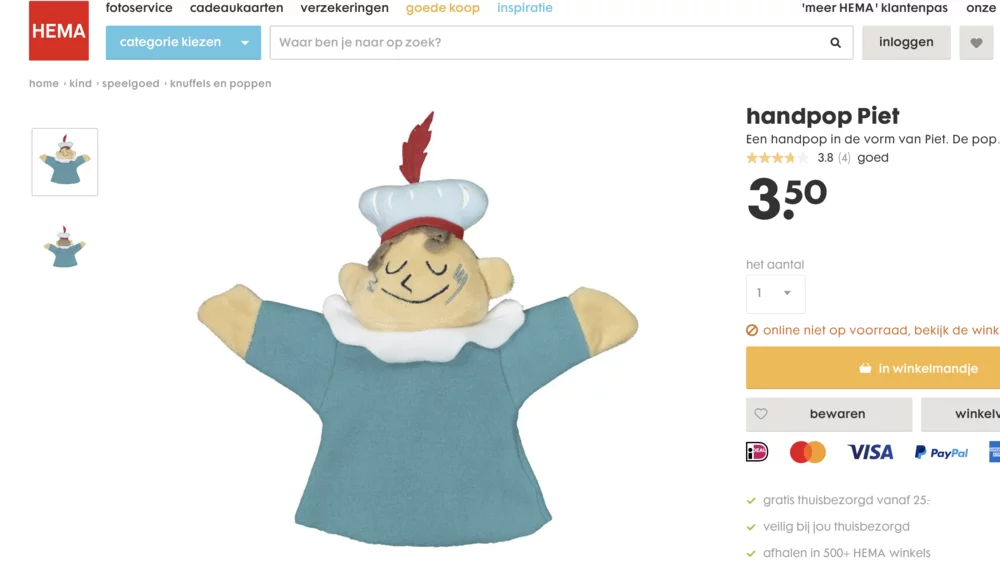
Meanwhile, mainstream discourse on Black Pete has been slowly changing over the years, mostly as a result of the hard work of organizations like Kick out Black Pete. Influential and large Dutch players have for instance set aside the black caricature in favor of a more inclusive and less racialized version, like the soot faced Petes that grace the shelves of HEMA and the RTL TV channel. The latter is especially of importance since it broadcasts the yearly, well-liked show De Club van Sinterklaas (“St Nicholas’ Club”) (Wikipedia, n.d.). More and more cities are, in similar fashion, getting rid of Black Pete in their yearly St Nicholas parades (Goudsmit 2020).
Even the aforementioned Dutch prime minister Mark Rutte has seemingly and surprisingly changed his mind about the tradition. In a debate surrounding the Black Lives Matter protests of last year, he made clear that his former firm stand on the blackness of Pete has altered to more compassion for the discrimination that is felt due to the racial caricature. While he now thus acknowledges a need, and approval of, change in the tradition, he does not think this should be imposed by the government. Instead, he says this should be up to the people, in which he does see a shift and consequently tries to reassure that the change will eventually come.
This too reflects Rutte’s tendency to not be too bold of a leader, as he moreover does not want to admit to the presence of institutional, deeply entrenched racism in The Netherlands. The reason for this? He does not want to antagonize “well-meaning Dutch citizens who would maybe feel that they are called racist" (NOS 2020). While Post, in contrast to Rutte, not only argues that the imagining and reimagining of tradition is, in fact, a political endeavor, it also seems like our prime minister is deeply committed to upholding the façade of “white innocence” that is entrenched in our Dutch society (Wekker 2016).
Back to topConclusion
All in all, there is a need to acknowledge how deeply drenched our society is in racist ideology, inherited from our colonial past. These well-established colonial systems have after all not only determined the distribution of societal power, but they have also laid the groundwork for traditions such as Black Pete. Traditions that, as mentioned, encompass the commodification of (obedient) blackness. I think the rigidity of these old systems are encountered now that more people rally against the caricature of Black Pete and the tradition is slowly being pushed into alteration. I believe the aforementioned tension between continuity and change is felt ever so severely now and I would like to give a tip to people resisting this very change. While tradition is a powerful entity due its undoubted connection with the past (Post 1996, 99), take note from Darwin: the species (or, tradition) that survives is the one that adapts.
Back to top
References
Goudsmit, Robin (2020, November 12). Wordt 2020 het Jaar dat Zwarte Piet de Das Omdoet? Trouw, retrieved from https://www.trouw.nl/
Hills-Collins, Patricia. Black Feminist Thought: Knowledge, Consciousness and the Politics of Empowerment. New York, NY: Routledge, 1990.
Hooks, Bell. “Eating the Other: Desire and Resistance In Black Looks: Race and Representation, 21-39. Boston, MA: South End Press
Yousman, B. (2003). Blackophilia and Blackophobia: White Youth, the Consumption of Rap Music, and White Supremacy.” Communication Theory 13 (4), (2003): 366-391.
Back to top
More from this author
Content ID
Published date