


Review
How BioShock makes you forget you’re playing a game
BioShock's narrative and clever game design fully immerse you into its story. You forget you are playing a game until suddenly the game makes you painfully aware you were never truly in control...

Published date
Courses
Intermediality
Copyright
This work is licensed under a Creative Commons Attribution-NonCommercial 4.0 International License.
Read time
6 minutes

Beware: spoilers ahead!
If there were ever a perfect time to have a minor crisis about whether or not free will exists, this is it. The popular horror first person shooter BioShock will have you feeling so immersed in its experience that by the end you will trust nothing anyone says to you. In Remediation: New Media (1999), Jay David Bolter and Richard Grusin call this type of experience ‘immediacy’, which is defined as a "style of visual representation whose goal is to make the viewer forget the presence of the medium (canvas, photographic film, cinema, and so on) and believe that he is in the presence of the objects of representation" (Bolter & Grusin, 1999, 272-73). BioShock is a good example of immediacy and hypermediacy working together in perfect harmony. You forget you’re playing a game until suddenly the game makes you painfully aware of the fact that you were never truly in control.
When we talk about immediacy we mean that a medium’s purpose is to disappear entirely from our experience, through immersion. Concerning BioShock, I cannot even begin to count the number of times I found myself quietly holding my breath because I was so frightened of what I would find around the next corner. As if I were the person that would be directly confronted with the potential enemies on the other side. I forgot I was actually sitting on my sofa, in the comfort of my own home, with a game controller in my hands. To make the experience even more immersive, and thus more frightening, when you wear headphones you hear the enemies 'behind' you. In this way BioShock creates a multimedial experience where what you hear is as important as what you see.
Back to topThe City of Rapture
The story begins with a plane crash, of which you seem to be the sole survivor. As you make your way to a lighthouse, you start hearing voices, and they are talking about you. “Someone’s coming”, they say. And someone does. It is at this point that you meet your first ally. Atlas, an Irishman who is desperately trying to get to his family, and he needs your help. Throughout the game, Atlas is your guide through Rapture, an underwater city, created by a businessman named Andrew Ryan. This serves as the setting for the game. In short, Ryan was a bit fed up with socialism and decided he could do better. Atlas tells you where to go, what to do and who to kill. Pretty straightforward, really. And so politely too, as he begins all these requests with “Would you kindly?”.
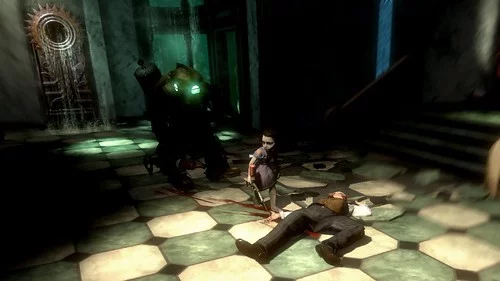
As with any first-person shooter, you have a main goal, which is to find the earlier mentioned Andrew Ryan and take him down. Atlas seems to have a particular dislike for the man, especially when later on in the game Ryan appears to have killed Atlas’ family. You also encounter a few side characters with their own backstories, such as a German woman named Tenenbaum who needs you to protect little sisters, young girls who have been genetically altered and mentally conditioned to collect ADAM (an addictive chemical substance). As well as Sander Cohen (more on him later).
“Is a man not entitled to the sweat of his brow?”
Getting to Ryan is not an easy task as you constantly have to fight off splicers, humans drugged up on ADAM, whose main goal is to kill you at any opportunity.
Back to topWould you kindly?
Things start to take a strange turn when you find recordings that give you more and more information about Rapture and its inhabitants. You learn about a man named Frank Fontaine, Ryan’s direct competitor, and eventually find out that he is actually your good friend Atlas. All this time, “Would you kindly?” was nothing but a code to control you to take down Andrew Ryan, so Fontaine could finally be in charge of Rapture.
Once you have found out that Atlas aka Fontaine has been playing you this whole time, you have your final confrontation with Ryan. He does not try to fight you but simply mocks you and then commands you to kill him. I personally thought this was an interesting turn of events. It could have been anticlimactic, but it suited his character. In the audiologs you find along the way, Ryan seems particularly petty and condescending. What's more petty than using your main enemy's secret weapon (i.e., the character you're playing) against yourself, just to spite them?
“A man chooses, a slave obeys”
The point in the story where it is painfully obvious that perhaps it is not you that is making all the decisions after all, is also the moment that immediacy turns into hypermediacy. Hypermediacy wants to remind you that ultimately, as immersed as you are, you are still dealing with a medium (Bolter & Grusin, 1999). It is the complete opposite of immediacy.
Suddenly it becomes very clear that you were always doing what you were told by pressing the right buttons on your controller. What is interesting about BioShock is that once it is revealed that you have been subjected to mind-control this whole time, you start questioning everything else too. Even the helpful prompts that tell you what buttons to press, like you would find in any other game. Are they truly there to help you or is the game just reminding you that you are a puppet?
The only time you really seem free of Atlas' or Ryan's influence is when you encounter Sander Cohen, a tortured artist who asks you to assassinate his ex-boyfriends. Which, when you think about it, is yet another example of someone asking you to do their bidding. Only perhaps you have been so conditioned to mindlessly do so that you no longer question it. He asks you to help him create his masterpiece, which consists of pictures of his dead exes. When you have nearly collected all the photos, he suddenly has an outburst because he believes you hate his work. In true Sander Cohen fashion, he turns his rage into a performance. As you are fighting off splicers, ‘Waltz of the Flowers’ by Tchaikovsky plays in the background, which completely breaks with the otherwise eerie tone the game has.
Back to topBioShock and clever narrativity
What makes this such a clever game is how it plays with narrativity. You, as a player, decide where you go and what rooms you decide to explore first, but ultimately, you were always meant to follow a certain path, similarly to how a movie follows a script. The story is linear, your choices were never yours. That splicer you killed for loot? You were told to do that. That person you ‘randomly’ talked to? You were told to do that. Nothing is left to chance.
For me, playing BioShock was exciting as much as it was terrifying. Both due to the eerie setting of Rapture and because of the underlying message, which is that perhaps we are all just slaves to a master. The story was so engaging that when I did find out about the mind control, I was genuinely frustrated. I had been helping the wrong guy! How could I not have noticed?
Tenenbaum wants you to save the little sisters from Rapture, Atlas - aka Fontaine - wants you to help him grab power, Andrew Ryan just wants to prove a point and Sander Cohen wants you to help him get back at his exes. Perhaps the latter is the only honest quest you receive.
Back to topReferences
Bolter, J. D., & Grusin, R. (1999). Remediation: Understanding new media. In Journal of the American Society for Information Science (Vol. 50). https://doi.org/10.1002/(sici)1097-4571(1999)50:8<730::aid-asi14>3.0.co…
Back to top
