


Article
Can ancestry tests become a threat to our privacy?
With the increasing popularity of ancestry tests, having our DNA used by big corporations might pose a threat to our privacy. This article analyzes the possible impact of such data-driven businesses on our lives.

Published date
Courses
The private life in a digital world
Copyright
This work is licensed under a Creative Commons Attribution-NonCommercial 4.0 International License.
Read time
10 minutes

As our technology advances and we move further into the digitalization of our everyday lives so does the medical system. In recent years, the medical system has also joined the domain of Oonline. From receiving your blood results on the e-mail to being a part of online medical websites such as the Dutch mijngezondheid.net, the medical system moved online in hope is to make it easier for patients and personnel to access data about patients.
One such example of a new type of online medical websites is the rise of the Ancestry sites that tell you where you come from. By just singing up, the client then can send his blood or usually a saliva sample to be further checked for his/her ancestry. After the results come, no one knows how or whether the DNA results are stored. In this paper I will analyze the risk of such companies that might pose to people’s privacy and wellbeing.
Back to topAncestry tests: How do they work?
With the recent hype over finding out one’s ancestry, a lot of companies emerged, especially in the U.S. One such company is ancestry.com. Advertised under the ”Discover the family story your DNA can tell” slogan, order a kit where have to give a sample of saliva that needs to be sent for analysis. After that, will receive the results and that’s it, as simple as that.
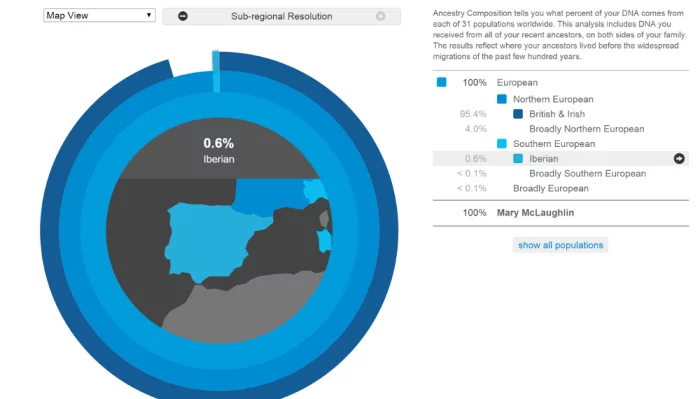
Ancestry.com is just one out of many sites that promise to do this. There are plenty other options such as 23andme.com or myheritage.com. But how safe are these tests? Of course, there has already been discussion going on about how accurate these tests are, but the problem I would like to stress in this paper is concerning privacy. After the person receives the results, in the form of percentages, we do not know how the data is being stored, and what might happen to it afterwards.
It is all about individuality
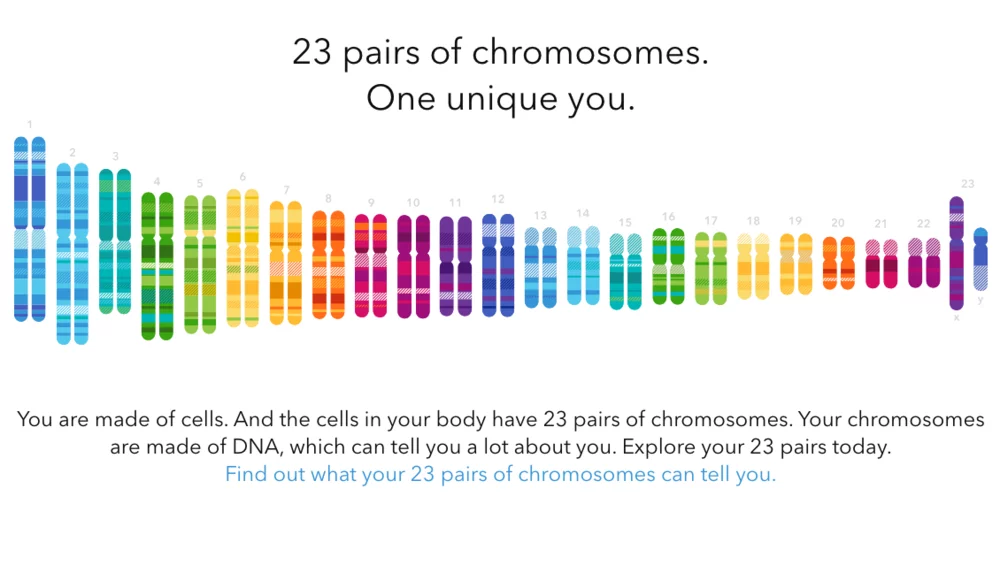
Whilst stumbling upon the ads of such companies one can not escape the heavy focus that theput on the individuality and identity. It is promoted as something you should definitely do in order to find out more about yourself. This is something that will reveal how unique one is. For instance, in the advertisements of 23andme, they put the emphasis that our DNA can tell a lot about ourselves. The slogan "Explore your 23 pairs today" definitely invites people to do this test in order to discover themselves. Even the direct address of "you" puts the accent on the individual.
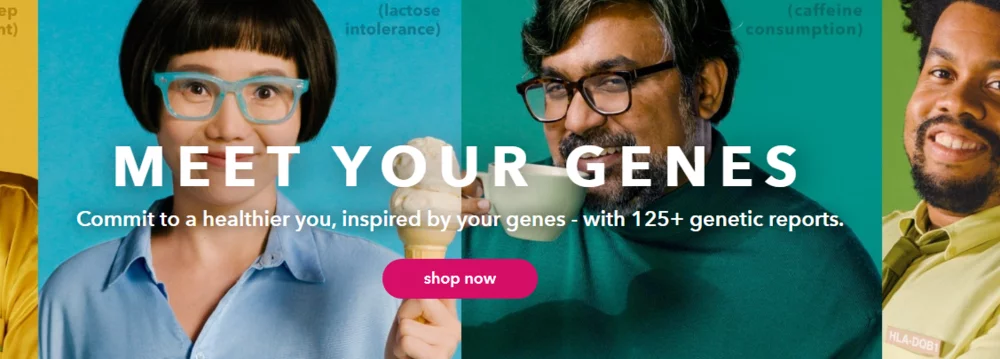
The slogan of Ancestry.com which I mentioned already is not any different from the one of 23andme.com. "Discover the family story YOUR DNA can tell" has the similar individual approach that stresses the importance of analyzing our DNA. The DNA can tell you things that you never knew about yourself and your family. Another slogan from the same company, "Meet your genes, commit to a healthier you" has the similar invitation feeling, that one has to do a DNA test in order to take care of their health, thus individuality and Foucaldian "the care of the self" are at the core of this industry's agenda.
Back to top
Is there any privacy in the digital era?
Before moving on to talking about the risks such companies can pose to our privacy first of all I will discuss about privacy in the digital era. Does such thing even exist? With companies such as Facebook and Google and post-Snowden revelations everyone knows that we are tracked in a way or another when we are online.
Privacy first of all is regarded as a "right or civil liberty associated with being a free person." (Lyon,2015). According to boyd, we have moved into an era of “public by default, private through effort.” (boyd, 2010).This means that it is very hard to keep information private and very easy to have something made public. This however, does not mean that privacy is dead, as explains, "privacy is not dead, but privacy is about having control over the information flows." (boyd, 2010) As long as we are in control of our data and the things that happen to it we can take care of our privacy.
After we gave our DNA and received the tests, what happens to our DNA sample and our results?
In the case of the DNA analysis people cannot have 100% control over their data. It can be sold, hacked, or made public by accident. This raises questions regarding the safety of such tests. People still care about their privacy and the idea of having your DNA stored and then sold does not sound so appealing. In the recent years, several criminals were caught because matching DNA from relatives was found in a genetic database, making it extremely easy to find them. One of the persons that used ancestryDNA stated "It makes me a little nervous, not in the sense that this technology is being used to stop violent criminals, but whether law enforcement will know when to stop”. (Rodriguez, 2018).
We have heard this rhetoric for a long time already. With the implementation of CCTV everywhere we have moved in an era of surveillance capitalism where it seems that the only way to stop crimes is to lose our privacy.
"These externalized ‘historical bodies’ (referring to our digital traces) take on many textual and material forms including stored CCTV footage, government records, and databases held by tele-com companies of all of our phone calls and the physical locations that have been logged by our phones’ GPS systems." (Jones, 2017).
Adding our DNA to this recipe and we are the perfectly traceable subject. Popularizing such DNA tests means that a lot of people will voluntarily give their DNA, so the governments do not even have to ask for it anymore. If your DNA will be used to trace down a relative that committed a crime you are definitely not going to be asked if you are ok with it or not.
Back to topPrivacy issues regarding DNA tests
After we gave our DNA and received the tests what happens to our DNA sample and our results? Where do these get stored? Do they actually get stored or will they be used in the future for other purposes? These are the questions that we need to ask. We can't tell who does the data belong to, as many companies might make deals to share their data.
We already are aware of the fact that self-tracking apps that monitor people’s health habits might influence the price of the health insurances that consumers pay. If the companies see that we smoke, the prices might go higher. But what if the same can be said about the DNA tests? They can simply be used to raise the prices of health insurances. For example, most of these DNA tests also give insight into the possible diseases one might get in the future. If health insurance companies will buy this data then it is easy for them to target personalized health insurance offers where for instance, a person that is prone to get a heart disease might have increased heart care prices.
In an article posted on the Irish Times, Karlin Lilington, a journalist known for her focus on technology, made a statement:"Do not buy online DNA ancestry tests. You are the real product." (Lilington, 2018). As Karlin puts it:
The data we produce is thus very valuable for big companies.
Think about the services we get from big companies such as Google and Facebook. It all comes to a price, and this price is our privacy. Numerous scandals where Facebook was involved raised questions whether our privacy is violated or not by the SNS. It is well known that our data collected from Facebook and Google is sold, thus the users provide a sort of labor to Facebook, for which they do not get paid, but are just offered their services of Social Media in return.
In the case of the DNA tests, the client pays for this service in exchange of the results. However, because the data is being kept this does not mean that these companies cannot adopt the same business tactics as giants like Google. So not only do people pay to have a DNA test but this might also violate their rights.
Back to topDNA as data
By checking ancestry.com terms and conditions it is stated that ancestry.com "does not claim any ownership rights in the DNA submitted for testing" but by submitting a sample you effectively "grant AncestryDNA ... a royalty-free, worldwide, sublicensable, transferable license to host, transfer, process, analyze, distribute, and communicate your Genetic Information for the purposes of providing you products and services." As they claim that the DNA is used only to provide services to the client, we still do not know how does this company decide what to do with this data? Can it be deleted upon request for example? And even so, if it is just stored, that still means it can be hacked and then used in the disadvantage of the people. "Now that even our DNA is being digitized and stored in the infinite online filing cabinet of the World Wide Web, we must confront a reality in which our own genetic makeup can be hacked, stolen or used against us." (Ryan,2019).Any stored data, especially medical data is at risk of being misused.
The problem seems to be that our DNA becomes data. When it becomes data this means that it can be sold, manipulated, hacked and used against us. There is a strong discussion about datafication and dataism, two ideologies that praise the objectivity of data, Datafication simply put is a technological trend that turns many aspects of our lives into data. Dataism, on the other hand, is a mindset that praises big data and how information flows represent the new revolution in our society.
problem wis that they ignore the fact that data collected about a person depersonalizes the person whose data belongs to because it is so "objective" (as they claim) that it is forgotten that this data actually belongs to a real human, and not a machine. Because data makes something look not personal, the idea that data is objective is used as an excuse to sell data. According to Van Dijck, "the ideology of dataism shows characteristics of a widespread belief in the objective quantification and potential tracking of all kinds of human behavior and sociality through online media technologies." (van Dijck, 2014).
In the case of DNA tests the data is regarded in the same manner. However, as I have mentioned earlier there is a strong accent on the INDIVIDUALITY, these results are very different from other people's results which means that because they are so unique it is very easy to find out who they belong to. It is even worse than in the case of having your likes and comments stored by Facebook.
Back to topConclusions
It seems that ancestry sites that analyse people’s DNA can majorly become a risk to people’s privacy in the future. They are marketed as a way of discovering yourself and your past, but behind these nice slogans the risk of our DNA falling into the wrong hands is there. The medical data needs to be more protected because if it is hacked, sold or misused it can heavily endanger one’s wellbeing.
It is more severe than having our likes stored by Facebook. If information about our DNA is sold to the health insurance companies our basic rights, including rights to healthcare, might be at stake. As this article’s aim was to raise awareness and contribute to the already existing discussion on this topic there are no stable conclusions regarding the safety of these services. Further research needs to be done in order to guarantee their credibility.
Back to topReferences
boyd,D. (2010). Privacy, publicity, and visibility. Microsoft Tech Fest. Redmond, March 4.
Jones.R.H.(2017). Surveillant landscapes. Linguistic Landscape 3 (2), 149-186.
Lyon, D. (2015). Surveillance after Snowden. Cambridge: Polity.
Lillington, K. (2018). Don't buy online DNA ancestry tests. You are the real product. Retrieved from https://www.irishtimes.com/business/technology/don-t-buy-online-dna-anc…
Rodriguez, M. (2018). You Discovered Your Genetic History. Is It Worth the Privacy Risk? Retrieved from http://fortune.com/2018/09/10/genetic-history-test-privacy-risk/
Ryan, J. (2019). What AncestryDNA taught me about DNA, privacy and the complex world of genetic testing. Retrieved from https://www.cnet.com/news/ancestrydna-taught-me-about-my-dna-privacy-an…
van Dijck, J. (2014). Datafication, dataism and dataveillance: Big Data between scientific paradigm and ideology. Surveillance & Society 12(2), 197-208.
Back to top

