


Article
The Adult in Leo and Layla's History Adventures
This article discusses the conservative image of children presented in the animated show Leo and Leyla's History Adventures.

Published date
Courses
Media Interventions
Copyright
This work is licensed under a Creative Commons Attribution-NonCommercial 4.0 International License.
Read time
19 minutes

On this page
- The adult hiding in his media
- ''''Some creators are very upfront about their ideas of what society should be like, which makes their child characters an explicit extension of their ideas''
- Fighting woke entertainment
- The lesson of the day
- ''''''Leo and Layla can no longer be vaguely linked to the creator’s opinions but become a direct display of PragerU’s conservative view of children''
- The visible adult
- Positive association over negative factsThis makes the episode a media intervention because it is part of the nonprofit’s media strategy to spread conservative ideas throughout society.
- Conclusion
- References
‘’I have a holiday?! Caramba, I should. I worked so hard to get to this point, what I just accomplished was insane’’, says an animated Christopher Columbus when asked to reflect on his journeys. The moment is part of Leo and Leyla’s History Adventures, an educational children’s show created by the conservative nonprofit PragerU. In 2021, the organization created PragerU Kids, a subdivision that offers children’s programming that espouses conservative ideas. Or, as its website states: ‘’What has happened to American schools and children’s entertainment? Woke agendas are infiltrating classrooms, culture, and social media. Is there anywhere that’s still safe for our children? Yes! It’s called PragerU Kids’’ (PragerU 2023).
Scholars Casie Hermansson and Janet Zepernik write that children’s entertainment finds itself in a weird spot, being defined by its target audience while not being made by them (Hermansson and Zepernick 2019, 1-2). Different adults have different ideas of what children are and what content suits them. Literature scholar Perry Nobelman writes that children’s stories betray what adults think children are like by how kids are portrayed (Nobelman 2016, 267). For Nobelman, each children’s story features a hidden adult, the adult’s idea of what a child is, which is made visible by how children are portrayed. Yet, is the adult always hidden? Given that organizations such as PragerU have a clear political purpose, is the adult still hidden if his ideas are explicitly connected to the content? And what image of children is being depicted in Leo and Leyla’s History Adventures? In the following paper, I will discuss these questions by analyzing an episode of Leo and Leyla’s History Adventures titled Leo and Leyla Meet Christopher Columbus, in which the titular children travel back in time to clear up their confusion surrounding Columbus Day.
Back to topThe adult hiding in his media
Children's entertainment, whether books, films or television shows, refers to a broad range of media that spans across several genres and technologies. According to scholars Casie Hermansson and Janet Zepernick, these media share several important characteristics, such as that they are produced by adults for a younger audience (Hermansson and Zepernick 2019, 1-2). For literature scholar Perry Nodelman, the difference between the creators and their target audience leads to the presence of the hidden adult, the creator who is present in children's media through his depictions of child characters (Nobelman 2008 referenced in Hermansson and Zepernick 2019, 9). Nodelman notes how, as children cannot produce media themselves, they rely on adults to do it for them (Nodelman 2016, 267). However, because they are not part of their target audience, adults make assumptions of what children are like (ibid). This in turn results in the author constructing an idea of what Nodelman terms ''acceptable childlikeness'', the creator's assumption of how children act, or should act. (ibid).
Yet authors and other creators do not exist in a vacuum. What specific subjects are discussed, what lessons are taught, and even how a child is supposed to act depends on what ideas circulate at any time and place. Within a Western, or more specifically the American context, media scholar Kirsten Drotner writes that children's media portrays childhood as an innocent period, wherein mostly white, middle-class children are taught how to behave within a particular society (ibid). Drotner writes that as authors and other creators insert their own ideas of what kids are inside their media, an image of the average child is created (Drotner 2013, 16). Portrayals of childhood that deviate from this norm are seen as undesirable or resisted by parents and organizations that wish to hang onto dominant narratives about what children should be like(ibid).
This may cause certain parties (such as parents, religious organizations, and broadcasting networks) to voice their outrage. This outrage might even lead to resistance, as concerned parties publish their own media to counter other narratives (Drotner 2013, 19). The last option would fall under what Kevin Howley terms media interventions, using media to acquire power for "strategic and tactical action" (Howley 2013). Parents and concerned organizations can use media to spread their outrage or defend ideas they think are being challenged, but the question is this: is the hidden adult still hidden in such
Back to top''''Some creators are very upfront about their ideas of what society should be like, which makes their child characters an explicit extension of their ideas''
This all leads to a situation wherein most children’s media depictions of kids are a combination of an author’s ideas about childhood and what society thinks children should be like. This means that narratives never depict actual children, but that portrayals are biased versions of them. Because of this, stories that are about children also feature the writer, in the sense that his ideas of children are on display. Nobelman terms this presence of the author the ‘’hidden adult’’, the adult who exists in the background of the narrative and can be perceived by noticing how the children are written (Nobelman 2008 referenced in Hermansson and Zepernick 2019, 9).
et, I do not think this adult is always hidden. Let’s say a group of people were to disagree with how kids are seen in most children’s media. This may cause certain parties (such as parents, religious organizations, and broadcasting networks) to voice their outrage. This outrage might even lead to resistance, as concerned parties publish their own media to counter other narratives (Drotner 2013, 19). The last option would fall under what Kevin Howley terms media interventions, using media to acquire power for ‘’strategic and tactical action’’ (Howley 2013). Parents and concerned organizations can use the media to spread their outrage or defend ideas they think are being challenged, but the question is: what happens to the hidden adult?
Is the adult still hidden when the author’s ideas of what a child is, no longer have to be inferred from a text, but is instead a reflection the author's ideology? The term ‘’hidden adult’’ brings with it an idea of implicitness, as if his ideas about acceptable childlikeness are only present in the background of a text. Yet, some creators are very upfront about their ideas of what society should be like, which makes child characters an explicit extension of their ideas. Would it not then mean that the adult who created the narrative is simply present, loudly stating his ideas of acceptable childlikeness for all to see?
Fighting woke entertainment
One such organization that loudly exposes its ideology is the right-wing nonprofit PragerU. PragerU (short for Prager University) was founded in 2009 by conservative radio host Dennis Prager. Despite its name, PragerU is not an actual university but instead, a media platform that hosts content to offerfor the purpose of offering "a free alternative to the dominant left-wing ideology in culture, media, and education" (PragerU 2023). The organization offers a variety of shows, magazines and opinion pieces aimed at spreading conservative values to people of various ages(ibid; Prageru 2022, 8-9). The nonprofit organization is not without controversy. Francesca Tripodi writes that PragerU has hosted several commentators, such as Milo Yiannopoulos, Paul Joseph Watson and Stefan Molyneux, that are associated with the alt-right and thus may serve as a gateway to extreme forms of conservatism via algorithmic suggestions: "(...)their choice of guests and underlying messaging demonstrates how this cross-promotion of ideas and influencers creates both an algorithmic and cultural connection between conservative ideology and “alt-right” terminology" (Tripodi 2017, 33, 36, 47). In 2021, PragerU launched PragerU Kids, a subdivision entirely dedicated to providing children’s books, magazines and shows (PragerU 2022, 12; 2023). According to the organization PragerU Kids’s goal is to provide children with conservative entertainment in order to combat ’woke agendas’’ (PragerU 2023).
In my analysis I will take a closer look at an episode of one particular Children's show titled Leo and Layla’s History Adventures. Each episode of the animated show focuses on the titular Leo and Layla, two young siblings who travel back in time to learn about historical figures. Each episode discusses a different person. The episode in question, Leo and Layla Meet Christopher Columbus, centers around Christopher Columbus, and the controversies surrounding Columbus Day (PragerU 2022). In the following I will discuss the link between PragerU’s conservative ideology and their portrayal of children,
after which I posit that the episode functions as a media intervention to steer children toward conservative views of American holidays. My analysis will be conducted along the lines of what Gunter Kress calls a multimodal discourse analysis, a method by which I will look at what the combination of the episode’s visuals, audio, and spoken text communicates to the viewer, as well as look at the episode’s social context (Kress 2012, 36). I will pay specific attention to the ways in which the hidden adult does not even pretend to hide I will also interpret the episode’s overall message and what societal change it attempts to accomplish.
Back to topThe lesson of the day
The episode starts with Leo and Layla reading up on Columbus Day because their teachers couldn’t agree on whether to celebrate Columbus’s arrival in the "New World". the websites Leo visits give different accounts of Columbus, with some calling him a "mean guy who spread, slavery, violence and disease" while another site called him "a really courageous guy who loved exploring, inspired generations and spread Christianity and western civilization." The confused kids decide to use their time-traveling abilities to go back to the year 1493 and ask Columbus about his journeys.
Back to top''''''Leo and Layla can no longer be vaguely linked to the creator’s opinions but become a direct display of PragerU’s conservative view of children''
The show follows the pattern of other children’s media. First off, Tthe show was made for children, to teachwith the purpose of teaching them about the society in which they live (Hermansson and Zepernick 2019). In this case, a society that celebrates Columbus Day, but in which the celebratory nature of this holiday is being debated. Leo and Layla are confused by the conflicting opinions about Christopher Columbus and are looking to clear up their confusion. Like other children’s media, the show attempts to give context to the society and culture children live in (ibid). As such, this particular episode is closely tied to the country in which it was made. I admit that these are not earth-shattering observations, but it is important to establish the educational purpose of the episode considering its conservative message. The episode is an example of adults creating content for children, with the explicit purpose of educating them about the society in which they live.
Back to topThe visible adult
Like other children’s shows, Leo and Layla’s History Adventures was made by adults for children, thus the episode features an adult’s idea of what children are or should be.that,qou This idea shines through in the character’s visual designs, traits and attitudes. When these features are placed in the context of PragerU’s overall goals, the hidden adult is no longer hidden but becomes an adult whose ideas about children are clearly visible.
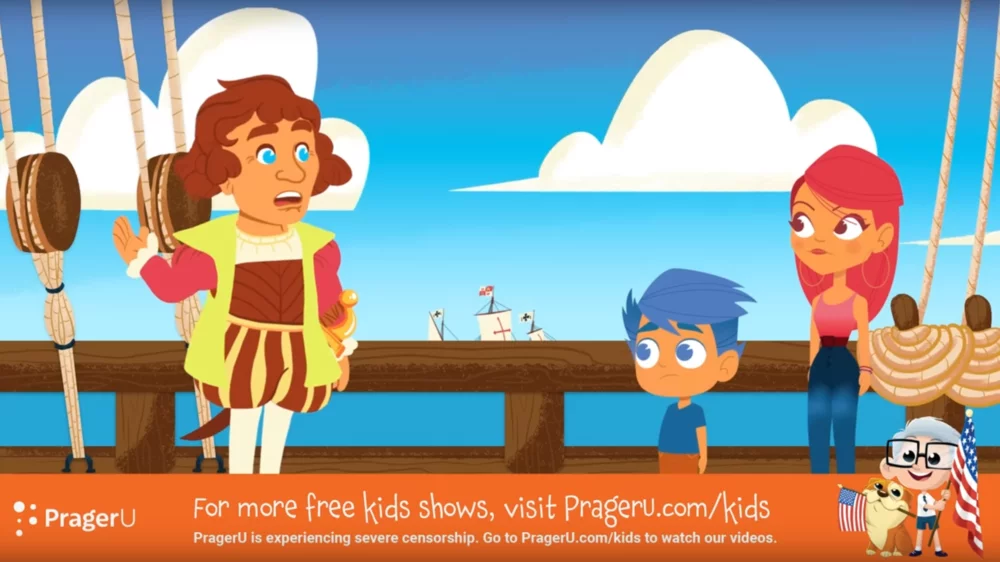
Leo and Layla display the adult creator’s idea of what children should be like. To start with, Leo and Layla fit traditional ideas about gender. Leo wears a T-shirt, has his short hair slid to the right, and wears shorts and sneakers. Meanwhile, Layla has long hair and wears a pink top, earrings, make-up, and tightly-fit jeans. This makes the characters fit a conventional standard of how children should dress according to their gender. these character designsreinforceown ,
Furthermore, both children are shown to be , able to do their own reseaand are curious about the world around them as shown in the opening scene in which they discuss the several interpretations of Columbus's actions. Yet, they find it difficult to make up their own minds, as becomes clear when they 'tfind the different opinions on Columbus confusing.
In this way, the hidden adults of PragerU become visible through Leo and Layla. Through their display of gender stereotypes and their curious nature, they display what PragerU might see as emblems of "acceptable childlikeness" (Nodelman 2016, 267).
ahistoric of the positive traits
stopembrace
thatwhat figurescelebratewillChritopherCoumbus, thatof
Back to topButhis,
CoumbusatHowever, the show's creators are no longer hidden once Leo and Layla are placed within the context of PragerU’s goals. Once you consider that the purpose of PragerU Kids is to combat the perceived "woke agendas" in schools, Leo and Layla can no longer be vaguely linked to the creator’s opinions, but becomes a direct display of PragerU’s conservative view of children. For PragerU, children areqou,day
gender-conforming, curious young people that should not be exposed to opinions that question American traditions because it might confuse them. Their confusion can be tied to the woke left-wing agendas PragerU says it's resisting.
Whereas the hidden adult’s perception of childlikeness needs to be inferred from how children are portrayed, PragerU’s Leo and Layla can be directly tied to the organization’s conservative views. Leo and Layla fit into gender norms and are curious, but are also confused by conflicting visions on the celebratory status of Columbus Day. With this, the organization communicates its view on children both in an implicit and explicit sense. Leo and Layla's History Adventures shows PragerU’s ideas of acceptable childlikeness, while also being a display of the organization’s conservative views. for
Positive association over negative factsThis makes the episode a media intervention because it is part of the nonprofit’s media strategy to spread conservative ideas throughout society.
Upon talking to Leo and Layla, Columbus explains that he did commit violent acts against Native Americans and was involved in the slavery of indigenous peoples, but he emphasizes that ‘’the natives were far from peaceful.’’ Columbus then goes on to state that such acts were normal in the 15th century. This information adds a degree of nuance to the figure of Columbus. The episode states the impossibility of viewing Columbus in an entirely positive light. It directly responds to the earlier stated readings of Columbus as either a thieving murderer or a paragon of Western civilization by stating that Columbus could be violent when he though he needed to. However, the episode then concludes with Columbus stating that if people want to celebrate the guts he displayed in searching new trade routes, they should do so. Leyla responds to this message with ‘’I guess you’re right’’, after which the kids travel back to their own time.
This shifts the focus of the episode from raising questions about the celebrated status of Columbus to a celebration of Columbus despite his violent acts, while these acts are exactly the problem for those questioning the holiday’s status. PragerU seems to argue that traditions may be questioned, venerration of historical figures can even be more nuanced, but traditions should not be changed. The celebration of controversial historical figures should continue, because of the positive traits society connects to that figure. Historical atrocities do not matter. By leaving the audience with this message, PragerU has attempted a media intervention. They used the show as a means of strategic and tactical action (Howley 2013). As PragerU states to be a substitute for supposedly left-leaning education and entertainment, Leo and Layla Meet Christopher Columbus can be considered part of a larger strategy to popularize conservative ideas within society.
The episode teaches children to not question the validity of American holidays based on factual information, but instead accept these holidays because of what society associates them with. When this message is placed in the context of PragerU’s goals, it is part of the organization’s media campaign in their battle against the ‘’woke agendas’’ they deem such a threat. As an educational children’s show, Leo and Layla Meet Christopher Columbus attempts to intervene in the debate surrounding Columbus Day. The episode, and by extension its creators, argue that children can be curious about historical figures, but young people should not change how these figures are seen. Rather, they should take factual information about violence and slavery into account, but ultimately discard it in favor of adherence to the status quo.
Back to topConclusion
In summary, the episode Leo and Layla Meet Christopher Columbus of the children’s show Leo and Layla’s History Adventures is an example of children’s media in which the hidden adult is no longer hidden. Although the creator’s ideas of acceptable childlikeness can be inferred from the gender-conforming, curious, easily confused and conservative ideas in the portrayal of Leo and Layla, the episode’s creators shine when considering PragerU’s branding as a conservative media organization. Suddenly, instead of hiding, the adult creators are in full view. The episode espouses a conservative position on the ideas of acceptable childlikeness and what children should think about holidays based on controversial historical figures. When placed in the context of PragerU’s intention to battle the ‘’woke agenda’’, the episode becomes part of a media intervention aimed at popularizing conservative opinions. For PragerU, children are allowed to question the worship of historical figures. Yet, children should still accept this veneration, while ignoring the unpleasant factual history associated with them.
Back to topReferences
Drotner, K. (2013). “The Co-Construction of Media and Childhood.” In The Routledge International Handbook of Children, Adolescents and Media. Routledge.
Hermansson, C., Zepernick, J. (2019). Children’s Film and Television: Contexts and New Directions. In: Hermansson, C., Zepernick, J. (eds) The Palgrave Handbook of Children's Film and Television. Palgrave Macmillan, Cham.
Kress, G. (2009). Multimodal discourse analysis. In: Gee, J.P., & Handford, M. (Eds). (2012). The Routledge Handbook of Discourse Analysis (pp. 35-50). Routledge.
Nodelman, P. (2016). The hidden child in the hidden adult. Jeunesse, 8(1), 266–277.
PragerU. (Production Company). (2021-present). Leo And Leyla’s History Adventures [Internet Series]. PragerU Kids.
PragerU Kids. (2022, October 7th). Leo and Leyla Meet Christopher Columbus [Video]. YouTube. Last visited oApril 5th, 2023. https://youtu.be/ux54IJ06uHg
PragerU. (2022). Annual Report 2022. PragerU. Last visited April 5th 2023. https://www.prageru.com/pdfs/prageru-2022-annual-report.pdf.
PragerU. (2023). ‘’What is PragerU?’’. PragerU. Last visited, April 5th, 2023. https://www.prageru.com/about.
PragerU. (2023). ‘’About PragerU Kids’’. PragerU. Last visited April 5th, 2023. https://www.prageru.com/kids.
Back to top

