

Article
The Army for Trump and Trump’s war against Sleepy Joe
Trump's 2020 election campaign is adopting war metaphors in an attempt at big organizing aiming to create an "army" of supporters. These efforts are supported by a masterful use of the hybrid media system against Joe Biden's most moderate campaign.
Published date
Copyright
This work is licensed under a Creative Commons Attribution-NonCommercial 4.0 International License.
Read time
13 minutes

The Trump campaign has adopted the language of war. Not only does Trump accuse Biden and the Democrats of destroying America, the campaign is organizing itself as an army controlled by his campaign team that goes on the name of Trump War Room on Twitter.
Back to topPresidential debates in a hybrid media system
Most commentators writing about the first debate between Trump and Biden looked at what happened on stage. And most of them saw an alpha male interrupting a well-mannered Biden who struggled to find his place in the battle on stage. Less attention has been directed to what happened online, as if that is a completely different sphere.
It is not. Research teaches us that people not only watch the debates (Chadwick, e.a. 2017). They also scroll through hashtags to make up their mind about the debate itself. Dual screening as it is called, has impact. Social media open up a window of opportunity for campaign teams to correct mistakes of their candidate or to highlight the ones of the opponent. Especially in a chaotic debate like this one, social media allow campaign managers to create coherence, to extract the good bits, and show their candidate in a new way.
Whereas the Trump team uses social media to create a Trump talking coherently on the issues and release new campaign materials, Biden’s team tries to create a fluent Biden making a strong point. People who were dual screening during the first debate and followed the Twitter-accounts of the two protagonists saw a different debate than the ones only looking at the debate.
Back to topBeefing up sleepy Joe
On Twitter Biden’s campaign team tried to give the usual understatedness of their candidate some extra panache. The Twitter posts that were released during the debate show a Biden that is attacking Trump. On Twitter, Biden is framing Trump as responsible for the many COVID-19 deaths in the US, as not distancing himself from white supremacists, as not willing to show his tax returns, as a president who breaks the law and creates disorder and as a president willing to cut social security in times of a pandemic.
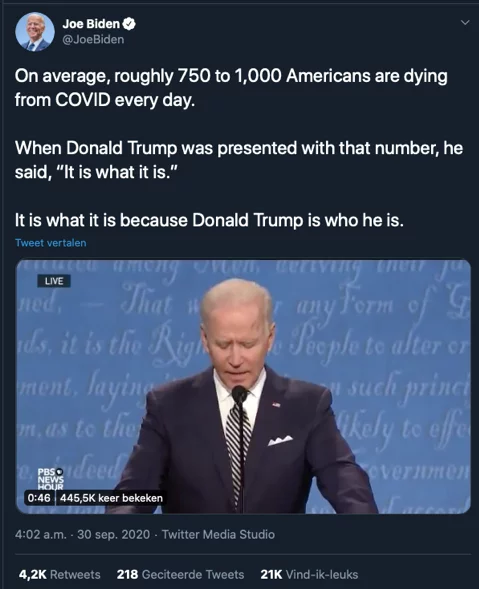
The Biden on Twitter is (a bit) better than the Biden we saw on stage. Biden’s slow talking, losing himself in details and struggling to find his words, is somewhat beefed up online. His discourse is repackaged by his team. But in the end, they have to work with what is there. For instance, his meandering talk on Trump’s disastrous COVID-19 policies is remediatized. The result is not a short pointy clip of one-liners, but a 46-second meandering clip accompanied by one short status that frames Trump as an egoistic self-centered man who doesn’t care for his people. Not much new material is released and most of the Twitter content extracts from the debate.
Even though Biden sounds and looks more to the point on Twitter, there is not so much discrepancy between studio Biden and Twitter Biden. Biden’s message is one of decency and knowledgeable and amiable boringness. He seems to know what he is talking about, but lacks charisma and a powerful and decisive appearence. At his best, Biden comes across as moderate, decent and somewhat presidential – especially compared to Trump – but also as slow, non-dynamic, and old. What is remarkable is that not one post on Biden’s page uses a hashtag and only one tweet tags Donald Trump. It is as if team Joe doesn’t want to expand his reach to attract non-followers.
Back to topBiden and the radical left as the enemy within
Trump’s Twitter wall looked entirely different. His campaign was clearly prepared to boost Trump’s performance on stage. Most posts used the hashtag #debates2020 and supported or expanded his interventions on stage. His team not only posted excerpts of the debate but all kinds of videos that support Trumps outrageous claims on stage. Just like on stage, the stream of communication of the Trump team was massive. ‘Fact checks’ on Biden, campaign clips that frame Biden and his son as corrupt and clips that show how disastrous Biden would be for the economy. Videos of Biden saying that we shouldn’t panic about the Corona virus and regular ‘Clinton-voters’ saying they do not trust Biden.
The Trump campaign has a strategy for the full hybrid media system (Chadwick, 2017) and uses the affordances of that system to the full extent. People looking at those clips while Biden grinned on stage when Trump made another hyperbolic claim, saw a different Biden. A Biden laughing away serious allegations.
Whereas Biden mostly talked about Trump, Trump combined negative messaging (Lempert & Silverstein, 2012) about Biden, with new campaign clips that stress what he has accomplished. Just like in 2016 (Maly, 2016), Trump is presenting himself as the savior of ‘national greatness’, as the one who has brought all the jobs back and created the reatest economy the world has ever seen’. The reason they attack me’, he says in a newly released campaign clip, ‘is because I fight for you’. That is his brand.
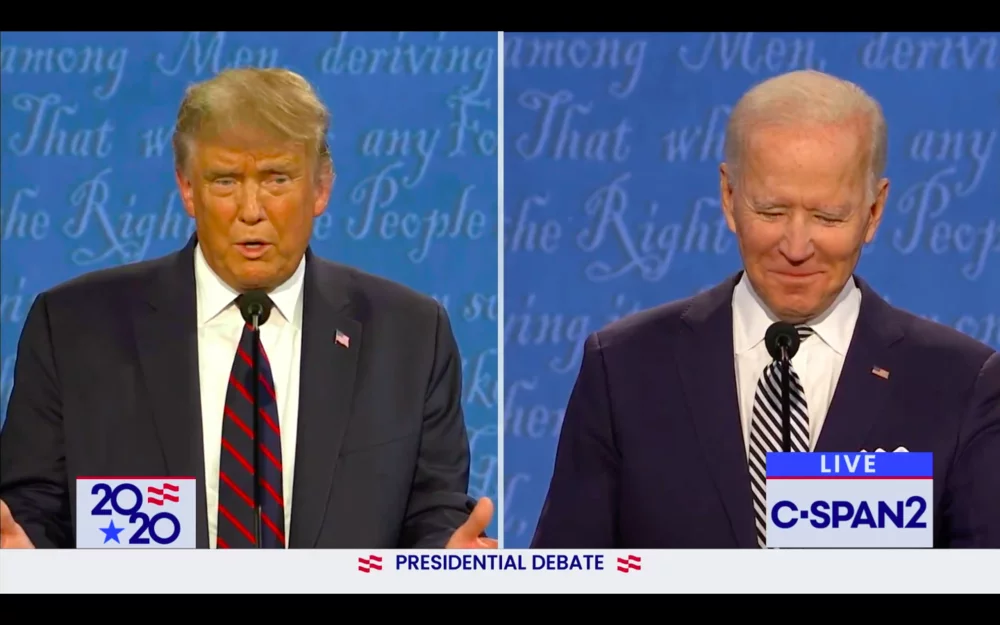
Trump's message is about fighting the cosmopolitan elite that looks down on the regular people, that laughs at them. Trump literally presents himself not only as the guy fighting for the common man, but as the embodiment of America. Each smile or smirk of Biden when Trump was saying something outrageous re-enforces this image of the superior feeling of the elite looking down at teh common man.
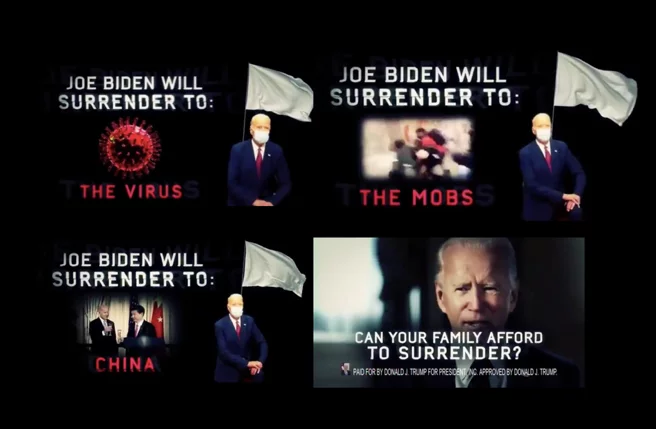
What is most remarkable, is how Biden’s Sleepy Joe image that Trump has created is now presented in a very different context. Biden is presented as a full blown and dangerous enemy of the American people. Sleepy Joe is now framed as an extremely dangerous man because of his weakness. The soft speaking man, the man searching for his words and his nuances, the man caring for the health of the Americans and following the advice of the virologists is now recreated into a man ready to surrender, not willing to fight. Surrendering to Black Lives Matter, Antifa, the radical left, comrades Sanders and AOC, COVID-19, and China.
The dominant frame in the staged debate and on Trump’s wall is that of Trump as a true alpha male fighting for America with everything he has got. In contrast, Biden is the weak beta male who will destroy the great America that Trump has built. Biden is presented as an enemy within. In two freshly released Twitter Video’s the supporters of Biden are framed as rioters and Biden as kneeling for them. The tone and images of the videos are threatening: they show an apocalyptic America full of violence, fire, burned out buildings and harassment and violence against the police. They show a world of anarchy and the approval and surrender of Biden. Biden’s message is turned into a dystopia.
Back to topTrump’s War Room
Biden tries to come across as moderate and presidential. He tries to present himself as the decent alternative for Trump. The harshest thing he said about Trump during the debate was that he was a clown. Of course, Biden’s position is supported by four years of negative mainstream media about Trump and the many different Republican against Trump ads who have done the negative messaging about Trump for him. builds on a large consensus, question is how many republicans who voted for Trump in 2016 do share this opinion in 2020.
Trump speaks a different language, the language of war. He plays in a different field. His campaign team creates a clear dichotomy: Trump stands for an America of hope. A strong Amercia with a thriving economy full of happy people. This America is under threat. COVID-19, China, Antifa and the liberal mob are said to to destroy this great nation and Biden’s weak stance will help to destroy it. This may all be seen as completely out of proportion, but that would be underestimate the feeling of despair that is now present in the American air.
Covid-19 not only generates fear of collapse and economic disaster or the falling apart of the great American empire, it also quarantines people. Many now see the world anno 2020 in the US through their (digital) media. On their screens and in their wallets that world looks grim. Especially so if you look through the eyes of FOX news, Trump’s influence network or even worse, through the eyes of QAnon as many of his supporters do. Then you believe in an America under siege, in a deep state trying to stop the president. And that was exactly what Trump said during the debate. 'There was never a peaceful transition of power when I won the election' he said:
‘If you look at crooked Hillary Clinton, if you look at all the different people. There was no transition, because they came after me trying to do a coup. They came after me spying on my campaign. They started from the day I won and even before I won. From the day I came down the escalator with our first lady. They were a disaster, a disgrace to our country. And we have caught them, we have caught them all. We have it all on tape.’(CNN, video 7: 2:00 – 3:16)
In such quotes, the name of Trump’s campaign team on Twitter - Trump’s War Room - gets an extra meaning. Whereas Biden’s campaign is run by the amaible ‘Team Joe’ on Twitter, the Trump campaign sees itself as in the midst of a war. The contrast couldn’t be bigger. This war metaphor is not only visible there, it is at the heart of his campaign. Trump is not campaigning, he is a president fighting a war. A war against the liberal elites and behind them the radical left. They are seen and portrayed as the ones willing to bend the law to get Trump out of the White house. As the ones staging a coupe and as the ones willing to defund the police, open up the borders and allow the rioting and thus crumbling down of America.
Back to topEnlist today in the Army for Trump
The idea of the rigged election was a key topic in Trump’s 2016 campaign and it has an even more central place in his 2020 narrative. The idea of the rigged election of course ties into the idea that ‘the left’ is destroying the voice of the US democracy: Trump. It also ties in very well with the QAnon rethoric of the deep state controlling everything and fighting a harsh battle against Trump. During the debate, when Trump mentioned the rigged elections, a tweet appeared on his account asking the people to become a ‘Trump Election Poll Watcher’ with a link to the website armyfortrump.com.
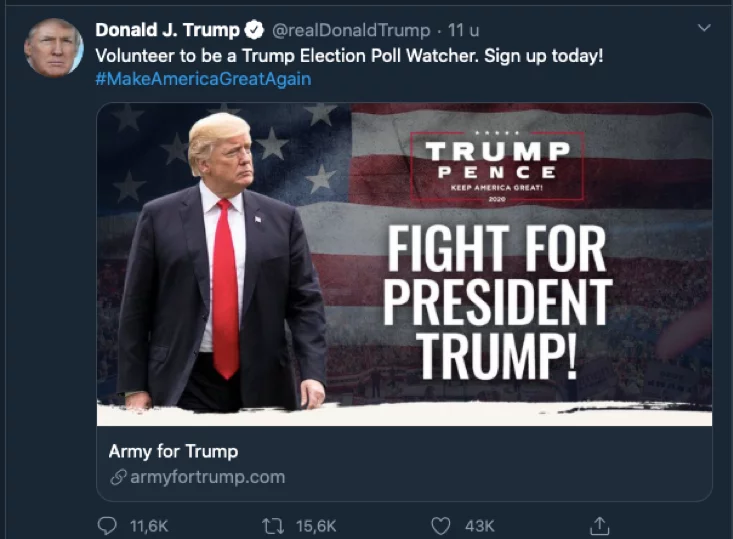
What is most interesting about this site, is the fact that Trump’s grassroots movement is organized under the banner of an ‘army’ that is controlled by Trump’s War Room. The image that accompanies the Twitter post asks those volunteers to ‘fight for president’ Trump. When potential volunteers click on the link, they enter a site that wants them to ‘enlist today’. This military language is used metaphorically. People are not asked to actually fight, but to become digital or algorithmic activists, to engage in phone banking, and start knocking on doors and helping people to vote.
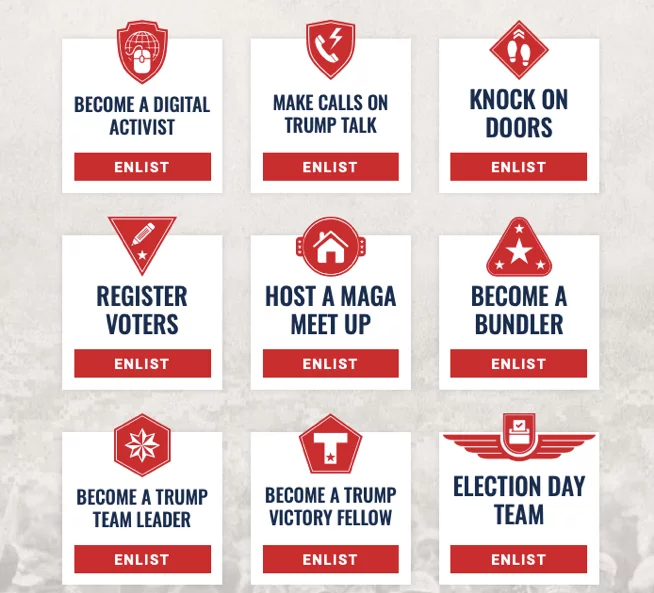
The army for Trump shows how Trump’s campaign is combining small organizing, that is a campaign that focusses on big data and micro-targeting, to big organizing (Bond & Exley, 2016). Big organizing is made prominent by Bernie Sanders who wanted to build a mass movement by using digital media to recruit people for big systemic change. This big organizing approach was not only developed to compensate for the lack of big funding, it was part of an ideological approach to politics. An approach that can best be seen as digital version of the old pillars of social democratic parties in Europe where people organize themselves in movements to have political leverage.
In the case of Trump, this big organizing approach is integrated in a very different discourse, set of practices and ideological tradition. With his anti-Enlightenment nationalism, Trump has always appealed to the right side of the political spectrum. In 2016 his campaign focused on microtargeting and on fusing different niches together in one movement to get Trump elected (Maly, 2018). To a large extent this was based on his persona and his discourse about cleaning up the Swamp and fighting for the regular people in combination with his many dog whistles to the extreme right. This generated not only a traditional political campaign, it was also supported by a networked movement of digital activists. MAGA-trolls (Make America Great Again Trolls) and influencers, Milo and Breitbart fused together with the so-called alt-right in giving Trump an edgy image and in silencing criticism by setting up intimidating troll campaigns.
In 2020 we see how the campaign needs to organize its own movement. This can be seen as a direct result of the lack of spontaneous support of this campaign and its financial problems. Trump has no other choice than to structure and organize his movement. To do this, Trump uses the full possibilities of the hybrid media system. During the debate he asked people to enlist to become a poll watcher and his campaign repeated that on his Twitter account. They also use data about donors to his campaign to personally address them and ask them to enlist in Trump's army (see the letter Washington Post journalist Aaron Blake tweeted). At the same time his campaign needs to create a sense of urgency. This is where the military language and war metaphors come in.
Back to topThe power of military metaphors
The use of such metaphors is not without consequences. ‘Metaphors can kill’, wrote Lakoff in his seminal essay on the discourse on the war in Iraq. Trump’s recruitment and organization of volunteers in combination with his discourse about Biden and the threat he and his supporters pose for the US and his story about the ‘rigged elections’ creates a very powerful and potentially dangerous mobilization discourse.
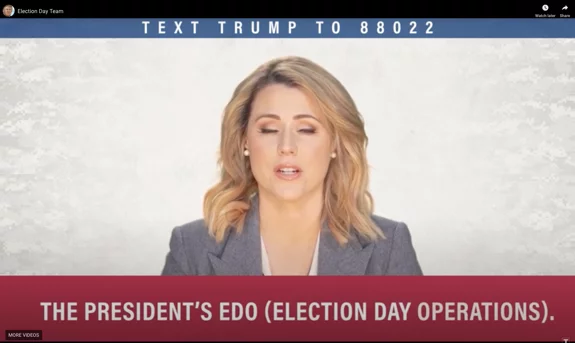
That is especially the case when the Trump campaign asks his army to also make sure that the elections are not rigged by enlisting for the ‘election day operations’. Volunteers will be allocated shifts at the election offices to make sure that they can stop the Democrats who ‘will be up to their old dirty tricks on Election day to make sure that President Trump doesn’t win’. This is a very thinly veiled call for intimidation and the veil becomes even thinner when we connected it with his ‘order’ to the Proud boys ‘to stand back and stand by’ and his support for the MAGA activists who drove into Portland to combat Black Lives Matters firing paintballs. A substantial group of these MAGA-protestors were actually Proud Boys claiming to drive the left out of the city.
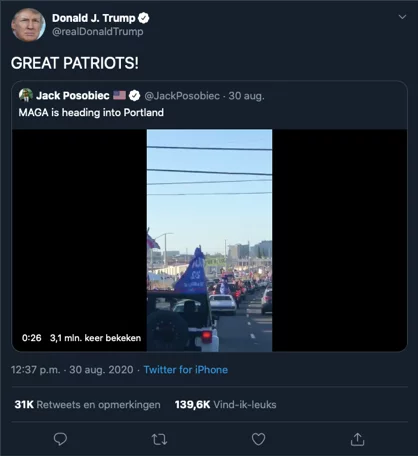
Trump's big organizing more and more starts to resemble the history of ultranationalist squadrons of the 20th century. He is not building a classic political movement, he enlists people in his personal army to commit to the president’s personal operations. Metaphors matter. The metaphor turns real when those volunteers start to imagine themselves as part of Trump’s personal army. This imagination is explicitly pushed in the letter to his patriots when they are rewarded with a 'never-before-seen limited Camo Keep America Great Hat' that allows 'the exclusive members of Trump's army' to identify themselves with.
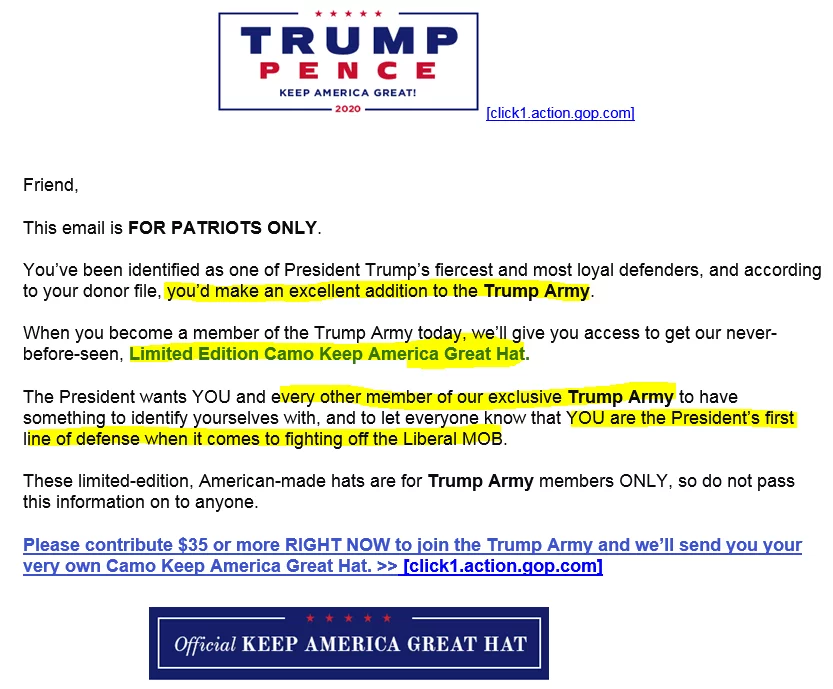
This membership of Trump's Army is a very powerful identity, especially so in combination with his discourse of war. Trump does not hesitate to point out who the enemy is: the liberal MOB. Next to the symbol of a common enemy, a prince of evil, the all-powerful leader is one of the most powerful unifying instruments. Trump is not only shaping strong ties among his political base, he is giving them reasons to fight for him. He tells them the future of the US is at stake.
Whatever happens on 3 November, we should realize that Trump’s army will not magically disappear. And that is something to worry about.
Back to top
References
Bond, B. & Exley, Z. (2016). Rules for revolutionaries. How Big Organizing can change everything. Vermont: Chelsea Green Publishing.
Chadwick, A. (2017). The Hybrid Media System. Politics and Power. Oxford University.
Chawick, A., O’Loughlin, B. and Vaccari, C. (2017). Why People Dual Screen Political Debates and Why It Matters for Democratic Engagement. Journal of Broadcasting & Electronic Media 61(2), 2017, pp. 220–239
Lempert, M. & Silverstein, M. (2012). Creatures of politics. Media, message and the American Presidency. Indiana University Press.
Maly, I. (2016). Explainin Trumps Message, part 1: Is Trump a clown? part 2: Trump, the celebrity-businessman and vox populism, part 3: How did Trump get this far? Diggit Magazine.
Maly, I. (2018). Nieuw Rechts. Epo: Berchem.
Back to top
More from this author


Content ID
Published date