


Paper
Pop music and Trump: World politics in local popular music
Globalization has changed the production of music. In this paper, we explore the way in which world politics appear in local music and how audiences engage with this, through two case studies of songs by De Staat and The 1975.

Published date
Courses
Art and globalization
Copyright
This work is licensed under a Creative Commons Attribution-NonCommercial 4.0 International License.
Read time
15 minutes

On this page
- How do world politics appear in local music performances
- The Global, the Globalized and the Local: Music in the Age of Globalization
- “Orange Entertainer”: A case study of De Staat’s Kitty Kitty
- “Modernity has failed us”: A case study of The 1975’s Love It If We Made It"
- Trump in Popular, Local Music
- References
In his book Local Music Scenes and Globalization: Transnational Platforms in Beirut (2012), Thomas Burkhalter discusses the way in which digitalization and globalization have changed music making. While introducing the topic and his aim, Burkhalter poses the following question: “Do new “successful” positions help reconfigure how we understand music— and even how we understand the world?”. With the rise of globalization – and so our grown access to constant flow of news from different parts of the globe – music making has changed. In the context of globalization, music can address worldwide problems due to the fact that artists have constant access to news sources on these problems. IAn increasing number of musical artists use their influential position to address worldwide problems to their followers; may it be via social media, during concerts or via their music.
Back to topHow do world politics appear in local music performances
This research seeks to explore the way in which world politics appear in locally based music performances and how audiences engage with these political messages.”, we will divide our research into two parts. First, we will look into the notions of the ‘global’ and the ‘local’, and their influence on music making (production and performance). We will then use two case studies of songs that have a strong political aura. Both case studies focus on a song that discuss Donald Trump and his presidency of the United States of America. However, both these songs are written and performed by artists that live outside of the USA. The songs used as case studies will be Kitty Kitty (2018) by the Dutch band De Staat, and Love It If We Made It (2018) by the British band The 1975.
The case studies will be done in a similar way; we will look at the lyrics and the performance (live performance and music video), what the band has said about the song themselves and how audiences respond to it. The latter will be done by looking at data gathered in two short questionnaires. These questionnaires – one for each song – were send out in order to gain more knowledge on how audiences engage with the songs. In each questionnaire, the respondent was being asked questions that entailed whether they were a fan of the band, whether they knew the song we are talking about it, whether they were aware of its political aura (and especially of its connection to Donald Trump) and if yes, how they had been informed on that. After that, they were asked whether they had noticed political references in the performance of the song and if so, whether they could elaborate on what they have noticed. Lastly, the interviewees were being asked whether the song had influenced the way they think about nowadays’ society and if so, which part in particular had done so. The final question was whether they would now listen to the song differently.
Back to topThe Global, the Globalized and the Local: Music in the Age of Globalization
Over the years, the world has become an increasingly “smaller place”; due to all kinds of (technological) developments we have become more connected to people from places all around the world. However, the process of globalization has been going on for ages, so it is not new. Neither is it even; some parts of the world are less affected by globalization than others. This means that even in the age of globalization, we are not truly ‘global’ in the sense that not “every part of the world is in lively commerce and contact on a relatively equal footing with every other part of the world.” (Caroll, 2007).
However, the process of globalization has made certain products globalized rather than global. Since there is an increased connectedness, it easier for us to introduce products (read products here as products of speech, products of thought as well as physical products) in new regions or to incorporate something from these new regions in our local products. By doing so, these local products are no longer local; they have become a globalized product.
"In order for art to be understood worldwide, we need both these universal meanings as well as shared understandings of the form."
In his article Art and Globalization, Then and Now (2007), Noell Caroll talks about the way globalization and art have affected each other. Even tough he is mainly talking about visual art, some of his claims could also be applied to music as a form of art. “(…) the artists, presenters, and viewers are not only aware of a number of recurring themes or frameworks; they also share knowledge of a battery of formal devices for advancing those themes, including radical juxtaposition, de-familiarization, and the de-contextualization of objects and images from their customary milieus.” (Caroll, 2007). Here Caroll implies that around the globe we see the similar forms of art, but what we mostly see are shared, universal themes which lead to shared meanings.
In order for art to be understood worldwide, we need both these universal meanings as well as shared understandings of the form. When focusing on music, we see the worldwide understandings of forms as well; we tend to categorize music into different genres that we worldwide agree upon. The shared, universal themes that appear in music range from the regularly used concept of love and heartbreak, to concepts such as politics and worldwide crisis.
Even tough such themes can be understood as ‘universal’ – since all around the world they can be experienced – we must recall that globalization is uneven. This leads to these universal themes as being somewhat locally-specific still; different cultures experience different ‘universal’ themes in different ways. By making use of both beforementioned tools – a shared form and shared meaning – local music can thus become a globalized good, that can still be interpreted and understood in different places around the globe. This interpreting and understanding is however done with one’s own local background in mind.
Further diving into the way globalization has affected the production and performance of music, we see that a lot of research has been done into the connection between music and national identity. In the chapter National Identity and Music in Transition: Issues of Authenticity in a Global Setting (2007), John O’Flynn quotes Robertson stating the following “the contemporary assertion of ethnicity and/or nationality is made within global terms of identity” (1995). This could be interpreted in the way that national identity is constructed in relation to the globalization discourse ; national identity is only one attribute to one’s global identity. Art – in this case: music – can thus be linked to the national identity of the artist, but it also has a place in the bigger picture of his or her identity as a globalized citizen in this globalized world.
We will now look into two bands that have successfully created a globalized product and we will look into the way their audiences engage with this product.
Back to top“Orange Entertainer”: A case study of De Staat’s Kitty Kitty
De Staat is a Dutch band that is considered to make “chameleonic rock music” (Spotify, n.d.). Their song Kitty Kitty came out in 2018. Even though the song itself is a local product – it is created by a Dutch band who has nothing to do with American politics and is performed in (mostly) European countries only – it addresses a universal theme, namely politics. Kitty Kitty covers the presidency of Donald Trump in the United States of America, and the battle between red and blue in the country. Based on American politics, they portray a universal theme (politics) through the lense of a local (i.e. Dutch) interpretation. This interpretation is remediated into a song that can be understood worldwide but which is locally performed .
In the lyrics of the song, there are a lot of indirect references to Donald Trump: Trump is never named, nor direct quotes from him are being used. However, a lot of aspects of Trump that are often critized are being used. The song starts with the lyrics “Big deal maker, orange entertainer” which already hints towards the fact that it is about Trump. Other examples of lyrics that point towards Trump are “Make the new news faker”, “Follow the tweeter” or “The great white white white preacher”.
In the performance of the song – both in live performances as well as in the music video – the band uses two ways to refer to Trump. Firstly, there is the use of blue and red lights only. These lights alternate and refer to the clash between democrats and republicans in the USA. Secondly, the lead singer Torre Florim behaves himself in a way that is often taken on by demagogues.
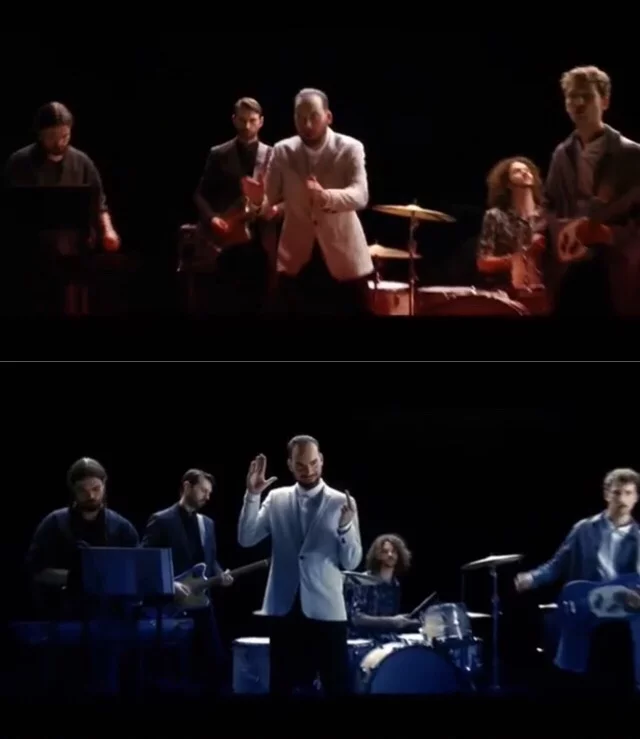
During interviews, De Staat has explained that the song came to life during the presidential campaigning period in 2016 (3voor12 extra, 2018). They explain how it is about “de opkomst van die oranje boy” (translation: “the rise of that orange boy”) and about the way that the democrats and the republicans sort of make claims against each other. The band also explains in the same interview that the song mainly critiques the idea that everyone is caught up in their own opinions and their own bubble, which leads to fights.
As mentioned in the introduction, a questionnaire was send out about this song with a response from 24 people. 17 of the respondents indicated that they were a fan of De Staat, 21 of the respondents knew the song. However, from those 21, only 17 responded that they were aware of the political references in the song. Most of them (15 from 17) knew that it references to Trump. The references were mainly picked up from the lyrics themselves (7 people) as well as from the band talking about it in an interview (4 people). Only 6 people were aware of and correctly elaborated on the political references in the live performance. From the 24 respondents, 12 answered that the song had not influenced the way they think about society. 10 respondents said it might have been of influence, and 2 respondents said it definitely has. Commonly mentioned lyrics that led to this influence were “Orange entertainer”, “Make it feel, make it feel real” and “Fuck up the facts”. Lastly, 17 respondents answered that they will probably listen differently to the song now.
Kitty Kitty is thus a globalized product that uses an international, political theme. Even though it contains a shared, universal theme, the song stays open for interpretation by not using direct references. In doing so, they tackle the fact of globalization being uneven by giving every global citizen the opportunity to interpret it in their own national contexts. In The Netherlands for example, the popularity of a demagogue, which is addressed repeatedly in the song, could be applied to politicians like Geert Wilders or Thierry Baudet. From the questionnaire has followed that using such a political theme can definitely be of influence on the way people think about society. Therefore, positioning themselves as globalized citizens has helped De Staat in educating other globalized citizens.
Back to top“Modernity has failed us”: A case study of The 1975’s Love It If We Made It"
The 1975 is a band from the United Kingdom that makes mainstream pop, but with their own artistic take on it (Spotify, n.d.). In 2018, they released their song Love It If We Made It. Throughout the entire song, the band mainly critiques the world we live in nowadays and all the bad things that are happening on society. By doing so, they discuss the universal theme of worldwide problems through a local product which is their music. This has turned their music into a globalized product. By taking on a slightly vaguer universal theme, the band leaves open the opportunity for interpretation in local scenarios; while addressing worldwide problems, they also address the idea that everyone has their local problems. Just like in Kitty Kitty, The 1975 also discuss Donald Trump and his presidency of the USA in this song.
What immediately stands out when looking at the lyrics is the direct and harsh way of stating them; nothing is sugar-coated in this song which is also a critique on the fact that in nowadays society, only controversial opinions get attention. The second lyrics of the song already refer to exactly this matter: “Saying controversial things just for the hell of it”. The lyric “Modernity has failed us” is a short summary of the universal theme that is carried throughout the song. Unlike in Kitty Kitty, the political meaning of the song is conveyed very direct; When referring to Trump, the song uses literal quotes from him as lyrics, namely “I moved on her like a bitch!” and “Thank you Kanye, very cool!”. By using literal quotes, they point out the absurdity of an influential person being this provocative, which is a theme that could be understood in different local societies.
During live performances of the song, the band uses the same visuals that are shown in the music video. Like in the lyrics, the visuals do not sugarcoat anything:; the images shown are very explicit and shocking, which again plays into the idea of “Saying controversial things just for the hell of it”. By showing provocative material, it also illustrates the main theme of “Modernity has failed us”. In reference to Trump, the music video shows actual footage of the president and thus makes the reference very direct again.
When looking at interviews with the band, the most interesting interview to look at is the interview with Genius. In the video interview with Genius, Matty Healy (the lead singer) says the following about the lyric “I moved on her like a bitch!”: “That is a direct quote from the sitting president of the United States, and that’s a weird reality. Like, when a radio plays your songs, they don’t play swear words. I would have to be censored for literally quoting the leader of the free world.” (Genius, 2018).
About the quote “Thank you Kanye, very cool!”, the band states the following on the site of Genius: “(…) Being on the wrong side of history is never normally celebrated retrospectively. The Kanye thing really confuses me, and upsets me a little bit (…). It’s just a fucking weird time, isn’t it?” (Genius, n.d.) In the video The 1975 - Matty Healy breaks down The 1975’s videos from ‘A Brief Inquiry…’ (2019), Healy states the following about the way things are portrayed lyrically and visually in the song: “We know all this stuff. That’s why it resonates. I don’t want to be provocative, but the point is that if we’re talking about shocking stuff, and we’re relating to shocking stuff, and we’re resonating with the song because of our relationship to that shocking stuff, we have to see the shocking stuff.”
"tThThat is a direct quote from the sitting president of the United States, and that’s a weird reality. Like, when a radio plays your songs, they don’t play swear words. I would have to be censored for literally quoting the leader of the free world." ~Matty Healy, 2019
Like in the case of Kitty Kitty, a questionnaire had been sent out for measuring the way in which audiences engage with the song. In total, 42 people filled in the questionnaire of which 35 labeled themselves as a fan. 40 respondents knew the song in advance, of which 36 were aware of the political aura of the song. From these 36 respondents, 26 were aware that literal quotes from Trump are being used as lyrics. 18 of them were informed on that by the lyrics itself. Others knew it from the band talking about it (6 respondents) or from others telling them about it (2).
Most of them noticed the shocking imagery used in the music video and were able to describe it excessively; only 6 respondents did not notice the shocking imagery. 7 respondents answered that the song did not influence their way of thinking about society; 19 respondents answered that it might have and 12 people answered that it definitely did. The lyrics mostly mentioned in response to the question which lyrics made them think differently about society were “Modernity has failed us”, “Saying controversial things just for the hell of it”, the quotes by Trump and “Selling melanin and then suffocate the black men, start with misdemeanors and we'll make a business out of them”. Lastly, 30 respondents answered they will now probably listen differently to the song.
Just like Kitty Kitty, Love It If We Made It can be seen as a globalized product. The song does not sugarcoat the shocking universal theme that it discusses, namely that modernity has failed us. However, this theme can be understood from local perspectives which turns the song into a great example of a globalized product. From the questionnaire has followed that expressing such a harsh critique on the world we live in can definitely be of influence on the way people think about this world and their place in it. Like De Staat, The 1975 position themselves as globalized citizens and they inform their audiences on this. In doing so, they educate them and encourage them to critically think about society outside one’s own nation as well.
Back to topTrump in Popular, Local Music
To conclude this article, we could thus state that in the age of globalization, music has become a globalized product. In order to understand such a globalized product – made by a local entity – there has to be a universal language of art in its form, and a shared meaning in the art. The latter comes in the form of a universally shared theme. This universally shared theme is there, but can still be interpreted in one’s own local entity. For artists, a globalized product can be a portrayal of national identity, as well as a portrayal of their global identity.
With regards to world politics in local music, local artists can portray themselves as globalized citizens by referring to a globally shared theme, in the two cases mentioned: world politics. The way audiences engage with it has been portrayed in our case studies. From the case studies we can conclude that the biggest part of the audience does recognize the shared theme in the song and lets it influence the way they think about society. Therefore, audiences engage with world politics in music by using it as an educational tool for them to become more critical towards nowadays’ society and for them to become a more globalized citizen.
Back to top
References
Burkhalter, T. (2012). Local Music Scenes and Globalization : Transnational Platforms in Beirut. Retrieved from https://ebookcentral.proquest.com
Carroll, N. (2007). Art and globalization: Then and now. The Journal of Aesthetics and Art Criticism, 65(1), 131-143.
Daniel G., Hann, A., Healy, M., MacDonald, R. (July 19th, 2018). Love It If We Made It [Recorded by The 1975]. On A Brief Inquiry into Online Relationships [CD]. West London, England : Dirty Hit.
Featherstone, M., Lash, S. M., & Robertson, R. (Eds.). (1995). Global modernities. Retrieved from https://ebookcentral.proquest.com
Florim, T. (August 10th, 2018). KITTY KITTY [Recorded by De Staat]. On KITTY KITTY [CD]. Amsterdam, The Netherlands : Caroline Benelux.
O’Flynn, J. (2007). National Identity and Music in Transition: Issues of Authenticity in a global Setting. In Biddle, I. & Knights, V. (2007). Music, National Identity and the Politics of Location : Between the Global and the Local (pp. 19-38). Retrieved from https://ebookcentral.proquest.com
Back to top
