


Article
SAG-AFTRA and WGA Strikes: Staging a Protest in the Age of Platformization
Streaming platforms have seriously altered working conditions in the cultural industry. This article analyzes key issues in the SAG-AFTRA and WGA strikes through platformization, demonstrating how streaming services have asserted technological, political, and economic power that has worsened working conditions concerning residual payments, contract lengths, and work security for many. Fortunately, we are seeing positive changes due to the strikes.

Published date
Courses
Global Communication Infrastructure
Copyright
This work is licensed under a Creative Commons Attribution-NonCommercial 4.0 International License.
Read time
10 minutes

Between May and July of 2023, two artistic unions - the Writers Guild of America (WGA) and The Screen Actors Guild-American Federation of Television and Radio Artists (SAG-AFTRA) initiated strikes against the Alliance of Motion Picture and Television Producers (AMPTP) due to disagreements on the labor conditions of artists and entertainers regarding their income, duration of work, and professional practices. With the rise of technological advancements, cultural industries have rapidly transformed, delivering new and improved experiences when it comes to entertainment. In particular, the introduction of subscription video-on-demand (SVOD) businesses such as Netflix, Disney+, and HBO Max has provided users with abundant choices for streaming content, offering a wide range of old and new movies and fictional and reality TV shows to a worldwide audience. However, on-demand services have launched a problematic business model within the cultural industry, generating huge profits from the work of actors and writers without providing them with the proper financial compensation and transparency. In this article, I will analyze the SAG-AFTRA and WAG strikes against the AMPTP, questioning how streaming services have shifted the political economy of cultural industries, bringing complications to the work conditions of writers and actors. Moreover, I will use Nieborg & Poell’s (2018) theory on the platformization of cultural production to understand how streaming platforms have impacted the production and dissemination of content, resulting in a dissatisfying professional environment for performers and writers alike. In the following paragraphs, I will first provide background on the actors' and writers’ unions, discussing reasons for the strikes. Then, I will demonstrate how streaming platforms have altered the working conditions in the cultural industry by focusing on the issue of royalty payments and the gig economy, arguing that the direction of cultural production has been seriously commodified.
Back to topBackground on SAG-AFTRA & WAG Strieks against the AMPTP
The Screen Actors Guild-American Federation of Television and Radio Artists (SAG-AFTRA) is an organization that represents media and entertainment professionals such as actors, television and radio hosts, and a variety of artistic performers in discussions related to working conditions and payments (Sanchez, 2023). With over 160 thousand members, the union's latest protecting initiative was the strike on July 14, 2023 strike. As stated on the official website of SAG-AFTRA, key factors in creators' working conditions of creators have been dramatically changed due to streaming services. The factors covered in this article focus on residual payments and the impact of on-demand platforms on cultural production.
Similarly, the Writers Guild of America (WGA) is a labor union that looks after the rights of thousands of screenwriters who create content for news and entertainment media productions. The strike initiated by WGA on May 2, 2023, expressed identical concerns, pointing out residual payments as a problem for writers’ working environment. Importantly, the Writers’ Guild of America mentions the introduction of “a gig economy" through mini-rooms as another threat established by streaming companies and their business models (Littleton, 2023). Collectively, the writers’ and actors’ organizations were in conflict with the Alliance of Motion Picture and Television Producers (AMPTP), which represents streaming platforms such as Amazon, Apple, Disney, Netflix, Paramount/CBS, Warner Bros/Discovery & HBO (Kilkenny, 2023). By joining powers, the unions have been able to send a powerful message and raise awareness of the faults in the business model of streaming services, which I will focus on in the following paragraphs.
Back to topThe Platformization of Cultural Production
Building on prior research on platformization, Nieborg & Poell (2018) unite business, political, and software studies on digital platforms to analyze how cultural production and cultural commodities have become contingent (Nieborg & Poell, 2018, p.4276). Defining platformization as the penetration of economic, governmental, and infrastructural extensions of digital platforms into the web and app ecosystems, fundamentally affecting the operations of cultural industries (Nieborg & Poell, 2018, p. 4276), the authors explore how digital affordances not only embrace socioeconomic, cultural, and political interactions but also dictate them.
First, this is done through the interpretation of theory from business, which follows the shifting from one or two-sided to multisided markets (Nieborg & Poell, 2018). Platforms are seen as matchmakers that unite "complementors" - platform actors who complement a platform’s services by providing a service of their own - and end-users into multisided markets that are subject to network effects, which could be direct and indirect (Nieborg & Poell, 2018, p. 4278). In the context of platformization, direct network effects show how platforms become more valuable when they attract more users (Stobierski, 2020). Additionally, platforms are affected by indirect network effects because of the relations between complementors and consumers from one side to another. In this way, if actors from one side leave, they indirectly affect the platform's value for other users (Nieborg & Poell, 2018, p. 4278).
Focusing on the changing governance due to platformization, the authors discuss how platform power has switched the political economy of cultural production (Nieborg & Poell, 2018, p.4279). As a result, it is suggested that platforms govern the relations between producers and consumers on platforms, resulting in complications regarding the independence of creators, diversity in production, and the overall distribution of content. As a final approach in the platformization model, Nienborg & Poell (2018) focus on the infrastructural transformation of cultural production through platformization, suggesting that algorithms and data have altered production and circulation practices (Nieborg & Poell, 2018, p. 4282). In this way, creators must adapt their work to platform specifics, solidifying the idea that cultural products and commodities have become contingent. Nienborg and Poell's three-step model (2018) allows us to better understand the synthesis between platform producers, complementors, and audiences in the streaming business in order to assess the meaning and impact of SAG-AFTRA and WGA strikes in today’s cultural industry.
In the race to provide the best service, companies have been pushing to create more content without giving enough time, funds, and freedom to artists.
As a foundation for my research, I used a variety of media articles discussing the SAG-AFTRA & WAG unions, the reasons behind the strikes, and other details about the conflicts relating to the people and organizations involved. As a theoretical background, I relied on the work of David Nieborg & Thomas Poell (2018) on the platformization of cultural production from the Journal of New Media & Society (2018). To conduct my empirical research, I searched for digital content about the strikes on the social media platform TikTok, following statements from actors and writers about the impact of streaming services on their work in connection to the strikes. Moreover, I used testimonials from the official site of the Writers Guild of America, where the negotiation and strike documents were published.
Back to topResiduals in the Age of Platformization
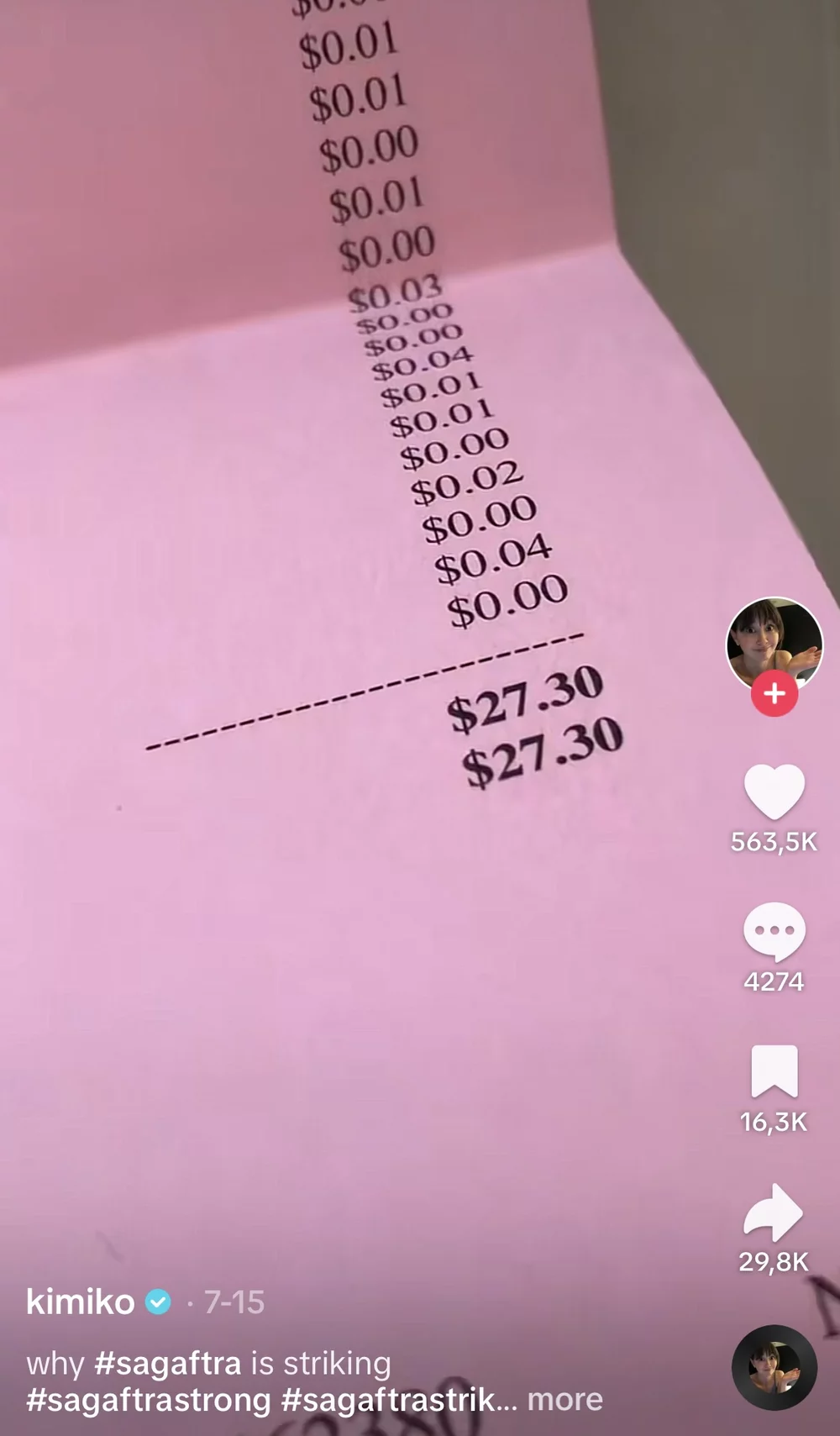
Royalty payments or residuals are compensations given to performers and writers when series or movies are released or re-aired to DVD formats, broadcast TV, or another entertainment source on top of their initial payment for doing the work. Typically, such compensations are essential to the livelihood of actors due to the unpredictability of their careers as they bring steady income over a certain period of time. Based on a report from CNBC, residuals in the era of streaming services have become a difficult subject because companies are reluctant to share viewership data on their platforms, intending to avoid a demand for better pay (Rizzo & Whitten, 2023). Moreover, actors have come forward to share their royalty profit from the streaming of movies and series, expressing disappointment and concern about being underpaid, although performing in widely known productions. One viral example is actress Kimiko Glenn’s Tiktok, showing her 27-dollar residual check as a leading actress for multiple seasons on Netflix's Orange is the New Black.
Writers have also expressed issues with the changes in the payment of residuals from streaming platforms; in a video from More Perfect Union, writers on the picket line are asked to compare their royalty payments from network TV against those from a streaming platform, emphasizing the vast difference between the funds received. Traditional broadcast television pays performers and writers every time their work is replayed on traditional entertainment channels (Rizzo & Whitten, 2023).However, due to the streaming business model, the calculation of residual payments is based on predetermined benefits, which are criticized for not matching viewership data, as explained by the second writer in the video.
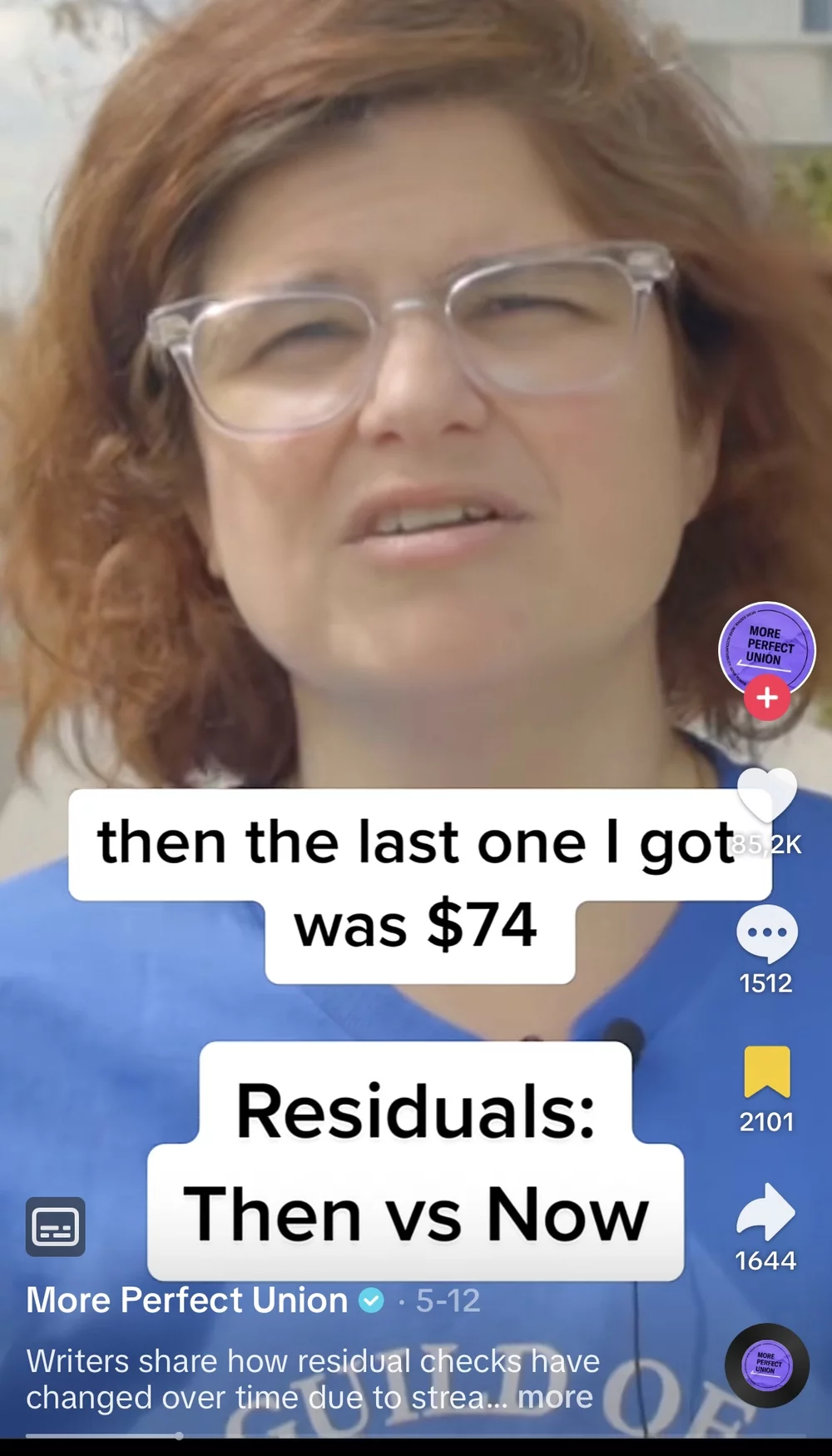
Being one of the main reasons for the strikes of SAG-AFTRA and WGA, royalty payments are an example of the impact of platformization on the cultural industry. Drawing back on the works of Nieborg & Poell (2018), it is apparent that streaming platforms have not disclosed viewership statistics to avoid being criticized for not paying writers and actors enough compensation. As a result, platforms are now governors of valuable data (Nieborg & Poell, 2018) that, for actors, is not only necessary for financial benefit but for the overall assessment of their performance. Furthermore, streaming services determine through algorithms what to propose to viewers. With such an abundance of content on each platform, residual amounts can decrease even more as shows and movies are less promoted on popular platforms. Thus, actors and writers have demanded transparency of viewership data that would reduce a platform's power over determining residuals.
Back to topStreaming services have asserted technological, political, and economic power that has limited working conditions concerning residual payments, contract lengths, and work security for many.
Writing and the Gig Economy in the Age of Platformization
Strongly connected to the issue of royalty payments, writing has been seriously affected by the breakthrough of entertainment streaming platforms. Based on one of many testimonials from the official site of WGA for the contract negotiations, “mini rooms” have been introduced. Considered as a "writers' room" - the office or location where the writing staff meets to work on a project, mini rooms entail the same activities, yet here, fewer than traditionally accepted writers have to prepare a project in a short period of time, regularly being paid minimum regardless of their expertise. Moreover, such mini rooms become separated from the actual production and filming process if a show or a movie gets picked up by the streaming service. In this way, writers are disposed from further creative input into the projects, although the showrunners and producers argue that they are still needed throughout filming. Here, platformization accounts for rapid changes in creative processes on streaming services by limiting creative freedom through time and participation cuts, which streaming companies adopt to decrease expenses. Further, it is observed that cultural production in the advent of streaming is contingent on cultural commodities (Nieborg & Poell, 2018). Initiatives to speed up the process of writing before production and the overall shorter duration of productions showcase the establishment of a new business model fostering swift projects where writers have become complementors who are pressured to optimize their content to match platform distribution (Nieborg & Poell, 2018, p. 4287).
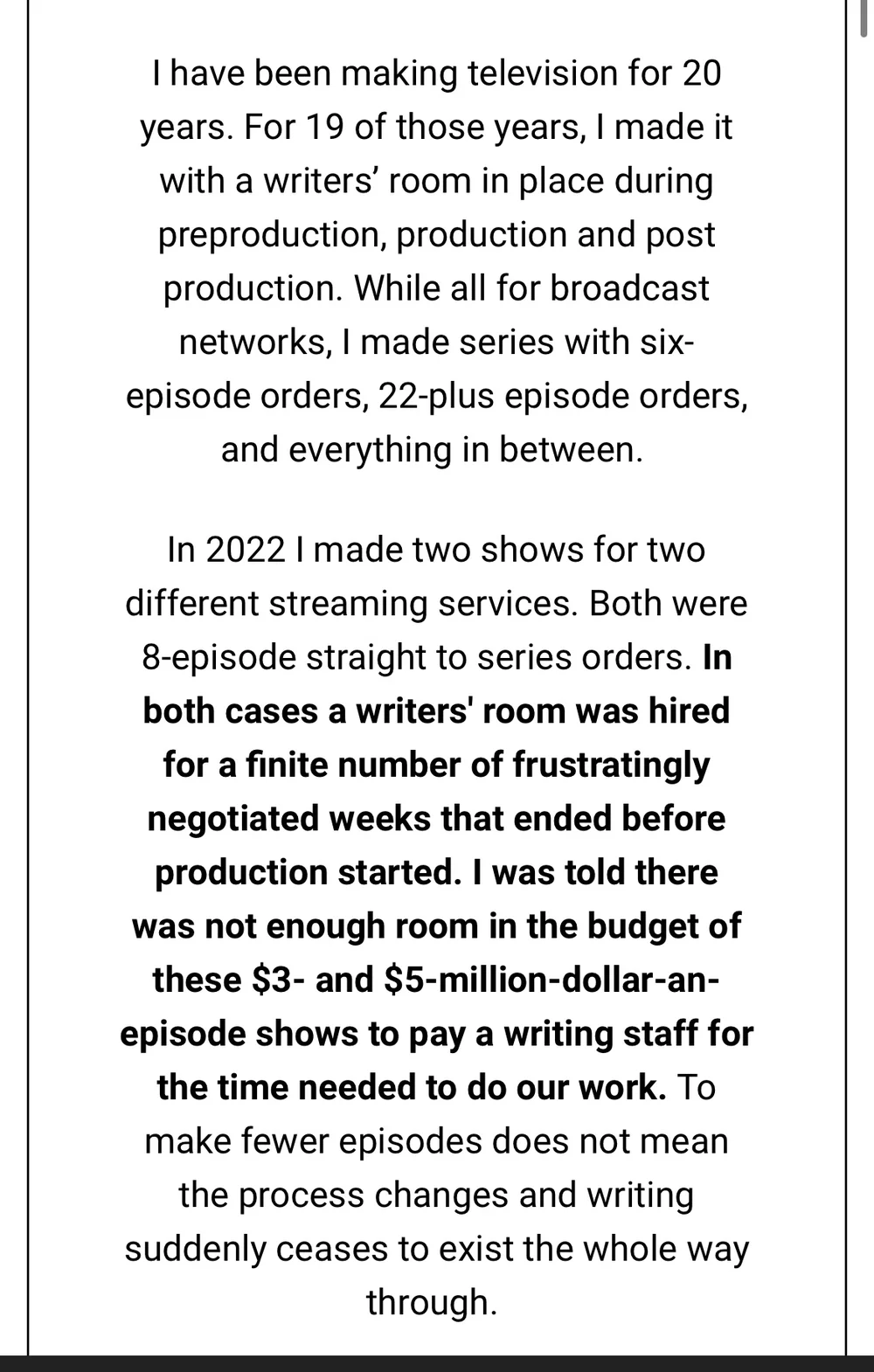
Additionally, by cutting short the number of writing staff on a production set, one of the main contributors to the entertainment industry receives less money and short working contracts, resulting in a “gig economy” - a labor market that relies heavily on temporary positions (Brock & Munichiello, 2022). This is heavily criticized as writers were typically involved in the entire creative journey, as expressed in the testimonial above.
In another testimonial repeating similar dissatisfactions, algorithmic power is also pointed out as a managerial method among streaming services that have utilized platforms' data-collecting properties to monitor customer preferences.
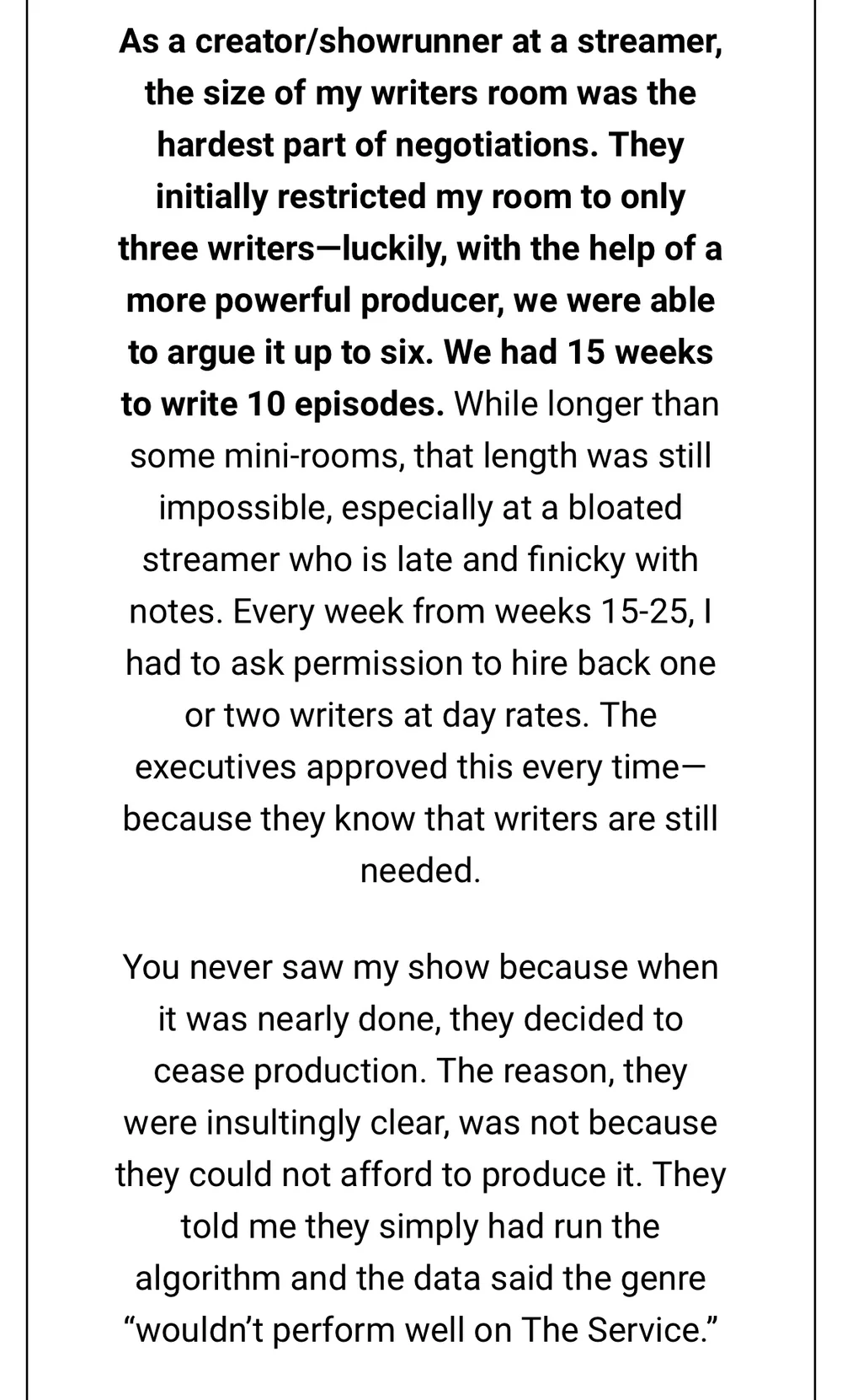
Problems with algorithms and data are significant, as this testimonial suggests that software has rejected projects due to the possibility of underperformance. Again, Nieborg & Poell’s work (2018) shows the platforms’ curation power over creative processes, having the final call on what is to be produced, replacing the expertise of real artists.
Back to topWrapping Up
The entertainment industry has significantly changed through streaming platforms, with more media companies hopping on the trend, disregarding the transitional state that the streaming business has entered (Rizzo & Whitten, 2023). In the race to provide the best service, companies have been pushing to create more content without giving enough time, funds, and freedom to artists. In this article, key issues in the SAG-AFTRA and WGA strikes were analyzed through platformization, demonstrating how streaming services have asserted technological, political, and economic power that has limited working conditions concerning residual payments, contract lengths, and work security for many. Fortunately, the strikes of SAG-AFTRA and WGA have come to a positive end for the unions, who were able to negotiate better contracts for their members. On September 25, the Writers Guild of America ratified a new agreement where employment terms and residual rates were improved to provide better income to writers. Similarly, the SAG-AFTRA reached a tentative agreement on December 5, having negotiated higher residual rates and a streaming participation bonus (Sanchez, 2023).
Back to topReferences
Kilkenny, K. (2023, October 10). Producers Ask AMPTP for Name Change Amid Confusion. The Hollywood Reporter.
Littleton, C. (2023, May 10). Writers Fear 'Gig Economy': WGA Strike Fueled by Changing Landscape. Variety.
Nieborg, D. B., & Poell, T. (2018). The platformization of cultural production: Theorizing the contingent cultural commodity. new media & society, 20(11), 4275-4292.
Rizzo, L., & Whitten, S. (2023, September 17). Hollywood is paying a steep price for never really figuring out the streaming model. CNBC.
Sanchez, C. (2023, November 9). Everything to Know About the SAG-AFTRA Strike in Hollywood. Harper's Bazaar.
Stobierski, T. (2020, November 12). What Are Network Effects? | HBS Online. HBS Online.
Back to top

