


Paper
Ellen DeGeneres: talk show host or CIA agent?
In 2018, people believed that Eric Trump suggested that Ellen DeGeneres is part of a hidden government within the US. This essay analyzes how this conspiracy theory has come into existence, who plays a role in it, and what this means online.

Published date
Courses
Reading and writing in online culture
Copyright
This work is licensed under a Creative Commons Attribution-NonCommercial 4.0 International License.
Read time
10 minutes

In 2018 Eric Trump posted a tweet that people took as if he was suggesting that the American talk show host Ellen DeGeneres is part of Deep State, and it has now become quite the conspiracy theory. This paper analyzes how this theory has come into existence, who the parties involved are, and what this means for their online interactions.
Back to topEllen DeGeneres as part of the Deep State
We often see Donald Trump and his supporters referring to different conspiracy theories: wind turbine syndrome, Spygate, Great Replacement, and so the list goes on. Now his son, Eric Trump, tweeted something peculiar.
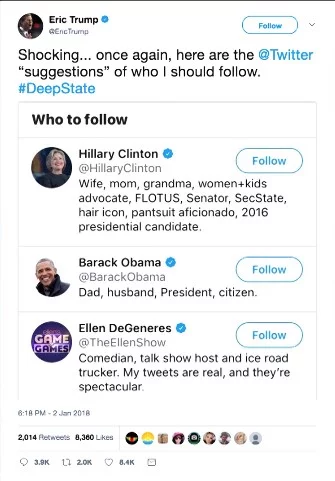
On the 3rd of January in 2018, Eric posted a tweet about the so-called Deep State, another conspiracy theory repeatedly pushed by Donald Trump and others. His tweet, now removed, said: “Shocking... once again, here are the @Twitter “suggestions” of who I should follow. #DeepState” following a picture of the Twitter accounts of Hillary Clinton, Barack Obama, and Ellen DeGeneres. Trump tweeted this to show how Twitter only suggested him to follow liberals and not right-wing politicians. People took it as if, according to Trump, DeGeneres herself was part of the Deep State. This has not gone unnoticed by Ellen DeGeneres and her team, and it has caused some interesting interactions on Twitter. The conspiracy theory has not left everyone’s mind since, with multiple actors involved.
What is the Deep State?
The 'deep state' has been associated with the 'military-industrial complex': an informal alliance between a nation's military and the defense industry that supplies it. President Dwight D. Eisenhower raised potential risks from the military-industrial complex in his farewell address in 1961: "In the councils of government, we must guard against the acquisition of unwarranted influence, whether sought or unsought, by the military-industrial complex. The potential for the disastrous rise of misplaced power exists and will persist."
Years later in the 1990s, the term deep state became important in Turkish politics and was central to Turkish citizens, scholars, and elites to describe how the military colluded with drug traffickers and hitmen to wage a war against Kurdish insurgents. In a short period of time, the concept of deep state began to spread as a way to describe other political systems in the region, like Pakistan, Iran, and Egypt.
There is, however, a lack of clarity about the concept, and for some, it means nothing more than tenacious military rule. This problem is inherent in the concept itself, which “indicates a hidden set of political actors and institutions that are concealed within the wider, “visible” state” (O’Neil, 2017). The term has come to mean a number of different things to different people: it is often a shorthand explanation for political events like political violence and conflict that defy easy explanation. This gets even more complex because of the problem of confirmation bias one'sds The conceptds has now become a part of a global conspiracy where actions at the national level are part of some grand plan.
As Patrick H. O’Neil in his essay on the meaning of Deep State, the concept is now seen as “a set of coercive institutions, actors and relationships beyond those formally charged with defense, intelligence and policing. Driven politically by a logic of tutelage and exercising a high degree of autonomy, the deep state justifies itself through the need to defend the nation against purported existential threats” (O’Neil, 2017). In the United States, this explanation of the term Deep State suggests that there is collusion and cronyism existing within the US political system and that there is a hidden government within the legitimately elected government. It is a supposed cabal of powerful, unelected bureaucrats secretly pursuing their own agenda.
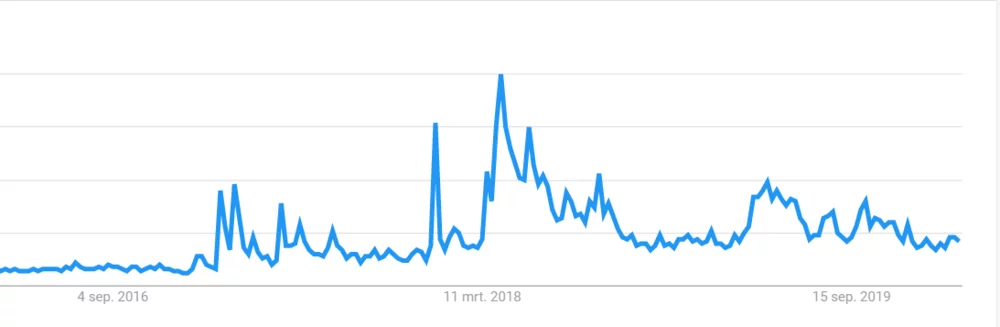
In the figure above, you can see in Google Trends that the interest in Deep State has grown since the beginning of Donald Trump’s presidency on the 20th of January in 2017. More people online discuss the Deep State theory and its possible effects on the accused people.
Back to topThe involved parties and their stance
In DeGeneres’ talk show, the host responded to Eric Trump’s tweet. “I just wanna say, Eric, I am honored that you think that I’m powerful enough to be part of a government conspiracy,” she joked. “I am sorry to disappoint you, I am not part of the Deep State. Even if somebody wanted me to be involved, I don’t have that kind of time.” After also posting the video on Twitter, most of Ellen’s followers responded in the same sarcastic manner. The claim did not make a serious impact on mainstream media, and the discussion has since then not been mentioned in Ellen DeGeneres’ talk show. Ellen’s executive producer, Andy Lassner still jokes about the theory on Twitter, responding to right-wing activists and believers of the Deep State theory and telling them that “Ellen runs the deep state. Keep up.”
However, there is another side to the story. Even though Eric Trump deleted the controversial tweet, the theory is still alive. One important actor in this issue is a woman called Tiffany FitzHenry, who is an independent author, public speaker, and screenwriter. She calls herself “an active, vocal and visible Hollywood whistleblower”. On her website, she mentions her experience in Hollywood after studying film and screenwriting, and how she began to truly see how the system actually works from her viewpoint. With her website and articles, she is working towards presenting the public with meaningful and substantial alternatives to Hollywood. FitzHenry also sells her own merch, which consists mostly of T-Shirts with quotes as “Conspiracy Theorists Are Sexy” and “Welcome To The Elite Apocalypse”.
Another Twitter account connected to Tiffany FitzHenry is @RightWingWatch. It is an online magazine, and according to their Twitter bio “a project of People For the American Way that monitors and exposes the activities of Radical Right political organizations”. They once tweeted a video where FitzHenry was in conversation with a right-wing conspiracy theorist about Ellen DeGeneres being a CIA operative.
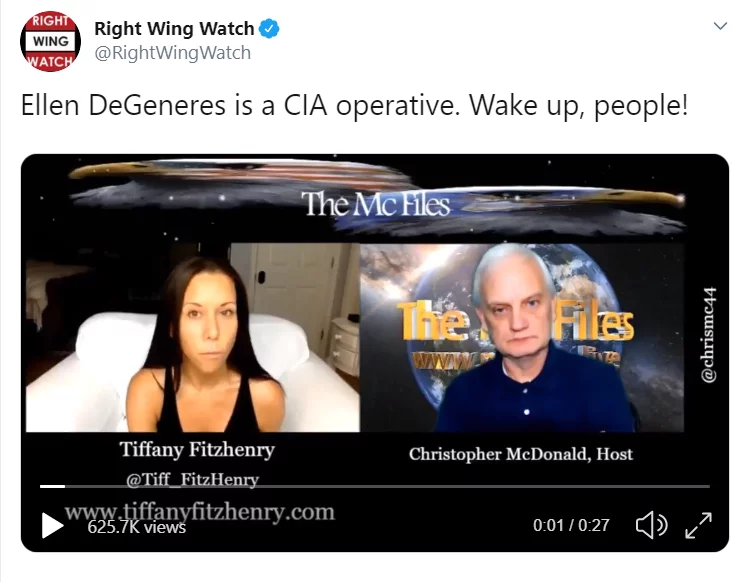
This video got retweeted 570 times and got around 1.500 likes. One important actor in this story responded to this video and that is Andy Lassner. He responded to the video in multiple tweets, joking about Ellen also being “Q”, referring to the QAnon theory, and making fun of other theories presented by FitzHenry, who he jokingly calls “TiffTiff”. However, it is important to note that Rightwingwatch and Lassner are sharing this concent with a clear eye to ridiculing and satirizing the association between DeGeneres and the CIA. In order to make distinctions between different groups and their stance regarding the issue, we should use the methods of issue mapping.

Analyzing the controversy through issue mapping
The now-removed tweet from Eric Trump about DeGeneres being a part of Deep State naturally went viral, and many people responded to it. To analyze these parties and opinions involved in this conspiracy theory, this paper uses issue mapping. TThis is analyzing based on the Actor-Network Theory (ANT) by scholar Bruno Latour. ANT holds that social forces cannot be used to explain social phenomena, but strictly empirical analysis should be undertaken to “describe” rather than “explain” social activity. More technically Tit can be described as a “material-semiotic” method, as it maps relations that are simultaneously material (between things) and semiotic (between concepts). In this case, it allows us to study the social interactions and find the actors and issues in a controversy by mapping the dynamics and relationships between the components of that controversy.
First of all, who are the dominant voices? In this conspiracy theory, multiple individuals play a big role. Eric Trump, of course, who seems to have made the most impact with his tweet.
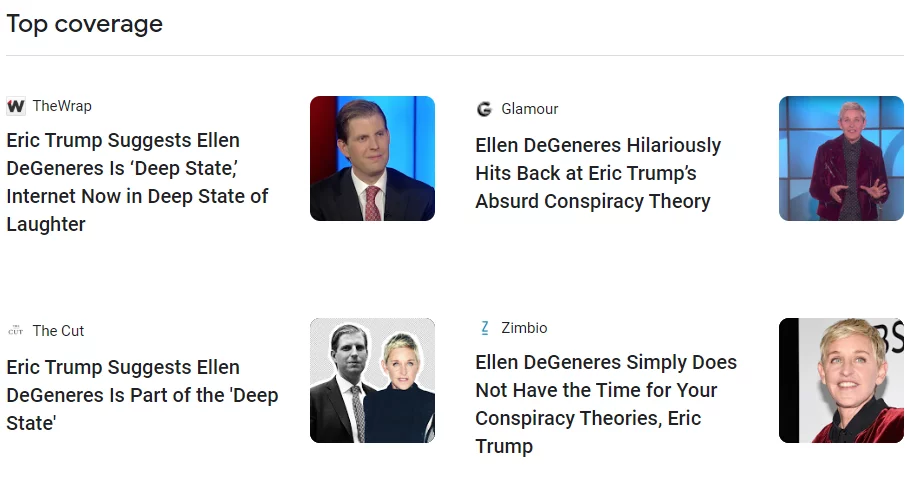
His tweet caused many online discussions and online articles. Another dominant voice is Ellen DeGeneres herself, as she quickly responded to Eric Trump in her talk show. Since she is a worldwide known talk show host, her talk show reaches many people all over the world. The video coming from her talk show in which she responds to Eric Trump now has more than 1,2 million views.
Another important actor in this theory is her executive producer, Andy Lassner. As mentioned above, he still discusses the conspiracy theory in his tweets in a jokingly matter. He also made fun of Tiffany FitzHenry, another essential voice when it comes to this conspiracy theory. FitzHenry has written an article about DeGeneres being a CIA operative, but she also interacted with the Right Wing Watch Twitter account about the issue.
Next up, whose concern is this issue? Who is in the issue space? We can divide this between the Program and the Anti-Program. Eric Trump and Tiffany FitzHenry are the most essential voices for the Program. They support the conspiracy theory that Ellen DeGeneres is not just a talk show host, but also a CIA operative. Part of the Anti-Program are then the Right Wing Watch, Ellen DeGeneres herself, and Andy Lassner. They are against the conspiracy theory. When looking at the tweets posted about this topic, it is noticeable that tweets from Lassner have been shared more than, for example, those by Trump and FitzHenry. This seems to show that there is a bigger group of people that is part of the Anti-Program. You can also see this in the articles mentioned above. They make fun of Eric Trump’s “absurd” conspiracy and do not take it seriously.
The third point of analysis is the commitment: how dedicated are actors to this issue? When Trump posted his tweet in January of 2018, DeGeneres responded to it. But after that, the talk show host has not mentioned it explicitly ever again. Her executive producer Andy Lassner, however, has mentioned it multiple times. His tweets shown above in Figure 3 show that they date from August 2019. He responded to it multiple times, and his responses then caused his followers to respond. Tiffany FitzHenry has made multiple comments, articles, and videos about Ellen DeGeneres, one of the latest being from October 2019. As you can see in the figure below, Ellen’s connection to Deep State was googled most between the 1st and 6th of January in 2018. This is when Eric Trump posted his tweet. The topic has not been discussed as much since, and the last “peak” was in October 2019, when FitzHenry posted her last video on Ellen DeGeneres. The relevance of the topic has worn off, and most actors are not still dedicated to support or debunk it.
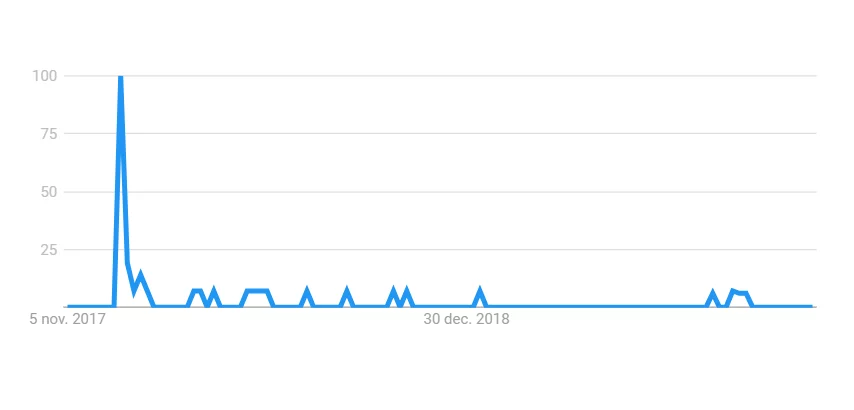
The positioning of the actors connected to this issue is also interesting. The people that are against this conspiracy theory have a similar issue language, as they often seem to joke about it and do not take it seriously. This is most visible in DeGeneres’ response and Andy Lassner’s tweets. However, the people that support this theory want to convince others in believing their theory and therefore, their language is very serious. They see the Deep State as a serious issue and Ellen DeGeneres is part of this issue.
When it comes to the last point of analysis, alignment, we discuss how the groups are formed around this issue. With this, you can refer back to the points discussed earlier. The issue language of the Anti-Program is very clear, as it exists mostly of jokes. This group is formed by their interactions: they laugh about the conspiracy theory together. The Program is formed through supporters of Eric Trump and Right-Wing figures like Tiffany FitzHenry. They want people to “wake up” and realize what the truth is according to these actors.
Back to topIn conclusion
As we have seen, a simple tweet by Eric Trump can create a whole new social controversy. This interesting case of conspiracy theory has multiple actors who are all different in their stance and dedication. Trump and FitzHenry are the dominant voices for the Program, while DeGeneres and Lassner are the dominant voices for the Anti-Program. Ellen DeGeneres herself does not seem to care anymore, but this seems to be in contrast with her executive producer, who regularly refers back to the conspiracy to make a joke out of it. FitzHenry is also still relatively active when it comes to trying to expose DeGeneres for her connection to the CIA, while Eric Trump has removed his tweet. So though the conspiracy theory is still alive, it does not seem to make such a difference for the key figures involved.
Back to top
References
FitzHenry, T. (2019). Behind The Illusion; Ellen Degeneres. Tiffany FitzHenry, (13 October 2019).
Latour, B. (2005). Reassembling the social: An introduction to actor-network theory. Oxford: Oxford University Press, (2005).
Michaels, J. D. (2019). Trump and the “Deep State”. Foreign Affairs, (19 February 2019).
O'Neil, P. (2013). The deep state: An emerging concept in comparative politics. Ssrn Electronic Journal, (2013).
Wikipedia contributors. (2019). Deep state in Turkey. Wikipedia, (31 December 2019).
Back to top
