Article
Disney Parks: COVID-19, surveillant landscapes in the Online-Offline Nexus
Covid-19 requires regulation of behavior and Disney have implemented vert and covert surveillance to achieve proper conduct. However, their fans know better.

Published date
Courses
The private life in a digital world
Copyright
This work is licensed under a Creative Commons Attribution-NonCommercial 4.0 International License.
Read time
10 minutes

Since the start of the COVID-19 pandemic, we must follow many rules when attending public places such as theme parks. There are signs telling us to sanitize, keep social distance, and wear a mask. Therefore it is interesting to ask, what has changed in the surveillant landscapes (Jones, 2017) of public spaces since the COVID-19 pandemic? How do people react to this? The examples through which I will research this are the Disney parks in Orlando.
I will mainly be looking at the behavior of fans inhabiting public spaces in this respect, as this is easier to research due to a large amount of publically available data. That is not to say that non-fan behavior is not interesting, it is merely beyond the scope of this paper.
I will look at the online and offline surveillant landscape of Disney Parks and how people react to this. This will show how overt and open surveillance or shaping of behavior can be more effective than covert tricks. This rings especially true for fans.
Back to topRelevance and Research Question
Disney parks have always tried to shape guest behavior. In the documentary series the Imagineering story, the company openly divulges how it often tries to shape its guests' perceptions and behavior. The following video and TikTok Illustrate that as well. The main questions of this paper are thus, how have Disney Parks tried to influence guest behavior during COVID-19, and how have guests and specifically fans, reacted to this?
In addition to this, the Disney parks were some of the first large public places to reopen. This means it might give us a clue about what other places should or should not implement.
I will be using data gathered online as my presence in the parks itself is not a possibility at the moment. In this process, I will apply surveillant landscaping. This means I look at how signs meant to shape a subject's behavior operate and are interacted with.
Back to topSurveillant landscapes in The online-offline nexus
Interpretation and internalization are very important variables in the success of surveillant landscapes. This causes one of their essential features Specifically that they can be subverted. Surveillance can only work if the subject of it responds as intended. For instance, hanging up a sign denoting a camera can be intended to convey that one should not commit crimes in this space. A subject could think it means, if I do commit a crime I should wear a mask, as I now know I might get caught if I do not do so. Surveillant landscapes thus depend on signs whose meaning can be subverted (Jones, 2017).
Furthermore, I must clarify an important distinction between the two types of surveillance. First of all, there is overt surveillance. This openly tries to influence someone's behavior. here is also covert surveillance. This means that the sign used to shape the subject's behavior does not acknowledge this to the subject (Eden, 2001). Design and implementation can affect behavior around it. However, we should not fall into the trap of technological determinism (Miller, 2020). Surveillance, including covert surveillance, is susceptible to subversion, for the reasons which I mentioned previously (Jones, 2017)(Van Dijck, 2013).
A final important concept here is the online-offline nexus (Diggit Wiki, 2020). This means that the online and offline worlds are not separate. For instance, in the Disney parks app, you make reservations for rides and dining that you execute in the actual parks. This means online and offline behavior are interconnected. They are not separate but one (Blommaert & Maly, 2019). By combining this notion of online-offline nexus with surveillant landscapes, we can see how design and surveillance can affect people whether it is on or offline. However, both can also be subverted.
Back to topRules that Disney Parks wants you to follow
As mentioned previously, surveillance entails attempting to influence people's behavior. This can be done by communicating rules. Under this link you can find all the COVID regulations as mentioned by Disney. The video above further illustrates them. Obligatory mask-wearing, social distancing, and hand sanitization are the main rules, but there are also regulations concerning a necessity for reservations for shopping and dining. Not obeying any of these rules is liable to get you thrown out of the park.
Back to topHow do Disney Parks communicate these rules?
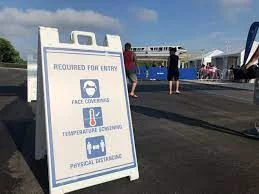
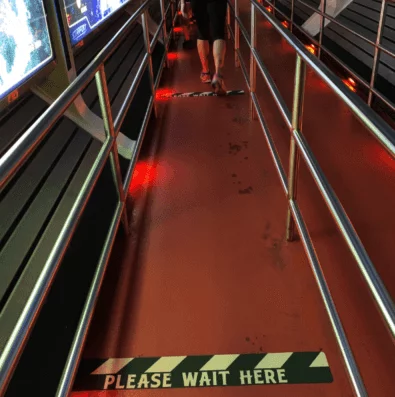
An explicit example of attempting to influence guest behavior would be the lines and signs as visible in the pictures above. They communicate desired behavior. Employees are supposed to be the ones checking on this. They, together with security are the ones who also enact "punishments" for guests who do not follow the rules.
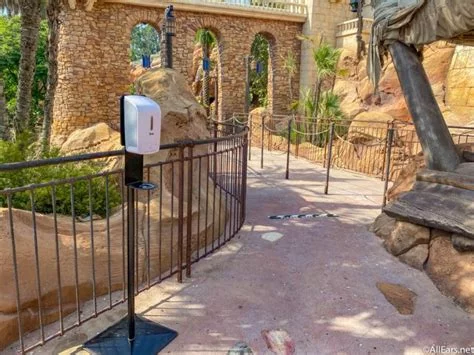
Furthermore, Disney also highlights things they want you to interact with and hide things they do not want you to notice. The highlighting of things they want you to interact with is again an overt means of influencing guest behavior. However, Disney Parks also covertly hide things they want you to ignore. This practice is by no means a new phenomenon, it is something that they have been doing for a long time. For instance, the parks use a color playfully dubbed noseeums green. This color is supposed to be as bland as possible so that things with this color are unnoticeable.
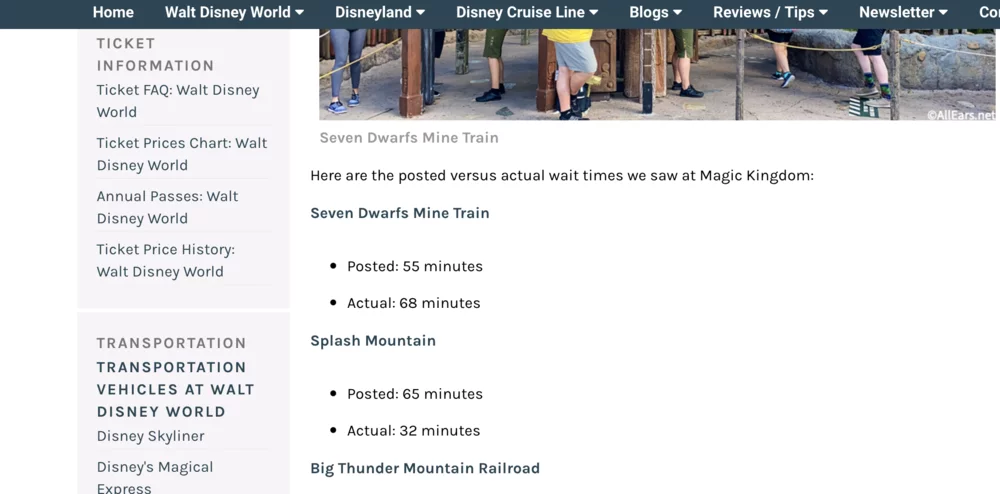
Similar tricks have been used to help enforce COVID regulations as well. Two examples of this are that Disney Parks pontifically show off their hand sanitization stands but hide large crowded attractions by increasing the displayed wait times. This final practice has been well documented. It shows how Disney Parks try to shape guest behavior with covert means. By ostensibly reporting false wait times they attempt to influence the flow of traffic through the parks so that no one place gets too busy.
Another example of both covert and overt surveillance is found through the MyDisneyExperience App. One of the functions of this application is to enable planning. You can see wait times, book timeslots, and make reservations. This allows Disney to steer the crowds around their parks. They can use limited bookings and in/deflated wait times to incentivize or disincentivize certain movements. They can also design their app in ways that alter behavior. One can hide certain material behind menus while prominently displaying other things. Notifications can draw guests' attention to specific things or remind them of reservations. This makes sure people remember and thus actually execute the plans that they made through the app. This is an example of how Disney steers traffic around their parks covertly. Not only wait times but also the designs and functions of Disney's mobile application can alter your behavior. This manifests itself through the making of plans in general, increasing the likelihood of carrying those plans out, steering traffic around the park, and drawing attention to certain aspects of the park through design. These are all covert means to steer guests' movement.
Furthermore, you are expected to order your food through the app. This makes sure that there are as few as possible people in each restaurant. If guests want to eat and drink at most venues they are expected to engage with the aforementioned app. You can physically order/make reservations, but it is made more difficult. This is a combination of overt and covert surveillance. Overtly, you are almost forced to engage in a certain action, covertly the alternatives are made to be abnormal, by treating them as such. This is executed by having to wait for an employee to escort you inside and having to ask and answer some questions. Comparatively, the process of using the app is made easier by making physical presence more difficult. This thus covertly incentivizes the use of mobile order. The whole mobile order process is documented in the video below.
Disney Parks use covert and overt surveillance.
We can thus see that Disney uses two kinds of surveillance. They overtly try to influence guests' behaviorhey also covertly (dis)incentivize behavior or hide certain things. DisneyParks thus use covert and overt surveillance (Eden, 2001). These can take place both online and offline (Van Dijck, 2013; Blommaert & Maly, 2019). The covert means are rather similar in nature to many ways the parks used to influence guest behavior before the pandemic.
How do guests react to this?
An intrinsic feature of surveillant landscapes is that they can be subverted (Jones, 2017). In this case, for the messages that tell people to follow the COVID restrictions to be executed guests have to interpret and internalize them. This does not happen with all messages. An example of that links to the Disney Parks fandom (Duffet, 2013).
In the video above we see a Disney fan analyzing the wait times in the parks. She tells people which are accurate and which are not. This subverts Disney's covert surveillance efforts in sending people to certain traction by increasing and decreasing displayed wait times. People do not internalize the message that they should or should not go to a particular attraction, but that they should go to certain attractions based on prior knowledge combined with wait times. This is interesting as logically Disney Parks fans are some of the company's most loyal customers (Havard, Wann, Grieve, & Collins, 2020). However, Disney seems less able to control their behavior than other guests.
This does not mean that the fans always intentionally subvert Disney's surveillance intentions. During the whole of the COVID pandemic, many Disney fandom influencers and YouTubers have spread information about the regulations. An example is to be found in the video above. Fans seem to largely endorse the overt rules. However, covert behavioral regulation is often subverted by fans' knowledge of how the parks work. Overt COVID regulations are not subverted by fans, but the covert strategies that help enforce them are. Communicating honestly about what you want them to do seems a better way to go.
It should be said that as of right now it is hard to establish the behavior of non-fans, as they are less active online and I cannot be in the parks at the moment. However, due to the lack of knowledge concerning the parks compared to fans, they would struggle with consciously subverting the surveillance. Furthermore, in the many videos I watched while researching, I could not find any testimony or footage of anyone breaking the overt covid regulations, such as wearing a mask and keeping six feet apart. This supports that covert and overt surveillance work on non-fans, but that knowledge about Disney Parks is the key to subverting covert surveillance. This is something that fans have more so than non-fans.
A better way to influence fans
Fans have a lot of knowledge about the park as exhibited through the many fan videos in this very article. They know what tricks Disney uses to shape guest behavior. It is only logical that fans thus also catch onto it when Disney uses similar means to attempt to shape guest behavior, connected to COVID-19. This gives them the ability to subvert it for their own gain. As most fans seem to want to cooperate with Disney on COVID-19 rules, it seems useful to just be honest and tell them why Disney does certain things. That way fans could understand why the parks attempt to shape their behavior and accept it.
Back to topConclusions
To answer my main question Disney has started using digital and physical means to affect guest behavior. This is done overtly and covertly. It seems that fans can catch onto covert surveillance. This allows them to subvert surveillant landscapes. This could be in part because Disney has been known to use covert tricks to shape guest behavior even before the pandemic. However, when fans are aware that they are asked to behave in a certain way they seem willing. Other venues can learn from this. Communicating honestly seems to be an effective way to shape fan behavior. Covert surveillance might work on average guests, but fans have more information that allows them to subvert these forms of surveillance. Networked information dissemination seems a solution to this. One could tell one thing to the fans and another to the general public. Determining the correct context is then key (Marwick & Boyd, 2014).
This reflects the theory of surveillant landscapes. Design can covertly and overtly be used to attempt to affect human behavior. This happens in an online-offline nexus. However, technological determinism does not hold true in the sense that attempts at behavioral regulation can and are subverted. Thus it is important to look at how people engage with the designs we make. Cooperation and honesty in this case then seem to work better than covert means of influencing a subject's behavior, due to the high level of knowledge certain subjects have about the Disney Parks.
Please take into account that the data for this study were collected before the relaxation of COVID-19 related regulations around the globe. We can learn from these experiences, but this study is not a reflection of the most current up-to-date measures.
Back to top
References:
Diggit Wiki, (2021) Chronotope, Diggit Magazine
Diggit Wiki, (2021) Online-Offline nexus, Diggit Magazine
Jones, R. H. (2017). Surveillant landscapes. Linguistic Landscape, 3(2), 149-186.
Miller, V. (2020). Understanding digital culture. Sage.
Wajcman, J., & MacKenzie, D. A. (Eds.). (1988). The social shaping of technology: How the refrigerator got its hum. Open University Press.
Walt Disney Studios, (2019) The Imagineering story, Disney+
Back to top