Article
Empress Theodora: A feminist at the dawn of the Middle Ages
We often think of feminism of something that started with the 19th century suffragette movements. This article, however, shows that ancient empress Theodora of Byzanthium was one of the precursors of modern-day feminism.

Published date
Courses
Gender and culture
Copyright
This work is licensed under a Creative Commons Attribution-NonCommercial 4.0 International License.
Read time
10 minutes

The deep superstition in which medieval societies were immersed turned women's life into a perennial feat. But how did a revolutionary historical figure achieve to eternally leave her mark as a harbinger of later feminism?
Back to topWho is Empress Theodora?
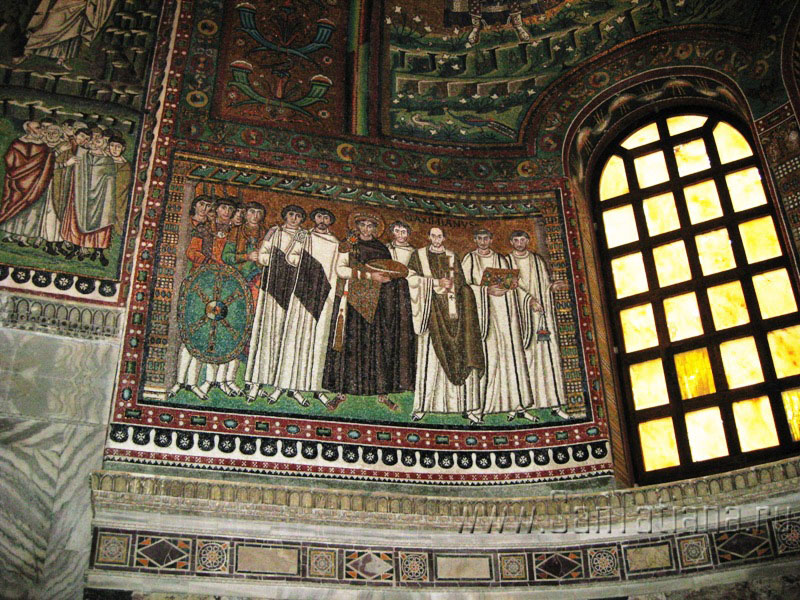
The lone ponderer’s senses will be delightfully nourished when found in the Basilica of San Vitale, an early Roman Catholic church located in Ravenna, a small port-city in the north-eastern Italy that is often described as “the capital of mosaics” due to the superb medieval artworks that decorate many of its archaeological sites. But while the eyes enjoy this aesthetic miracle, a vigilant mind may unexpectedly come into great surprise while encountering a strange discordance among the age that the church has been built, that is the 6th century AD, and two of its most luminous mosaics. This of emperor Justinian and that of his wife and empress, Theodora, which both adorn the apse’s opposite side walls.
"Byzantine images do not simple illustrate; they also encapsulate ideology" argues Liz James (2001). And by reflecting on this, what surprisingly raises a few eyebrows is the fact that both central figures of these mosaics are symmetrically displayed opposite each other, being identical in height, size, and embellishment, showcasing thus overtly, as LeBel and McLaughlin state, a prevailing gender equality between them, and connoting that empress' role has been equivalent to that of the emperor's with regard to the governance of the empire.
But who is Theodora and why is she that important?
Her name serves as a good reason to trace ourselves back to the very early stages of feminism and to shed light on her historical figure. One who, as J.W. Barker (1966) writes, “clawed her way up from a life among the dregs of human society to the peak of human ambition”. And one whose contribution to the amelioration of women's status has been considered so valuable that led the highly prominent Byzantine scholar Charles Diehl (1979) to describe her as 'deeply feminine'.

A 'rag to riches' story and a portrait in question
Before rising to the throne of the Byzantine Empire, Theodora’s life has been a diametrically opposite one. Her beginnings are described by Austin (2010) as 'exceedingly humble', as she was born into a circus family and grew up in the casual society of the Hippodrome of Constantinople. Her father’s early death led her to become an 'actress', a term that, as Gregory (2005) states, "is synonymous with a prostitute in modern day" and to live a life of sexual immorality, as the stage implied.
The events that mark this period of her life compose a portrait of which pioneer is Procopius of Caesarea, the most eminent historian of the age. His Secret History, a scandalous narrative that has received universal credence, has been the main source of the life events of the uncrowned then empress and one that resulted in her utter denigration. In it Procopius, being influenced by the social ideology that surrounded members of lower class and the preexisting unfavorable views of women, as Lankila (2008) argues, uses the baldest terms to discuss Theodora. As a consequence, what is ascribed to her is a lascivious status and a life of a turpitude without parallel. To understand how trivializing these texts are, one could argue that C.E. Mallet's (1887) statement that "from the date of the publication of the Secret History, Theodora was condemned" aptly describes the degree of tarnishing that her name suffered.
But is this the Theodora that we shall remember?
Many of the events of her later life led her to incarnate an unfortunately less known self. Theodora's life took a wholly different trajectory once meeting Justinian. Through their marriage, which completed after the institutionalization of a special law, as it was illegal for men of senatorial rank to marry courtesans, she was moved up to the uppermost position in a class-conscious society. Her part has been essential to the expression of her husband's imperial role, thing that provided her the ability to exercise political power. Consequently, she occupied an exceptional position of influence upon political matters, as Vasiliev (1958) informs us, and her opinion had always been taken into account in emperor's decision making.
But Theodora's rise to the throne did not made her forget the anything but halcyon days of her youth. Her first-hand experience of the evils that women of the lower class could face turned her to a woman of great philanthropy, who lavishly provided a helping hand to those living in thrall of the strictly patriarchal and misogynist society of Byzantium, as James (2009) describes it. To paraphrase Diehl (1905), one could argue that her feminist spirit was based on the following phrase of Virgil's Aeneid (2008): “No stranger to misfortune myself, I have learned to receive the sufferings of other”.
Hence, it would be prudent not to judge Theodora to such a harsh extent in relation to the ethics of her early life. Contradictorily, it would be constructive to sketch a portrait based on her charity. One that honorarily characterized by N.E. Korte (2004) as universal.
Back to topJean-Joseph Benjamin-Constant An advocate for women
Lynda Garland (1999) mentions in her book Byzantine empresses: Women and power in Byzantium that "much of Justinian’s legislation was concerned with protecting women and their rights”. Of course, even from back then, violence against women and girls, had been a global phenomenon that had been hidden, ignored, and accepted. Theodora was aware of that, and aimed thus to leave her tangible imprint in favor of them. Her influence, in regards to many reforms and legislations concerning the status and the protection of women, though latent, has been decisive. Emphasis has been given in three points: the strengthening of the institution of marriage, the banishment of prostitution and the provision of welfare for the traumatized ones.
For Theodora, marriage was the the "holiest of all institutions", as Diehl (1979) highlights. Her convictions are being fully corroborated thanks to a range of laws that expanded the rights of women. A first big step was done thanks to the legitimization of marriages between men and women of different social classes. With regard to this, a marriage between a citizen and an ex-slave woman, or one who has been an actress, was to remain intact, even if the husband was made a senator. A similar reform allowed senators to marry the daughters of tavern-keepers or pimps. Dowry, in addition, has been described as “strictly unnecessary” and the repudiation of those not having one was strictly prohibited. As kindly stated in a law: “mutual affection is what creates a marriage”. Thus in retrospect, as main prerequisite has been defined just the consent from both the woman and the man.
Νo woman, thus, could be forced to marry any man, but any woman could marry the man of her choice.
But also in cases of divorce both women and men could end a marriage. However, to get one became harder. A woman could divorce her husband due to treason, attempting to kill her and falsely accusing her of adultery, while a a man could divorce his wife if she committed adultery, was away from the house and not with her parents or betrayed him. The killing of adulterous wives has been strictly forbidden. Although these reasons may seem ridiculous to us, they certainly were particularly progressive and beneficial for the women of the era, especially if we consider that If a woman wanted to stay with her husband she would just have to live by specific guidelines. So, because husbands could not just simply decide to divorce their wives it allowed the women greater opportunity to obtain status. As Thomas (2005) argues,
"this law was hugely beneficial for the respect of women and it helped men to view them more as human beings"
Nevertheless, to justify Diehl's (1979) characterization of Theodora as "deeply feminine", one shall examine the laws against prostitution. Her anxiety to help the unfortunate ones is being corroborated behind the following words of an imperial edict, blatantly inspired by her:
"We have set up magistrates to punish robbers and thieves; are we not even more straitly bound to prosecute the robbers of honor and the thieves of chastity?"
Arguably, her early exposure to the realities of a lower class upbringing, and the awareness of all the evils that women of this class could suffer, led her to take a personal interest in such issues, thing that is closely reflected in her benefactions as recorded by historians. These included reforms on regulating prostitution and also setting up establishments for women on street where they could receive help and guidance, as Garland (1999) informs us.
Prostitution had always been an issue, especially in the empire's capital, Constantinople. Numerous were the procurers who were conducting their traffic in brothels, selling others' youth. Apparently, young girls were forced unwillingly into a life of unchastity after being enticed away from their parents by promises of clothes or food and by being led to believe that their contracts with or promises made to their pimps were legitimate. Theodora, aspiring to put an end to their drama, devised a range of plans to vanquish these dehumanizing phenomenon. As early as 528 AD she was involved in taking action against pimps and brothel-keepers who were forcing poor girls into prostitution. She ordered that all such manipulators should be outlawed and arrested, and also paid for young girls to be freed from them, as Nilson (2009) infroms. As a resource for their new life, she presented the girls with a set of clothes and offered monetary support to each of them. In this way the state was cleansed of the pollution of brothels and the women who were struggling with extreme poverty were provided with independent maintenance.
Her benevolence, however, has not been limited to these acts. Mallet (1887), by making an allusion to earlier historical accounts, refers to a stately palace that was build on the shores of Bosporus and that was set apart as a refuge of the unhappy women and former prostitutes whom she had rescued from the streets of Constantinople. To make it of lasting benefit, she endowed it with an ample income of money and added many remarkable buildings so that these women would never be compelled to depart from the practice of a virtuous life. But as unexpectedly human touches shall also be characterized the parts of legislation that concern the protection of women from any kind of sexual offense. These cover the rape, which, as it happens in many contemporary cases, had often been a matter of stigma for the victim rather than the perpetrator, but also abduction and seduction. What shall be emphasized is that before Theodora the act of raping a woman of the lower classes and slaves was legal; "but she enacted a law making the rape of any woman punishable by death", as Nilsson (2009) mentions. At last, women who were shouldered with major criminal charges were also benefited, as it was ruled that they were to be sent to a convent or be guarded by reliable women, aiming to ensure their protection.

A springboard for change
Procopius (1996) writes that Theodora "was naturally inclined to assist women in misfortune". Surely, we can not adamantly argue to what degree may her beneficences arose from a natural charisma. However, what shall be unanimously argued is that early in history she achieved to turn the prevailing tide of silence, to promulgate the high prevalence of violence against women and girls and to fight for their rights. As Garland (1999) argues, 'No doubt she brought greater knowledge to bear on the problems suffered by the lower class than the usual great lady in Byzantium, and it would be satisfactory to think that her measures were more successful than was customary'.
These days, Theodora's remembrance shall not just trigger a sense of nostalgia, but rather to serve as a strongly promising motivator for the future of a world under reformation. Her feminism, consequently, shall be deemed as a visionary one. One that managed to instigate a shift of perception towards female dignity in many aspects, from respecting the chastity of female human body to giving women the right to mark their own destiny in life. And one that was also meant to pave the way for later proponents’ visualization for an egalitarian society, because, as resonantly stated in another law of her age:
'In the service of God there is no male or female, nor freeman nor slave’.
Back to top
References
Austin, Cheridan E., "Sex and Political Legitimacy: an Examination of Byzantine Empresses (399 -1056 c.e.)" (2010). Honors College Theses. 94.
https://digitalcommons.pace.edu/honorscollege_theses/94
Barker, J. (1966). Justinian and the later roman empire. Madison: University of Wisconsin Press.
Diehl, C. (1979). Byzantine portraits (H. Bell, Trans.). New York: A.A. Knopf.
Diehl, C. (1905). Théodora, impératrice de Byzance [Theodora, empress of Byzantium],(5e éd. ed.). Paris: H. Piazza.
Garland, L. (1999). Byzantine empresses : Women and power in Byzantium, aD 527-1204. London: Routledge.
García-Moreno C., Zimmerman c., Morris-GehringA. , Heise L. , Amin A., Abrahams N. , Montoya O.,Bhate-Deosthali P, Kilonzo N, Charlotte Watts (2015), Violence against women and girls. Addressing violence against women: a call to action, Papers WHO.
Gregory, T. E. (2005) A History of Byzantium. Malden: Blackwell Publishing.
Horner, T., Paulin, J., Stackhouse, H., Stephen, C. (2010, March 19) The status of Byzantine Women. Retrieved May 18, 2018 from http://curriculumhistory.org/Studies_in_Curriculum_History_and_Educatio…
James, L. (2001). Empresses and power in early byzantium (Women, power, and politics). London: Leicester University Press.
James, L. (2009). Men, Women, Eunuchs: Gender, Sex and Power. In J. Haldon, The Social History of Byzantium. Blackwell Publishing Ltd.
Korte, N. E. (2004). Procopius’ Portrayal of Theodora in the Secret History: ‘Her Charity was Universal’. Hirundo, Vol.3 (2004)
Lankila, T. (2008) "The Unkown Empress: Theodora as a Victim of Distorted Images." Language and the Scientific Imagination: 113. Web. 3 Feb. 2010.
LeBel, K., McLaughlin, M. The Byzantine Empress Theodora. 1-5. Retrieved May 18, 2018 from http://curriculumhistory.org/Studies_in_Curriculum_History_and_Educatio…
Mallet, C. E. (1887). "The Empress Theodora." The English Historical Review: 1-20. Web. 15 Feb. 2010.
Nilsson, C. (2009). "Perspectives of Power: Byzantine Emperor Women." Preteritus 1 : 4-13.
Procopius of Caesarea, The Secret History as cited in: “Procopius The Secret History.”Internet Medieval Sourcebook , 1996 < http://procopius.net/secrethistorycontents.html>, accessed June 2, 2018
Teall, J., & Barker, J. W. (1967). Justinian and the later roman empire. The American Historical Review, 72(3), 941-941. doi:10.2307/1846682
Thomas, J. C. (2005). Justinian’s law as it applied to women and families. Women in the ancient world. www.womenintheancientworld.com
Vasiliev, A. (1958). History of the byzantine empire (2nd English ed. ed.). Madison: University of Wisconsin Press.
V., Fagles, R., & Knox, B. (2008). The aeneid (Penguin classics deluxe edition). New York: Penguin Books.
Back to top